Discover the World Bank Labour Codes Report with LAAC NLUJ research support in India, analyzing implications for female and migrant workers.
The World Bank Labour Codes Report LAAC NLUJ research support India has officially been published, marking a significant milestone in the study of India’s new labour regulations. The Legal Aid and Awareness Committee (LAAC) at National Law University, Jodhpur (NLUJ) contributed extensive research support, highlighting the university’s commitment to impactful legal research.
LAAC and NLUJ’s Pioneering Role
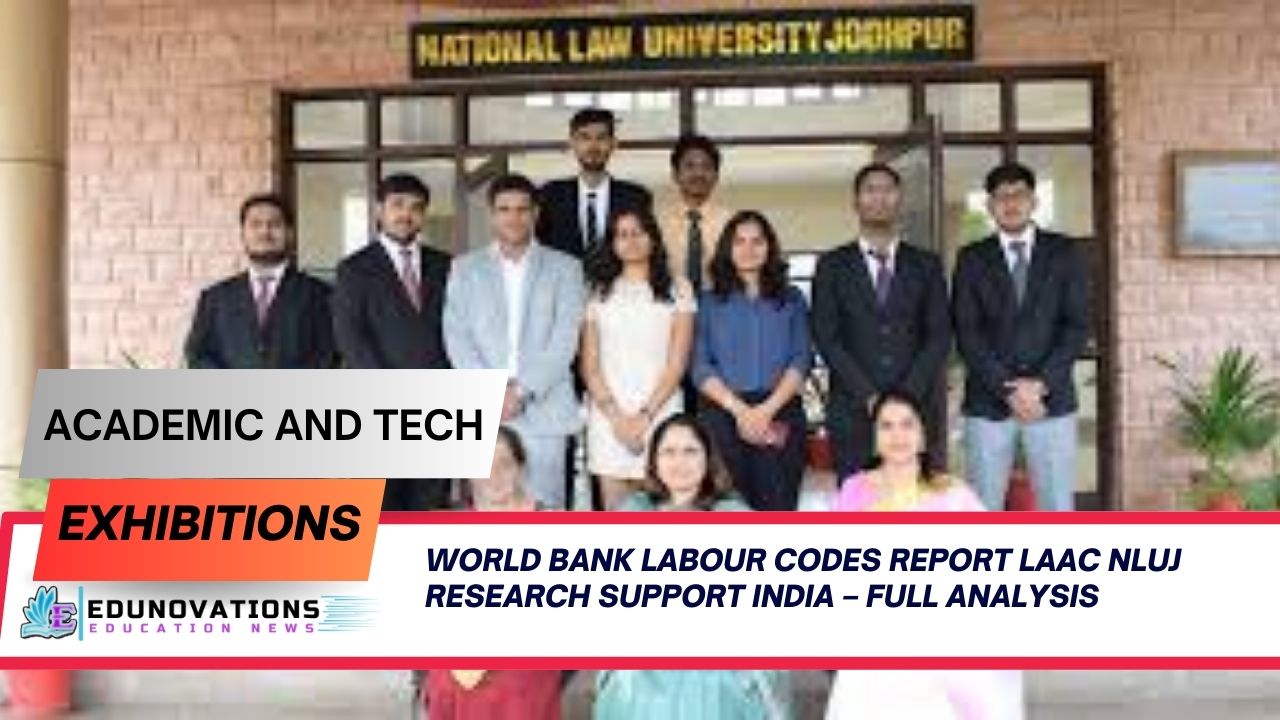
Under the guidance of Prof. (Dr.) Harpreet Kaur, Hon’ble Vice Chancellor of NLUJ, twelve LAAC student researchers collaborated with the Migration & Asylum Project (MAP) to provide critical research input for this landmark report. The collaboration focused on evaluating the implementation of India’s four new labour codes, particularly concerning female and migrant workers.
The team’s work spanned three months, involving in-depth research, field data analysis, and legal interpretation. This partnership represents an innovative model of academic engagement in global policy research, combining student involvement with expert oversight.
Student Contribution Highlights
The students who contributed to the study included Aashish Gupta, Devendra Pratap Singh, Dhruv Singhal, Jayam Jha, Lavanya Agarwal, Manas Upadhyay, Mishi Bohra, Nandini Arya, Samiksha Lohia, Sinchan Chatterjee, Tisha Gupta, and Vipashyana Hilsayan. Their efforts under the guidance of Dr. Anjali Thanvi, Chairperson of LAAC, were instrumental in developing insights that informed the final publication.
This demonstrates NLUJ’s commitment to fostering research-driven legal education, empowering students to engage in real-world policy analysis.
Key Findings of the Report
The World Bank report titled “India’s New Labour Codes: A Study of the State Rules for Female and Migrant Workers” provides an exhaustive analysis of:
- The four new labour codes in India
- State and Union Territory implementation strategies
- Implications for worker rights, particularly for women and migrant workers
- Gaps and challenges in policy enforcement
The report identifies areas where legal reforms can enhance worker protections and offers actionable recommendations for policymakers, industry stakeholders, and legal practitioners.
Expert Insights
Roshni Shanker, Executive Director of MAP, emphasized the importance of academic collaboration in shaping labour policies. She noted, “This partnership between NLUJ’s LAAC and MAP allowed for a detailed understanding of the ground realities faced by migrant and female workers across India.”
Astha Sharma, Project Coordinator, highlighted that such research ensures evidence-based policymaking and strengthens the legal framework for worker protections. Meanwhile, Kuldeep Lakwal, Project Officer, commended the students’ contributions, stating that their analytical skills enriched the report’s findings.
Impact on Labour Law Research in India
This report not only advances legal scholarship but also provides a practical framework for evaluating labour code implementation across diverse states. By integrating academic research with global policy initiatives, NLUJ and LAAC have demonstrated the power of student-driven legal research.
For students and professionals interested in labour law and policy research, the report offers a detailed roadmap for understanding how new legislation translates into actionable worker protections.
Why This Matters for Female and Migrant Workers
India’s new labour codes aim to streamline and modernize the workforce regulations. However, the success of these reforms hinges on state-level adoption and enforcement. The World Bank report, supported by LAAC NLUJ research, provides:
- Insights into state-specific implementation challenges
- Analysis of worker awareness and accessibility of rights
- Recommendations for strengthening gender and migrant inclusivity in labour laws
Integrating Research into Education
NLUJ continues to lead by example in integrating hands-on research opportunities into its curriculum. Students involved in LAAC research gain practical experience, enhancing their employability and preparing them for careers in legal research, policy analysis, and international development.
- Internal Resources for Students: NCERT Courses, current affairs, MCQs, notes, and video lessons enhance understanding of labour law principles (NCERT Courses, Current Affairs, MCQs, Notes, Videos, Syllabus, NCERT PDF Downloads, Mind Maps)
- External References: Collaboration insights and legal frameworks are available via authoritative sources such as Mart India Infotech.
Conclusion
The World Bank Labour Codes Report LAAC NLUJ research support India represents a landmark achievement for both global labour policy and academic engagement. It highlights the importance of student-led research, academic collaboration, and evidence-based policymaking. NLUJ and LAAC have set a benchmark for future legal research initiatives in India and beyond.
Toppers Use Mind Maps to score more than 95%
NCERT Class 11th Commerce Mind Maps
Add to cartOriginal price was: ₹999.00.₹199.00Current price is: ₹199.00.NCERT Class 12th Chemistry Mind Maps
Add to cartOriginal price was: ₹199.00.₹75.00Current price is: ₹75.00.NCERT Class 12th Commerce Mind Maps
Add to cartOriginal price was: ₹999.00.₹199.00Current price is: ₹199.00.NCERT Class 12th Science Mind Maps
Add to cartOriginal price was: ₹999.00.₹199.00Current price is: ₹199.00.NCERT Mind Maps For Class 10th
Add to cartOriginal price was: ₹999.00.₹199.00Current price is: ₹199.00.





Purchase Today
FAQs
- What is the focus of the World Bank Labour Codes Report LAAC NLUJ research support India?
The report focuses on India’s four new labour codes, specifically analyzing state rules for female and migrant workers. - Who contributed to the LAAC NLUJ research for this report?
Twelve student researchers from LAAC, NLUJ, worked under Dr. Anjali Thanvi’s guidance. - Which organization collaborated with LAAC for this research?
The Migration & Asylum Project (MAP) partnered with LAAC for research support. - Why is the report important for female and migrant workers?
It evaluates state-level implementation and identifies gaps affecting women and migrant worker rights. - How long did the LAAC students work on this research?
The research spanned three months, including field data collection and legal analysis. - Who are the authors of the World Bank report?
The report was authored by Roshni Shanker, Astha Sharma, and Kuldeep Lakwal, with support from LAAC students. - How does this report impact labour law research in India?
It provides a framework for evidence-based policymaking and highlights implementation challenges across states. - Where can students access resources related to labour laws?
Students can access courses, notes, videos, MCQs, and syllabus through NLUJ’s recommended platforms. - How does LAAC integrate research into education?
LAAC enables students to work on real-world projects, providing practical experience in legal and policy research. - Which internal and external links are recommended for further study?
Internal: NCERT courses, current affairs, notes, MCQs, videos, syllabus. External: Mart India Infotech for authoritative legal insights.