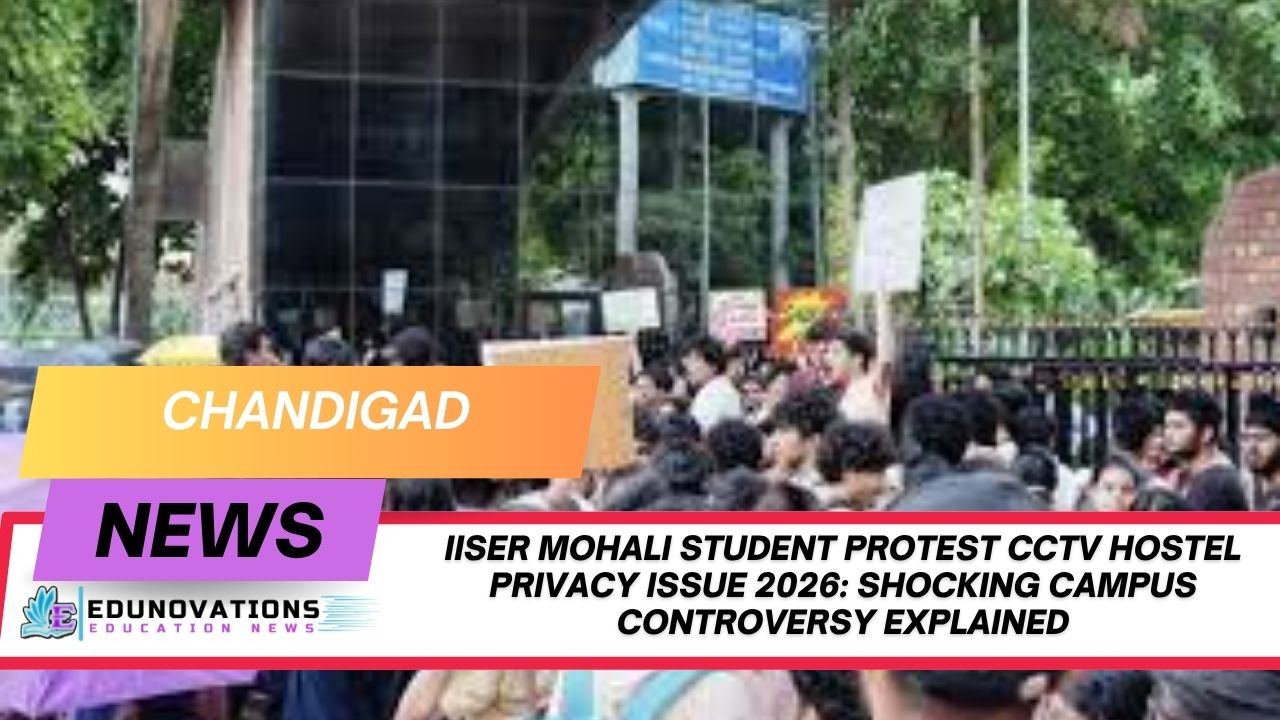
IISER Mohali student protest CCTV hostel privacy issue 2026 sparks nationwide debate on surveillance, student rights, and campus policies in India.
Introduction
The IISER Mohali student protest CCTV hostel privacy issue 2026 has emerged as one of the most significant campus controversies in India, drawing attention to the growing concerns around surveillance, privacy, and student autonomy in higher education institutions. What began as a localized grievance at a premier research institute has now evolved into a nationwide discussion about student rights and institutional accountability.
Students at the Indian Institute of Science Education and Research (IISER), Mohali, have raised strong objections to the installation of CCTV cameras inside hostel premises, citing serious privacy concerns. The protest has also expanded to include dissatisfaction with restrictive campus policies, inadequate facilities, and lack of dialogue with administration.
Background of the Protest
The IISER Mohali student protest CCTV hostel privacy issue 2026 started when students noticed an increase in surveillance infrastructure within hostel premises. According to student groups, cameras were installed in areas they considered intrusive, raising alarms about personal privacy.
Key triggers behind the protest:
- Installation of CCTV cameras in hostel corridors and common areas
- Strict entry-exit timing policies
- Lack of prior consultation with students
- Concerns about misuse of surveillance data
Students argue that hostels are not merely residential spaces but also personal environments where privacy should be respected.
Why Students Are Protesting CCTV Cameras in Hostel Mohali Campus
The question—why students protesting CCTV cameras in hostel Mohali campus—has become central to the debate. Students believe that excessive monitoring violates their fundamental rights and creates an atmosphere of distrust.
Major concerns raised:
- Privacy invasion: Students feel constantly watched, even in semi-private spaces
- Mental health impact: Continuous surveillance may increase stress and anxiety
- Lack of transparency: No clear policy on data storage or access
- Autonomy erosion: Students feel treated like minors rather than adults
Experts in education policy highlight that while security is important, it must be balanced with individual rights.
Student Protest Against Hostel Surveillance Policies in India 2026
The student protest against hostel surveillance policies in India 2026 is not limited to IISER Mohali. Similar issues have surfaced in universities across the country, indicating a broader systemic challenge.
National trend highlights:
- Increasing use of surveillance technologies in campuses
- Growing resistance from student communities
- Debate over digital rights and institutional control
According to higher education analysts, such protests reflect a generational shift where students are more aware of privacy laws and digital rights.
IISER Mohali Entry Exit Policy Protest Student Demands Explained
Alongside surveillance concerns, the IISER Mohali entry exit policy protest student demands explained another layer of dissatisfaction among students.
Key demands include:
- Relaxation of strict hostel entry and exit timings
- Better internet connectivity and Wi-Fi access
- Improved food quality in mess facilities
- Upgraded hostel infrastructure
Students argue that these issues collectively affect their academic performance and overall campus experience.
Privacy Concerns Over CCTV in Indian University Hostels Case Study
The privacy concerns over CCTV in Indian university hostels case study at IISER Mohali offers critical insights into the challenges faced by modern educational institutions.
Legal and ethical aspects:
- India currently lacks a comprehensive data protection law fully addressing such cases
- Institutions often implement surveillance without clear guidelines
- Students have limited mechanisms to challenge such decisions
Legal experts suggest that educational institutions must adopt transparent policies aligned with global privacy standards.
Administrative Response and Dialogue
The institute administration has defended its decision, stating that CCTV cameras were installed to enhance safety and prevent misconduct. However, students argue that safety measures should not come at the cost of privacy.
Administration’s stance:
- Cameras are installed in “common areas” only
- Surveillance is intended to ensure student safety
- Policies are in line with institutional guidelines
Despite these claims, the IISER Mohali student protest CCTV hostel privacy issue 2026 continues, with students demanding written assurances and policy revisions.
Expert Insights on Campus Surveillance
Education experts and sociologists have weighed in on the controversy.
Key observations:
- Excessive surveillance can erode trust between students and administration
- Universities should promote self-regulation rather than strict monitoring
- Privacy is a fundamental right, even within institutional settings
A senior academic commented that “campuses should be spaces of freedom and intellectual growth, not constant monitoring.”
Impact on Academic Environment
The IISER Mohali student protest CCTV hostel privacy issue 2026 has also affected academic activities.
Consequences observed:
- Disruption of classes and research work
- Increased tension between students and faculty
- Negative publicity for the institution
Such developments may impact the reputation of institutions and influence future admissions.
Role of Media and Public Opinion
Media coverage has amplified the issue, turning the IISER Mohali student protest CCTV hostel privacy issue 2026 into a national conversation.
Public reactions:
- Support for student rights and privacy
- Concerns about campus safety
- Calls for balanced policies
Social media platforms have played a crucial role in mobilizing support and spreading awareness.
What This Means for Indian Higher Education
The student protest against hostel surveillance policies in India 2026 highlights the need for policy reforms.
Key takeaways:
- ضرورة (Need) for clear surveillance guidelines
- Importance of student consultation in decision-making
- Balance between security and privacy
Institutions must adopt a participatory approach to governance to avoid similar conflicts.
Resources for Students
Students seeking academic support and awareness can explore:
- NCERT Courses: https://courses.edunovations.com/
- Current Affairs: https://edunovations.com/currentaffairs/
- Notes: https://edunovations.com/notes/
- MCQs: https://edunovations.com/mcq/
- Videos: https://edunovations.com/videos/
- Syllabus: https://edunovations.com/syllabus/
- Free NCERT PDFs: https://courses.edunovations.com/shop-2/
For educational website development, institutions can connect with Mart Ind Infotech.
Conclusion
The IISER Mohali student protest CCTV hostel privacy issue 2026 serves as a wake-up call for Indian higher education institutions. While safety is a legitimate concern, it must not override fundamental rights such as privacy and dignity.
The ongoing protests underline the importance of dialogue, transparency, and mutual respect between students and administration. As India moves toward a more digitized and monitored society, finding the right balance between surveillance and freedom will be crucial.
Toppers Use Mind Maps to score more than 95%
NCERT Class 11th Commerce Mind Maps
Add to cartOriginal price was: ₹999.00.₹199.00Current price is: ₹199.00.NCERT Class 12th Chemistry Mind Maps
Add to cartOriginal price was: ₹199.00.₹75.00Current price is: ₹75.00.NCERT Class 12th Commerce Mind Maps
Add to cartOriginal price was: ₹999.00.₹199.00Current price is: ₹199.00.NCERT Class 12th Science Mind Maps
Add to cartOriginal price was: ₹999.00.₹199.00Current price is: ₹199.00.NCERT Mind Maps For Class 10th
Add to cartOriginal price was: ₹999.00.₹199.00Current price is: ₹199.00.





Purchase Today
FAQs
1. What is IISER Mohali student protest CCTV hostel privacy issue 2026?
It refers to student protests against CCTV surveillance in hostel areas, raising privacy concerns.
2. Why students protesting CCTV cameras in hostel Mohali campus?
Students believe the cameras invade privacy and create a stressful environment.
3. What are student protest against hostel surveillance policies in India 2026?
These protests highlight opposition to increasing surveillance in campuses across India.
4. What are IISER Mohali entry exit policy protest student demands explained?
Students demand relaxed timings, better facilities, and policy transparency.
5. Are CCTV cameras allowed in Indian hostels?
There is no uniform rule; policies vary by institution, often lacking clear guidelines.
6. What are privacy concerns over CCTV in Indian university hostels case study?
Concerns include misuse of data, lack of consent, and constant monitoring.
7. How does surveillance affect students?
It may increase anxiety and reduce sense of freedom.
8. What actions have students taken?
Students organized protests, raised demands, and sought dialogue with authorities.
9. What is administration’s response?
Authorities claim cameras are for safety and installed in common areas only.
10. What is the future of such protests in India?
Experts expect more awareness and policy reforms regarding student rights.