The landscape of social entrepreneurship in India has reached a remarkable milestone as young minds continue to engineer scalable solutions for society’s most complex hurdles.
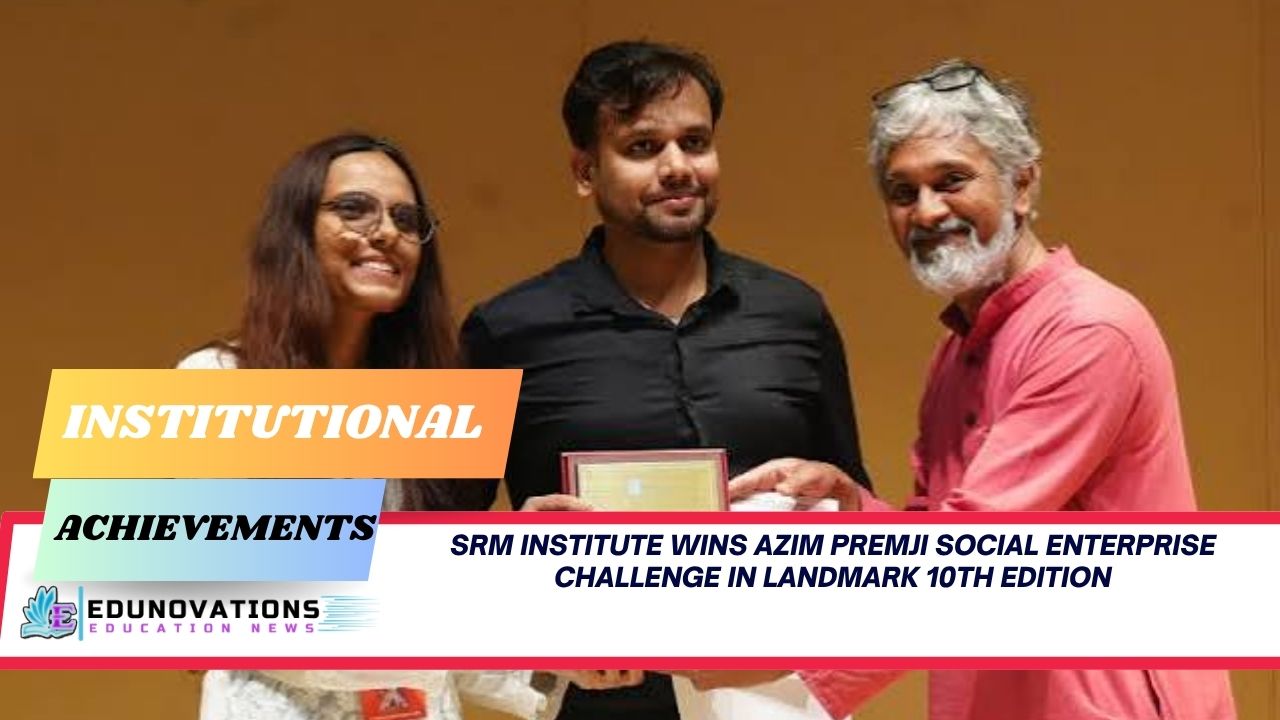
The landscape of social entrepreneurship in India has reached a remarkable milestone as young minds continue to engineer scalable solutions for society’s most complex hurdles. Innovation took center stage at the 10th edition of Azim Premji University’s flagship event, where the SRM Institute wins Azim Premji social enterprise challenge title. This prestigious victory not only highlights the exceptional problem-solving capabilities of engineering and technology students today but also underscores the growing intersection between academic rigor and grassroots social impact across the nation.
With over 270 entries submitted from universities and colleges nationwide, competition was fierce. The event, which celebrated its decade-long anniversary this year, continues to serve as an indispensable launchpad for student-led startups tackling critical pillars of society—ranging from education and public health to livelihoods, environmental sustainability, and governance.
Fostering Grassroots Change: A Decade of Innovation
Launched originally in 2016, the annual Social Enterprise Idea Challenge was conceived to bridge the gap between theoretical knowledge and real-world execution. Over the last ten years, the initiative has grown exponentially, evolving from a modest regional contest into a premier national platform. It encourages students to venture out of comfort zones, engage directly with marginalized communities, and design sustainable economic models that address systemic disparities.
According to institutional mentors, the trajectory of the challenge mirrors the evolving mindset of India’s youth. Modern students are no longer content with just building technical prototypes; they are deeply invested in financial sustainability, ethical scalability, and measurable social outcomes. As the initiative marks its 10th milestone, its core mission remains steadfast: providing students with critical mentorship, cross-disciplinary networking, and direct pathways to potential funders.
For students and aspirants preparing for competitive examinations, civil services, or higher studies, keeping track of such national socio-economic developments is vital. Candidates can enrich their preparation by exploring structured learning paths, such as checking out NCERT Courses or staying updated with daily Current Affairs. A robust understanding of socio-economic schemes often requires diving deep into comprehensive Notes and testing conceptual clarity through regular MCQ’s. Furthermore, visual learners can utilize dynamic Videos and structured Syllabus breakdowns to map out their study journey.
The Grand Finale: Top Shortlisted Innovations
From the initial pool of 270 submissions, only 10 exceptional teams made the final cut to pitch their ventures before a panel of seasoned industry experts, social entrepreneurs, and university mentors. Each shortlisted project demonstrated exceptional technical ingenuity fused with profound empathy.
1. The Crown Jewel: Team Urappu
The first prize was clinched by the stellar contingent representing the SRM Institute of Science and Technology, Chennai. Their pioneering venture, known as Team Urappu, introduced a revolutionary service designed to bridge a massive structural gap in India’s informal workforce.
Construction workers form the backbone of urban development, yet a vast majority remain oblivious to or locked out of state welfare boards, insurance schemes, and financial safety nets due to bureaucratic red tape. Urappu addresses this by deploying trained facilitators and sophisticated case-management systems. The platform simplifies worker registration, rigorous documentation, eligibility verification, timely renewals, and grievance claims.
Under its primary operational model, real estate builders and construction contractors absorb the service fee, ensuring that vulnerable laborers access these legal entitlements entirely free of charge. Furthermore, the team has been actively exploring advanced iterations featuring bundled insurance benefits to protect workers against occupational hazards.
2. Empowering the Visually Impaired: Team SuoMoto
Securing the second prize was the innovative team from Azim Premji University, Bengaluru, with their transformative project. The SuoMoto visually impaired app Azim Premji idea challenge submission introduced an intuitive digital ecosystem specifically tailored for persons with benchmark disabilities (PwBD) and visually impaired individuals.
Navigating competitive examinations and professional environments has historically been fraught with physical and digital barriers for visually impaired students. SuoMoto Academy changes this narrative by integrating specialized audio-based learning tools and advanced memory techniques. This allows users to solve complex academic and professional problems independently without relying on pen-and-paper formats.
Complementing the academy is the SuoMoto Club, a community-driven feature that seamlessly connects users with sustainable employment opportunities, inclusive corporate events, and peer networks while incorporating secure navigation supports.
3. Transforming Rural Sanitation: GreenPath
Sharing the third-prize honors were collaborative teams from Azim Premji University and Lovely Professional University who introduced GreenPath rural waste management platform Azim Premji initiatives.
Rural waste management remains one of the most neglected environmental challenges across Indian villages. GreenPath tackles this head-on via a localized digital platform that assigns unique digital identities to households, tracks daily waste collection via QR code scans, and monitors household waste segregation metrics alongside digital payment tracking. Crucially, the platform equips local village panchayats with real-time operational data, optimizing cleanliness drives and ensuring that rural waste collectors receive the economic visibility, dignity, and fair compensation they deserve.
Expert Insights and Economic Significance
Experts across economic and sociological spheres have lauded institutional incubators for nurturing grassroots innovation. Dr. Smita Kulkarni, a prominent sociologist specializing in labor economics, notes:
“When young technocrats shift their focus from corporate software solutions to building administrative bridges for construction laborers and persons with disabilities, it signals a profound ethical maturation of our educational system. Initiatives like the Social Enterprise Idea Challenge transform passive learners into active architects of social equity.”
Statistical analysis from various labor welfare reports indicates that over 80% of India’s construction workforce remains unorganized, missing out on billions of rupees allocated annually under various welfare cesses. Platforms like Urappu serve as vital digital bridges, proving that tech-enabled social entrepreneurship can tangibly accelerate financial inclusion.
For students looking to build their own entrepreneurial blueprints or dive deeper into academic resource materials, having access to reliable study aids is indispensable. You can explore Downloads of Free NCERT PDFs for foundational concepts or map out complex sociological theories using NCERT Mind Maps. Educational institutions and tech startups aiming to scale their digital infrastructure can also partner with specialized technology providers like Mart Ind Infotech to build high-performance web platforms.
Looking Forward: The Next Decade of Social Venturing
As the Social Enterprise Idea Challenge looks toward its next decade of impact, organizers have signaled plans to expand institutional partnerships, increase seed funding grants, and establish a cross-campus incubation network. The success of SRM Institute’s team proves that premier technological institutions can successfully channel engineering brilliance toward solving deeply entrenched human problems.
Ultimately, events of this magnitude do more than just distribute awards; they cultivate an ecosystem of empathy, resilience, and sustainable development. By turning bold classroom ideas into market-ready social ventures, India’s youth are proving that economic growth and social justice can—and must—go hand in hand.
Toppers Use Mind Maps to score more than 95%
NCERT Class 11th Commerce Mind Maps
Add to cartOriginal price was: ₹999.00.₹199.00Current price is: ₹199.00.NCERT Class 12th Chemistry Mind Maps
Add to cartOriginal price was: ₹199.00.₹75.00Current price is: ₹75.00.NCERT Class 12th Commerce Mind Maps
Add to cartOriginal price was: ₹999.00.₹199.00Current price is: ₹199.00.NCERT Class 12th Science Mind Maps
Add to cartOriginal price was: ₹999.00.₹199.00Current price is: ₹199.00.NCERT Mind Maps For Class 10th
Add to cartOriginal price was: ₹999.00.₹199.00Current price is: ₹199.00.





Purchase Today
Frequently Asked Questions (FAQs)
Q1: Which institution won the 10th edition of Azim Premji University’s National Social Enterprise Idea Challenge?
A: SRM Institute of Science and Technology, Chennai, secured the first prize in the landmark 10th edition of the competition.
Q2: What is the primary objective of Team Urappu’s winning project?
A: Team Urappu developed a service and case-management system that helps construction workers easily access government welfare benefits, documentation, and insurance claims.
Q3: How does the business model of Team Urappu function for construction workers?
A: Under its primary model, builders and contractors pay for the facilitation service, allowing construction workers to access registration and welfare benefits completely free of charge.
Q4: What problem does the SuoMoto platform solve?
A: SuoMoto is a digital platform and audio-based learning academy designed to help visually impaired individuals and persons with benchmark disabilities prepare for competitive exams and secure employment.
Q5: How does GreenPath improve rural waste management?
A: GreenPath assigns digital identities to households, tracks waste collection via QR codes, monitors segregation, and provides panchayats with real-time data to streamline rural cleanliness.
Q6: How many entries were received for this year’s National Social Enterprise Idea Challenge?
A: Over 270 entries were submitted from colleges and universities nationwide, out of which 10 exceptional teams were shortlisted for the final pitch.
Q7: When was Azim Premji University’s Social Enterprise Idea Challenge initially launched?
A: The annual competition was launched in 2016 to promote student-led social entrepreneurship and connect innovators with mentors and potential funders.
Q8: What core societal pillars were addressed by the shortlisted teams this year?
A: The shortlisted innovations addressed critical areas including education, public health, livelihoods, environmental sustainability, and local governance.
Q9: Who secured the second prize in the competition?
A: A student team from Azim Premji University, Bengaluru, won the second prize for their accessibility platform, SuoMoto.
Q10: Why are student social entrepreneurship challenges significant for India’s economy?
A: They encourage young innovators to build sustainable, scalable enterprises that address grassroots socio-economic problems, bridging the gap between academic theory and real-world impact.