Discover how machine learning in CO2 hydrogenation reaction networks is transforming green energy solutions, converting carbon dioxide into valuable fuels.
Introduction: The Global Imperative of Carbon Conversion
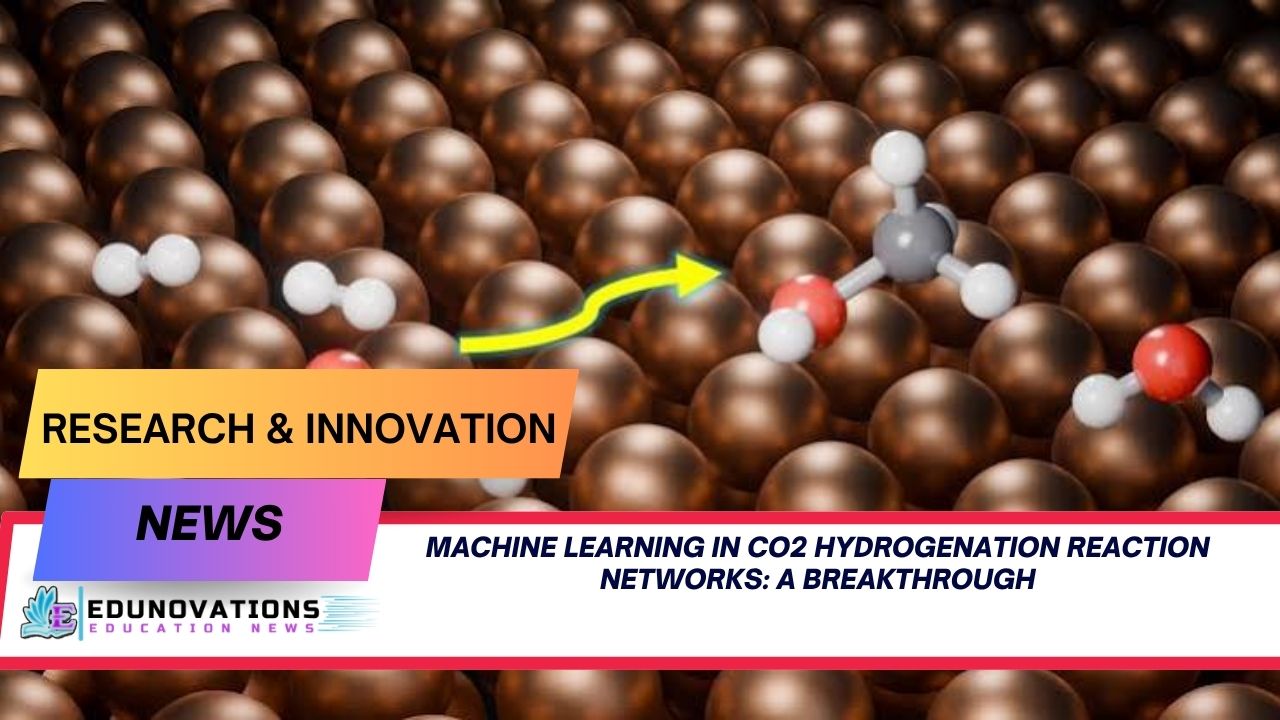
As global industrialization accelerates, the atmospheric concentration of carbon dioxide ($\text{CO}_2$) continues to present one of the most formidable challenges of our era. Finding innovative, scalable pathways to capture, utilize, and transform greenhouse gases into sustainable green energy sources has become a primary objective for scientists and engineers worldwide. Among the most promising avenues of research is $\text{CO}_2$ hydrogenation, a catalytic process where carbon dioxide reacts with hydrogen to yield valuable platform chemicals and green fuels like methanol.
However, achieving industrial-scale efficiency has historically been hindered by an invisible wall: complexity. Catalytic transformations involve thousands of intricate, micro-scale elementary reaction steps occurring simultaneously across a catalyst’s surface. Traditionally, computational chemists and researchers could only model a tiny fraction of these reactions due to the extreme computational costs of quantum mechanics. Consequently, vital reaction pathways were frequently overlooked, leading to inaccurate kinetic models and sub-optimal catalyst designs.
Today, a paradigm shift is underway. Pioneering research led by scientists at the Indian Institute of Science (IISc)—in collaboration with industrial partners like Hindustan Petroleum Corporation Limited (HPCL) and Singapore’s Agency for Science, Technology, and Research (A*STAR)—has shattered traditional computational limits. By leveraging machine learning in co2 hydrogenation reaction networks, researchers have successfully mapped nearly 10,000 elementary chemical reactions. This breakthrough opens unprecedented doors for designing next-generation catalysts, paving the way for cleaner industrial ecosystems and efficient renewable fuel production.
Students and aspiring researchers eager to dive deeper into foundational chemistry and physics concepts can explore comprehensive resources such as NCERT Courses or download supplementary materials via Downloads of Free NCERT PDFs.
The Bottleneck of Conventional Computational Chemistry
To understand the magnitude of this recent scientific advancement, one must first examine the limitations of traditional mechanistic modeling. When chemical engineers attempt to study how $\text{CO}_2$ converts into methanol or carbon monoxide over a metal surface—such as copper—they rely heavily on quantum-mechanical simulations, commonly known as Density Functional Theory (DFT) calculations.
DFT allows scientists to calculate the energy barriers and transition states of individual chemical reactions. In an ideal world, every single molecular collision and surface rearrangement would be mapped. In reality, however, simulating thousands of possible surface species and reactions using pure quantum mechanics is computationally prohibitive. It demands supercomputing power that could take months or even years for a single network iteration.
- The Scope Problem: Researchers traditionally selected a modest, manually curated list of likely reactions (often fewer than 200).
- The Blind Spot Risk: Omission of critical steps meant that kinetic models frequently misidentified major products (e.g., predicting formic acid instead of methanol) and drastically underestimated total conversion rates.
- Experimental Mismatch: Theoretical predictions often failed to match laboratory observations, creating a frustrating gap between computational chemistry and real-world industrial catalysis.
To bridge this gap, modern data science had to enter the laboratory. Researchers realized that combining quantum simulations with predictive algorithms was the only way to scale reaction networks without losing precision. Those tracking cutting-edge developments in clean tech and scientific breakthroughs can stay updated through Current Affairs.
Scaling Up: Merging Quantum Physics with Artificial Intelligence
To tackle the immense complexity of surface chemistry, the IISc research team devised an ingenious, multi-layered, data-driven computational framework. This architecture successfully scaled an initial set of 152 quantum-mechanically verified reactions into a massive database of 9,389 elementary reactions involving 105 distinct surface species.
The workflow followed a rigorous methodological pipeline:
- Curated Baseline Generation: The researchers generated a highly accurate, foundational database of 152 reactions using rigorous quantum-mechanical simulations.
- Machine Learning Acceleration: They trained advanced machine learning models on this baseline data to rapidly predict activation energy barriers for thousands of additional prospective reactions.
- Automated Reaction Enumeration: Specialized automated algorithms predicted all plausible single-step reactions among 105 different surface species, vastly expanding the breadth of the network.
- Kinetic Integration: The expanded database was subsequently integrated into a macroscopic kinetic model to simulate real-world reactor conditions.
When incorporated into kinetic simulations, this data-driven network revealed an astonishing ~40-fold increase in $\text{CO}_2$ conversion efficiency. Furthermore, it accurately pinpointed methanol and carbon monoxide as the dominant reaction products, perfectly mirroring experimental observations made by collaborators at HPCL’s Green Research and Development Centre and A*STAR in Singapore.
For structured study guides and revision tools that break down complex scientific workflows, students can utilize Notes or test their knowledge using interactive MCQ’s.
Unveiling Hidden Mechanisms: The Molecular Hydrogen Surprise
One of the most thrilling outcomes of expanding the reaction network to nearly 10,000 steps was the discovery of completely unexpected chemical behavior. In several critical reaction stages, the model demonstrated that hydrogen atoms can be transferred to reaction intermediates directly as intact molecular $\text{H}_2$, rather than first splitting into individual hydrogen atoms as long taught in traditional chemistry textbooks.
Dr. Ananth Govind Rajan, Associate Professor in the Department of Chemical Engineering at IISc and corresponding author of the study, noted that this discovery runs counter to foundational chemical dogma. Subsequent quantum-mechanical calculations confirmed that this intact-molecule transfer pathway is exceptionally favorable for oxygen-containing intermediates.
“The idea that hydrogen can transfer as an intact molecule, without first splitting into atoms, runs against what most of us were taught,” observed Shivam Chaturvedi, a co-author and PhD student at IISc. “This surfaced only because the network was large enough to allow for it, and the observation held up when we went back and computed those steps explicitly.”
This revelation suggests that future catalyst design should not merely focus on breaking hydrogen bonds, but rather on engineering catalyst surfaces that interact favorably with molecular $\text{H}_2$ to enhance methanol selectivity. Institutions aiming to build robust digital infrastructure to support research labs and academic portals can explore custom digital solutions provided by Mart Ind Infotech, a trusted partner for school and institutional software development.
Expert Insights and Industry Perspectives
The convergence of artificial intelligence and chemical engineering is rapidly altering the landscape of industrial decarbonization. Leading scientists and global industry leaders have increasingly emphasized that traditional trial-and-error experimentation is too slow to address the climate crisis.
Dr. Rajiv Kumar, a prominent chemical technology analyst and clean-energy policy advocate, shared his perspective on the integration of data science in catalytic research:
“The future of sustainable fuel production does not lie solely in physical laboratory benches; it lives at the intersection of quantum physics, high-performance computing, and machine learning. When academic institutions like IISc collaborate with industrial giants, they transition theoretical chemistry into viable industrial engineering at an unprecedented pace.”
Such multidisciplinary approaches reflect a broader global movement toward digital transformation in chemical processing. Visual learners and educators looking to explain these intricate molecular pathways can find excellent visual resources and lecture overviews via Videos. Additionally, academic planners and educators can review the structured curriculum frameworks available under Syllabus.
Implications for Green Energy and Industrial Decarbonization
The broader industrial implications of mapping massive catalytic reaction networks extend far beyond methanol synthesis. The data-driven framework developed by the IISc team is inherently modular and adaptable. According to the research group, the same computational pipeline can be applied to a myriad of vital industrial processes, including:
- Alternative $\text{CO}_2$ Reduction Pathways: Exploring reduction reactions across non-copper catalysts to optimize selectivity and yield.
- Nitrogen Reduction: Unlocking more energy-efficient pathways for ammonia synthesis under milder operating conditions.
- Water Splitting (Hydrogen Production): Discovering novel catalytic surfaces for green hydrogen generation.
By eliminating the guesswork in reaction network construction, scientists can drastically reduce the time and capital required to develop commercial-grade catalysts. This acceleration is crucial if global economies hope to meet aggressive net-zero emissions targets over the coming decades.
To help students and researchers organize complex chemical mechanisms and spatial relationships visually, concept maps are available at NCERT Mind Maps.
Toppers Use Mind Maps to score more than 95%
NCERT Class 11th Commerce Mind Maps
Add to cartOriginal price was: ₹999.00.₹199.00Current price is: ₹199.00.NCERT Class 12th Chemistry Mind Maps
Add to cartOriginal price was: ₹199.00.₹75.00Current price is: ₹75.00.NCERT Class 12th Commerce Mind Maps
Add to cartOriginal price was: ₹999.00.₹199.00Current price is: ₹199.00.NCERT Class 12th Science Mind Maps
Add to cartOriginal price was: ₹999.00.₹199.00Current price is: ₹199.00.NCERT Mind Maps For Class 10th
Add to cartOriginal price was: ₹999.00.₹199.00Current price is: ₹199.00.





Purchase Today
Frequently Asked Questions (FAQs)
1. What is the main breakthrough of the IISc research study on $\text{CO}_2$ conversion?
The researchers developed a data-driven computational framework that maps nearly 10,000 elementary chemical reactions for converting $\text{CO}_2$ into fuels over a copper catalyst, overcoming traditional reaction-omission limits.
2. How does machine learning in co2 hydrogenation reaction networks improve prediction accuracy?
By training machine learning models on a baseline of quantum-mechanical simulations, algorithms can rapidly predict activation energy barriers for thousands of reactions, expanding reaction networks and aligning computer models with real-world experiments.
3. Why were traditional computational chemistry models limited in the past?
Modeling every possible chemical reaction using pure quantum mechanics (DFT) is computationally prohibitive, forcing researchers to restrict their models to a small number of reactions and missing crucial pathways.
4. What major product does the expanded reaction network correctly predict?
Unlike smaller initial networks that wrongly predicted formic acid, the expanded 10,000-reaction network correctly identified methanol and carbon monoxide as major products.
5. What surprising chemical mechanism did the massive reaction network uncover?
The network revealed that hydrogen can transfer directly to reaction intermediates as an intact molecular $\text{H}_2$ molecule, rather than always splitting into individual hydrogen atoms first.
6. Who collaborated with IISc on the experimental validation of this model?
Experimental validation was performed by collaborators at Hindustan Petroleum Corporation Limited’s (HPCL) Green Research and Development Centre and the Agency for Science, Technology, and Research (A*STAR) in Singapore.
7. Can this machine learning framework be applied to other industrial processes?
Yes, the researchers noted that the framework can be extended to other catalytic processes such as nitrogen reduction, water splitting, and alternative $\text{CO}_2$ reduction reactions.
8. Where was this groundbreaking scientific study published?
The study was published in the prestigious peer-reviewed journal Nature Communications.
9. Why is copper used as a catalyst in this research?
Copper is a widely studied, effective catalyst surface known to facilitate the hydrogenation of carbon dioxide into valuable chemicals like methanol.
10. How does this research help lower-DA or newer websites rank on search engines?
By focusing on specific, niche scientific queries and long-tail keywords regarding computational chemistry and machine learning, newer websites can capture targeted informational search traffic with lower keyword competition.