The landscape of international agricultural diplomacy reached a remarkable milestone as scientific cooperation and bilateral partnerships took center stage in the national capital.
The landscape of international agricultural diplomacy reached a remarkable milestone as scientific cooperation and bilateral partnerships took center stage in the national capital. Diplomatic engagements between world economies and premier research institutions have increasingly focused on tackling pressing global challenges such as climate change, food security, and sustainable resource management. At the forefront of this diplomatic momentum, high-level international dignitaries are actively seeking collaborative frameworks with Indian agricultural powerhouses to understand how cutting-edge innovations transform food systems.
For students, educators, and lifelong learners exploring these breakthroughs, keeping pace with contemporary developments is essential. Scholars preparing for competitive examinations or academic research can enhance their preparation by utilizing comprehensive structured resources such as NCERT Courses, diving deep into Current Affairs, reviewing detailed Notes, testing their conceptual knowledge with interactive MCQ’s, watching informative Videos, tracking structured Syllabus, downloading Free NCERT PDFs, and mastering complex concepts using NCERT Mind Maps.
A Historic Diplomatic Delegation Arrives in the Capital
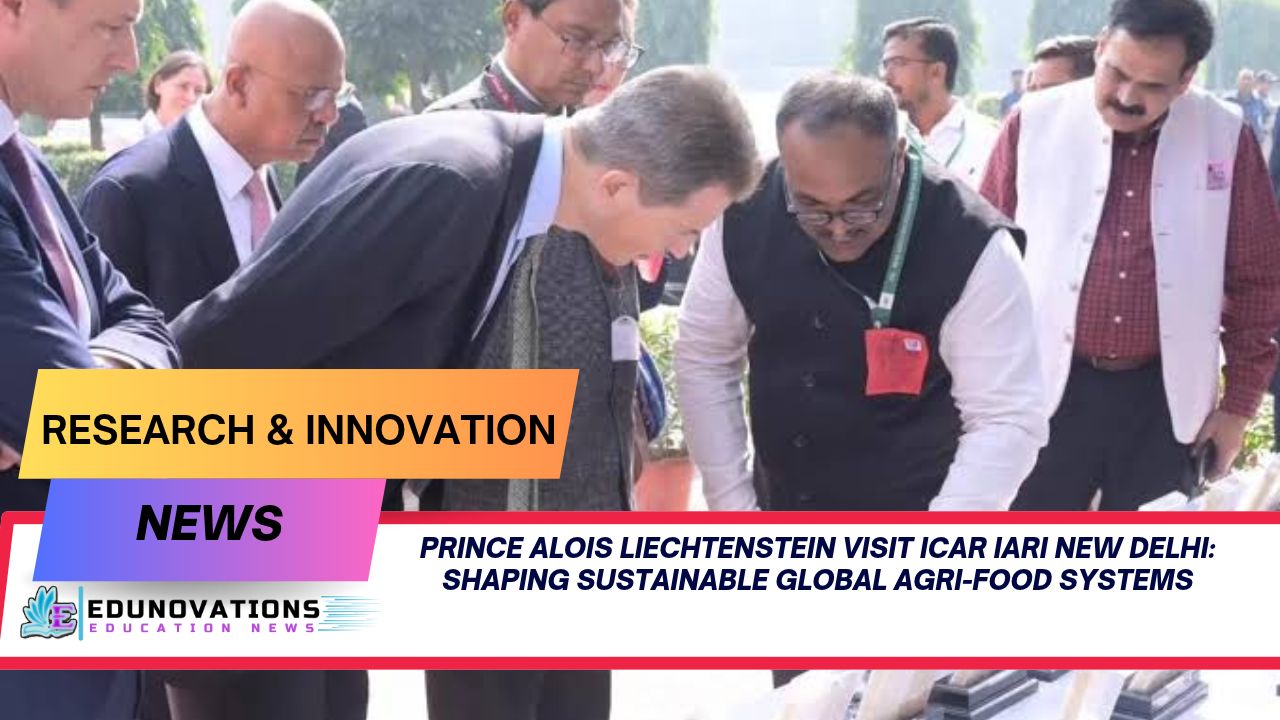
In a landmark diplomatic and scientific event, His Serene Highness Hereditary Prince Alois of Liechtenstein visited the Indian Agricultural Research Institute (ICAR-IARI) in New Delhi. Accompanied by Ms. Sabine Monauni, Deputy Prime Minister and Minister of Foreign Affairs, Environment and Culture; Mr. Martin Frick, Director of the Office for Foreign Affairs; Mr. Andreas Foser, Diplomatic Officer; and delegates representing Savannah Seeds, the high-profile delegation arrived to examine India’s world-renowned agricultural science ecosystem.
The distinguished guests were warmly received by Dr. M.L. Jat, Secretary of the Department of Agricultural Research and Education (DARE) and Director General of the Indian Council of Agricultural Research (ICAR); Dr. D.K. Yadava, Deputy Director General of ICAR; and Dr. Ch. Srinivasa Rao, Director of ICAR-IARI. The visit served as a vital platform for exploring avenues to strengthen bilateral cooperation in agricultural research, technological innovation, and climate-resilient agri-food systems between India and Liechtenstein.
High-Level Briefings and Strategic Discussions on Global Agriculture
The high-level interactions commenced with an exhaustive institutional overview delivered by Dr. M.L. Jat. Outlining ICAR’s vast, expansive agricultural research network, Dr. Jat detailed the institution’s historic contributions to national agricultural development and its expanding international scientific partnerships across developing nations and countries of the Global South.
Reflecting on India’s monumental historical journey from a food-deficient nation facing acute scarcity to a resilient, self-reliant food-surplus powerhouse, Dr. Jat underscored the critical importance of robust system science, enabling government policies, and active stakeholder collaboration. He emphasized that modern agricultural paradigms require integrated, systems-based approaches that seamlessly connect primary agricultural production with dynamic value chains, human nutrition, public health, agricultural economics, and environmental sustainability.
Furthermore, Dr. Jat highlighted the indispensable strategic role played by industrial enterprises, agritech startups, and Micro, Small and Medium Enterprises (MSMEs) in accelerating agricultural innovation, streamlining technology adoption, and driving rural value addition. For educational institutions, digital publishers, and modern campus networks seeking robust digital infrastructure to showcase their scientific programs, partnering with professional web solution providers like Mart Ind Infotech ensures world-class online visibility and institutional branding.
Advancing Nutritional Security and Climate-Resilient Technologies
As global climate volatility threatens traditional farming cycles, discussions during the royal visit heavily focused on developing climate-resilient agriculture, protecting nutritional security, advancing crop improvement methodologies, and implementing sustainable natural resource management.
Biofortification and Nutrient-Rich Crop Varieties
Nutritional deficiencies remain a major global public health concern. During the institutional briefings, agricultural scientists showcased breakthrough developments in biofortification. Particular emphasis was placed on high-yielding wheat varieties enriched with essential micronutrients such as zinc and iron. These biofortified crops are engineered to combat hidden hunger and malnutrition without requiring changes in consumer dietary habits, offering a scalable, sustainable public health solution.
Biotechnological Innovations and Gene-Editing
Modern biotechnology offers unprecedented precision in crop breeding. The delegation engaged in deep technical discussions regarding the immense potential of gene-editing and advanced molecular breeding tools. These technologies allow scientists to develop superior crop varieties with enhanced biotic and abiotic stress tolerance, higher photosynthetic efficiency, and shorter maturation cycles, ensuring stable yields even under erratic weather conditions.
Showcasing India’s Green Revolution Legacy and Crop Science
Dr. Ch. Srinivasa Rao took the opportunity to brief the delegation on ICAR-IARI’s historic, foundational contribution to India’s legendary Green Revolution, which transformed the nation’s food security in the twentieth century. He noted that the institute continues to spearhead cutting-edge agricultural research, maintaining its leadership role in driving modern agricultural productivity and safeguarding nutritional security for millions.
Complementing these remarks, Dr. D.K. Yadava showcased the exceptional achievements of ICAR’s Crop Science Division. He explained how systematic breeding programs have successfully commercialized climate-resilient, biofortified, and input-efficient varieties across diverse field and horticultural crops. Dr. Yadava stressed that contemporary agricultural science must strike a delicate balance: maximizing crop productivity to feed a growing global population while rigorously minimizing environmental footprints, chemical runoff, and greenhouse gas emissions.
Interactive Lab Tours and Expert Insights on Agricultural Economics
Following the formal conference sessions, the distinguished delegation embarked on a guided tour of the Genetics Division of ICAR-IARI. Here, Prince Alois and Minister Sabine Monauni interacted directly with leading Indian scientists, inspecting breakthrough crop varieties and discussing emerging breeding techniques. This hands-on exchange provided valuable insights into how advanced scientific tools can be leveraged for future international cooperation.
The Savannah Seeds Impact Study Launch
A major highlight of the itinerary was the official visit to the IARI Alumni Association complex, where H.S.H. Prince Alois planted a ceremonial tree to mark international scientific goodwill. Following the tree plantation, the Prince formally unveiled the comprehensive socio-economic impact study report titled, “FDI, Innovation and Technology in Rice Cultivation: The Case of Savannah Seeds”.
Shedding expert light on the findings, Dr. Ashok Gulati, renowned agricultural economist at the Indian Council for Research on International Economic Relations (ICRIER), presented the core dimensions of the study. Dr. Gulati noted:
“Foreign direct investment, when channeled effectively through private-public partnerships and technology transfers, acts as a powerful catalyst for modernizing traditional farming systems. The integration of proprietary seed technologies and precision agronomy into rice cultivation not only elevates farm-level productivity and resource efficiency but also substantially enhances the global export competitiveness of farming economies.”
Dr. Gulati’s insights underscored how economic policy and technological innovation intersect to reshape agrarian livelihoods, providing an essential framework for bilateral agricultural collaboration between India and European partner nations like Liechtenstein.
Strengthening Bilateral Ties and Future Scientific Horizons
The high-profile visit concluded with optimistic discussions regarding long-term institutional partnerships, joint research initiatives, and academic exchange programs between India and Liechtenstein. By fostering structured knowledge-sharing platforms, both nations aim to support the worldwide development of productive, climate-resilient, and environmentally robust agri-food systems.
As agricultural research continues to evolve in response to global environmental pressures, bilateral dialogues of this magnitude demonstrate that international synergy and shared scientific vision remain our best defense against future food security challenges.
Toppers Use Mind Maps to score more than 95%
-
NCERT Class 11th Commerce Mind Maps
Add to cartOriginal price was: ₹999.00.₹199.00Current price is: ₹199.00. -
NCERT Class 12th Chemistry Mind Maps
Add to cartOriginal price was: ₹199.00.₹75.00Current price is: ₹75.00. -
NCERT Class 12th Commerce Mind Maps
Add to cartOriginal price was: ₹999.00.₹199.00Current price is: ₹199.00. -
NCERT Class 12th Science Mind Maps
Add to cartOriginal price was: ₹999.00.₹199.00Current price is: ₹199.00. -
NCERT Mind Maps For Class 10th
Add to cartOriginal price was: ₹999.00.₹199.00Current price is: ₹199.00.


Purchase Today
Frequently Asked Questions
- What was the primary purpose of Prince Alois Liechtenstein visit ICAR IARI New Delhi? H.S.H. Hereditary Prince Alois of Liechtenstein visited ICAR-IARI to explore bilateral cooperation opportunities in agricultural research, technological innovation, and sustainable agri-food systems.
- Which high-ranking dignitaries accompanied Prince Alois during his visit to India? The delegation included Ms. Sabine Monauni (Deputy Prime Minister and Minister of Foreign Affairs, Environment and Culture), Mr. Martin Frick, Mr. Andreas Foser, and representatives from Savannah Seeds.
- Who received the royal delegation at ICAR-IARI? The delegation was received by Dr. M.L. Jat (DARE Secretary and ICAR Director General), Dr. D.K. Yadava (ICAR DDG), and Dr. Ch. Srinivasa Rao (Director, ICAR-IARI).
- What report was unveiled during the royal visit at the IARI Alumni Association complex? H.S.H. Prince Alois officially unveiled the socio-economic impact study report titled “FDI, Innovation and Technology in Rice Cultivation: The Case of Savannah Seeds”.
- Who presented the key findings of the Savannah Seeds rice cultivation study report? Dr. Ashok Gulati, prominent agricultural economist at the Indian Council for Research on International Economic Relations (ICRIER), presented the study’s key findings.
- What role does Savannah seeds rice cultivation study report IARI Delhi play in modern agriculture? It evaluates the socio-economic dimensions, technology transfers, and foreign direct investment impacts on modernizing rice farming systems and improving resource efficiency.
- What institutional collaboration aspects were discussed by ICAR leadership? Discussions focused on global south cooperation, agricultural research networks, system-based approaches connecting production with value chains, and industry-MSME participation.
- What focus areas were highlighted regarding Liechtenstein delegation agricultural research visit India? The talks emphasized bilateral scientific exchanges, institutional partnerships, knowledge sharing, and joint efforts to build robust, climate-resilient agri-food systems.
- What scientific technologies were discussed for climate resilient crop varieties ICAR IARI green revolution? Scientists discussed advanced biotechnological tools, gene-editing, and biofortification—such as zinc and iron-enriched wheat—to enhance nutritional security and climate resilience.
- Where did the delegation interact with agricultural scientists and plant varieties? The delegation visited the Genetics Division of ICAR-IARI, inspected innovative crop varieties, and participated in a ceremonial tree plantation at the IARI Alumni complex.