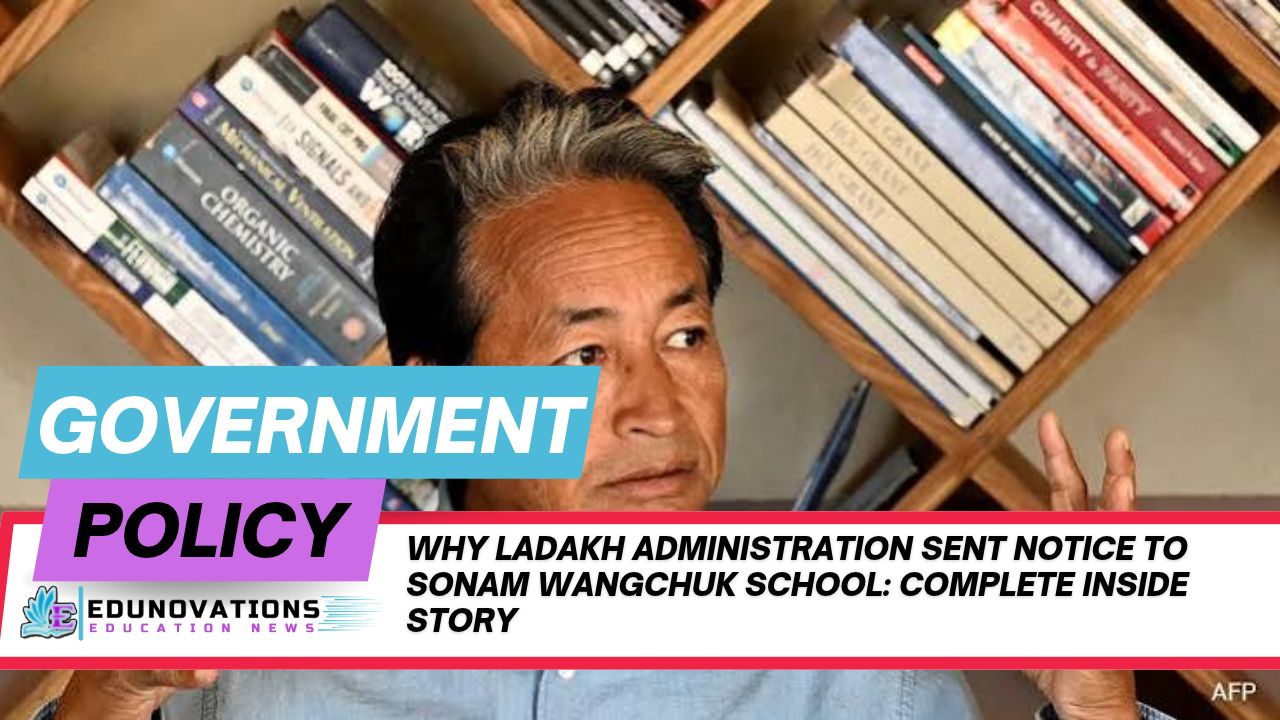
Discover why ladakh administration sent notice to sonam wangchuk school, halting Desert Flower School classes amid an intense legal battle over land disputes.
The picturesque landscape of Ladakh has once again turned into a fierce battleground of administrative authority, public policy, and institutional vision. In a development that has sent shockwaves through the educational and activist circles of the Union Territory, the local administration issued a formal and urgent directive ordering the closure of classes and activities at the newly operational Desert Flower School. The institution, which operates under the wider umbrella of the Himalayan Institute of Alternatives, Ladakh (HIAL)—founded by renowned educationist, innovator, and climate activist Sonam Wangchuk—has found itself locked in a high-stakes confrontation with the Union Territory administration.
For students, parents, and observers tracking educational developments in India’s northernmost frontier, this controversy highlights the growing friction between regional governance bodies and independent, alternative educational models. To deeply understand this unfolding scenario, students and educators can explore structured academic resources, including NCERT Courses and Current Affairs, which track regional policy shifts and administrative disputes across the country. Furthermore, candidates preparing for competitive examinations can utilize comprehensive Notes and practice MCQ’s to stay updated on critical domestic developments.
The Genesis of the Crisis: Land Allotment and Legal Battles
The roots of the current standoff trace back to a contentious land dispute involving a 40-year lease agreement for 1,076 kanals of land situated at Phyang Thang in Leh. HIAL, which is co-founded and managed by Gitanjali J. Angmo (wife of Sonam Wangchuk and CEO of the institute), had initially secured this land allotment to build a sprawling, sustainable campus designed to revolutionize mountain education.
However, relations between the administration and the institute soured significantly. The Ladakh administration cancelled the land allotment, arguing that HIAL had failed to comply with mandatory lease conditions, including the timely payment of premium ground rent within the stipulated first year of allotment. Refusing to back down, the institute—represented legally through writ petitions—approached the High Court of Jammu and Kashmir and Ladakh to challenge the cancellation order.
As the matter remains strictly sub judice, the legal friction intensified when HIAL proceeded with the construction and subsequent inauguration of the Desert Flower School, a specialized kindergarten facility catering to young children aged 3 to 5 years.
The Administration’s Directive: Maintaining Status Quo
The immediate flashpoint arrived when the Leh Tehsildar’s office issued an official notice directed to Gitanjali J. Angmo. The order explicitly commanded the institution to “maintain status quo” and refrain from undertaking any further actions concerning the functioning or commencement of classes at Desert Flower School.
According to administrative spokespersons, the core of the objection lies in procedural non-compliance. The administration maintained that the school initiated academic operations without securing the mandatory No Objection Certificate (NOC), clearances, and formal approvals from the competent local education and municipal authorities. Officials pointed out that while an application for an NOC concerning the proposed members of the school’s managing committee was formally submitted by Angmo on September 22, the evaluation and approval process was still pending when classes abruptly commenced on November 2.
For institutions seeking proper infrastructural guidelines and standard operating procedures, expert institutional consulting from entities like Mart Ind Infotech often helps organizations navigate regulatory compliance, digital documentation, and administrative frameworks seamlessly.
Sonam Wangchuk and Management Hit Back: Calling it a “Witch-Hunt”
Reacting sharply to the administrative order, Sonam Wangchuk and Gitanjali Angmo addressed an online press conference, dismissing the administration’s claims as a coordinated “vendetta” and political witch-hunt aimed at tarnishing the institute’s global reputation.
Wangchuk didn’t mince words while criticizing the delivery method of the notice, alleging that it was leaked to media outlets before being formally served to the school management solely to create public chaos, frighten parents, and force them to withdraw their children. Highlighting the global and national acclaim garnered by HIAL, Wangchuk remarked:
“India’s Parliamentary Committee on Education recommended that HIAL be replicated all over the country. London’s Victoria and Albert Museum has a permanent display on it. Time magazine featured its projects in TIME100 Climate Solutions. And yet, they want it closed!”
Furthermore, Gitanjali Angmo defended the institution’s procedural integrity, stating that the administration’s own lease execution policies remained incomplete and ambiguous. She asserted that the school’s construction, which began in 2023 with funding support from responsible Public Sector Undertakings (PSUs) after thorough compliance checks, should not be penalized due to bureaucratic delays.
To align academic curriculums with broader educational frameworks, students and educators can access structured Videos, detailed Syllabus, and downloads of Free NCERT PDFs alongside visual learning aids like NCERT Mind Maps.
Broader Context and Sociopolitical Implications
This administrative crackdown unfolds against a volatile backdrop of civic agitation in Ladakh. Over the past year, Sonam Wangchuk has been at the forefront of intensive regional movements demanding constitutional safeguards under the Sixth Schedule for Ladakh, environmental protections for fragile Himalayan ecosystems, and full statehood. His activism—including high-profile fasts and participation in demonstrations—has frequently placed him at loggerheads with the Union Territory’s bureaucratic leadership.
Educational analysts point out that while regulatory compliance is non-negotiable for any educational startup, the timing and severity of notices served to innovative projects often reflect deeper political undercurrents. Parents who enrolled their children in Desert Flower School find themselves caught in the crossfire, worried about how administrative litigation will impact early childhood learning modules that emphasize experiential and climate-conscious education.
Statistical Overview of the Controversy
To grasp the magnitude of the dispute, consider the following structural metrics associated with the unfolding administrative action:
| Parameter | Detail / Metric |
| Institution Involved | Desert Flower School (Under HIAL Ecosystem) |
| Key Leadership | Sonam Wangchuk (Activist) & Gitanjali J. Angmo (CEO) |
| Target Age Group | Early Childhood Kindergarten (Ages 3–5 years) |
| Current Enrollment | 50 Young Students |
| Land Parcel in Dispute | 1,076 Kanals at Phyang Thang (Leh) |
| Judicial Forum | High Court of Jammu and Kashmir and Ladakh |
Toppers Use Mind Maps to score more than 95%
-
NCERT Class 11th Commerce Mind Maps
Add to cartOriginal price was: ₹999.00.₹199.00Current price is: ₹199.00. -
NCERT Class 12th Chemistry Mind Maps
Add to cartOriginal price was: ₹199.00.₹75.00Current price is: ₹75.00. -
NCERT Class 12th Commerce Mind Maps
Add to cartOriginal price was: ₹999.00.₹199.00Current price is: ₹199.00. -
NCERT Class 12th Science Mind Maps
Add to cartOriginal price was: ₹999.00.₹199.00Current price is: ₹199.00. -
NCERT Mind Maps For Class 10th
Add to cartOriginal price was: ₹999.00.₹199.00Current price is: ₹199.00.





Purchase Today
Frequently Asked Questions (FAQs)
1. why ladakh administration sent notice to sonam wangchuk school?
The Ladakh administration sent the notice because the institute allegedly commenced classes and academic activities at Desert Flower School without obtaining mandatory prior clearances, No Objection Certificates (NOCs), and formal administrative approvals.
2. What is the background of the desert flower school leh land dispute case update?
The land dispute stems from the administration’s cancellation of a 40-year lease for 1,076 kanals of land at Phyang Thang in 2025, a decision that HIAL subsequently challenged through a writ petition in the High Court.
3. What are the hial ladakh school closure high court order details?
The High Court is currently adjudicating the land lease cancellation petition. Pending final judgment, the local Tehsildar issued an advisory instructing HIAL to maintain strict status quo and halt all active school operations.
4. Is desert flower school in ladakh legal or unauthorized?
The administration claims the school started operations without proper statutory approvals, whereas the management argues that delays in finalizing the administration’s lease policies created administrative hurdles, and they have acted in good faith with complete funding compliance.
5. What was sonam wangchuk hial school controversy explained by founders?
Sonam Wangchuk and Gitanjali Angmo termed the notice a “witch-hunt” and a “vendetta” designed to scare parents and create public chaos, emphasizing that the institution has received high national and international recognition for innovative mountain education.
6. Who is the co-founder and CEO of HIAL?
Gitanjali J. Angmo serves as the co-founder and CEO of the Himalayan Institute of Alternatives, Ladakh (HIAL), and received the administrative notice regarding Desert Flower School.
7. How many students are currently enrolled in Desert Flower School?
The kindergarten facility in Phyang, Leh, currently caters to young children aged between 3 and 5 years.
8. What legal protection has HIAL sought from the judiciary?
HIAL has filed a writ petition in the High Court of Jammu and Kashmir and Ladakh challenging the land lease cancellation and seeking protection against administrative overreach regarding third-party rights on the disputed land.
9. When did Desert Flower School officially commence its classes?
Desert Flower School commenced its academic operations and kindergarten classes in early November 2026, right before the administration’s restrictive notice was enforced.
10. What is the broader political context of Sonam Wangchuk’s activism in Ladakh?
Sonam Wangchuk has been leading prominent campaigns advocating for constitutional safeguards, environmental protection, and regional autonomy for Ladakh under the Sixth Schedule, which has frequently strained relations with local authorities.