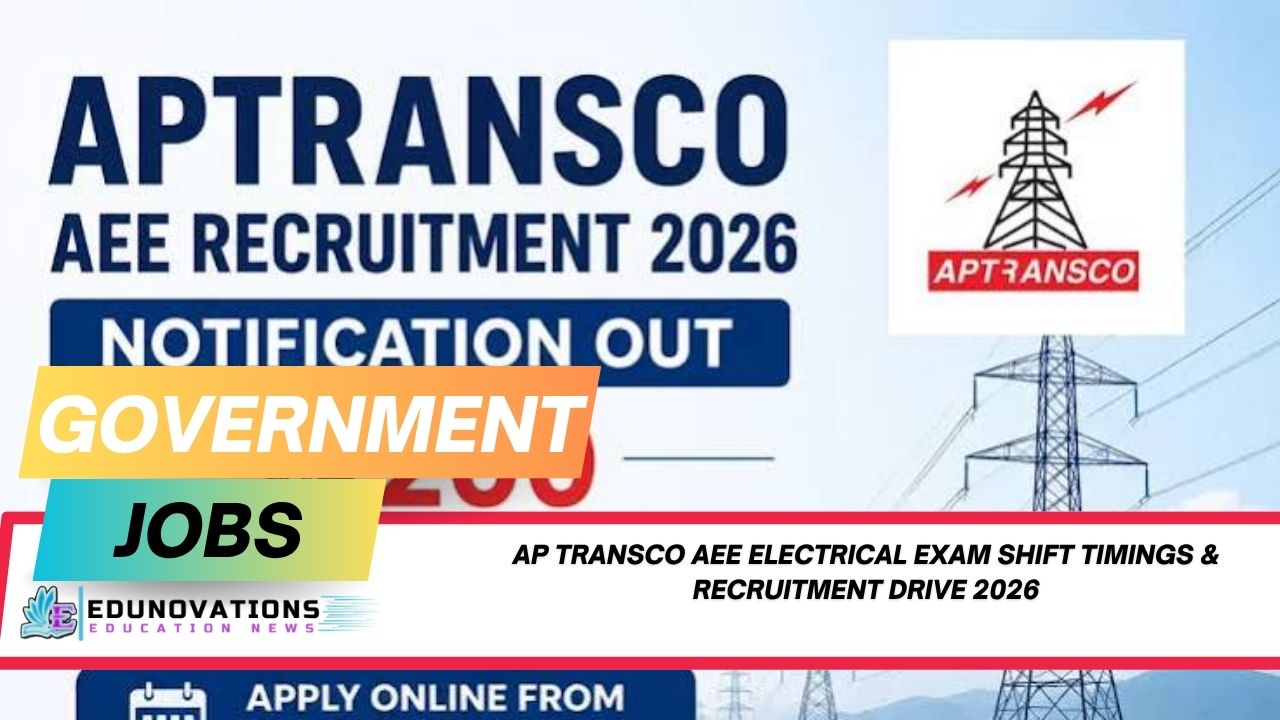
Explore the AP Transco AEE electrical exam shift timings, recruitment exam protocols for 629 posts, security measures, and selection criteria in Andhra Pradesh power sector.
The power distribution and generation sector in Andhra Pradesh has entered a critical operational phase as the state power utilities officially initiated the recruitment examination drive to fill 629 Assistant Executive Engineer (AEE) positions. Organized across multiple disciplines—including Civil, Electrical, Mechanical, and Telecom/Electronics Engineering—this mega examination drive aims to onboard skilled technical professionals into five prestigious state power utilities: AP Transco, AP Genco, APSPDCL, APEPDCL, and APCPDCL.
With over 1.05 lakh registered candidates competing for a limited number of technical positions, state officials have instituted unprecedented anti-malpractice measures, high-tech security controls, and strict candidate verification protocols across 94 specialized examination centers. Understanding the structure of these examinations, strict biometric checks, and candidate schedules provides essential clarity for competitive exam aspirants across the region.
High-Stakes Technical Recruitment in Andhra Pradesh Power Sector
The common recruitment examination for Assistant Executive Engineers represents one of the largest competitive technical drives conducted by state entities in recent years. A total of 1,05,566 candidates submitted applications following the official recruitment announcement issued on June 25, 2026.
To ensure equitable distribution of examination infrastructure and candidate access, state authorities set up 94 dedicated computer-based testing (CBT) centers. Among these, 81 examination centers were established within the borders of Andhra Pradesh, while 13 external centers were organized across neighboring states to accommodate out-of-state applicants seamlessly.
Total Applications Received : 1,05,566 Candidates
Total Available Vacancies   : 629 Posts (AP Transco, AP Genco, APSPDCL, APEPDCL, APCPDCL)
Total CBT Exam Centers     : 94 Centers (81 in Andhra Pradesh | 13 in Other States)
Selection Criteria          : 100% Merit-Based Performance in Written CBT
The scale of candidate participation varies heavily by engineering specialization. The electrical engineering discipline witnessed the highest applicant density, followed by telecom/electronics, civil, and mechanical branches.
Branch-Wise Candidate Attendance and Stream Scheduling
The competitive examination drive was structured across multiple consecutive days to accommodate stream-specific candidate volume without overloading server infrastructure or testing hubs. The recruitment tests were conducted in two daily sessions: a morning session running from 9:00 AM to 12:00 PM and an afternoon session running from 2:30 PM to 5:30 PM.
The civil engineering examination inaugurated the testing cycle. Out of 16,183 registered applicants for the civil discipline, 12,301 candidates appeared for their exams at designated centers on the opening day. The mechanical engineering test followed with 6,411 out of 9,444 registered candidates sitting for the test.
| Engineering Stream | Total Applicants | Candidates Appeared | Attendance Rate (%) | Primary Utilities Allocation |
| Civil Engineering | 16,183 | 12,301 | 76.01% | AP Transco, AP Genco, Discoms |
| Mechanical Engineering | 9,444 | 6,411 | 67.88% | AP Genco, AP Transco |
| Telecom & Electronics | 26,237 | 19,947 | 76.02% | AP Transco, APEPDCL, APSPDCL |
| Electrical Engineering | 53,702 | 46,244 | 86.11% | AP Transco, AP Genco, All Discoms |
| Total Overall | 1,05,566 | 84,905 | 80.40% | State Power Utilities |
The electrical engineering discipline required extended scheduling spanning multiple test sessions due to massive applicant volume. Candidates navigating the exam timeline had to carefully track the AP Transco AEE electrical exam shift timings to ensure timely arrival at their assigned CBT centers.
To prepare systematically for competitive engineering assessments, aspirants frequently analyze structured exam syllabus patterns and standard curricula available on Edunovations Detailed Syllabus.
Technical Security, Jammer Deployment, and Anti-Malpractice Measures
To maintain complete transparency and public trust in the examination system, the Andhra Pradesh power management framework implemented security protocols equivalent to national competitive exams such as GATE, UGC-NET, CAT, and JEE. Joint Managing Director (Vigilance & HRD) G. Surya Sai Praveen Chand emphasized that merit in the written examination would remain the sole criterion for selection.
+-------------------------------------------------------------------------+
|                CBT RECRUITMENT SECURITY FRAMEWORK                        |
+-------------------------------------------------------------------------+
                                    |
     +------------------------------+------------------------------+
     |                                                             |
[Physical Verification]                                 [Digital & Cyber Security]
  - Biometric Thumbprint                                   - Encrypted Exam Papers
  - Live Photo Capture                                     - Real-Time Decryption
  - Aadhaar Photo ID Cross-Check                           - Mobile Frequency Jammers
  - Enclosed Female Frisking                               - Randomised Questions & Options
     |                                                             |
     +------------------------------+------------------------------+
                                    |
                    [Central Control Command Center]
                      - 24/7 CCTV Live Monitoring
                      - Vidyut Soudha Headquarters
Advanced Biometric Verification Protocol
Candidates entering exam premises were subjected to multi-stage identity verification. This process involved biometric fingerprint scanning, real-time photographic capture, original photo identification verification, and physical frisking. Dedicated enclosed verification booths staffed by female personnel were arranged at every center to conduct frisking for female candidates comfortably and securely. Candidates researching administrative regulations can reference detailed procedural steps outlined in AP AEE Biometric Verification Guidelines.
Data Security and Encrypted Question Delivery
Question papers were transmitted directly to secure center servers in an encrypted digital format. Decryption occurred automatically only at the exact scheduled start time of the test session. Furthermore, to prevent organized copying or unauthorized pattern sharing, seat allocations, question sequences, and answer option sequences were completely randomized by central testing algorithms.
Signal Jammers and Centralized Monitoring
To counter wireless communication attempts, mobile jammers were installed across all test centers in coordination with Bharat Electronics Limited (BEL). Continuous CCTV coverage monitored hall interiors, building corridors, entry access points, and server operations rooms.
All surveillance feeds were relayed live to a centralized monitoring command and control unit set up at Vidyut Soudha in Vijayawada. To maintain uninterrupted testing operations during power outages, centers were backed by dedicated power feeders, high-capacity diesel generator sets, and uninterruptible power supply (UPS) backups.
For candidates preparing for state-level general awareness and technical exams, practicing with curated online question banks like those on Edunovations Practice MCQs serves as an effective revision tool.
Insights from Executive Leadership: G. Surya Sai Praveen Chand, IAS
Speaking at the Vidyut Soudha Command and Control Center in Vijayawada, G. Surya Sai Praveen Chand, IAS, Joint Managing Director (HR & Administration, Vigilance), provided key operational insights into the common examination system:
“Our primary objective is to ensure that every eligible candidate gets an equal, fair, and transparent opportunity. By integrating advanced digital technology, biometric verification, total CCTV surveillance, and centralized real-time monitoring, we have systematically eliminated possibilities of malpractice.”
Addressing rumors circulating on social media regarding potential exam postponements or pattern alterations, the Joint Managing Director clarified:
“The recruitment process is strictly merit-based. There is absolutely no change in syllabus parameters, nor can any third party influence the outcome. Candidates must remain cautious of fraudulent individuals promising appointments and rely strictly on official state portals for updates.”
Strategic Preparation and Core Syllabus Structure
Securing an Assistant Executive Engineer post requires consistent technical preparation across core engineering subjects alongside general aptitude. Candidates seeking comprehensive reference materials can consult structured study resources such as Edunovations Subject Notes to strengthen core concepts.
      +---------------------------------------------------------------+
      |             AP POWER UTILITIES AEE EXAM PATTERN               |
      +---------------------------------------------------------------+
                                      |
         +----------------------------+----------------------------+
         |                                                         |
  [Section A: Core Technical]                               [Section B: General Aptitude]
    - 70% Weightage                                           - 30% Weightage
    - Branch-Specific Engineering                             - Quantitative Aptitude
      (Electrical, Civil, Mechanical,                         - General Intelligence & Reasoning
       Telecom/Electronics)                                   - Computer Knowledge & English
Core Engineering Weightage (70%)
The bulk of the question paper focuses on stream-specific engineering principles:
- Electrical Engineering: Power Systems, Electrical Machines, Control Systems, Power Electronics, Electromagnetic Theory, Circuit Analysis, and Protection Systems.
- Civil Engineering: Structural Analysis, Reinforced Concrete Structures, Soil Mechanics, Fluid Mechanics, Environmental Engineering, Transportation, and Surveying. Candidates aiming to analyze previous year question patterns can review detailed question papers referenced under AP Power Utilities AEE Civil Question Paper PDF.
- Telecom & Electronics Engineering: Signal Processing, Digital Communications, Microprocessors, Analog Circuits, Microcontroller Architectures, and Antenna Theory. Aspirants looking for syllabus blueprints can access curated guides like AP EPDCL AEE Telecom Electronics Syllabus PDF.
- Mechanical Engineering: Thermodynamics, Heat Transfer, Fluid Dynamics, Mechanics of Materials, Manufacturing Processes, and Machine Design.
General Aptitude and Analytical Reasoning (30%)
The remaining portion of the examination tests analytical skill, logical reasoning, numerical capability, computer literacy, and basic English communication. Developing strong foundational knowledge in science and mathematics through basic textbooks is highly recommended; candidates can access free study content via Edunovations Free NCERT PDFs Download or utilize visual learning tools like Edunovations NCERT Mind Maps.
To complement self-study with video explanations of complex technical topics, candidates can browse lecture series available on Edunovations Video Lessons. For foundational building across general studies subjects, structured curriculum programs are available via Edunovations NCERT Courses.
Administrative Rules and Exam Day Regulations
To ensure smooth entry and avoid disqualification at testing centers, candidates must strictly observe official examination room regulations:
- Mandatory Documentation: Candidates must produce a printed admit card along with an unexpired, original government-issued photo identity proof (such as an Aadhaar Card, Voter ID, Passport, or Driving License).
- Prohibited Electronic Items: Smartwatches, mobile phones, Bluetooth headsets, calculators, electronic key fobs, and digital storage devices are strictly prohibited inside the hall.
- Reporting Timings: Candidates must reach their assigned center well in advance of the session start time to clear biometric check-in. Entry gates close strictly prior to examination commencement.
- Randomized Seating Compliance: Seating arrangements and terminal allocations are managed dynamically by central software, reflecting parameters detailed under AP Genco AEE Hall Ticket Randomization Seat Rules.
For educational institutions and examination boards requiring digital administrative portals or robust software infrastructure for test management, professional web development solutions can be explored at Mart Ind Infotech.
Selection Process, Remuneration, and Career Progression
The selection framework for AP Power Utilities AEE posts is completely objective and performance-driven. Following the completion of the CBT sessions, the power utilities release a preliminary answer key, opening a dedicated window for candidates to submit technical objections.
[Phase 1: CBT Written Exam] ---> [Phase 2: Answer Key & Objections] ---> [Phase 3: Merit List & DV] ---> [Phase 4: Two-Year Probation]
Evaluation and Merit List Declaration
After evaluating candidate objections, final normalized scores are calculated to formulate state-wide merit lists. Candidate allocation to specific power utilities—whether AP Transco, AP Genco, or regional distribution companies (APSPDCL, APEPDCL, APCPDCL)—is determined based on candidate rank, category reservations, and utility preferences submitted during online registration.
Pay Structure and Employee Benefits
Newly appointed Assistant Executive Engineers undergo a mandatory two-year probation period, during which they receive a consolidated monthly remuneration of ₹75,000. Upon successful completion of the probation phase, officers are integrated into the regular Revised Pay Scale (RPS-2022) cadre, qualifying for standard state power utility allowances, medical coverage, provident fund contributions, and structured promotional avenues toward Executive Engineer (EE) and Superintending Engineer (SE) roles.
Candidates tracking broader administrative developments, educational policies, and competitive exam news across the state can stay informed by reading regular updates published on Edunovations Current Affairs Channel.
Toppers Use Mind Maps to score more than 95%
NCERT Class 11th Commerce Mind Maps
Add to cartOriginal price was: ₹999.00.₹199.00Current price is: ₹199.00.NCERT Class 12th Chemistry Mind Maps
Add to cartOriginal price was: ₹199.00.₹75.00Current price is: ₹75.00.NCERT Class 12th Commerce Mind Maps
Add to cartOriginal price was: ₹999.00.₹199.00Current price is: ₹199.00.NCERT Class 12th Science Mind Maps
Add to cartOriginal price was: ₹999.00.₹199.00Current price is: ₹199.00.NCERT Mind Maps For Class 10th
Add to cartOriginal price was: ₹999.00.₹199.00Current price is: ₹199.00.




Purchase Today
Comprehensive FAQ Section
Q1: What are the shift timings for the AP Transco electrical engineering examination?
The common computer-based test for power utility AEE posts is conducted in two daily shifts: a morning shift from 9:00 AM to 12:00 PM and an afternoon shift from 2:30 PM to 5:30 PM. Candidates should check their hall ticket to confirm their specific session timing and report at least 60 minutes prior to gate closure.
Q2: What is the total number of vacancies announced in the AP Power Utilities AEE recruitment drive?
The joint recruitment notification covers a total of 629 Assistant Executive Engineer (AEE) vacancies distributed across AP Transco, AP Genco, APSPDCL, APEPDCL, and APCPDCL.
Q3: How is identity verification performed at the examination centers?
Verification involves a multi-tiered security check including biometric thumbprint scanning, live candidate photo capture, physical frisking, and cross-checking original government-issued photo identification against online hall ticket records.
Q4: Where can aspirants download previous papers like the AP Power Utilities AEE Civil Question Paper PDF?
Candidates can access official answer keys, sample question papers, and preparation guides through state recruitment portals and educational study platforms such as Edunovations.
Q5: What security measures were deployed to prevent exam paper leaks?
Question papers were transmitted to local examination servers in encrypted formats and decrypted only at the scheduled start time. Furthermore, question sequences and option choices were randomized for every candidate terminal, supported by mobile jammers deployed by Bharat Electronics Limited (BEL).
Q6: Are electronic calculators permitted inside the CBT exam hall?
No. Handheld electronic calculators, smartwatches, mobile devices, and digital books are strictly banned inside testing centers. On-screen scientific calculators are provided within the CBT interface if required by specific engineering streams.
Q7: What syllabus guidelines apply to the AP EPDCL AEE Telecom Electronics branch?
The syllabus consists of two primary sections: 70% technical questions covering core Telecommunication and Electronics Engineering concepts, and 30% assessing General Intelligence, Reasoning, Quantitative Aptitude, English, and basic Computer Literacy.
Q8: How does the seating allocation process work during the examination?
Seating arrangements are assigned through automated randomization software upon candidate check-in, preventing pre-planned candidate seating configurations across centers.
Q9: What is the starting monthly salary for selected AEE candidates during probation?
Selected candidates receive a consolidated remuneration of ₹75,000 per month during their two-year probation period. Following probation, they are transitioned to the regular state power utility pay scale (RPS-2022) with standard allowances.
Q10: How are utility preferences allocated among successful candidates?
Final allotment to AP Transco, AP Genco, or regional Discoms (APSPDCL, APEPDCL, APCPDCL) depends strictly on candidate rank in the written CBT merit list, category reservation rules, and preference choices indicated during application.