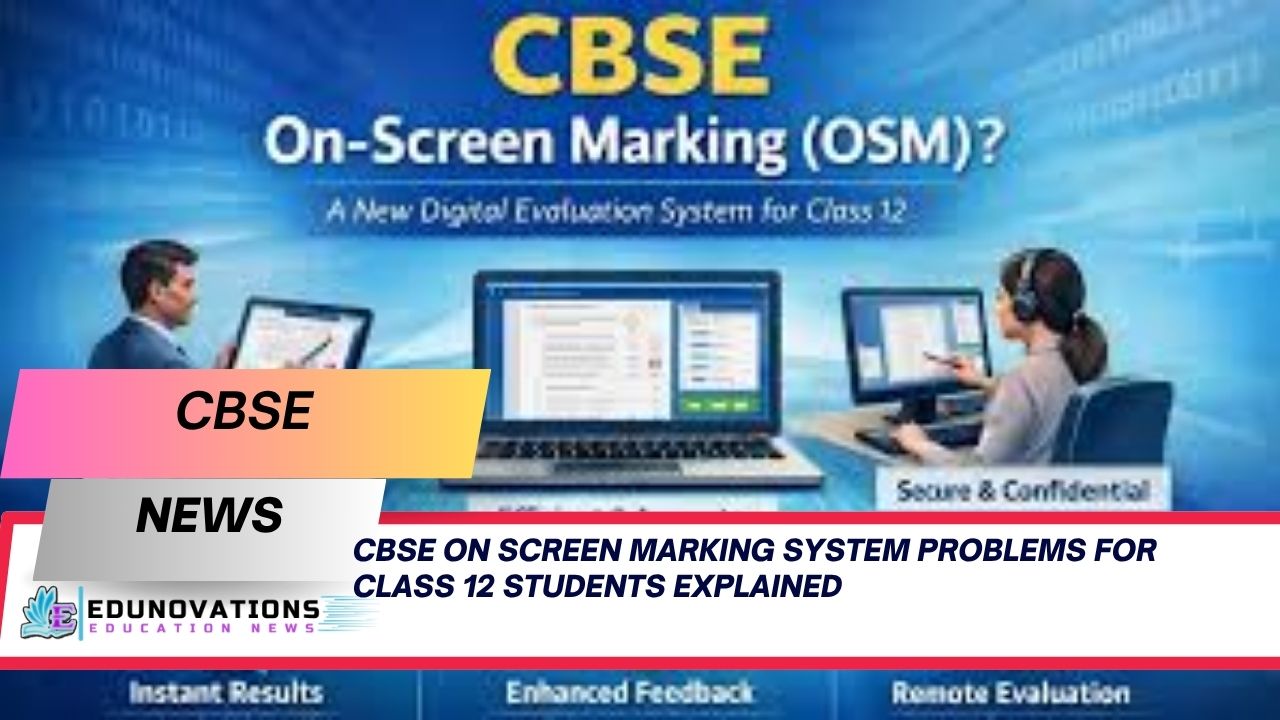
CBSE on screen marking system problems for class 12 students spark nationwide debate over digital evaluation accuracy, moderation issues, rechecking concerns, and board exam fairness in 2026.
The growing discussion around cbse on screen marking system problems for class 12 students has triggered fresh concerns among parents, teachers, education experts, and policymakers across India. As the Central Board of Secondary Education (CBSE) increasingly relies on digital evaluation methods for board examinations, many stakeholders are questioning whether the current system ensures fairness, consistency, and transparency for lakhs of students appearing in Class 10 and Class 12 board exams every year.
The issue gained national attention after several educators and technology experts highlighted flaws in the digital correction process, especially in subjective answer evaluation. The debate has now evolved into a larger conversation about the future of assessment in India’s school education system.
Experts believe that while technology-driven assessment methods can reduce human error and improve efficiency, the present implementation of the on-screen marking model requires urgent reforms to protect student interests.
Understanding the Digital Evaluation Process Used by CBSE
CBSE introduced the digital evaluation model to streamline answer sheet checking and reduce logistical challenges associated with physical paper handling. Under this process, answer sheets are scanned and uploaded to secure digital systems where evaluators assess responses electronically.
The board initially promoted the system as a modern solution capable of:
- Reducing evaluation time
- Increasing transparency
- Minimizing manual handling errors
- Improving examiner monitoring
- Enhancing result processing efficiency
However, concerns surrounding cbse on screen marking system problems for class 12 students have exposed limitations that many schools and teachers believe cannot be ignored any longer.
Education experts argue that subjective subjects such as Political Science, English, History, Sociology, and Philosophy require nuanced human understanding that digital interfaces may not adequately support.
Why Students and Teachers Are Raising Concerns
One of the major criticisms is that evaluators often experience screen fatigue while checking lengthy descriptive answers. Teachers say continuous digital evaluation for several hours affects concentration and consistency.
Many examiners reportedly find it difficult to zoom, navigate, annotate, and compare responses efficiently on-screen. This has led to increasing discussions about why cbse digital evaluation system is facing criticism 2026 among education communities.
Some key concerns include:
Limited Reading Comfort
Reading long handwritten responses on a screen can reduce examiner efficiency compared to paper-based checking.
Inconsistent Marking Patterns
Teachers claim evaluators may unintentionally skip portions or misread scanned answers because of poor image clarity or interface limitations.
Time Pressure on Evaluators
Several educators believe digital evaluation encourages speed over quality.
Technical Difficulties
Occasional server slowdowns and login issues reportedly disrupt the evaluation workflow.
These challenges have strengthened arguments surrounding cbse osm answer sheet scanning issues and low marks explained, particularly after students alleged unexpected score reductions in humanities and language papers.
Students Demand Greater Transparency
As conversations about cbse on screen marking system problems for class 12 students continue to grow, students have started demanding more transparent rechecking mechanisms.
Many candidates who applied for revaluation in previous years claimed their marks increased after verification. This has led to widespread discussions about cbse class 12 re evaluation after on screen marking controversy across social media and academic forums.
Several coaching experts believe students deserve:
- Access to clearer answer sheet copies
- Better explanation of moderation policies
- Improved grievance redressal systems
- Faster response timelines during rechecking
Parents also argue that board examination marks directly impact college admissions, scholarships, and competitive exam opportunities. Therefore, even minor evaluation inconsistencies can have long-term academic consequences.
Students preparing through platforms offering structured resources like NCERT Courses and NCERT Notes are increasingly seeking clarity regarding board assessment policies.
Education Experts Call for Hybrid Evaluation Model
Several academic leaders now recommend adopting a hybrid correction model instead of fully relying on digital evaluation systems.
Under a hybrid model:
- Objective sections can be digitally checked
- Subjective answers may undergo manual verification
- Random answer sheets can be audited physically
- AI-based anomaly detection may identify inconsistent marking
Education technology analysts say the debate around how cbse on screen marking affected board exam results 2026 reflects the urgent need for balance between automation and academic judgment.
According to school administrators, digital evaluation should assist teachers rather than replace human expertise entirely.
Experts also recommend better examiner training programs to reduce errors during digital correction sessions.
Students preparing for school and competitive exams can also access updated academic material through Current Affairs Resources and NCERT MCQs to strengthen conceptual understanding.
Technology Experts Highlight Systemic Limitations
Technology professionals say the problem is not digital evaluation itself but the implementation quality.
Specialists working in educational software systems point out that scanned answer quality, monitor calibration, internet stability, and software usability significantly affect evaluation accuracy.
Experts associated with digital education infrastructure companies say systems must prioritize:
- High-resolution scanning
- Examiner-friendly interfaces
- Smart navigation tools
- Real-time quality monitoring
- Automated answer completeness alerts
Industry observers from organizations such as Mart Ind Infotech believe educational institutions need stronger technological ecosystems before depending entirely on digital evaluation frameworks.
Psychological Impact on Students
The increasing debate around cbse on screen marking system problems for class 12 students has also affected student confidence.
Psychologists say uncertainty about evaluation fairness increases stress among board candidates. Since CBSE results influence undergraduate admissions, students become anxious when controversies emerge around marking accuracy.
Counsellors have observed:
- Increased rechecking applications
- Anxiety after result declaration
- Fear of technical evaluation mistakes
- Reduced trust in digital assessment
Many students now spend extra time preparing for revaluation processes rather than focusing on future academic planning.
Experts suggest schools must provide emotional support and guidance sessions after board results.
Students can additionally benefit from educational video explainers available through Educational Videos and syllabus guidance from NCERT Syllabus Resources.
Global Trends in Digital Evaluation
Several countries have adopted digital assessment systems, but most combine them with strict quality audits.
Education analysts point out that nations using successful digital correction frameworks generally implement:
- Double evaluation systems
- AI-assisted moderation
- Mandatory random audits
- Examiner certification programs
- Continuous software upgrades
Indian education experts say CBSE can learn from international best practices while redesigning its current structure.
The ongoing conversation regarding why cbse digital evaluation system is facing criticism 2026 demonstrates that technological adoption in education requires long-term planning rather than rapid implementation alone.
Former Educators Share Their Observations
Retired principals and former board evaluators have also expressed concern regarding digital-only correction methods.
Some former examiners argue handwritten answers often contain diagrams, side notes, rough workings, and flowcharts that are easier to interpret physically than digitally.
A former CBSE evaluator from Delhi stated that evaluating lengthy literature answers on-screen for several hours becomes mentally exhausting, increasing the possibility of oversight.
These observations have added momentum to discussions about cbse osm answer sheet scanning issues and low marks explained in education circles.
Many educators now believe examiner workload management must become a central priority during board evaluation reforms.
Role of Artificial Intelligence in Future Evaluations
Education technology companies are experimenting with AI-supported assessment systems capable of detecting incomplete evaluations or inconsistent scoring patterns.
However, experts caution that artificial intelligence cannot fully replace human academic judgment, especially in descriptive subjects requiring interpretation and creativity.
Future systems may include:
- AI-assisted flagging tools
- Automated answer completeness checks
- Evaluation analytics dashboards
- Examiner performance tracking
- Smart moderation systems
Still, policymakers agree that human oversight must remain essential.
The growing concerns around how cbse on screen marking affected board exam results 2026 highlight the need for careful integration of technology with academic ethics.
Schools Seek Better Communication from CBSE
School administrators say one of the biggest challenges is the lack of detailed public communication regarding the digital evaluation framework.
Principals are requesting:
- Clearer examiner guidelines
- Public transparency reports
- Evaluation audit disclosures
- Student awareness campaigns
- Simplified rechecking procedures
Education experts say proactive communication can help reduce misinformation and panic among students and parents.
Several institutions are also encouraging students to strengthen conceptual learning through free study material available at Free NCERT PDFs and visual learning aids from NCERT Mind Maps.
The Future of Board Examination Reforms
The ongoing national discussion about cbse on screen marking system problems for class 12 students may eventually influence broader examination reforms in India.
Education policy analysts believe future reforms could include:
- Mixed-mode evaluation systems
- Better examiner training
- Improved digital infrastructure
- Stronger moderation standards
- Transparent grievance mechanisms
The debate also reflects larger concerns about balancing efficiency with educational fairness.
As India’s education system rapidly digitizes, policymakers must ensure technological innovation does not compromise academic credibility.
The future success of CBSE’s evaluation system will likely depend on how effectively the board responds to growing concerns from students, teachers, parents, and academic experts.
Conclusion
The controversy surrounding cbse on screen marking system problems for class 12 students has become one of the most discussed education issues in 2026. While digital evaluation offers speed and operational efficiency, concerns regarding transparency, consistency, and student trust continue to intensify.
Experts agree that technology should enhance academic evaluation rather than create uncertainty among students. As CBSE considers future reforms, a balanced approach combining digital tools with human academic judgment may provide the most effective solution.
For millions of students whose academic futures depend on board examination scores, ensuring fair and accurate evaluation remains the ultimate priority.
Toppers Use Mind Maps to score more than 95%
NCERT Class 11th Commerce Mind Maps
Add to cartOriginal price was: ₹999.00.₹199.00Current price is: ₹199.00.NCERT Class 12th Chemistry Mind Maps
Add to cartOriginal price was: ₹199.00.₹75.00Current price is: ₹75.00.NCERT Class 12th Commerce Mind Maps
Add to cartOriginal price was: ₹999.00.₹199.00Current price is: ₹199.00.NCERT Class 12th Science Mind Maps
Add to cartOriginal price was: ₹999.00.₹199.00Current price is: ₹199.00.NCERT Mind Maps For Class 10th
Add to cartOriginal price was: ₹999.00.₹199.00Current price is: ₹199.00.




Purchase Today
FAQs
1. What are cbse on screen marking system problems for class 12 students?
The issues mainly involve digital evaluation accuracy, screen fatigue among evaluators, scanning errors, and concerns about inconsistent marking patterns.
2. Why cbse digital evaluation system is facing criticism 2026?
The system is being criticized due to alleged marking inconsistencies, technical limitations, and increasing student complaints regarding score accuracy.
3. What are cbse osm answer sheet scanning issues and low marks explained?
Students and teachers claim poor scan quality and interface limitations may affect evaluators’ ability to assess answers properly.
4. Can students apply for cbse class 12 re evaluation after on screen marking controversy?
Yes, CBSE allows rechecking and revaluation procedures after board result declarations.
5. How cbse on screen marking affected board exam results 2026?
Experts believe some students may have experienced score variations because of digital evaluation limitations.
6. Is digital evaluation better than manual checking in CBSE exams?
Digital evaluation improves speed and logistics, but many educators believe manual oversight remains necessary for subjective answers.
7. What reforms are experts suggesting for CBSE evaluation?
Experts recommend hybrid evaluation systems, better examiner training, AI-assisted moderation, and improved transparency.
8. Are scanned answer sheets always accurate in digital evaluation?
Not always. Poor handwriting visibility, scan quality issues, and software limitations can affect readability.
9. How can students prepare better despite evaluation concerns?
Students should focus on conceptual clarity, structured answer writing, and proper presentation techniques.
10. Will CBSE change its digital evaluation policy in future?
Education experts believe CBSE may introduce reforms if concerns from students and educators continue to grow.