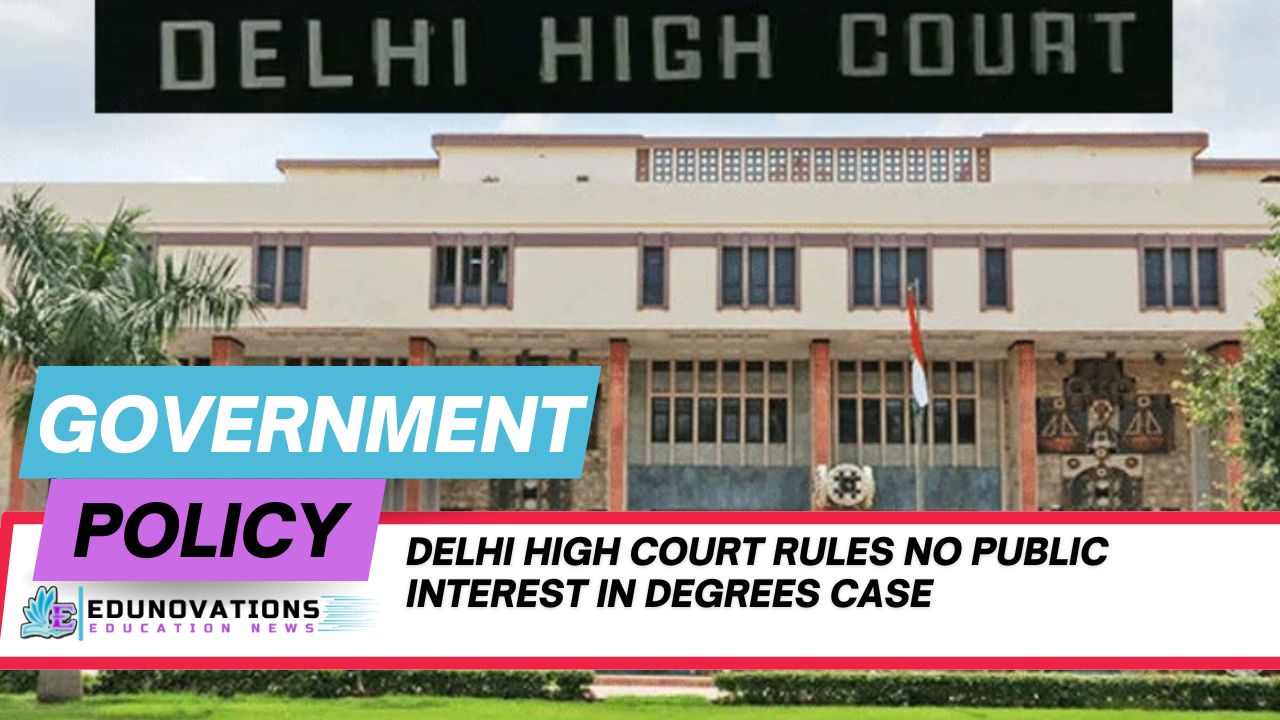
Delhi High Court rules no public interest in degrees of PM Narendra Modi and Smriti Irani, stating academic records are personal information.
Introduction
The Delhi High Court has issued a landmark judgment clarifying the scope of the Right to Information (RTI) Act in relation to the disclosure of academic qualifications of public officials. In its ruling, the court held that there is no public interest in degrees of Prime Minister Narendra Modi or Union Minister Smriti Irani. The decision emphasized that educational details constitute personal information and are not automatically subject to disclosure under RTI unless a direct and overriding public interest is proven.
This judgment comes amid years of debate and petitions questioning the academic background of top political figures. While the issue has attracted significant media attention and public curiosity, the court made it clear that mere political prominence does not translate into a blanket right to access private academic records.
Background of the Case
The controversy began when requests were filed under the RTI Act seeking details of Prime Minister Narendra Modi’s graduation records and Union Minister Smriti Irani’s educational qualifications. Petitioners argued that transparency in political life requires public access to such information. However, the Central Information Commission (CIC) and other authorities faced conflicting interpretations of what qualifies as “public interest.”
The Delhi High Court, in a detailed judgment, reversed earlier directions that suggested disclosure of such records. The bench stated that academic records are personal documents and cannot be made public without just cause. This ruling aligns with previous Supreme Court interpretations on privacy and personal data protection in India.
Toppers Use Mind Maps to score more than 95%
NCERT Class 11th Commerce Mind Maps
Add to cartOriginal price was: ₹999.00.₹199.00Current price is: ₹199.00.NCERT Class 12th Chemistry Mind Maps
Add to cartOriginal price was: ₹199.00.₹75.00Current price is: ₹75.00.NCERT Class 12th Commerce Mind Maps
Add to cartOriginal price was: ₹999.00.₹199.00Current price is: ₹199.00.NCERT Class 12th Science Mind Maps
Add to cartOriginal price was: ₹999.00.₹199.00Current price is: ₹199.00.NCERT Mind Maps For Class 10th
Add to cartOriginal price was: ₹999.00.₹199.00Current price is: ₹199.00.




Purchase Today
Key Judicial Observations
- Academic Records as Personal Data
The court emphasized that educational records fall within the definition of personal information under Section 8(1)(j) of the RTI Act. Disclosure of such data without a pressing public interest would amount to an invasion of privacy. - Limits of Public Curiosity
Justice Subramonium Prasad observed that public curiosity is not equivalent to public interest. Merely being curious about the Prime Minister’s or a Minister’s degree does not justify breaching their right to privacy. - RTI and Fiduciary Relationship
The universities that hold these records do so under a fiduciary capacity, which imposes a duty of confidentiality. Thus, compelling disclosure would violate fiduciary principles. - Precedent in Indian Law
The ruling resonates with the Supreme Court’s earlier decisions that reinforced the balance between transparency and privacy, notably the landmark Puttaswamy judgment on the right to privacy.
Political and Social Implications
This judgment has significant implications for transparency debates in India. While opposition parties have previously demanded disclosure of Prime Minister Modi’s degrees, the High Court has drawn a line between political accountability and personal privacy.
Critics argue that academic records of public figures should be accessible to voters, especially when such qualifications were cited in election affidavits. Supporters of the judgment counter that affidavits already serve as official declarations, and further probing into educational documents without specific grounds risks turning RTI into a tool of political vendetta.
Expert Insights
- Dr. Anup Surendranath, Legal Scholar: He noted that the court’s ruling strengthens privacy jurisprudence, ensuring that RTI is not misused to target individuals for political purposes.
- Senior Advocate Indira Jaising: Commented that while transparency is vital in a democracy, the line must be carefully drawn to protect individual dignity.
- Data Privacy Experts: They suggest that the judgment is consistent with India’s emerging data protection framework, where academic details are classified as personal information.
Public Debate and Media Coverage
The ruling has sparked widespread discussion in the media. While some news outlets emphasized the privacy angle, others criticized the decision for limiting transparency. The case has reignited conversations on the scope of RTI in India, particularly in balancing the public’s right to know with an individual’s right to privacy.
Opposition leaders from the Congress and Aam Aadmi Party (AAP) expressed dissatisfaction, arguing that transparency about academic qualifications enhances trust in leadership. However, legal experts broadly welcomed the ruling as a step toward refining the scope of RTI.
Implications for RTI Jurisprudence
- Clarifying the Scope of Public Interest
The judgment sets a precedent that not all information about public figures qualifies as public interest. Courts will now have a clearer benchmark when dealing with similar petitions. - Strengthening Fiduciary Principles
Educational institutions now have legal backing to deny disclosure requests without specific justification. - Protecting Against Political Misuse
The ruling discourages the use of RTI as a tool for political mudslinging, restoring its intended role as an instrument of transparency in governance rather than personal targeting.
Broader Context: Privacy vs Transparency
The judgment must also be seen in light of India’s ongoing efforts to balance privacy with transparency. Following the Puttaswamy case, privacy has been recognized as a fundamental right. At the same time, RTI remains a cornerstone of democratic accountability.
By ruling that there is no public interest in degrees, the court is not denying accountability but clarifying that accountability has limits. Political leaders remain accountable for their actions in governance, but their personal academic records cannot be indiscriminately exposed without sufficient cause.
How the Ruling Affects Citizens and Institutions
- For Citizens: This ruling may limit access to some types of information through RTI. Citizens seeking records must demonstrate a clear public interest beyond mere curiosity.
- For Institutions: Universities and boards gain stronger legal footing to resist disclosure requests that compromise privacy.
- For Politicians: It shields public figures from politically motivated RTI queries into their personal history.
Linking RTI to Democratic Education
For students preparing for competitive exams, current affairs questions often cover such rulings. This makes it essential to connect the legal developments with learning resources:
- NCERT Courses for conceptual clarity on governance.
- Current Affairs for updates on judgments.
- Notes and MCQs to practice exam-oriented content.
- Videos for visual explanations of court decisions.
- Syllabus mapping to understand relevance for UPSC and law entrance exams.
- Free NCERT PDFs and NCERT Mind Maps for quick revision.
For schools looking to create online learning platforms, solutions from Mart India Infotech offer tailored education technology services.
Conclusion
The Delhi High Court ruling is a watershed moment in India’s RTI and privacy discourse. By declaring that there is no public interest in degrees of political leaders like Narendra Modi and Smriti Irani, the court has emphasized the principle that transparency must not come at the cost of individual privacy.
This decision will influence future debates around RTI, shaping how citizens, institutions, and politicians navigate the complex relationship between openness and confidentiality. While transparency remains non-negotiable in governance, this ruling ensures that personal dignity and privacy retain their rightful place in India’s democratic framework.
FAQs
Q1. What does the Delhi High Court mean by “no public interest in degrees”?
It means that academic records of public figures are considered personal information and cannot be disclosed under RTI unless a strong public interest is demonstrated.
Q2. Does this ruling affect Prime Minister Narendra Modi’s degree controversy?
Yes. It clarifies that Modi’s educational records cannot be accessed through RTI without a valid public interest reason.
Q3. How does this ruling impact Smriti Irani’s education details?
The judgment shields her academic records from RTI disclosure on the grounds of personal privacy.
Q4. What section of RTI was applied in this case?
Section 8(1)(j), which exempts disclosure of personal information that has no relation to public interest.
Q5. Does public curiosity count as public interest under RTI?
No. The court specifically ruled that curiosity does not equate to public interest.
Q6. What role do universities play in this ruling?
Universities hold records in a fiduciary capacity, meaning they have a duty of confidentiality.
Q7. How does this judgment affect RTI petitions against politicians?
It sets a precedent that educational and personal records cannot be accessed without clear justification.
Q8. What larger principle does this ruling support?
It strengthens privacy rights in India, aligning with Supreme Court judgments on personal dignity.
Q9. Can affidavits filed during elections still be scrutinized?
Yes. Affidavits remain public documents, but academic records themselves remain private unless otherwise justified.
Q10. Why is this judgment important for law students and exam aspirants?
It provides a case study on privacy vs transparency, crucial for exams in law, polity, and governance.