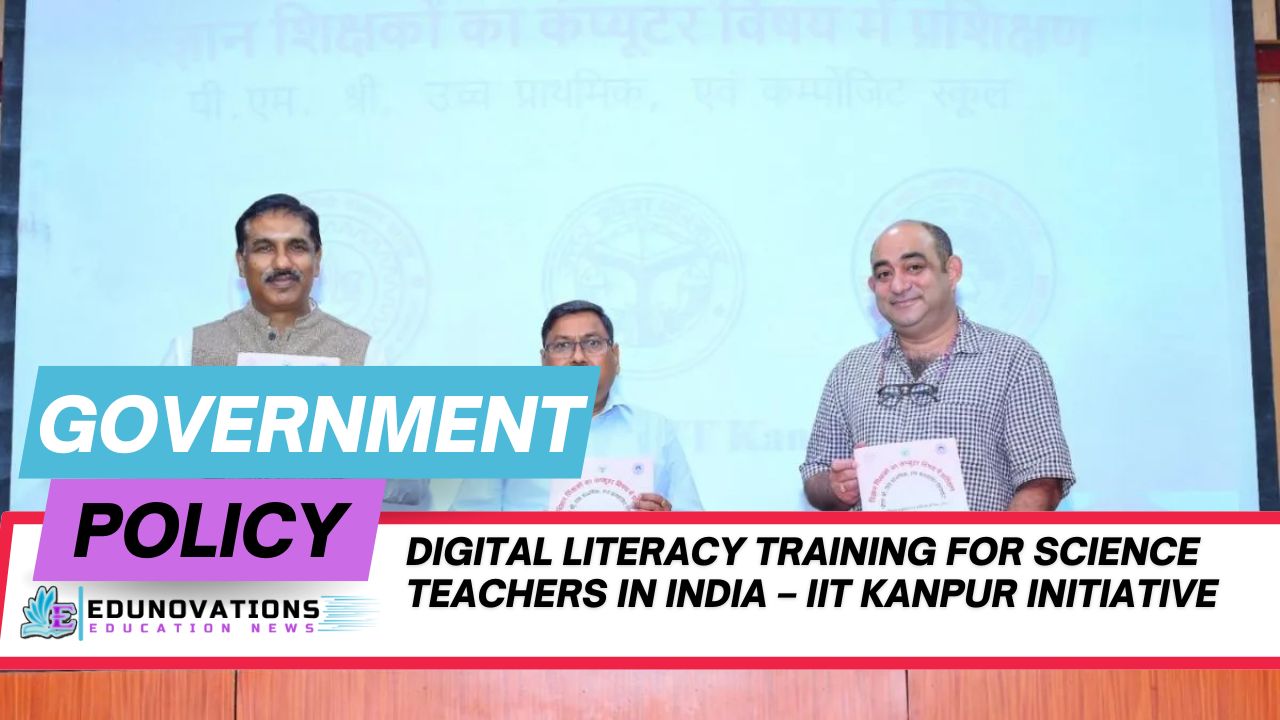
IIT Kanpur introduces a national program on digital literacy training for science teachers in India, focusing on coding, computational thinking, and AI skills for modern classrooms.
A National Step Toward Empowering Educators
India is rapidly moving toward an education system powered by digital technology, artificial intelligence (AI), and computational thinking. To keep pace with this change, the Indian Institute of Technology Kanpur (IIT Kanpur) has launched a National Teacher Training Program on Digital Literacy. The initiative is a significant stride toward digital literacy training for science teachers in India, aiming to strengthen their ability to use technology responsibly and effectively in classrooms.
Organized in collaboration with the State Council of Educational Research and Training (SCERT), Uttar Pradesh, this program is designed to train educators from government schools, particularly those teaching in PM SHRI Schools. The effort reflects the broader goals of India’s National Education Policy (NEP) 2020, which emphasizes digital pedagogy and the integration of advanced skills into school education.
Why This Program Matters
Technology has become an inseparable part of classrooms. Yet, many science teachers across India—especially in government schools—face barriers in accessing structured training on digital tools and AI.
This program addresses those gaps by:
- Equipping teachers with computational thinking and coding workshops for school teachers.
- Enhancing AI literacy through practical training.
- Encouraging innovative use of online plus offline digital pedagogy for science educators.
- Supporting sustainable teacher development through multi-stage teacher training in digital skills and AI.
By providing these resources, IIT Kanpur is not only enabling science educators to adopt new methodologies but also ensuring that rural and urban schools can equally benefit from technology-driven education.
The Structure of the Training
The initiative follows a blended model, reflecting the evolving needs of educators.
- In-Person Workshops: Teachers participate in a five-day residential program on IIT Kanpur’s campus. The sessions are hands-on, focusing on coding, AI literacy, and classroom applications of digital tools.
- Online Engagement: After the offline sessions, participants continue learning through structured online modules. This ensures that teachers can refine their skills over time and adapt them to classroom realities.
- Long-Term Follow-Up: Teachers receive sustained support, making this program one of the few that ensures continuity instead of one-time exposure.
Such a format sets the benchmark for future teacher training programs in India.
Voices from the Education Sector
During the program’s launch, Professor Manindra Agrawal, Director of IIT Kanpur, highlighted that this effort is not just about digital tools but also about empowering teachers to use technology ethically and effectively.
Educationists have also praised the initiative. According to Dr. Anil Sahasrabudhe, Chairman of the National Educational Technology Forum (NETF), “Equipping teachers with AI and digital pedagogy skills is the foundation for preparing the next generation of problem solvers.”
His statement underlines the importance of training teachers to go beyond basic digital literacy and embrace advanced learning models.
Toppers Use Mind Maps to score more than 95%
NCERT Class 11th Commerce Mind Maps
Add to cartOriginal price was: ₹999.00.₹199.00Current price is: ₹199.00.NCERT Class 12th Chemistry Mind Maps
Add to cartOriginal price was: ₹199.00.₹75.00Current price is: ₹75.00.NCERT Class 12th Commerce Mind Maps
Add to cartOriginal price was: ₹999.00.₹199.00Current price is: ₹199.00.NCERT Class 12th Science Mind Maps
Add to cartOriginal price was: ₹999.00.₹199.00Current price is: ₹199.00.NCERT Mind Maps For Class 10th
Add to cartOriginal price was: ₹999.00.₹199.00Current price is: ₹199.00.


Purchase Today
Impact on Government Schools
The program has immense implications for teachers working in government institutions. For years, one of the biggest challenges for schools has been the lack of structured training in AI literacy training for government school teachers. By focusing on this gap, the program empowers educators to adopt innovative teaching practices without being overwhelmed by technology.
This transformation is especially critical for schools in semi-urban and rural areas, where access to high-quality resources remains limited. With digital skills, science teachers can:
- Integrate simulations into science experiments.
- Use coding exercises to explain problem-solving concepts.
- Encourage students to explore AI applications responsibly.
Such approaches prepare students not only for exams but also for future careers in science, technology, engineering, and mathematics (STEM).
The Policy Perspective
The National Education Policy 2020 emphasizes that every student must be digitally literate by the end of secondary school. To make this vision a reality, teacher training becomes the backbone of implementation.
This program is a clear example of aligning institutional efforts with national policy. By providing specialized skills in AI and computational thinking, it ensures that teachers are ready to deliver cutting-edge education.
For a detailed overview of NEP-related study materials and syllabus alignment, readers can explore:
Role of Blended Pedagogy
One of the most innovative aspects of this initiative is the online plus offline digital pedagogy for science educators. While traditional teacher training relied heavily on in-person workshops, this program combines the best of both formats:
- Offline training builds confidence and practical skills.
- Online modules offer flexibility and continuous learning.
- Teachers remain connected through digital platforms, exchanging ideas and resources.
This hybrid model ensures that learning never stops, creating a community of educators who are well-prepared for modern challenges.
Technology as an Equalizer
Technology is often seen as a barrier for under-resourced schools. However, IIT Kanpur’s program is changing that narrative. By providing access to structured, high-quality training, the initiative proves that technology can be a great equalizer—bridging gaps between private and government institutions.
For schools seeking reliable technical solutions, platforms such as Mart Ind Infotech provide affordable digital infrastructure tailored for educational needs.
Expert Insights and Future Outlook
Education experts believe that this program will inspire similar initiatives across other states and institutions. By documenting best practices, IIT Kanpur is setting a blueprint for scaling digital literacy programs nationwide.
Moreover, the multi-stage teacher training in digital skills and AI ensures that teachers are not left behind as technology evolves. The goal is not just short-term training but continuous professional growth.
With India’s push toward becoming a global AI hub, training teachers today is equivalent to investing in the workforce of tomorrow.
Internal Resources for Educators
Teachers and education enthusiasts can explore complementary resources to deepen their understanding:
- Current Affairs for Educators
- Download Free NCERT PDFs
- MCQ Practice for Competitive Exams
- Educational Videos
- Notes for Science and Technology
These resources ensure that both teachers and students have access to quality academic material aligned with India’s evolving curriculum.
Conclusion
The digital literacy training for science teachers in India launched by IIT Kanpur marks a turning point in the country’s education landscape. By blending coding, computational thinking, AI literacy, and pedagogy, the program empowers teachers to embrace digital tools responsibly and innovatively.
This initiative is more than a training program—it is a roadmap for transforming Indian classrooms, preparing educators and students alike for a technology-driven future.
FAQs
Q1. What is the focus of the digital literacy training for science teachers in India?
The program emphasizes coding, computational thinking, and AI literacy for government school educators.
Q2. Who is eligible to participate in this training initiative?
Primarily science teachers from government and PM SHRI schools are the target participants.
Q3. How does the program support computational thinking and coding workshops for school teachers?
Through hands-on coding sessions, simulations, and problem-solving exercises during the training.
Q4. Why is AI literacy training for government school teachers important?
It prepares educators to responsibly integrate artificial intelligence into classroom teaching.
Q5. What is unique about the multi-stage teacher training in digital skills and AI?
It offers both in-person and online modules, ensuring long-term professional growth.
Q6. How does the program implement online plus offline digital pedagogy for science educators?
Teachers attend residential workshops at IIT Kanpur and then continue structured online learning.
Q7. What role does the National Education Policy 2020 play in this initiative?
NEP 2020 emphasizes digital literacy as a national goal, making teacher training crucial.
Q8. How will this training benefit students in rural areas?
Students will gain access to modern learning tools and methods, bridging the digital divide.
Q9. Can teachers access supporting materials after training?
Yes, structured follow-up sessions and online modules provide ongoing resources.
Q10. How does this initiative contribute to India’s AI goals?
By preparing teachers with AI literacy, it indirectly builds a skilled future workforce.