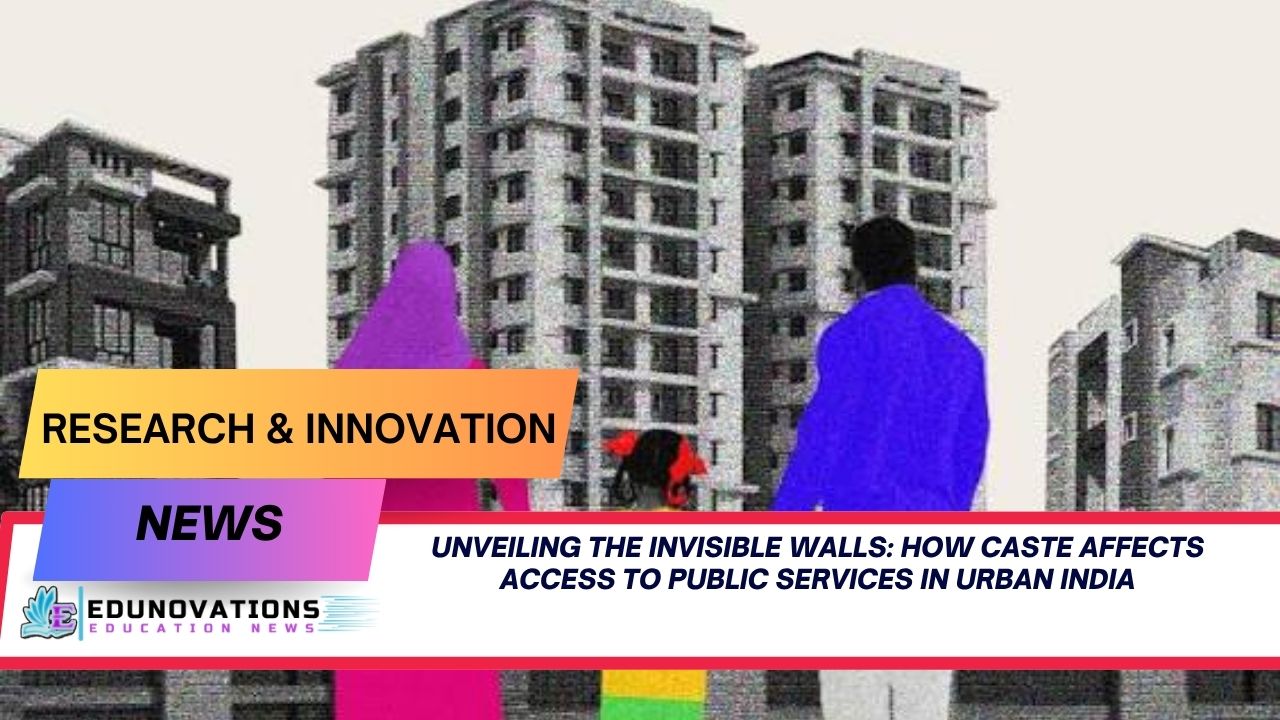
The modern urban landscape in India is often perceived as a melting pot of opportunities, a space where traditional hierarchies dissolve under the pressures of globalization and economic mobility.
The modern urban landscape in India is often perceived as a melting pot of opportunities, a space where traditional hierarchies dissolve under the pressures of globalization and economic mobility. However, beneath the gleaming glass facades of high-rise corporate hubs and the bustling infrastructure projects, a deep-seated structural reality persists. The way in which how caste affects access to public services in urban India remains a critical subject of sociological and economic inquiry, challenging the narrative of urban neutrality. As city planners and policymakers strive for inclusive development, the persistence of spatial segregation—rooted in historical caste dynamics—continues to dictate the quality of life for millions.
In a recent discourse led by Professor Deepak Malghan at the National Law School of India University (NLSIU), the conversation turned toward the complex political channels that link residential patterns to the unequal distribution of essential resources like piped water and sanitation. To truly grasp the future of urban development, one must first confront how historical stratifications are being reproduced in our cities today.
The Geography of Inequality: Beyond Traditional Perceptions
When we examine the urban environment, we often look at income disparities as the primary driver of segregation. While wealth certainly plays a role, it is not the sole architect of the urban form. The phenomenon of “micro-segregation” reveals that even within administrative units as small as a municipal ward, residential sorting occurs with startling precision. This sorting is not merely a matter of personal preference; it is frequently an expression of deep-rooted community clustering that facilitates or hinders political negotiation.
For students exploring these complexities for their competitive examinations, it is essential to bridge the gap between academic theory and ground-level governance. Whether you are studying through NCERT Courses, reviewing Current Affairs, or practicing MCQs, understanding these social dynamics is vital.
The mechanism by which how caste affects access to public services in urban India functions involves the capacity of a neighborhood to organize and petition the state. Segregated communities, particularly those that have historically held social capital, are better positioned to leverage political competition to secure public goods. Conversely, marginalized areas often find themselves at the periphery of municipal attention, where their demands are filtered through a lens of in-group favoritism and subtle, systemic exclusion.
Political Channels and the Myth of Neutral Governance
Urban governance is often presented as a technical, administrative process—an objective exercise of resource allocation. However, scholars like Prof. Deepak Malghan, an ecological economist known for his work in scale theory and ethnic inequality, argue that the state’s response to citizen demands is rarely devoid of bias.
The state’s ability to act is modulated by the caste composition of a ward relative to the city at large—a concept termed “macro-segregation.” When a neighborhood’s demographic profile allows it to act as a unified voting bloc, it exerts disproportionate pressure on local representatives. This leads to a scenario where essential public infrastructure becomes a bargaining chip.
Why Spatial Sorting Matters
- Resource Allocation: Neighborhoods that are better organized can demand faster installation of water lines and sewage systems.
- Political Accountability: Segregated blocks can hold local representatives accountable through collective voting power.
- The Feedback Loop: When one area receives better services, property values rise, further cementing the segregation of communities that cannot afford to move in.
For a deeper dive into how policy shapes these environments, you can browse through our collection of Notes or analyze the curriculum via our Syllabus page.
The Role of Infrastructure in Social Stratification
It is not enough to simply observe inequality; we must analyze how it is reproduced through the built environment. Piped water, for instance, is not merely a physical utility; it is a marker of political inclusion. In many Indian cities, the absence of clean, piped water in a neighborhood is a direct reflection of that area’s inability to penetrate the political channels of the municipal body.
In Videos covering urban development, experts often highlight that infrastructure is the most tangible representation of power. If you are preparing for exams, keeping track of these systemic issues is as important as learning the history behind them. For those looking for visual aids to simplify these concepts, checking out NCERT Mind Maps can be incredibly beneficial.
Furthermore, if your institution or organization is looking to modernize its digital footprint to disseminate such critical information, Mart Ind Infotech provides comprehensive solutions for schools and organizations looking to bridge the communication gap between administrators and the community.
Addressing the Systemic Divide
The question of how caste affects access to public services in urban India is not just an academic one; it is a policy challenge. Prof. Deepak Malghan’s work, which also touches upon ecological political economy and environmental injustice, suggests that environmental hazards are also distributed along these same lines. Areas that are marginalized in terms of caste are frequently those that bear the brunt of poor drainage, waste management issues, and lack of green spaces.
To understand the broader context of these issues, students should refer to Free NCERT PDFs to gain a foundational understanding of Indian social structures, which remain the bedrock for understanding contemporary urban phenomena.
Expert Insights on Spatial Inequality
The intersection of thermodynamics and scale theory, as explored by Malghan, provides a unique lens to view urban hydrology. Efficiency, often touted as the goal of modern governance, is rarely equitable. True efficiency would require an objective assessment of needs across all wards, regardless of the community residing within them. However, current trends show that urban governance is struggling to break away from the influence of historical social hierarchies.
Toppers Use Mind Maps to score more than 95%
NCERT Class 11th Commerce Mind Maps
Add to cartOriginal price was: ₹999.00.₹199.00Current price is: ₹199.00.NCERT Class 12th Chemistry Mind Maps
Add to cartOriginal price was: ₹199.00.₹75.00Current price is: ₹75.00.NCERT Class 12th Commerce Mind Maps
Add to cartOriginal price was: ₹999.00.₹199.00Current price is: ₹199.00.NCERT Class 12th Science Mind Maps
Add to cartOriginal price was: ₹999.00.₹199.00Current price is: ₹199.00.NCERT Mind Maps For Class 10th
Add to cartOriginal price was: ₹999.00.₹199.00Current price is: ₹199.00.





Purchase Today
FAQs
- How caste affects access to public services in urban India in modern times? It creates a system where organized, demographically clustered neighborhoods have better political leverage to demand essential services like water and sewage, often leaving marginalized groups behind.
- What is micro-segregation and how does it impact urban living? Micro-segregation refers to residential sorting within a small ward, which allows specific groups to act as a cohesive political unit, influencing how public funds are spent in their area.
- Why is macro-segregation important for city planning? Macro-segregation considers the caste composition of a ward relative to the whole city, which often dictates the level of state attention and favoritism an area receives.
- Are urban services really distributed based on caste? While infrastructure allocation is officially merit-based or need-based, research shows that political channels are often influenced by the social capital and bargaining power of the neighborhood’s residents.
- How can students learn more about these social dynamics? Students can supplement their studies with NCERT Courses and Current Affairs updates to understand the intersection of sociology and governance.
- Does spatial inequality lead to environmental injustice? Yes, marginalized neighborhoods often suffer from worse urban planning, leading to issues like poor water quality and lack of sanitation.
- What role does political competition play in service delivery? Political competition can amplify demands from well-organized segregated neighborhoods, forcing the state to respond to those specific groups while potentially neglecting others.
- Where can I find study notes on these urban policy topics? You can visit Notes to find organized summaries on sociological and political science topics related to Indian urbanism.
- How can institutions improve their reach regarding such critical lectures? By utilizing professional services like those from Mart Ind Infotech, institutions can better manage their outreach and digital infrastructure.
- Is there a way to visualize these social-urban structures? Using NCERT Mind Maps is a highly effective way to visualize the complex links between caste, urban governance, and public service delivery.