Corporate Social Responsibility (CSR) has shifted from a regulatory compliance obligation into a powerful engine for national development.
Corporate Social Responsibility (CSR) has shifted from a regulatory compliance obligation into a powerful engine for national development. For grassroots organizations, academic researchers, and non-governmental organizations (NGOs) across the nation, understanding how to get csr funding for environmental projects in india is now an essential skill.
The path forward was illuminated at the Indian Institute of Technology Delhi (IIT Delhi), where the Corporate Relations Office hosted the landmark CSR Conclave 2026. Centered on the critical theme of “Environment & Sustainability,” the event gathered over 245 high-level leaders spanning corporate foundations, public sector enterprises, non-profit institutions, and academic departments to address India’s most urgent ecological issues.
The Paradigm Shift in Green Corporate Funding
India’s regulatory framework mandates that corporations of a certain scale spend at least 2% of their average net profits on developmental initiatives. While education and healthcare historically dominated these portfolios, shifting climate dynamics have pushed ecological balance to the forefront. Understanding how to get csr funding for environmental projects in india requires an awareness of this shift toward high-impact, science-backed interventions.
During the conclave, Prof. Rangan Banerjee, Director of IIT Delhi, emphasized that solving deep-rooted environmental problems requires a multi-stakeholder ecosystem. He observed:
“India’s journey towards sustainable and inclusive development requires strong partnerships between academia, industry, government, and civil society. At IIT Delhi, we are committed to developing technologies that address national priorities, and through strategic CSR collaborations, we can accelerate the translation of research into scalable solutions that benefit society.”
For organizations figuring out how to get csr funding for environmental projects in india, the Director’s statement highlights a vital truth: corporate donors are looking to move away from superficial activities like one-off tree plantation drives. Instead, they are prioritizing scalable, verifiable tech solutions that support the Government of India’s climate targets.
Translating Academic Innovations into Scalable Solutions
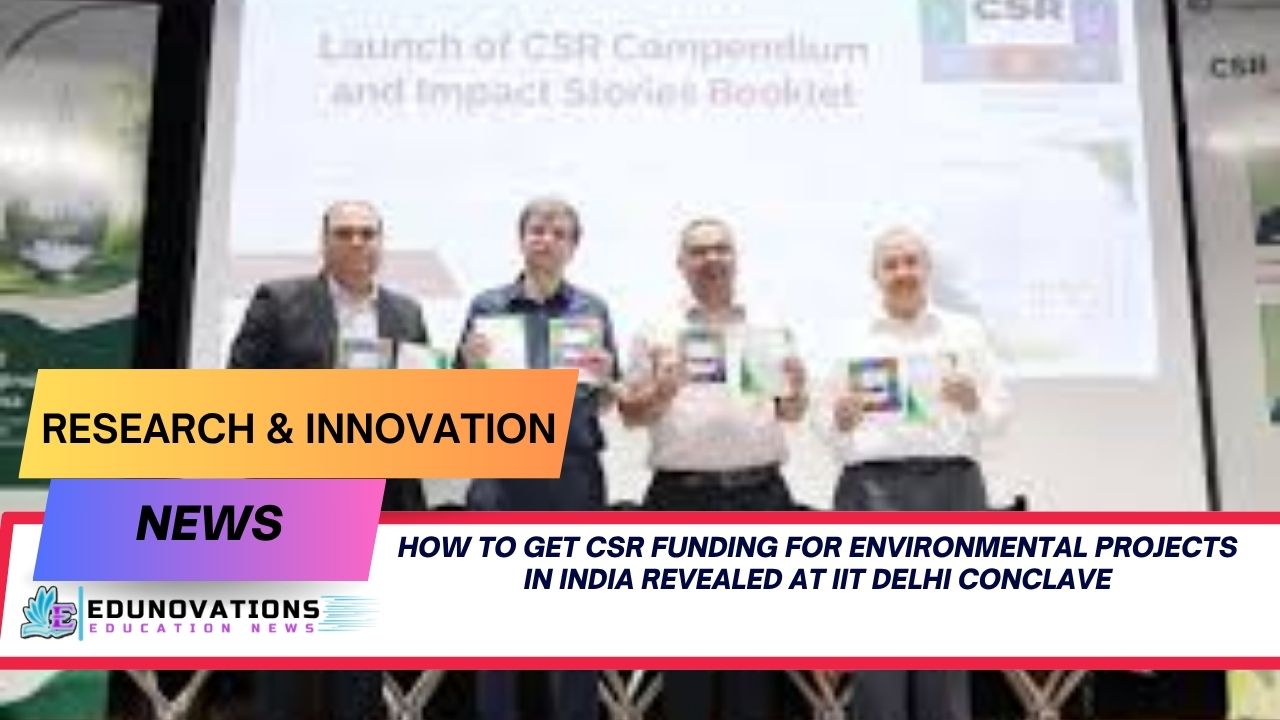
A core obstacle for many seeking sustainability grants is the gap between laboratory research and commercial deployment. To solve this, IIT Delhi launched two distinct resources at the conclave: the CSR Project Compendium and the CSR Impact Stories booklet. These publications provide a structured guide on how to get csr funding for environmental projects in india by presenting corporate donors with pre-vetted, high-impact research projects that are ready for field deployment.
The launch was led by Prof. Rangan Banerjee alongside an elite academic panel, including:
- Prof. Vivek Buwa, Deputy Director (Strategy & Planning), IIT Delhi
- Prof. Jayant Jain, Dean of Corporate Relations, IIT Delhi
- Prof. Ashwini Agrawal, Dean of Research and Development, IIT Delhi
For educational institutions looking to replicate this model, discovering how to build industry academia partnerships for sustainability is essential. These structured ecosystems help translate specialized laboratory breakthroughs into verifiable, real-world community assets.
Showcasing Waste-to-Wealth and Energy Innovations
A standout feature of the 2026 Conclave was the research and innovation showcase. Here, faculty members presented functional technologies aligned with India’s national missions. Organizations looking for ideas on how to get csr funding for environmental projects in india can learn from these core focus areas:
- Agriculture and Rural Impact: Deploying low-cost, decentralized cold storage units and clean irrigation tools driven by renewable energy.
- Sustainable Materials and Circularity: Developing biodegradable alternatives to single-use plastics and creating industrial-grade polymers from crop residues.
- Clean Green Combustion Devices: Engineering advanced burners that dramatically cut down emissions in small-scale rural industries.
A particularly popular exhibit focused on examples of successful csr projects in waste management, specifically highlighting a project titled “From Waste to Wealth: Circular Bioeconomy through Algal and Microbial Biotechnology.” This initiative processes organic waste and agricultural run-off into bio-fuels and soil-enriching bio-fertilizers, demonstrating how corporate funding can turn an environmental liability into a rural economic asset.
Strategic Blueprints for Grassroots and Institutional Growth
Securing corporate backing requires a structured, data-driven approach. When evaluating how to get csr funding for environmental projects in india, project leaders must design proposals that read less like emotional pleas and more like concrete business cases.
1. Rigorous Data and Baseline Metrics
Corporate donors operate under strict Environmental, Social, and Governance (ESG) frameworks. A winning proposal must outline clear baseline data, projected milestones, and explicit key performance indicators (KPIs).
2. Alignment with National Commitments
Proposals that tie directly into national priorities—such as the National Clean Air Programme (NCAP) or the Green Hydrogen Mission—are much more likely to secure funding. Corporations prefer projects that help them fulfill both their local regulatory requirements and broader international climate goals.
3. Structural Stability and Governance
Grassroots organizations must maintain impeccable compliance records, including valid 12A, 80G, and CSR-1 registrations. For educational institutions and community spaces looking to upgrade their internal administrative frameworks to manage these large-scale grants, partnering with expert technical developers can streamline the process. Organizations can explore specialized web development options by choosing to Need Website for Schools Contact Mart Ind Infotech.
Pioneering Research Fields in Green Technology
The conclave highlighted that the most competitive proposals focus on cutting-edge fields. Exploring technology solutions for circular bioeconomy in agriculture has emerged as a high-priority area for corporate boards. By backing research that turns crop residue into valuable industrial feedstocks, corporate sponsors can simultaneously address the issue of seasonal stubble burning while supporting rural livelihoods.
Furthermore, there is surging corporate interest in the latest clean energy technologies developed by indian researchers. These local innovations—ranging from next-generation solid-state batteries to advanced carbon-capture storage units—are tailor-made for India’s unique climatic and economic conditions. This makes them highly attractive to corporate boards looking to maximize the social return on their investments.
To encourage the next generation of innovators to solve these environmental challenges, having access to foundational learning resources is crucial. Aspiring researchers can build their foundational knowledge using premium NCERT Courses or stay informed on environmental policy changes by reviewing dedicated sections for Current Affairs.
Building a Pipeline for Future Ecological Innovators
The ultimate lesson of the IIT Delhi CSR Conclave 2026 is that solving environmental issues requires long-term talent cultivation alongside immediate financial investments. Corporate leaders at the event emphasized that funding academic infrastructure, student fellowships, and youth-led hackathons is just as vital as supporting field-ready technology.
For students and young researchers determined to make a mark in sustainability, mastering foundational science and policy is the first step. Academic aspirants can accelerate their preparation by utilizing comprehensive Notes and testing their knowledge across core disciplines via targeted MCQ’s.
Visual learners can dive into complex ecological concepts through educational Videos, while structured exam preparation can be guided by checking the official Syllabus. Additionally, foundational textbooks are readily available via Downloads of Free NCERT PDFs, and complex scientific pathways can be easily reviewed using NCERT Mind Maps.
By combining corporate capital with academic brilliance and grassroots execution, India is building a robust framework for sustainable development. Learning how to get csr funding for environmental projects in india is no longer just an administrative task—it is a vital step toward creating a cleaner, more resilient future for the nation.
Toppers Use Mind Maps to score more than 95%
NCERT Class 11th Commerce Mind Maps
Add to cartOriginal price was: ₹999.00.₹199.00Current price is: ₹199.00.NCERT Class 12th Chemistry Mind Maps
Add to cartOriginal price was: ₹199.00.₹75.00Current price is: ₹75.00.NCERT Class 12th Commerce Mind Maps
Add to cartOriginal price was: ₹999.00.₹199.00Current price is: ₹199.00.NCERT Class 12th Science Mind Maps
Add to cartOriginal price was: ₹999.00.₹199.00Current price is: ₹199.00.NCERT Mind Maps For Class 10th
Add to cartOriginal price was: ₹999.00.₹199.00Current price is: ₹199.00.





Purchase Today
Frequently Asked Questions (FAQs)
1. How to get csr funding for environmental projects in india for a newly registered NGO?
Newly registered NGOs must first secure their 12A and 80G tax exemptions and register with the Ministry of Corporate Affairs via Form CSR-1. To attract corporate partners, focus on small-scale, verifiable pilot studies that show clear data-driven outcomes before applying for larger corporate grants.
2. What are some real-world examples of successful csr projects in waste management?
Prominent examples include IIT Delhi’s “Waste to Wealth” initiative, which utilizes algal and microbial biotechnology to convert organic waste into bio-fertilizers. Other successful models include corporate-sponsored decentralized composting units and plastic upcycling centers managed by urban local bodies.
3. How to build industry academia partnerships for sustainability in smaller technical colleges?
Smaller colleges can start by setting up dedicated industrial liaison cells, hosting localized technology open houses, and pitching targeted faculty research to local businesses. Aligning academic projects with the specific environmental or operational challenges faced by regional industries is a proven way to kickstart collaboration.
4. Why are corporations prioritizing technology solutions for circular bioeconomy in agriculture?
These projects deliver multiple benefits: they reduce the environmental damage caused by agricultural waste burning, lower carbon emissions by replacing fossil-based products, and inject fresh income into rural economies, making them highly attractive for corporate ESG portfolios.
5. Where can I find the latest clean energy technologies developed by indian researchers?
Leading research institutions like IIT Delhi regularly publish these breakthroughs in their official research compendiums, academic journals, and annual CSR conclaves. Key focus areas include green hydrogen production, advanced solar cell development, and energy-efficient combustion devices.
6. What documents are mandatory when learning how to get csr funding for environmental projects in india?
An applicant needs an active MCA CSR-1 registration, audited financial statements from the past three years, a detailed project proposal with clear KPIs, a defined budget breakdown, and valid 80G and 12A certification documents.
7. Do corporate foundations fund pure academic research or only field implementation?
While some corporations fund fundamental scientific research through specialized chairs and institutional grants, the vast majority of corporate boards prefer funding applied research that includes a clear field-testing component and direct benefits for local communities.
8. How do corporations measure the impact of environmental CSR grants?
Impact is measured through clear, quantitative metrics such as metric tons of carbon dioxide abated, liters of groundwater recharged, tons of waste diverted from landfills, or the number of rural households transitioned to clean energy sources.
9. Can an international corporation fund environmental projects in India through CSR?
Yes, international corporations operating in India that meet the threshold criteria outlined in Section 135 of the Companies Act are legally required to fulfill their CSR mandates, and they frequently prioritize local environmental and sustainability initiatives.
10. What role do green combustion devices play in agricultural sustainability portfolios?
Green combustion devices optimize fuel efficiency and dramatically cut down particulate emissions in biomass-reliant industries. Supporting these technologies allows corporations to directly improve air quality while helping small rural enterprises cut down on their fuel costs.