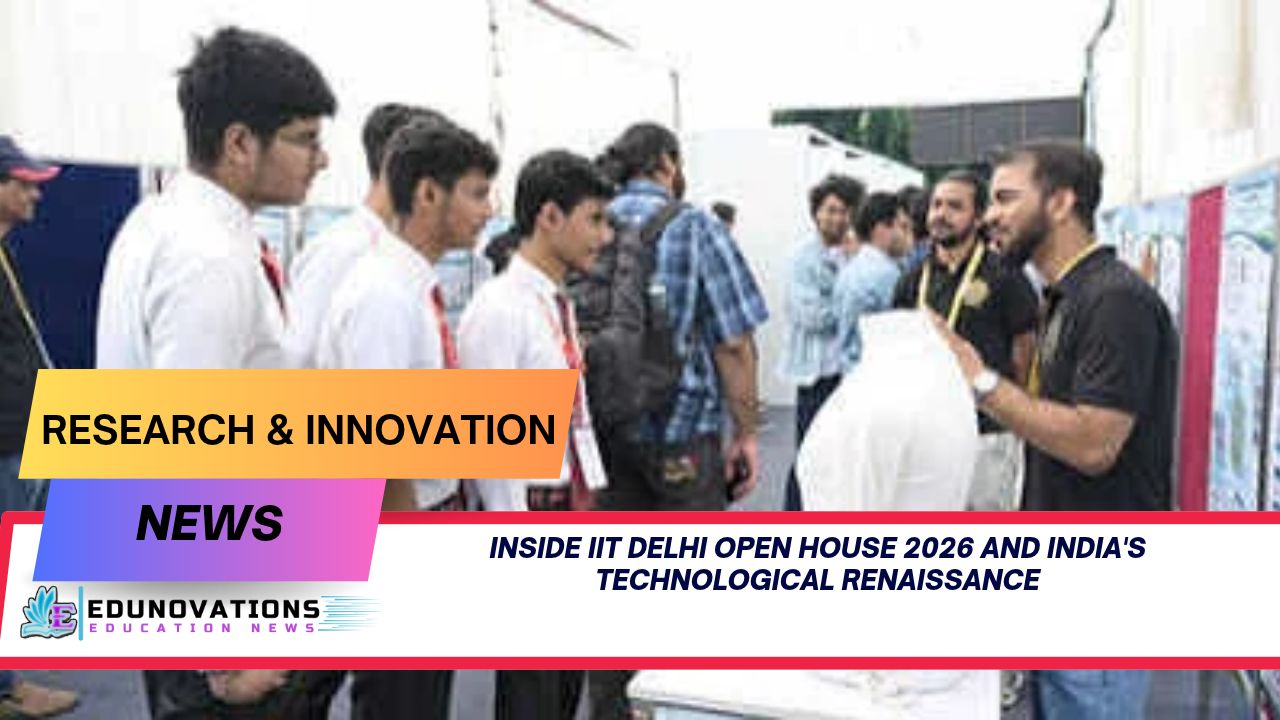
The pursuit of scientific excellence and technological self-reliance received a monumental boost as academic institutions across the country opened their gates to the public.
The pursuit of scientific excellence and technological self-reliance received a monumental boost as academic institutions across the country opened their gates to the public. Among these premier institutions, the Indian Institute of Technology (IIT) Delhi once again took center stage by hosting its landmark annual event. This year’s exhibition brought together the brightest young minds, industry leaders, and academic stalwarts to showcase groundbreaking innovations that promise to reshape the future of Indian engineering, defence, and sustainable development.
For students, researchers, and technology enthusiasts tracking the nation’s rapid advancements, events like the iit delhi open house 2026 student innovation projects serve as vital indicators of where modern science is heading. By bridging the gap between theoretical knowledge and practical execution, these exhibitions offer a rare glimpse into the prototypes and solutions designed to solve real-world problems.
Bridging Academia, Industry, and National Vision
The journey of technological advancement relies heavily on seamless collaboration between educational institutions and national research bodies. At the core of this year’s exhibition was a powerful emphasis on indigenous technology development. Dignitaries and industry experts gathered to evaluate hundreds of technological presentations spanning critical domains such as artificial intelligence, quantum technologies, semiconductors, robotics, and advanced materials.
When exploring the expansive exhibition halls, visitors witnessed firsthand how academic rigor translates into tangible applications. Educational platforms and resources such as comprehensive NCERT courses lay the foundational groundwork for these young innovators, cultivating analytical thinking from an early age. As students transition from school curricula to advanced higher education, structured learning paths help them tackle complex engineering challenges.
Furthermore, keeping abreast of national technological milestones requires regular engagement with current affairs, ensuring that aspiring engineers understand the socio-economic and strategic context of their innovations.
Highlights from the Exhibition Floors
The scale of innovation on display was staggering. The event featured over 500 technological presentations distributed across 10 thematic areas. Visitors navigated through interactive laboratory displays, startup presentations, and live demonstrations of cutting-edge prototypes.
Key highlights included:
- Advanced Robotics & Automation: Autonomous systems designed for industrial automation and disaster response.
- Semiconductor & Quantum Tech: Next-generation computing architectures built by student research groups.
- Biotechnology & Healthcare: Affordable medical devices and assistive technologies aimed at rural healthcare enhancement.
- Sustainability & Clean Energy: Efficient energy storage platforms and pollution-mitigation prototypes.
Students preparing for competitive technical examinations often rely on curated notes and rigorous MCQ’s to master fundamental engineering concepts. Mastering these fundamentals is what enables undergraduate and postgraduate researchers to conceptualize and build award-winning prototypes that catch the eye of national industry leaders.
Expert Insights and Strategic Collaborations
A major highlight of the inauguration was the keynote address delivered by esteemed defense technology leaders. Dr. Binay Kumar Das, Director General of Electronics and Communication Systems (ECS) at DRDO, Government of India, graced the occasion as the chief guest. Addressing a packed auditorium of enthusiastic students and faculty members, Dr. Das emphasized the critical importance of nurturing scientific curiosity from an early age.
Highlighting the theme of nation-building, Dr. Das remarked on the immense potential harbored by young Indian minds. He pointed out that collaborative frameworks—such as the Defence, Industry, Academia-Centre of Excellence (DIA-CoE)—demonstrate how strategic partnerships between academic powerhouses and defense research organizations can successfully accelerate indigenous technology creation.
For students seeking deeper conceptual clarity on these technological frameworks, watching explanatory videos and reviewing structured syllabus outlines can provide valuable structural insights into specialized engineering fields. Additionally, educators and institutions looking to digitize their administrative and academic outreach often collaborate with specialized technology partners like Mart Ind Infotech to streamline digital infrastructure and maximize educational accessibility.
Empowering the Next Generation of Innovators
The success of any technical ecosystem depends on how effectively it disseminates knowledge and resources to emerging learners. Aspiring researchers often require access to foundational reference materials, study guides, and academic whitepapers. Students and educators can easily access and downloads of free NCERT PDFs to strengthen basic science concepts.
Moreover, visual learning tools such as detailed NCERT mind maps help learners organize complex scientific theories and technological workflows into easily digestible visual frameworks. This structured approach to learning ensures that students develop both the theoretical depth and the creative flexibility needed to excel in multidisciplinary research environments.
The annual exhibition also marked the launch of new digital research discovery surfaces designed to map out academic papers, intellectual property, and institutional expertise, further solidifying the institute’s role as a global beacon of higher education.
Toppers Use Mind Maps to score more than 95%
-
NCERT Class 11th Commerce Mind Maps
Add to cartOriginal price was: ₹999.00.₹199.00Current price is: ₹199.00. -
NCERT Class 12th Chemistry Mind Maps
Add to cartOriginal price was: ₹199.00.₹75.00Current price is: ₹75.00. -
NCERT Class 12th Commerce Mind Maps
Add to cartOriginal price was: ₹999.00.₹199.00Current price is: ₹199.00. -
NCERT Class 12th Science Mind Maps
Add to cartOriginal price was: ₹999.00.₹199.00Current price is: ₹199.00. -
NCERT Mind Maps For Class 10th
Add to cartOriginal price was: ₹999.00.₹199.00Current price is: ₹199.00.





Purchase Today
Frequently Asked Questions
1. What was the main objective of the iit delhi open house 2026 student innovation projects?
The primary objective was to showcase groundbreaking research, student prototypes, and interdisciplinary technological innovations to students, academia, and industry stakeholders, fostering a culture of self-reliant scientific advancement.
2. How many technological presentations were featured at the event?
The exhibition featured more than 500 technological presentations spanning 10 major thematic areas, including artificial intelligence, quantum technologies, robotics, and advanced materials.
3. Who inaugurated the annual innovation exhibition as the chief guest?
Dr. Binay Kumar Das, Director General of Electronics and Communication Systems (ECS) at DRDO, inaugurated the event and delivered an inspiring keynote address to aspiring student innovators.
4. What role do strategic collaborations play in academic research?
Collaborations between academic institutions and national R&D bodies like DRDO help bridge the gap between theoretical research and practical, strategic defense and industrial applications.
5. How can students benefit from participating in academic open house events?
Such events provide students with valuable exposure to advanced laboratory demonstrations, mentorship from industry experts, and inspiration to pursue careers in scientific research and nation-building.
6. What thematic areas were covered during the technology exhibition?
The event covered 10 key domains, including Semiconductors, Optics and Photonics, Biotechnology, Sustainability, Defence and Space, and Advanced Materials.
7. What awards and recognitions were presented during the exhibition?
Undergraduate and postgraduate students presented their research through three-minute talks and poster presentations, evaluated by a distinguished panel of industry experts and alumni jury members.
8. How does early exposure to research impact young students?
Early exposure sparks scientific curiosity, encouraging school and college students to explore STEM fields and contribute effectively to India’s technological future.
9. Where can students find supplementary educational resources for technical preparation?
Students can utilize curated academic portals, online video libraries, and structured syllabus guides to enhance their preparation for technical careers and higher education.
10. Why are open house exhibitions important for industrial growth?
They provide a direct interface between academic innovators and industry leaders, facilitating the translation of laboratory prototypes into market-ready commercial solutions.