Discover how IIT Madras Team Aritra triumphed at the Njord Challenge 2026 in Norway, showcasing breakthrough autonomous vessel technology.
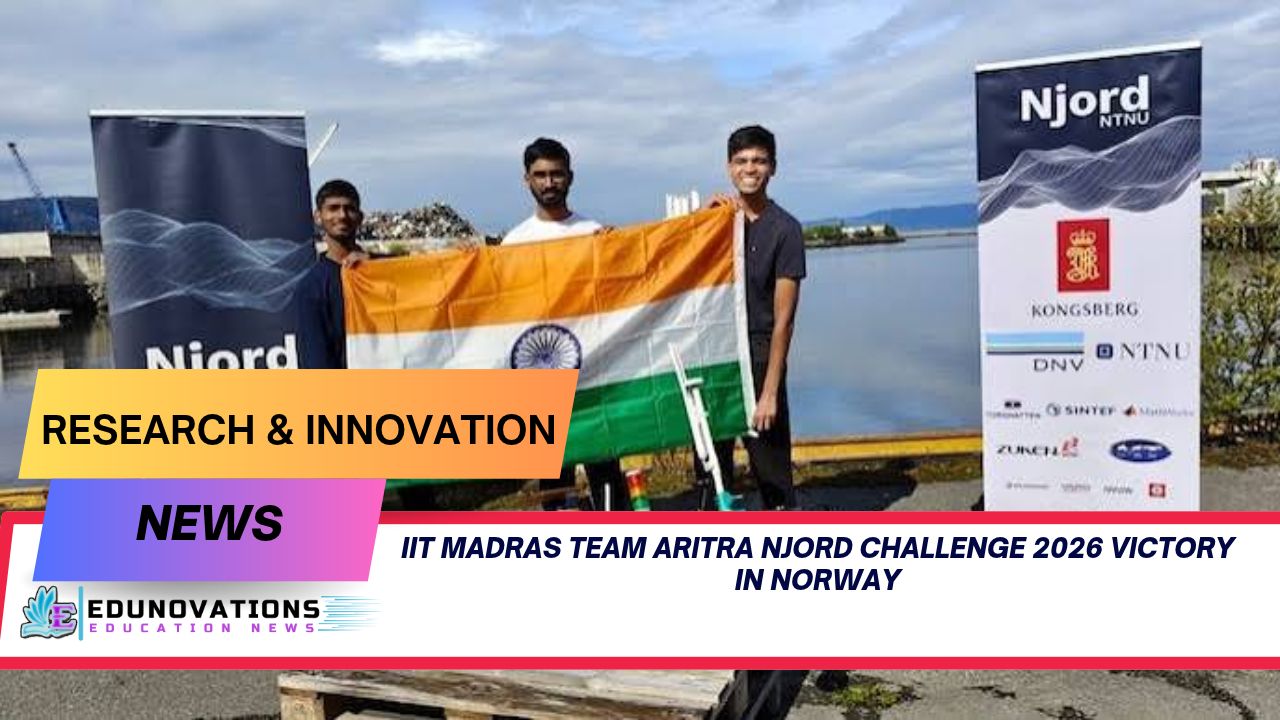
The landscape of global marine engineering witnessed an unprecedented milestone as academic excellence intersected with futuristic robotics on international waters. In a stellar display of technical grit, precision programming, and innovative vessel design, student engineers from the Indian Institute of Technology (IIT) Madras secured an astonishing global victory. Competing against elite minds from across continents, IIT Madras Team Aritra Njord Challenge 2026 captured headlines worldwide by claiming the absolute championship title at the prestigious Njord Challenge held in Trondheim, Norway.
Organized biennially by the esteemed Norwegian University of Science and Technology (NTNU), this high-stakes competition serves as the ultimate crucible for autonomous surface vessels (ASVs). For aspiring technologists, researchers, and students tracking breakthroughs in modern engineering, keeping pace with contemporary global developments is vital. Learners preparing for technical examinations or exploring structured academic curricula can benefit greatly by exploring comprehensive NCERT Courses alongside regular updates on Current Affairs to understand how global technological triumphs shape modern scientific policy.
The Anatomy of a Global Marine Triumph
The journey to the top of the podium was neither simple nor accidental. The 2026 edition of the competition brought together 23 highly competitive student syndicates hailing from nine different countries, including traditional maritime powerhouses across Europe, North America, and Asia. Despite competing against heavily funded international labs, the Indian contingent stood tall, accumulating an impressive overall score of 90.42 points to dominate the leaderboard.
Comprising brilliant young minds—including Aarav Patel, S. Gurukesav, and Madhava Sai—Team Aritra operated under the specialized umbrella of the institute’s Marine Autonomous Vessels Laboratory. Their winning entry was an advanced, custom-built autonomous surface vessel designed to execute complex maritime operations without human intervention.
To achieve this level of autonomy, students must master multidisciplinary subjects ranging from fluid dynamics to advanced artificial intelligence. Students looking to solidify their foundational knowledge in mathematical modeling and physics can check out curated Notes and test their understanding using interactive MCQ’s designed for academic excellence. Furthermore, visual learners can leverage engaging Videos and structured Syllabus guides to map out advanced engineering concepts.
Engineering Challenges on Foreign Waters
Deploying a robotic watercraft in real-world marine environments introduces a myriad of unpredictable variables. During the multi-day event in Norway, the competition matrix rigorously tested participating vessels across core competencies, including autonomous docking, precise collision avoidance, complex maneuvering, strict pathfinding, and comprehensive technical presentations.
Adding to the complexity, organizers introduced a “surprise autonomy challenge”—a dynamic, unannounced test designed on-the-spot to evaluate how swiftly teams could adapt their software architecture to unfamiliar, high-pressure maritime scenarios. Team Aritra faced significant environmental hurdles during the heats, including localized magnetic interference at the arena. This anomaly caused sudden, disruptive drifts in the vessel’s Inertial Measurement Unit (IMU), throwing off critical calculations required for stable autonomous navigation.
Additionally, the student engineers had to troubleshoot unexpected electromagnetic interference occurring between the onboard camera array and GPS systems. Through swift collaborative debugging, meticulous hardware-software isolation, and robust algorithmic coding, the team overcame these barriers, securing absolute maximum points in both the pathfinding and boat-control evaluation metrics.
Rigorous Preparation and Institutional Backing
Behind every international championship lies countless hours of rigorous testing, trial, and iterative failure. Long before shipping their vessel to Scandinavian waters, the student cohort spent months fine-tuning their creation closer to home. Extensive trials were conducted at the specialized wave basin facility within the Department of Ocean Engineering at IIT Madras, alongside comprehensive navigational tests performed across the institute’s internal campus lake.
This victory also highlights the growing importance of practical, hands-on infrastructure in modern Indian higher education. For schools and institutions seeking to build robust digital portals, virtual laboratories, and modern web presences to showcase student achievements, expert technological deployment and school website services can be explored through partners like Mart Ind Infotech.
Faculty advisors and institutional leaders were quick to praise the monumental accomplishment. Faculty mentor Abhilash Sharma Somayajula, Associate Professor in the Department of Ocean Engineering, noted that the achievement stands as a powerful testament to what young minds can achieve when given absolute freedom to explore, experiment, and build tangible engineering solutions. The team was further supported by co-mentor M.A. Atmanand and senior members of the Marine Autonomous Vessels Laboratory.
Leadership Praise and National Vision
Applauding the extraordinary feat, IIT Madras Director Professor V. Kamakoti personally met with Team Aritra members to congratulate them on their global triumph. Emphasizing the broader impact of such milestones, the Director encouraged the students to continue advancing their research, urging them to channel their technical expertise toward building indigenous capabilities that directly serve national development.
Industry analysts and academic experts have frequently underscored that autonomous marine robotics will form the backbone of future maritime economies. Commenting on the rising prominence of student-led innovation in India, noted technologist and policy commentator Dr. R. Chidambaram remarked:
“When young academic minds are empowered to tackle complex, unchartered engineering problems with indigenous tools, they stop being mere learners and transform into true architects of national technological self-reliance.”
Such insights underline why academic institutions must continue fostering experiential learning. Students and educators aiming to deepen their grasp of fundamental scientific theorems can access foundational resources, including Free NCERT PDFs and detailed conceptual NCERT Mind Maps, to build a rock-solid base for future technological innovations.
The Future of Marine Autonomy
The implications of Team Aritra’s success extend far beyond the trophy cabinet. Autonomous surface vessels hold massive commercial and strategic utility in the modern era. Key applications include:
- Coastal and Harbor Surveillance: Continuous, unattended monitoring of national maritime borders and port perimeters.
- Environmental Data Collection: Automated tracking of oceanographic parameters, water quality, and climate indicators.
- Infrastructure Inspection: Safe, automated scanning of offshore platforms, underwater pipelines, and bridge pylons.
- Hydrographic Surveying: High-precision underwater mapping and bathymetric data acquisition without deploying manned research vessels.
With this latest win—building upon their previous third-place finish and Sustainability Award secured back in 2023—IIT Madras has firmly cemented its status as a global powerhouse in ocean engineering and marine robotics education. As Team Aritra looks toward future horizons, their journey serves as an inspiring beacon for engineering students across the globe, proving that with passion, resilience, and rigorous scientific discipline, even the most complex waters can be successfully navigated.
Toppers Use Mind Maps to score more than 95%
-
NCERT Class 11th Commerce Mind Maps
Add to cartOriginal price was: ₹999.00.₹199.00Current price is: ₹199.00. -
NCERT Class 12th Chemistry Mind Maps
Add to cartOriginal price was: ₹199.00.₹75.00Current price is: ₹75.00. -
NCERT Class 12th Commerce Mind Maps
Add to cartOriginal price was: ₹999.00.₹199.00Current price is: ₹199.00. -
NCERT Class 12th Science Mind Maps
Add to cartOriginal price was: ₹999.00.₹199.00Current price is: ₹199.00. -
NCERT Mind Maps For Class 10th
Add to cartOriginal price was: ₹999.00.₹199.00Current price is: ₹199.00.





Purchase Today
Frequently Asked Questions
- What is the Njord Challenge, and where was the 2026 edition held?The Njord Challenge is an international autonomous marine vessel competition organized biennially by the Norwegian University of Science and Technology (NTNU) in Trondheim, Norway, designed to test autonomous surface vessels under real-world conditions.
- Which institution won the overall championship at the Njord Challenge 2026?IIT Madras secured the overall championship victory at the international maritime competition.
- What was the name of the student team representing IIT Madras?The student team was named Team Aritra, representing the Department of Ocean Engineering.
- What score did IIT Madras Team Aritra achieve to win the competition?The team clinched the top spot with an exceptional overall score of 90.42 points.
- Who were the student members of Team Aritra during this campaign?The core student team comprised Aarav Patel, S. Gurukesav, and Madhava Sai.
- What major technical obstacles did the team overcome during the event?The team successfully diagnosed and resolved magnetic interference that caused IMU sensor drift, alongside mitigating electromagnetic interference between their onboard camera and GPS systems.
- Where did the team conduct their pre-competition trials?Extensive testing was conducted at the specialized wave basin facility within the Department of Ocean Engineering and the internal campus lake at IIT Madras.
- Who served as the faculty advisor for Team Aritra? The team was mentored by faculty advisor Abhilash Sharma Somayajula, Associate Professor in the Department of Ocean Engineering, alongside co-mentor M.A. Atmanand.
- What are the primary practical applications of Autonomous Surface Vessels (ASVs)?ASVs are utilized for coastal surveillance, port infrastructure monitoring, environmental data collection, hydrographic surveying, and oceanographic research.
- Has IIT Madras achieved success at the Njord Challenge previously?Yes, a different student cohort from Team Aritra previously finished third globally and won the Sustainability Award at the competition in 2023.