The intersection of science, policy, and grassroots agricultural development has never been more critical.
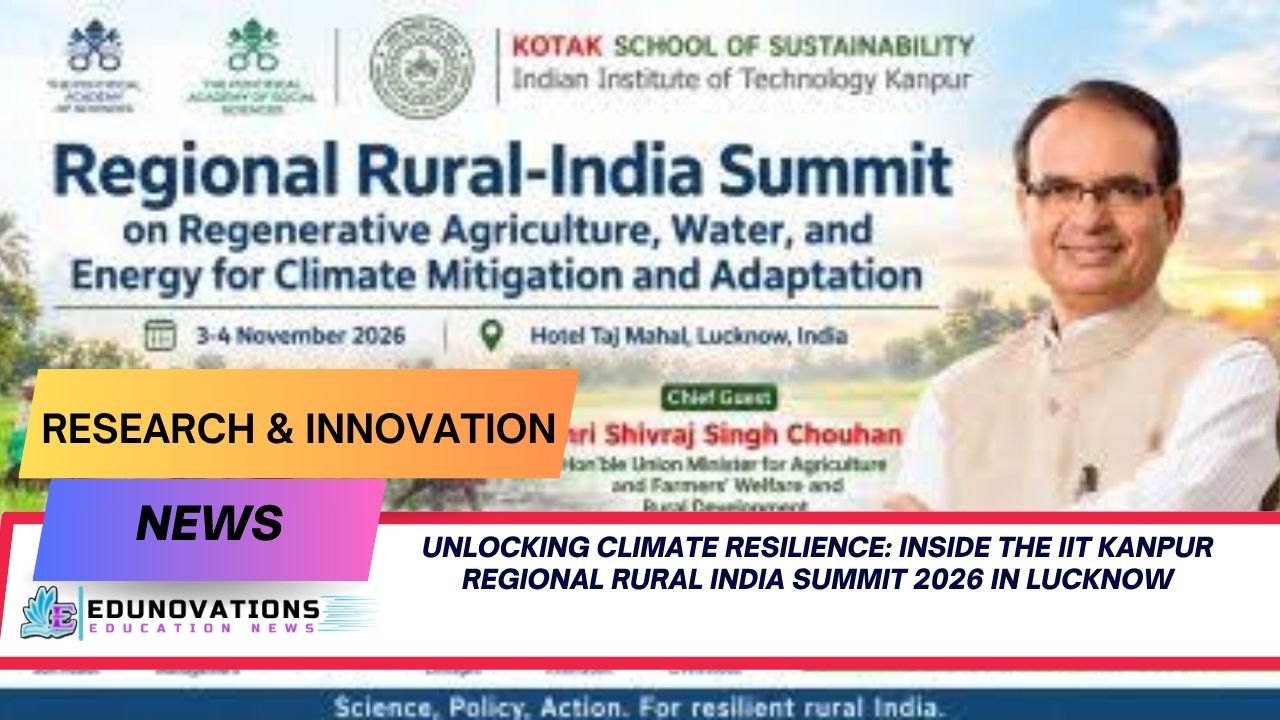
The intersection of science, policy, and grassroots agricultural development has never been more critical. As environmental pressures mount across South Asia, academic institutions are stepping up to bridge global dialogue with local action. Recently, the spotlight turned toward a landmark collaborative initiative aimed at transforming the future of farming and rural livelihoods. The IIT Kanpur Regional Rural India Summit 2026 Lucknow brought together international visionaries, policymakers, and agricultural scientists to tackle the escalating challenges posed by climate change in the Indo-Gangetic Plains.
Organized through the Kotak School of Sustainability, this high-profile gathering serves as a vital blueprint for sustainable development, ecological restoration, and community empowerment. For students, researchers, and educators striving to understand these structural shifts, exploring specialized learning tracks—such as NCERT Courses or reviewing structured Notes—provides foundational context on how environmental science intersects with public policy.
A Critical Convergence for South Asian Agriculture
The Indo-Gangetic Plains represent one of the most intensively cultivated and densely populated agricultural zones on the planet. However, they are also among the most vulnerable to ecological disruption. Rising temperatures, unpredictable monsoon patterns, alarming groundwater depletion, and acute soil degradation are placing unprecedented stress on rural communities.
The summit was designed to move beyond isolated, sectoral responses. Instead, it championed integrated frameworks that connect soil health management, water stewardship, clean energy adoption, and climate-responsive farming practices. Scholars and practitioners engaged in deep-dive panel discussions, evaluating how modern technological innovations can be successfully deployed at the village level.
Key Dimensions of the Climate Crisis in Rural Regions
- Monsoon Variability: Erratic rainfall patterns disrupt traditional sowing schedules, directly threatening crop yields and smallholder farmer incomes.
- Groundwater Stress: Intensive irrigation practices without adequate recharge mechanisms have depleted underground water tables across several northern states.
- Soil Health Degradation: Chemical-heavy farming and intensive cropping cycles have stripped topsoils of essential organic matter and microbial diversity.
- Energy Vulnerability: Rural farming communities face persistent challenges in securing reliable, clean energy sources for post-harvest storage and irrigation.
The Role of Global Frameworks and Institutional Leadership
The initiative forms an integral part of the wider international climate-resilience agenda championed by the Pontifical Academy of Sciences (PAS) and the Pontifical Academy of Social Sciences (PASS) based in Vatican City. Grounded in the MAST framework—Mitigation, Adaptation, and Societal Transformation—the dialogue builds upon prior global summits held in the Vatican, California, Massachusetts, Nairobi, Vienna, Brasília, and Dakar.
By bringing this international framework to Lucknow, the organizers ensured that global scientific expertise directly engaged with local realities. Leaders emphasized that theoretical models must translate into practical, scalable solutions for rural farmers. For those tracking these administrative and academic developments for competitive exams, staying updated through dedicated Current Affairs modules and practicing targeted MCQ’s can greatly enhance conceptual clarity.
“India offers an important opportunity to bring the MAST framework to a region of immense agricultural and human significance. The Summit connects global science with India’s knowledge and grassroots experience.” — Prof. Joachim von Braun, President, Pontifical Academy of Sciences.
Regenerative Agriculture as a Restoration Pathway
A dominant theme throughout the two-day program was regenerative agriculture. Unlike conventional intensive farming, which often depletes natural resources over time, regenerative practices focus on active ecological restoration.
Experts discussed several core methodologies designed to rebuild soil architecture and enhance resilience:
- Minimum Tillage: Reducing mechanical soil disturbance to preserve soil structure, retain moisture, and protect beneficial underground organisms.
- Cover Cropping: Planting non-cash crops during off-seasons to prevent soil erosion, suppress weeds, and naturally fix nitrogen into the earth.
- Crop Diversification: Moving away from monoculture reliance by integrating multi-cropping systems that naturally break pest cycles and improve dietary diversity in rural households.
- Water Retention Structures: Implementing micro-irrigation, check dams, and farm ponds to maximize rainwater harvesting and artificial groundwater recharge.
To visually map out these complex ecological concepts and prepare for academic evaluations, students frequently utilize detailed NCERT Mind Maps and free downloadable NCERT PDFs. Furthermore, educational institutions looking to modernize their digital outreach and administrative workflows can explore customized technology solutions provided by Mart India Infotech.
Expert Insights and Multi-Sectoral Collaboration
The summit featured prominent thought leaders, Padma awardees, and global scientists who shared cross-disciplinary perspectives. Union Agriculture Minister Shri Shivraj Singh Chouhan addressed the gathering as the Chief Guest, emphasizing the central government’s commitment to doubling farmers’ incomes through sustainable technology adoption and rural infrastructure development.
Renowned environmentalist Dr. Anil Prakash Joshi highlighted the economic value of ecological preservation, noting that GDP metrics must eventually account for natural capital depreciation. Similarly, agricultural economist Prof. Ashok Gulati underscored the necessity of reallocating power and fertilizer subsidies toward green incentives that reward farmers for conserving water and adopting organic soil enhancers.
Additional academic depth was provided by international experts such as Dr. Soumya Swaminathan and Dr. Rattan Lal, who connected soil organic carbon sequestration directly to human health outcomes and climate mitigation milestones. Accessing curated Videos and structured academic Syllabus breakdowns can further assist learners in mastering these multidisciplinary environmental topics.
Toppers Use Mind Maps to score more than 95%
NCERT Class 11th Commerce Mind Maps
Add to cartOriginal price was: ₹999.00.₹199.00Current price is: ₹199.00.NCERT Class 12th Chemistry Mind Maps
Add to cartOriginal price was: ₹199.00.₹75.00Current price is: ₹75.00.NCERT Class 12th Commerce Mind Maps
Add to cartOriginal price was: ₹999.00.₹199.00Current price is: ₹199.00.NCERT Class 12th Science Mind Maps
Add to cartOriginal price was: ₹999.00.₹199.00Current price is: ₹199.00.NCERT Mind Maps For Class 10th
Add to cartOriginal price was: ₹999.00.₹199.00Current price is: ₹199.00.




Purchase Today
Frequently Asked Questions (FAQs)
1. What was the primary objective of the IIT Kanpur Regional Rural India Summit 2026 Lucknow?
The summit aimed to foster science- and policy-led pathways to strengthen climate resilience, agricultural sustainability, and rural livelihoods within the Indo-Gangetic Plains.
2. Where was the summit held and who organized it?
The event took place in Lucknow, Uttar Pradesh, organized by the Kotak School of Sustainability at IIT Kanpur in partnership with the Pontifical Academy of Sciences and the Pontifical Academy of Social Sciences, Vatican City.
3. Who inaugurated the summit as the Chief Guest?
Shri Shivraj Singh Chouhan, Hon’ble Minister for Agriculture & Farmers’ Welfare and Rural Development, served as the Chief Guest for the inaugural session.
4. What is the MAST framework discussed during the conference?
MAST stands for Mitigation, Adaptation, and Societal Transformation, serving as a universal protocol for climate resilience developed by international scientific academies.
5. How does regenerative agriculture help combat climate change?
Regenerative agriculture rebuilds soil organic matter, improves water retention, integrates biodiversity, enhances resource efficiency, and actively draws down greenhouse gases from the atmosphere.
6. Which academic institution established the Kotak School of Sustainability?
The Kotak School of Sustainability was established at the Indian Institute of Technology Kanpur (IIT Kanpur) with support from Kotak Mahindra Bank.
7. Why are the Indo-Gangetic Plains particularly vulnerable to climate shocks?
The region faces severe pressures from rising temperatures, erratic monsoon variability, acute groundwater depletion, and soil degradation, which collectively threaten regional food and water security.
8. Which notable environmentalists and economists spoke at the event?
The event featured prominent speakers including Dr. Anil Prakash Joshi, Prof. Ashok Gulati, Dr. Rajendra Singh (known as the “Jal Purush”), and global agricultural scientist Dr. Rattan Lal.
9. What role do international bodies play in this regional summit?
Bodies like the Pontifical Academy of Sciences bring global climate-resilience frameworks to regional dialogues, connecting international scientific research with grassroots Indian experience.
10. How can students and researchers utilize educational resources to study these developments?
Students can explore specialized current affairs modules, academic notes, NCERT courses, and structured curriculum syllabi to analyze the intersection of environmental policy and sustainable agriculture.