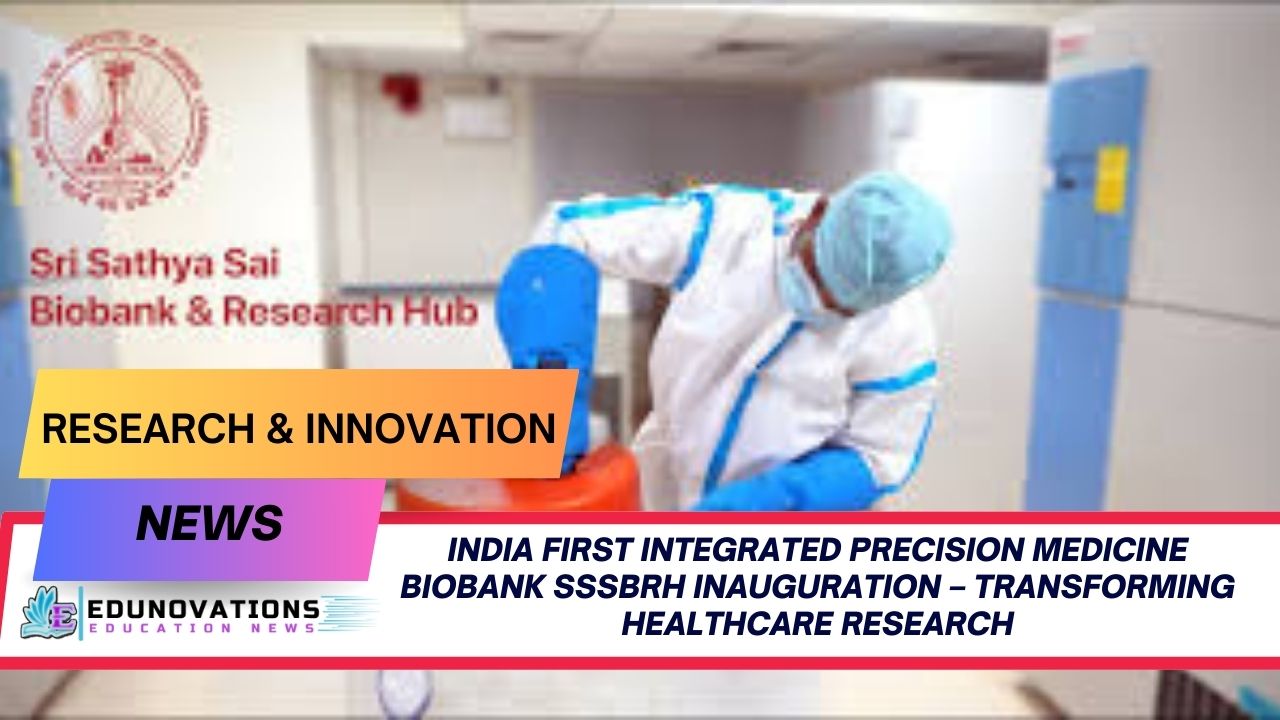
Discover the India first integrated precision medicine biobank SSSBRH inauguration at SSSIHL, Prasanthi Nilayam, enhancing genomics, diagnostics, and therapeutics research.
The India first integrated precision medicine biobank SSSBRH inauguration marks a new era in healthcare research in India. The state-of-the-art facility at Sri Sathya Sai Institute of Higher Learning (SSSIHL), Prasanthi Nilayam, combines advanced technology with an extensive biobank to accelerate precision medicine research. This development is not only a milestone for the institute but also a significant step forward for medical science, genomics, and personalized healthcare in India.
SSSIHL’s Vision for Precision Medicine
SSSIHL has long been a pioneer in combining education, research, and social responsibility. The inauguration of this biobank reflects the institute’s commitment to fostering cutting-edge scientific research while maintaining ethical and community-oriented principles. The biobank for genomic research in India Prasanthi Nilayam facility is designed to store, manage, and facilitate access to thousands of biological samples, paving the way for transformative studies in genomics and personalized medicine.
The new hub is equipped with AI-driven analytics tools, enabling researchers to process and interpret complex datasets efficiently. As a result, the AI enabled predictive healthcare biobank India 2025 launch ensures that predictive models for disease susceptibility and therapeutic response are more accurate, enhancing patient outcomes.
Key Features of the SSSBRH Facility
The SSSIHL biobank samples 25000 biospecimens for Indian research, including blood, tissue, and other biological materials. This vast repository allows scientists to conduct longitudinal studies, comparative analyses, and translational research that bridges laboratory discoveries with clinical applications. Some of the key features of the facility include:
- High-Capacity Storage: Temperature-controlled systems preserving biological integrity.
- Advanced AI Analytics: Integration of artificial intelligence for predictive modeling and pattern recognition.
- Secure Data Management: Robust digital infrastructure ensuring sample traceability and data confidentiality.
- Collaborative Access: Enabling both national and international researchers to access samples for legitimate research purposes.
By housing a large number of biospecimens, the institute can drive research on rare diseases, population-specific genomics, and precision therapeutics, making India a global contributor in medical science innovation.
Impact on Indian Healthcare and Research
The inauguration of the India first integrated precision medicine biobank SSSBRH is expected to have a profound impact on healthcare in India. By enabling large-scale genomics research, the facility helps in identifying genetic markers for disease, predicting patient responses to treatment, and developing tailored therapies. Here’s how the facility is shaping the future:
- Boosting Genomic Research: Researchers can now access high-quality, well-documented biological samples, which will accelerate discoveries in genomics and molecular medicine.
- Enhanced Diagnostics: Predictive models built from biobank data can help clinicians detect diseases earlier and design personalized treatment plans.
- Therapeutics Research: Pharmaceutical and biotech companies can leverage the biobank for drug discovery, reducing the time and cost of bringing new treatments to market.
- Academic Growth: The facility strengthens SSSIHL’s position as a hub for scientific education, attracting scholars and fostering interdisciplinary research collaborations.
Experts have emphasized that how India’s new biobank boosts diagnostics therapeutics research is not just a scientific endeavor but a step toward a healthier nation, ensuring equitable access to medical innovation.
Technological Advancements in Biobanking
The SSSBRH is not just a storage facility—it represents the next generation of AI enabled predictive healthcare biobank India 2025 launch. Artificial intelligence algorithms help in:
- Automating sample sorting and categorization.
- Predicting disease risks based on genomic patterns.
- Enhancing precision medicine research through predictive modeling.
By integrating AI with biobanking, researchers can analyze vast datasets faster, revealing insights that were previously inaccessible. This advancement significantly reduces human error and increases the reliability of research outputs.
Collaborative Opportunities and Outreach
SSSIHL has envisioned the biobank as a national collaborative platform, inviting partnerships with universities, research institutes, hospitals, and pharmaceutical companies. This aligns with the goal of how India’s new biobank boosts diagnostics therapeutics research by making samples, data, and AI tools accessible to authorized collaborators.
Moreover, the institute has committed to public engagement initiatives, ensuring that communities understand the importance of biobanking in improving healthcare. This includes awareness programs, workshops, and seminars for students, researchers, and healthcare professionals.
Educational Integration and Student Involvement
A unique aspect of the SSSBRH is its integration with the institute’s academic programs. Students pursuing biotechnology, bioinformatics, and medical sciences are provided hands-on experience with biobank management, genomic research, and AI-based data analysis. This approach helps cultivate the next generation of scientists and healthcare innovators in India.
Internal links for students to explore related educational resources:
- NCERT Courses
- Current Affairs Updates
- Educational Notes
- MCQs Practice
- Video Learning
- Syllabus Reference
- Free NCERT PDFs
- Mind Maps for NCERT
National and Global Significance
The launch of the India first integrated precision medicine biobank SSSBRH inauguration places India on the global map of precision medicine research. By consolidating genomic data, biospecimens, and AI tools, the biobank empowers scientists to tackle diseases prevalent in India and worldwide, including diabetes, cancer, and genetic disorders.
External reference: Schools and research institutions can benefit from collaboration through platforms like Mart India Infotech for technology and infrastructure support.
Expert Insights
Dr. Ramesh Babu, a genomics expert, commented on the initiative:
“The SSSBRH biobank is a transformative facility. By integrating AI with precision medicine, it allows researchers to move from hypothesis to therapy with unprecedented speed.”
Similarly, Dr. Anjali Menon, a healthcare innovation analyst, noted:
“This biobank is not only a repository of samples but a hub for interdisciplinary collaboration. It sets a new benchmark for biomedical research in India.”
Such expert endorsements underline the importance of the SSSIHL biobank samples 25000 biospecimens for Indian research, which will fuel future breakthroughs in diagnostics and therapeutics.
Challenges and Future Prospects
While the biobank represents significant progress, maintaining sample integrity, ensuring ethical compliance, and safeguarding data privacy are ongoing challenges. The institute has implemented strict protocols, including:
- Ethical approvals for all research access
- High-security storage and restricted access
- Regular audits and quality checks
Looking forward, the facility plans to expand its capacity, integrate additional AI-driven predictive tools, and develop collaborations with international precision medicine programs, making the biobank for genomic research in India Prasanthi Nilayam facility a globally recognized hub.
Conclusion
The India first integrated precision medicine biobank SSSBRH inauguration marks a historic milestone in Indian healthcare and research. By combining AI, genomics, and precision medicine, SSSIHL is setting new standards in diagnostics, therapeutics, and academic excellence. The biobank not only enhances scientific capabilities but also empowers the next generation of researchers, ensuring that India remains at the forefront of healthcare innovation.
Toppers Use Mind Maps to score more than 95%
NCERT Class 11th Commerce Mind Maps
Add to cartOriginal price was: ₹999.00.₹199.00Current price is: ₹199.00.NCERT Class 12th Chemistry Mind Maps
Add to cartOriginal price was: ₹199.00.₹75.00Current price is: ₹75.00.NCERT Class 12th Commerce Mind Maps
Add to cartOriginal price was: ₹999.00.₹199.00Current price is: ₹199.00.NCERT Class 12th Science Mind Maps
Add to cartOriginal price was: ₹999.00.₹199.00Current price is: ₹199.00.NCERT Mind Maps For Class 10th
Add to cartOriginal price was: ₹999.00.₹199.00Current price is: ₹199.00.





Purchase Today
FAQs
- What is the India first integrated precision medicine biobank SSSBRH inauguration?
It is the official launch of India’s first precision medicine biobank at SSSIHL, Prasanthi Nilayam, enabling advanced genomics research. - Where is the biobank for genomic research in India Prasanthi Nilayam facility located?
The facility is located at Sri Sathya Sai Institute of Higher Learning, Prasanthi Nilayam, Andhra Pradesh. - What is the significance of the AI enabled predictive healthcare biobank India 2025 launch?
It integrates AI with biobanking to predict disease risks and personalize therapies, advancing precision medicine. - How many samples does the SSSIHL biobank store?
The biobank currently stores 25,000 biospecimens for research on genetics, disease, and therapeutics. - How does India’s new biobank boost diagnostics therapeutics research?
By providing high-quality samples and AI tools, it enables early diagnosis, personalized treatment, and novel therapy development. - Can researchers access the SSSIHL biobank for collaboration?
Yes, authorized national and international researchers can collaborate under ethical and regulatory guidelines. - What kind of samples are stored in the biobank?
The biobank stores blood, tissue, DNA, and other biological specimens for genomic and therapeutic research. - How does the biobank integrate with educational programs?
Students in biotechnology, bioinformatics, and medical sciences gain hands-on experience in sample management and AI analytics. - What are the future plans for the SSSBRH facility?
Expansion of capacity, integration of more AI tools, and global research collaborations are planned. - Why is the SSSIHL biobank considered a milestone in Indian research?
It combines precision medicine, AI, and a large biobank repository, making India a global contributor to healthcare innovation.