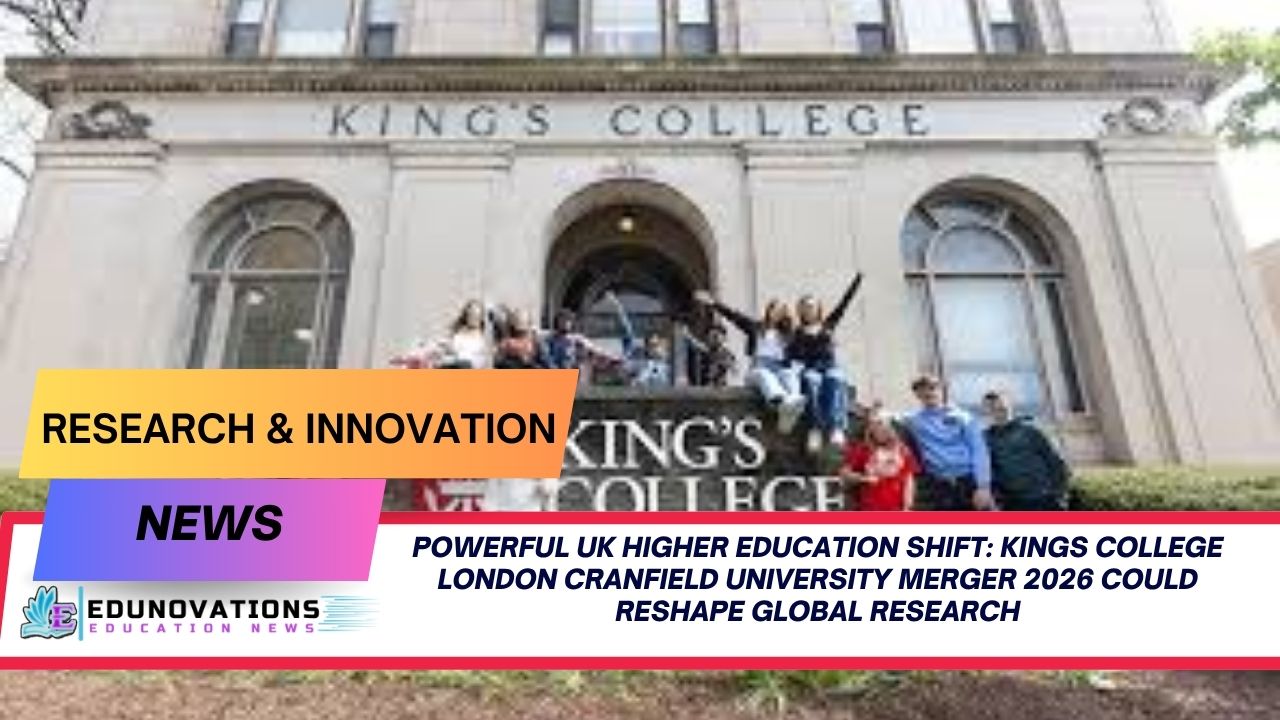
The kings college london cranfield university merger 2026 proposal could transform UK higher education, global research partnerships, defence innovation, and student opportunities.
The proposed kings college london cranfield university merger 2026 has sparked intense discussion across the British higher education sector, with academics, students, policymakers, and global education experts closely monitoring developments. If finalized, the move could create one of the United Kingdom’s most influential research-led institutions, combining academic excellence, defence research expertise, engineering innovation, and international outreach.
The emerging kings college london cranfield university merger 2026 conversation reflects a broader trend in global higher education where universities are increasingly seeking strategic partnerships to strengthen research funding, attract international students, and improve competitiveness against leading institutions in the United States and Asia.
Education experts believe the proposal could significantly reshape the UK university ecosystem over the next decade.
Students preparing for higher education and competitive examinations can also explore academic resources through NCERT Courses and updated study materials on Current Affairs.
Why the Proposed Collaboration Is Making Headlines
The potential partnership between King’s College London and Cranfield University is being viewed as more than a traditional university collaboration. Analysts suggest it could become a strategic academic alliance focused on research, innovation, defence technology, artificial intelligence, healthcare systems, and sustainable engineering.
King’s College London is already recognized globally for its strengths in medicine, law, humanities, international affairs, and public policy. Cranfield University, meanwhile, has earned an international reputation for postgraduate engineering, aerospace research, manufacturing technology, and defence-related innovation.
The proposed kings college london cranfield university merger 2026 would combine these complementary strengths into a larger global institution capable of competing with elite research universities worldwide.
According to higher education analysts, mergers of this scale remain relatively uncommon in the UK, which is why the development has attracted widespread attention from education observers and policymakers.
Students looking for structured exam preparation can additionally access NCERT Notes and practice questions through MCQs.
Growing Pressure on Universities Worldwide
The conversation surrounding the kings college london cranfield university merger 2026 also reflects increasing financial and strategic pressure across the global university sector.
Several universities in Europe and the United Kingdom are dealing with:
- Rising operational costs
- Global competition for research funding
- Declining domestic student enrollment in some fields
- Increasing dependence on international student revenue
- Rapid technological disruption
- Expanding demand for interdisciplinary research
Experts say universities are now under pressure to create larger collaborative ecosystems that can deliver innovation at scale.
A report from international education consultants has shown that universities with strong research collaborations often attract more global investment and achieve stronger rankings performance. The proposed UK university partnership may therefore represent a strategic long-term response to changing educational realities.
Focus on Research and Innovation
One of the most discussed aspects of the kings college london cranfield university merger 2026 proposal is its potential impact on advanced research.
King’s College London already maintains extensive global research partnerships in healthcare, neuroscience, cybersecurity, and policy studies. Cranfield University is known for its highly specialized expertise in aerospace engineering, autonomous systems, defence research, and manufacturing innovation.
Together, the institutions could potentially strengthen the UK’s position in critical sectors including:
- Artificial intelligence
- Aerospace technology
- Defence innovation
- Climate sustainability
- Advanced healthcare research
- Data science
- Robotics and automation
Education policy experts argue that large-scale collaborations help institutions compete for major international grants and government-funded innovation projects.
The proposed merger could also improve opportunities for industry partnerships with technology companies, defence organizations, healthcare firms, and manufacturing enterprises.
Learners interested in academic video resources may visit Educational Videos and syllabus guidance on Syllabus Resources.
What This Could Mean for Students
Students are among the key stakeholders following the kings college london cranfield university merger 2026 discussions closely.
If the merger progresses, students may benefit from:
Expanded Academic Programs
The collaboration could potentially offer broader interdisciplinary courses combining engineering, policy, healthcare, and technology.
Increased Research Exposure
Students may gain access to larger research networks, advanced laboratories, and international collaboration opportunities.
Better Industry Connections
Cranfield University’s strong industrial partnerships combined with King’s College London’s global reputation could improve internship and placement opportunities.
International Recognition
A larger global institution may attract greater international recognition, potentially enhancing graduate employability.
However, some students and faculty members have also raised concerns regarding:
- Institutional restructuring
- Administrative integration challenges
- Tuition fee implications
- Campus identity preservation
- Cultural integration between institutions
Higher education specialists note that successful mergers require careful long-term planning and transparent communication with students and faculty.
Experts Weigh In on the Proposal
Several education experts have commented on the significance of the emerging uk university merger global institution latest news discussions.
Professor Simon Marginson, a globally recognized higher education expert known for his research on international university systems, has frequently highlighted how research-intensive collaborations are becoming increasingly important in global education competitiveness.
Analysts believe the proposed partnership could strengthen Britain’s influence in research and innovation at a time when countries worldwide are heavily investing in science and technology infrastructure.
Industry observers also suggest that the collaboration may align with broader UK government goals focused on technological leadership, innovation-driven growth, and defence modernization.
The ongoing uk university merger global institution latest news conversation has therefore expanded beyond academia into broader economic and policy discussions.
International Competition Driving Institutional Change
The proposed cranfield university joining kings college london update comes at a time when universities worldwide are adapting to major structural changes in higher education.
Universities in countries such as China, the United States, Singapore, and Germany have increased investment in:
- Research infrastructure
- Innovation parks
- AI-driven education systems
- International collaborations
- Industry-linked education
To remain competitive, UK institutions are increasingly exploring strategic partnerships and shared innovation ecosystems.
Education analysts say the cranfield university joining kings college london update demonstrates how British universities may be moving toward larger, research-focused institutional frameworks capable of competing on a global scale.
Defence and Aerospace Capabilities Could Expand
One area receiving significant attention in the kcl cranfield merger impact on students and research discussions is defence and aerospace research.
Cranfield University already has strong expertise in aerospace engineering, defence systems, and military-related research. King’s College London brings internationally respected departments focused on security studies, international relations, cybersecurity, and medical sciences.
Experts believe the combination could potentially create:
- Expanded defence research collaboration
- Stronger aerospace innovation programs
- Advanced cybersecurity initiatives
- New AI-driven defence applications
- Integrated policy and engineering research
The UK government has recently emphasized the importance of strengthening domestic innovation capabilities in defence and advanced technology sectors. Analysts say the proposed merger could align with these strategic priorities.
Economic Impact on the UK Education Sector
The kcl cranfield merger impact on students and research may also have broader implications for the UK economy.
Higher education remains one of Britain’s most important economic sectors, contributing billions annually through:
- International student enrollment
- Research commercialization
- Innovation partnerships
- Employment generation
- Technology transfer
Large research institutions often attract international businesses seeking partnerships in emerging technologies.
If implemented successfully, the proposed collaboration could strengthen Britain’s role as a global education and research destination.
Experts also believe stronger university-industry collaboration may support regional economic development through innovation hubs and startup ecosystems.
Students searching for downloadable educational resources can access Free NCERT PDFs and mind map resources via NCERT Mind Maps.
Academic Identity and Institutional Heritage
While many experts view the proposal positively, institutional identity remains an important issue in the british universities merger creating global education hub debate.
King’s College London has a historic legacy dating back to the 19th century and is widely recognized as part of the University of London system. Cranfield University also has a distinct identity rooted in postgraduate technical education and aerospace research.
Observers note that preserving these institutional cultures would be essential if any merger progresses further.
Faculty groups and alumni communities are expected to play an important role in shaping future discussions.
The evolving british universities merger creating global education hub conversation demonstrates how modern universities must balance innovation with institutional heritage.
How Global Rankings Could Be Affected
University rankings remain highly influential in international higher education.
Analysts suggest that the proposed kings college london cranfield university merger 2026 could potentially strengthen performance indicators in areas such as:
- Research output
- Citation impact
- International collaboration
- Industry income
- Graduate employability
- Innovation metrics
Global ranking systems increasingly reward interdisciplinary collaboration and large-scale research partnerships.
If the institutions successfully integrate their strengths, the combined organization may achieve stronger visibility in global university rankings over time.
Challenges That Cannot Be Ignored
Despite optimism, experts warn that university mergers involve substantial operational challenges.
Key risks include:
Administrative Complexity
Combining governance systems, academic structures, and operational processes can be difficult.
Faculty Concerns
Academic staff may worry about restructuring, resource allocation, and institutional priorities.
Financial Integration
Large mergers require substantial financial planning and long-term investment.
Student Transition Issues
Ensuring continuity for current students remains essential.
Brand Management
Balancing institutional identities while creating a unified vision can be challenging.
Education specialists emphasize that long-term success depends on transparent leadership and clear communication strategies.
Technology and Artificial Intelligence Opportunities
Another major discussion area linked to the uk university merger global institution latest news is artificial intelligence research.
Both institutions already contribute to AI-related academic fields, though from different perspectives.
Potential combined strengths may include:
- AI ethics research
- Healthcare AI systems
- Defence AI applications
- Autonomous transport technologies
- Data analytics
- Smart manufacturing systems
Experts believe interdisciplinary collaboration between engineering, medicine, law, and policy could become a defining strength of the proposed institution.
Industry Partnerships and Private Sector Collaboration
The proposed cranfield university joining kings college london update could also enhance relationships with global industries.
Large research universities increasingly depend on partnerships with:
- Aerospace companies
- Pharmaceutical firms
- Technology corporations
- Defence contractors
- Renewable energy enterprises
Cranfield University already maintains strong industry-focused research partnerships, while King’s College London has extensive global academic and healthcare collaborations.
Industry leaders often prefer working with institutions that can provide large-scale interdisciplinary expertise.
Educational institutions seeking digital outreach and school communication services can explore Mart Ind Infotech for technology-driven solutions.
Future Outlook for UK Higher Education
The discussions surrounding the kcl cranfield merger impact on students and research may ultimately influence how universities across Britain approach future collaboration.
Education analysts believe the sector could witness:
- More research alliances
- Shared innovation centers
- Cross-disciplinary institutions
- Expanded global partnerships
- Increased specialization
The UK government’s focus on science, research, and innovation may further encourage universities to develop stronger collaborative frameworks.
While no final outcome has yet been confirmed, the proposal has already generated extensive debate regarding the future direction of British higher education.
Conclusion
The proposed kings college london cranfield university merger 2026 represents one of the most closely watched developments in the UK education sector. If implemented, the partnership could create a globally influential institution combining world-class expertise in engineering, medicine, defence, public policy, artificial intelligence, and advanced research.
Supporters believe the collaboration could strengthen Britain’s competitiveness in global higher education and innovation. Critics, however, stress the importance of protecting institutional identity, student interests, and academic independence.
As discussions continue, universities worldwide will likely observe the process carefully because its outcome may influence future collaboration strategies across international higher education systems.
Toppers Use Mind Maps to score more than 95%
-
NCERT Class 11th Commerce Mind Maps
Add to cartOriginal price was: ₹999.00.₹199.00Current price is: ₹199.00. -
NCERT Class 12th Chemistry Mind Maps
Add to cartOriginal price was: ₹199.00.₹75.00Current price is: ₹75.00. -
NCERT Class 12th Commerce Mind Maps
Add to cartOriginal price was: ₹999.00.₹199.00Current price is: ₹199.00. -
NCERT Class 12th Science Mind Maps
Add to cartOriginal price was: ₹999.00.₹199.00Current price is: ₹199.00. -
NCERT Mind Maps For Class 10th
Add to cartOriginal price was: ₹999.00.₹199.00Current price is: ₹199.00.





Purchase Today
FAQs
1. What is the kings college london cranfield university merger 2026 proposal?
The proposal involves potential collaboration or merger discussions between King’s College London and Cranfield University to strengthen research, innovation, and global academic competitiveness.
2. Why is the uk university merger global institution latest news important?
The development could reshape British higher education by creating a stronger research-focused institution with international influence.
3. What would students gain from the cranfield university joining kings college london update?
Students may benefit from expanded academic programs, advanced research facilities, global exposure, and stronger industry partnerships.
4. How could the kcl cranfield merger impact on students and research?
The merger may improve interdisciplinary research opportunities while also bringing administrative and structural changes for students and faculty.
5. Why are british universities merger creating global education hub discussions increasing?
Universities worldwide face growing competition for research funding, innovation leadership, and international students.
6. Could the proposed merger improve UK university rankings?
Experts believe stronger research collaboration and interdisciplinary output could positively affect global rankings.
7. What sectors could benefit most from the proposed partnership?
Key sectors include aerospace, artificial intelligence, defence technology, healthcare research, robotics, and cybersecurity.
8. Are university mergers common in the United Kingdom?
Large-scale university mergers are relatively uncommon in the UK, making this proposal particularly significant.
9. What challenges could arise during institutional integration?
Potential challenges include governance restructuring, financial planning, cultural integration, and maintaining institutional identity.
10. How does this proposal reflect global education trends?
Universities globally are increasingly forming partnerships to improve innovation, research funding, and international competitiveness.