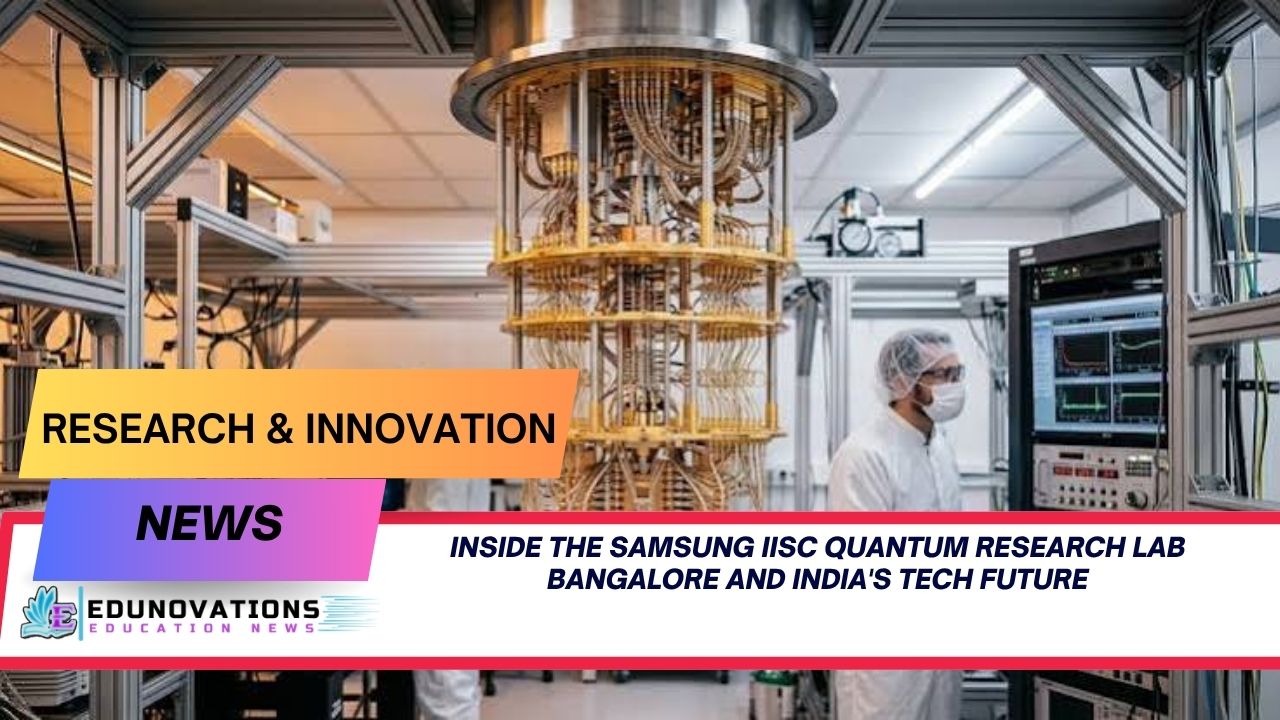
Discover how the Samsung IISc Quantum Research Lab Bangalore is transforming India’s quantum capabilities, advanced semiconductors, and technical education.
Introduction to India’s Quantum and Semiconductor Renaissance
The landscape of technological innovation in South Asia is undergoing a profound transformation. As global supply chains shift and deep-tech research takes center stage, academic institutions and industry giants are forging unprecedented alliances. A landmark development in this arena is the recent inauguration of a dedicated facility at the premier science institute in Bengaluru. This initiative is designed not only to bolster foundational research in quantum mechanics and advanced microelectronics but also to cultivate a robust national talent pool capable of competing on the global stage.
For students, researchers, and technology enthusiasts tracking these developments, staying informed with structured resources is essential. Whether you are preparing for competitive examinations or exploring advanced science streams, utilizing comprehensive study tools like NCERT Courses provides a strong academic foundation. Understanding how high-level industry partnerships impact national growth also ties directly into staying updated with daily Current Affairs.
Bridging Industry and Academia: The Core Vision
The establishment of modern research facilities requires a seamless blend of corporate social responsibility, visionary leadership, and academic excellence. The collaborative venture between corporate research divisions and premier scientific academies sets a new benchmark for how private enterprises can fuel public sector innovation. By pooling resources, these entities create ecosystems where theoretical physics translates directly into tangible, real-world hardware.
When analyzing major technological shifts, learners often benefit from breaking down complex subjects into digestible pieces. Reviewing structured Notes can help clarify the complex physics governing subatomic particles and semiconductor physics. Furthermore, testing one’s comprehension through targeted MCQ’s ensures that students grasp foundational concepts thoroughly before diving into advanced research papers.
Exploring the Technical Pillars of the Facility
At the heart of the newly minted facility lie several critical areas of study that dictate the future of computing. Traditional silicon-based microchips are rapidly approaching physical limitations, prompting researchers to explore alternative paradigms.
Qubit Characterization and Cryogenic Electronics
One of the primary focal points of the facility involves working with qubits—the basic units of quantum information. Unlike classical bits, qubits require extreme operational environments, often near absolute zero. Cryogenic electronics play an indispensable role here, allowing control circuitry to function seamlessly alongside quantum processors without introducing thermal noise.
For visual learners and those looking for multimedia explanations, exploring curated educational Videos can demystify how cryogenic systems and quantum states interact. Additionally, keeping track of the official academic Syllabus helps students align their educational pursuits with modern industry demands.
The Role of 2D Materials in Next-Gen Hardware
Moving beyond traditional three-dimensional silicon, researchers are heavily investigating two-dimensional materials such as graphene and transition metal dichalcogenides. These ultra-thin substances exhibit extraordinary electronic and optical properties, making them prime candidates for building ultra-efficient single-photon sources and quantum detectors.
To dive deeper into these scientific breakthroughs without getting overwhelmed, students can access simplified study materials and Free NCERT PDFs for foundational physics concepts. Visualizing these complex material structures is also made easier through structured NCERT Mind Maps.
Workforce Development and National Skill Building
Advanced hardware is only as good as the engineers operating it. Recognizing a critical skill gap in device physics, process development, and microchip modeling, the initiative incorporates specialized training modules. These programs aim to train thousands of students and early-career researchers across various technical institutions in India.
Industry experts emphasize that infrastructure alone cannot drive innovation; human capital is the ultimate catalyst. Commenting on the broader implications of corporate-academic synergies, renowned technologist and strategist Dr. Vivek Wadhwa noted, “When private technology leaders invest heavily in academic research and workforce training, they do not just build products—they build self-sustaining national innovation ecosystems that can weather global supply chain disruptions.” This sentiment echoes the core mission of bridging the gap between theoretical classroom education and high-stakes semiconductor experimentation.
For academic institutions seeking to upgrade their digital infrastructure to support online learning and research portals, partnering with specialized technology service providers like Mart India Infotech (“Mart Ind Infotech”) offers reliable web development and digital transformation solutions.
The Broader Economic and Geopolitical Impact
India’s push into quantum technology is part of a larger national strategy to secure domestic capabilities in critical technologies. With global investments in quantum computing surging past billions of dollars annually, nations that establish domestic R&D pipelines early will dictate the standards for cybersecurity, cryptography, and high-performance computing in the coming decades.
The integration of corporate research funding with premier institutional brainpower ensures that research outcomes are not siloed. Instead, they form an open pipeline where academic discoveries can be scaled into commercial applications. This synergy helps retain top-tier engineering talent within the country, mitigating brain drain and positioning the nation as an exporter of high-tech intellectual property.
Conclusion
The opening of cutting-edge quantum and semiconductor research facilities marks a pivotal chapter in technological self-reliance. By combining advanced experimental infrastructure with structured workforce training programs, this initiative lays a solid foundation for the future. As students, researchers, and industry professionals continue to adapt to this rapidly evolving landscape, leveraging comprehensive educational platforms and keeping pace with technological news will remain vital for success.
Toppers Use Mind Maps to score more than 95%
NCERT Class 11th Commerce Mind Maps
Add to cartOriginal price was: ₹999.00.₹199.00Current price is: ₹199.00.NCERT Class 12th Chemistry Mind Maps
Add to cartOriginal price was: ₹199.00.₹75.00Current price is: ₹75.00.NCERT Class 12th Commerce Mind Maps
Add to cartOriginal price was: ₹999.00.₹199.00Current price is: ₹199.00.NCERT Class 12th Science Mind Maps
Add to cartOriginal price was: ₹999.00.₹199.00Current price is: ₹199.00.NCERT Mind Maps For Class 10th
Add to cartOriginal price was: ₹999.00.₹199.00Current price is: ₹199.00.




Purchase Today
Frequently Asked Questions (FAQs)
- What is the significance of the Samsung IISc Quantum Research Lab Bangalore? It marks a major milestone in strengthening India’s indigenous capabilities in quantum technologies and advanced semiconductor research through joint industry-academia efforts.
- How does the India Semiconductor Workforce Development Program help students? It addresses critical skill gaps by offering practical training in device physics, modeling, simulation, and characterization.
- What types of devices are studied at the new quantum facility? The lab focuses on 2D-material-based quantum devices, qubits, cryogenic electronics, and single-photon sources and detectors.
- Who leads the Department of Electronic Systems Engineering at IISc? Prof. Mayank Shrivastava serves as the Chair of the department and leads these advanced research initiatives.
- How does the lab plan to extend its benefits beyond IISc? Through structured training and research exposure, it provides students and researchers from across India access to specialised experimental infrastructure.
- What role do 2D materials play in quantum research? They serve as next-generation material platforms that push the boundaries of quantum devices and future computing architectures.
- Who inaugurated the facility and what was their role? Samsung Semiconductor India Research (SSIR) and the Indian Institute of Science (IISc) inaugurated the lab, supported by SSIR’s corporate social responsibility initiatives.
- What is the overarching goal of SSIR and IISc’s partnership? To build indigenous capabilities in frontier technologies by combining advanced infrastructure, academic expertise, and talent development.
- How do cryogenic conditions impact quantum research? Extremely low temperatures near absolute zero are necessary to maintain stable qubit states and reduce thermal noise in quantum systems.
- Where can students find supplementary educational resources for science studies? Students can utilize platforms like Edunovations for structured courses, notes, MCQs, and syllabus guides to enhance their academic learning