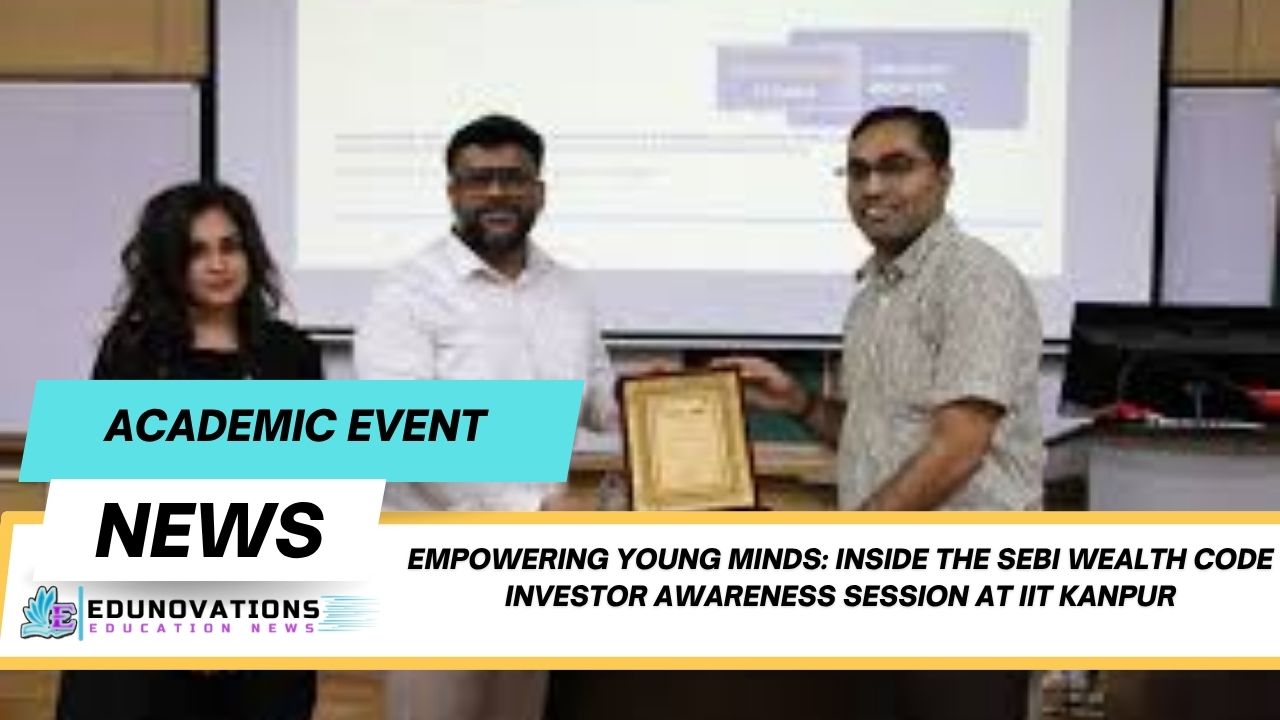
Financial literacy is no longer just an optional life skill; it is a fundamental necessity for navigating the modern economic landscape.
Financial literacy is no longer just an optional life skill; it is a fundamental necessity for navigating the modern economic landscape. As digital platforms expand access to financial markets, young adults and students find themselves facing unprecedented opportunities alongside rising vulnerabilities. Recognizing this critical need, the Indian Institute of Technology Kanpur (IIT Kanpur) recently took a monumental step toward financial empowerment by hosting the SEBI Wealth Code investor awareness session IIT Kanpur.
Organized during World Investor Week, this collaborative initiative brought together institutional excellence and regulatory oversight. By bridging the gap between academic rigor and practical financial education, the event equipped the next generation of innovators, engineers, and entrepreneurs with the knowledge required to make prudent, informed financial decisions.
The Vision Behind the ‘Wealth Code’ Initiative
In an era defined by rapid technological advancements and digital trading apps, early financial planning has transitioned from a matter of preference to an absolute urgency. The SEBI Wealth Code investor awareness session IIT Kanpur served as a dynamic platform to demystify personal finance, investment instruments, and market regulations for undergraduate and postgraduate students.
The event was jointly spearheaded by Techkriti—IIT Kanpur’s renowned annual technical and entrepreneurship festival—and the Alumni and Corporate Relations (ACR) Committee of the Department of Management Sciences (DoMS). Instrumental in bringing this initiative to campus was Prof. Suman Saurabh of DoMS, IIT Kanpur, whose visionary support ensured that students received direct exposure to regulatory insights.
For students balancing rigorous technical coursework with career planning, understanding wealth creation is paramount. Those looking to complement their analytical training with foundational academic concepts often explore structured learning modules, such as NCERT Courses, which lay the groundwork for analytical reasoning and economic literacy.
Expert Insights from Regulatory Leadership
The core of the awareness session was delivered by Mr. Vipul Jain, Deputy General Manager at the Northern Regional Office of the Securities and Exchange Board of India (SEBI). Bringing over a decade of hands-on experience in enforcing securities market regulations, investigating market fraud, and inspecting intermediaries, Mr. Jain offered students a rare, insider perspective on market integrity.
Mr. Jain emphasized that wealth accumulation is a marathon rather than a sprint. He detailed how disciplined, regular investing habits initiated early in life can leverage the immense power of compounding. To help students transition from theory to practice, the session introduced various investment avenues, including:
- Mutual Funds: Professionally managed funds pooling money from multiple investors to purchase diversified securities.
- Systematic Investment Plans (SIPs): A disciplined method of investing small, regular amounts into mutual funds to mitigate market volatility through rupee-cost averaging.
- Real Estate Investment Trusts (REITs): Vehicles that allow individuals to invest in income-producing real estate assets without directly buying property.
- Bonds: Fixed-income instruments representing loans made by investors to corporate or governmental borrowers.
Students keen on staying updated with broader macroeconomic trends, banking developments, and regulatory policy shifts frequently monitor Current Affairs to understand how global financial movements impact domestic markets.
Navigating Financial Safety and Avoiding Online Fraud
While modern financial markets offer unprecedented growth opportunities, they also expose unwary participants to sophisticated digital scams. A major focal point of the session was raising awareness regarding online investment fraud, unsolicited social media tips, and unverified ‘sure-shot’ profit calls.
Mr. Jain cautioned attendees against falling victim to fraudulent investment schemes promising guaranteed returns. He stressed that legitimate financial growth requires due diligence and adherence to established regulatory frameworks. Students were advised to deal exclusively with SEBI-registered intermediaries and verify their credentials through official verification portals.
Key defensive strategies highlighted during the session included:
- Verification via SEBI Check: An essential tool enabling investors to verify an intermediary’s bank account or UPI ID before transferring funds.
- Avoiding Social Media Noise: Ignoring unsolicited financial advice, unverified Telegram channels, and WhatsApp investment groups.
- Utilizing Official Educational Resources: Relying on trusted platforms like the SEBI SaaRthi app and official investor education portals.
For students preparing for competitive examinations or professional certifications where economic governance and regulatory bodies form part of the core syllabus, reviewing structured Notes can provide comprehensive clarity on market mechanics and consumer protection laws.
Grievance Redressal and Institutional Support
Empowerment involves not only knowing how to invest safely but also understanding recourse mechanisms when disputes arise. The session thoroughly outlined the channels available for lodging investor grievances and reporting financial fraud.
Participants were introduced to the SEBI Complaints Redressal System (SCORES), a centralized web-based platform that allows investors to lodge complaints against companies and market intermediaries online. Additionally, students were provided with SEBI’s toll-free investor helpline numbers (1800-266-7575 and 1800-22-7575) for immediate assistance and query resolution.
Educational institutions aiming to foster holistic development often integrate such practical awareness programs into their broader academic calendars. Students supplementing their academic preparation with targeted self-assessment tools frequently utilize MCQ’s to test their comprehension of financial concepts, business laws, and economic principles.
Fostering a Culture of Financial Literacy in Higher Education
The collaboration between Techkriti and DoMS at IIT Kanpur underscores the evolving role of premier technical institutes in shaping well-rounded professionals. Engineering and technology graduates frequently enter industries where financial acumen—ranging from startup funding to personal wealth management—dictates long-term career success.
Experts across the financial sector have consistently lauded such institutional outreach. Commenting on the importance of early financial education, renowned industrialist and philanthropist Nandan Nilekani has frequently emphasized:
“Financial inclusion and digital literacy are the twin pillars of a modern, resilient economy. When young minds understand the fundamentals of wealth creation, risk management, and regulatory compliance early in life, they build a secure foundation not just for themselves, but for the entire nation’s economic future.”
Such endorsements highlight why initiatives like the SEBI Wealth Code investor awareness session IIT Kanpur hold transformative value. By bridging academia and regulatory oversight, institutions prepare students to navigate complex economic environments with absolute confidence.
To visualize complex financial structures, economic cycles, and regulatory frameworks, students often rely on visual learning aids such as NCERT Mind Maps, which break down intricate topics into easily digestible visual components. Furthermore, candidates seeking structured academic roadmaps can review detailed curriculum structures through Syllabus portals to align their studies with contemporary professional requirements.
Expanding Educational Horizons and Institutional Excellence
As academic institutions continue to expand their curricular and extracurricular offerings, digital accessibility plays a pivotal role in democratizing education. Comprehensive digital libraries ensure that students across diverse backgrounds have access to high-quality study materials, video lectures, and reference guides.
For instance, students pursuing multidisciplinary subjects can access curated Videos that offer in-depth explanations of complex technical, economic, and managerial concepts. Additionally, academic institutions seeking to upgrade their digital infrastructure, web presence, and student management portals often collaborate with specialized technology partners such as Mart Ind Infotech (“Mart Ind Infotech”) to streamline administrative workflows and enhance digital engagement.
For self-paced learners and educators looking for comprehensive reading materials, exploring archival resources and Downloads of Free NCERT PDFs provides an invaluable repository of foundational texts spanning mathematics, science, social studies, and economics.
Conclusion: Cultivating Vigilance and Long-Term Vision
The SEBI ‘Wealth Code’ session at IIT Kanpur concluded with a resounding message encapsulated in SEBI’s core investor awareness motto: “Savdhaan Bartein, Satark Rahein” (Exercise caution, remain vigilant). In an age where digital connectivity exposes investors to both unprecedented opportunities and sophisticated risks, informed vigilance remains the ultimate safeguard.
By fostering direct dialogue between securities market regulators and young investors, IIT Kanpur has set a commendable benchmark for holistic education. Armed with discipline, regulatory awareness, and a long-term investment horizon, the participants of this landmark session are well-prepared to steer their financial futures toward sustainable prosperity and security.
Toppers Use Mind Maps to score more than 95%
NCERT Class 11th Commerce Mind Maps
Add to cartOriginal price was: ₹999.00.₹199.00Current price is: ₹199.00.NCERT Class 12th Chemistry Mind Maps
Add to cartOriginal price was: ₹199.00.₹75.00Current price is: ₹75.00.NCERT Class 12th Commerce Mind Maps
Add to cartOriginal price was: ₹999.00.₹199.00Current price is: ₹199.00.NCERT Class 12th Science Mind Maps
Add to cartOriginal price was: ₹999.00.₹199.00Current price is: ₹199.00.NCERT Mind Maps For Class 10th
Add to cartOriginal price was: ₹999.00.₹199.00Current price is: ₹199.00.




Purchase Today
Frequently Asked Questions (FAQs)
- What was the primary objective of the SEBI Wealth Code investor awareness session IIT Kanpur? The primary objective was to promote financial literacy, encourage disciplined early investing, and educate young investors about market instruments, regulatory compliance, and fraud prevention.
- Who organized the ‘Wealth Code’ investor awareness session at IIT Kanpur? The event was organized by Techkriti (IIT Kanpur’s annual technical and entrepreneurship festival) in collaboration with the Alumni and Corporate Relations (ACR) Committee of the Department of Management Sciences (DoMS).
- Which regulatory official conducted the financial awareness session? Mr. Vipul Jain, Deputy General Manager at SEBI’s Northern Regional Office, conducted the session, drawing upon his extensive experience in securities market regulation and fraud investigation.
- What key investment avenues were introduced to the students during the session? Participants were introduced to mutual funds, Systematic Investment Plans (SIPs), Real Estate Investment Trusts (REITs), and bonds, along with their basic features and associated risks.
- How can investors verify the legitimacy of financial intermediaries or UPI IDs? Investors can verify intermediaries and check UPI IDs or bank accounts securely before transferring funds by utilizing official regulatory verification tools like SEBI Check.
- What is the SEBI SaaRthi app used for? The SEBI SaaRthi app is a trusted investor education resource designed to help investors understand the basics of securities markets and personal finance.
- How can investors lodge grievances or report financial fraud involving market intermediaries? Investors can lodge formal complaints and track grievance redressal through the centralized SEBI Complaints Redressal System (SCORES) online platform.
- What are the official toll-free investor helpline numbers provided by SEBI? SEBI provides dedicated toll-free investor helpline numbers at 1800-266-7575 and 1800-22-7575 for immediate assistance and query resolution.
- Why is early financial planning emphasized for college students? Starting early allows young investors to harness the power of compounding, build disciplined saving habits, and achieve long-term financial security with lower market risk impact.
- What does SEBI’s investor awareness motto “Savdhaan Bartein, Satark Rahein” signify? It translates to “Exercise caution and remain vigilant,” emphasizing the critical need for investors to stay informed, verify credentials, and avoid unverified or fraudulent investment schemes.