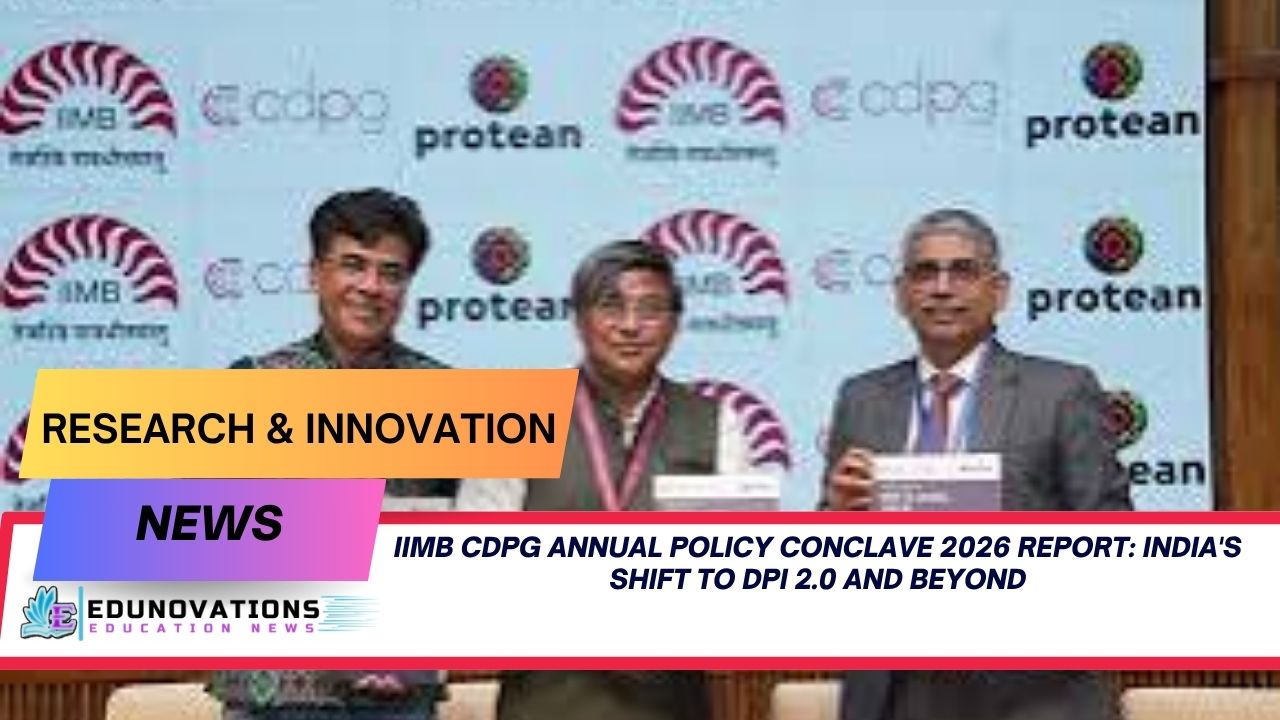
The evolution of India’s digital architecture has reached a pivotal juncture, moving from basic transactional rails to deeply integrated, cross-sectoral institutional networks.
The evolution of India’s digital architecture has reached a pivotal juncture, moving from basic transactional rails to deeply integrated, cross-sectoral institutional networks. At the forefront of this transformation is the newly released iimb cdpg annual policy conclave 2026 report, unveiled during a high-profile gathering at the Indian Institute of Management Bangalore (IIMB). Jointly hosted by the Center for Digital Public Goods (CDPG) and the eGov Foundation, this landmark event brought together global thinkers, public policy architects, and industry leaders to analyze how Digital Public Infrastructure (DPI) is reshaping modern governance, commerce, education, and public service delivery across the nation.
Commissioned by Protean eGov Technologies Ltd. and authored by the academic experts at CDPG, the publication titled State of DPI in India 2026 delivers an empirical evaluation of how open digital standards enable institutional coordination across dynamic ecosystems. The key findings presented in the iimb cdpg annual policy conclave 2026 report underscore a fundamental strategic migration: India is successfully transitioning from establishing isolated digital guardrails (DPI 1.0) toward building interconnected, interoperable, and sector-wide ecosystems (DPI 2.0), while setting the preliminary groundwork for an AI-enabled future (DPI 3.0).
The Strategic Evolution: Moving from DPI 1.0 to DPI 2.0 in India
For the past decade, India’s digital journey was anchored in building foundational rails. Phase 1.0 prioritized widespread identity verification through Aadhaar, seamless digital payments through the Unified Payments Interface (UPI), and scalable document authentication via Data Empowerment and Protection Architecture (DEPA). However, as highlighted in the iimb cdpg annual policy conclave 2026 report, single-purpose infrastructure is no longer sufficient to solve complex, multi-stakeholder socioeconomic challenges.
The ongoing transition from dpi 1.0 to dpi 2.0 in india shifts focus toward systemic interoperability, shared registries, consent-driven data exchanges, and cross-domain synergy. Rather than operating in isolated silos, financial networks, health databases, logistics corridors, and educational repositories are now communicating through standardized open protocols.
“Through comparative analysis and interactive visualizations, the 2026 edition of the ‘State of DPI in India’ report builds on the Center’s efforts to develop an evidence base on India’s evolving DPI landscape and contribute to the global discourse on how open, reusable and interoperable DPI can advance inclusive growth, institutional coordination and resilient public-service ecosystems.” — Prof. R. Srinivasan, Chairperson of the Center for Digital Public Goods (CDPG) and Faculty in Strategy at IIM Bangalore.
Prof. Srinivasan’s observations reinforce that DPI maturity should not be evaluated as a static, binary achievement. Instead, it is a dynamic evolutionary continuum measured by institutional adoption, ecosystem participation, public trust, and decentralized market innovation.
Deep-Dive into Sectoral Transformation Across Five Domains
The comprehensive empirical model embedded in the iimb cdpg annual policy conclave 2026 report tracks five core pillars of the national economy: financial services, healthcare, agriculture, digital commerce, and education. Each domain reflects varying stages of digital adoption, operational maturity, and structural integration.
1. Financial Services: The Golden Standard of DPI Maturity
Financial services represent the most mature ecosystem within India’s digital landscape. Having achieved massive population-scale adoption, the sector is leveraging interoperable transaction engines to expand credit access to micro, small, and medium enterprises (MSMEs). By utilizing unified account aggregators and friction-free payment networks, financial institutions can instantly evaluate creditworthiness using verified digital footprints rather than collateral.
2. Healthcare: Creating Connected Health Registries
The implementation of the Ayushman Bharat Digital Mission (ABDM) exemplifies the expansion of digital public infrastructure in education and healthcare. Shared health registries, standardized facility identifiers, and consent-driven health data exchanges empower patients to transfer records seamlessly across hospitals, diagnostic centers, and tele-consultation platforms, ensuring continuity of care without compromising personal privacy.
3. Agriculture: Overcoming Fragmented Value Chains
India’s agricultural sector has historically suffered from market fragmentation, opaque pricing, and asymmetric information. Through AgriStack and open digital frameworks, farmers are gaining direct access to verified land records, targeted credit facilities, customized weather advisories, and direct-to-consumer digital marketplaces. By connecting input suppliers, state government schemes, and financial institutions, DPI is reducing operational friction for rural communities.
4. Digital Commerce: Democratizing E-Commerce Through Open Networks
The Open Network for Digital Commerce (ONDC) demonstrates how interoperable digital marketplaces break central monopolies. Small local retailers can now showcase products across multiple buyer platforms without paying prohibitive platform commission fees. Similarly, unified logistics and procurement systems facilitate transparent price discovery and streamlined supply chain management across domestic trade networks.
5. Education: Continuous Lifelong Learning Infrastructure
The deployment of shared digital platforms, such as the NDIER (National Digital Education Architecture) and DIKSHA, showcases the powerful application of digital public infrastructure in education and healthcare. By establishing verified learner identities, portable digital credentials, and accessible repositories, students across urban centers and rural areas can build lifelong learning portfolios. To complement these academic advances, students preparing for foundational exams can explore curated resource centers like For NCERT Courses and download essential textbooks via For Downloads of Free NCERT PDFs.
Key Insights from Industry Leaders at the Policy Conclave
The unveiling ceremony at IIM Bangalore was led by key figures who have spearheaded large-scale public technology initiatives across India. The iimb cdpg annual policy conclave 2026 report was formally released alongside detailed commentary from executive leaders representing both technical implementation partners and policy non-profits.
Mr. V. Easwaran, Executive Director & Chief Operating Officer at Protean eGov Technologies Ltd., reflected on the broader societal implications of the findings presented in the iimb cdpg annual policy conclave 2026 report:
“Protean has had the privilege of being part of India’s digital transformation journey from its early chapters, and it is deeply rewarding to see how that journey has evolved into a globally relevant conversation around Digital Public Infrastructure. For us, DPI has always been about more than technology; it is about building trusted systems that make everyday interactions simpler, more inclusive and more accessible. Our association with the Center for Digital Public Goods at IIM Bangalore gives us an opportunity to step back, reflect on how far the ecosystem has come, and contribute to the thinking on where it goes next. The ‘State of DPI in India 2026’ report captures that transition beautifully.” — Mr. V. Easwaran, ED & COO, Protean eGov Technologies Ltd.
Mr. Viraj Tyagi, Chief Executive Officer of eGov Foundation, further emphasized that the primary challenge moving forward is organizational, non-technical coordination. Building resilient public-service delivery channels requires aligning regulatory mandates across municipal, state, and central authorities.
Measuring DPI Maturity: An Institutional Framework
A prominent takeaway from the iimb cdpg annual policy conclave 2026 report is the reframing of DPI as an institutional innovation rather than a purely technological upgrade. Technology provides the protocol layer, but long-term success is dictated by governance structures, incentive alignment, techno-legal safeguards, and user confidence.
       [ DPI 1.0: Foundational Layer ]
  (Identity, Payments, Basic Registries)
                  │
                  ▼
       [ DPI 2.0: Connected Ecosystems ]
  (Interoperability, Open Networks, Sector Protocols)
                  │
                  ▼
       [ DPI 3.0: Intelligent Governance ]
  (AI Integration, Automated Decisions, Predictive Care)
To achieve true institutional maturity, the iimb cdpg annual policy conclave 2026 report advocates for a Whole-of-Government (WoG) governance methodology. Public administrative bodies often operate in functional silos, forcing citizens to navigate fragmented portals to access statutory services. By embedding shared digital registries and common data standards across government ministries, departments can deliver unified, proactive public service experiences.
Charting the Horizon: The Future of DPI 3.0 and Artificial Intelligence Governance
As digital ecosystems become increasingly interconnected, the strategic discourse is already looking beyond static platform management. A major portion of the iimb cdpg annual policy conclave 2026 report explores future of dpi 3.0 and artificial intelligence governance, detailing how generative models and machine learning algorithms will serve as the cognitive layer of public infrastructure.
In a DPI 3.0 framework, Artificial Intelligence (AI) will leverage trusted, consent-based registries to anticipate citizen needs, automate administrative workflows, personalize educational pathways, and optimize medical interventions. However, the integration of AI models into sensitive public domain infrastructure introduces significant ethical considerations.
Essential Pillars for DPI 3.0 Governance:
- Algorithmic Accountability: Ensuring automated decision-making processes within public welfare delivery systems remain fully auditable and unbiased.
- Techno-Legal Privacy Guardrails: Embedding privacy-by-design architecture, zero-knowledge proofs, and secure multiparty computation to protect citizen data.
- Proactive Security Architecture: Implementing continuous threat monitoring to safeguard mission-critical networks against cyber disruptions.
- Public Information & Civil Preparation: Providing candidates and policy professionals with structured educational materials. Aspirants studying governance architectures can access dedicated study modules at For Notes, review current public policy developments via For Current Affairs, and test their comprehension using structured exercises on For MCQ’s.
The iimb cdpg annual policy conclave 2026 report emphasizes that maintaining public trust requires strict compliance with privacy standards, ensuring that technology serves citizens equitably regardless of socioeconomic background.
Policy Recommendations & The Path Forward for Global Adoption
The findings in the iimb cdpg annual policy conclave 2026 report offer a comprehensive blueprint for emerging economies seeking to replicate India’s digital transformation. By open-sourcing underlying protocols, standardizing data schemas, and encouraging private market innovation, nations can build resilient digital public goods without risking vendor lock-in.
Key structural recommendations outlined in the iimb cdpg annual policy conclave 2026 report include:
- Prioritizing Open Specifications: Ensuring core software, APIs, and data models remain open-access to promote healthy market competition.
- Promoting Academic Research: Fostering academic-industry partnerships between institutions like IIM Bangalore, tech organizations, and global development entities to maintain robust evidence-based research.
- Enhancing Digital Literacy: Supporting comprehensive training resources for educators, civil servants, and students. Educational institutions seeking web infrastructure solutions to digitize their curriculum can connect with industry experts through Mart Ind Infotech.
- Interactive Multi-Media Learning: Leveraging modern educational media platforms, such as those available at For Videos, alongside structural study guides located at For Syllabus and visual learning frameworks available via For NCERT Mind Maps.
As the insights from the iimb cdpg annual policy conclave 2026 report demonstrate, India’s journey from isolated foundational tools to an integrated, AI-ready DPI ecosystem provides a compelling template for global public governance in the 21st century.
Toppers Use Mind Maps to score more than 95%
NCERT Class 11th Commerce Mind Maps
Add to cartOriginal price was: ₹999.00.₹199.00Current price is: ₹199.00.NCERT Class 12th Chemistry Mind Maps
Add to cartOriginal price was: ₹199.00.₹75.00Current price is: ₹75.00.NCERT Class 12th Commerce Mind Maps
Add to cartOriginal price was: ₹999.00.₹199.00Current price is: ₹199.00.NCERT Class 12th Science Mind Maps
Add to cartOriginal price was: ₹999.00.₹199.00Current price is: ₹199.00.NCERT Mind Maps For Class 10th
Add to cartOriginal price was: ₹999.00.₹199.00Current price is: ₹199.00.





Purchase Today
Frequently Asked Questions (FAQs)
1. What is the primary focus of the iimb cdpg annual policy conclave 2026 report?
The iimb cdpg annual policy conclave 2026 report, titled State of DPI in India 2026, focuses on evaluating the evolution of India’s Digital Public Infrastructure across five core sectors: financial services, healthcare, agriculture, commerce, and education. It details the strategic shift from basic foundational tools to connected, interoperable ecosystems.
2. Who authored and commissioned the State of DPI in India 2026 report?
The report was authored by academic researchers at the Center for Digital Public Goods (CDPG) at IIM Bangalore and commissioned by Protean eGov Technologies Ltd. It was officially unveiled in partnership with the eGov Foundation at IIMB.
3. What is the difference between DPI 1.0 and DPI 2.0 as highlighted in the report?
DPI 1.0 focused on building individual foundational rails like identity (Aadhaar), payments (UPI), and data verification (DEPA). The transition from dpi 1.0 to dpi 2.0 in india focuses on interconnecting these rails into interoperable networks, creating shared registries, and building digital institutions across complex sectors.
4. How does the report define digital public infrastructure in education and healthcare?
According to the report, digital public infrastructure in education and healthcare provides shared, consent-driven frameworks—such as portable learning credentials and unified health registries—that enable continuous service delivery and seamless information exchange across institutions.
5. What role will Artificial Intelligence play in the future of DPI 3.0?
The future of dpi 3.0 and artificial intelligence governance involves layering AI models over trusted digital infrastructure to provide predictive analysis, automated administrative processing, personalized learning paths, and intelligent public service delivery.
6. How is DPI maturity evaluated in the iimb cdpg annual policy conclave 2026 report?
DPI maturity is evaluated as an evolutionary continuum rather than a binary outcome. It assesses technological deployment, institutional adoption, user trust, ecosystem participation, and cross-boundary coordination.
7. What is the Whole-of-Government (WoG) approach mentioned in the conclave?
The Whole-of-Government approach aligns interoperable systems, governance frameworks, and data standards across all ministries and administrative levels to create seamless citizen experiences across government services.
8. Which sector has achieved the highest level of DPI maturity in India?
Financial services represent the most mature sector in India’s DPI landscape, having successfully scaled interoperable digital payments, account aggregation, and automated credit assessment engines nationwide.
9. Where can students access educational resources related to public policy and exam preparation?
Students and policy aspirants can access study materials, notes, and interactive guides through platforms such as For NCERT Courses and examine current updates at For Current Affairs.
10. Why is the iimb cdpg annual policy conclave 2026 report significant globally?
The report provides an evidence-based roadmap for developing open, reusable, and interoperable digital public goods, offering valuable insights for emerging nations looking to build inclusive digital economies.