The intersection of higher education, national defense, and corporate recruitment has long been a battleground for ideological debate.
Introduction to the Modern Campus Conflict
The intersection of higher education, national defense, and corporate recruitment has long been a battleground for ideological debate. Modern universities are increasingly viewed not merely as ivory towers of academic pursuit, but as vital talent pipelines for cutting-edge technological and defense industries. This dynamic took center stage during a recent high-profile gathering on a prominent California campus. When elite academic institutions open their doors to military-industrial stakeholders, the friction between institutional growth and student activism frequently erupts into public view.
Understanding how academic environments navigate these complex relationships requires looking closely at both sides of the modern geopolitical and ethical divide. For students studying contemporary public policy, international relations, or sociology—similar to topics covered in structured educational curriculums like NCERT Courses—these events provide live case studies in civic engagement and institutional governance. To fully grasp the broader implications of these developments, students and educators alike often rely on comprehensive Notes and daily updates found via dedicated Current Affairs portals.
The Backdrop: DEFCON and the Defense Industry on Campus
Universities across the globe have steadily deepened their ties with artificial intelligence, aerospace, and defense contracting firms. These partnerships are typically framed by university administrators as essential drivers of economic innovation, technological progress, and lucrative career pathways for graduating engineers and computer scientists.
At the center of the recent demonstration was a multi-day meetup designed to foster industry engagement between defense contractors and university talent. Featuring prominent venture-backed startups and defense agencies alongside senior government officials, the gathering aimed to showcase the latest in dual-use technologies, aerial drones, and AI-driven military applications.
However, this growing integration has alarmed various student coalitions who argue that channeling elite academic talent into military applications carries profound ethical consequences. Critics point to global conflicts where modern surveillance technology, predictive analytics, and autonomous systems are deployed, raising profound questions about the moral responsibility of academic institutions. For those preparing competitive exams or analyzing institutional policies, practicing with specialized MCQ’s and reviewing curated Syllabus guidelines can help contextualize how public institutions balance corporate partnerships with academic freedom.
Anatomy of the Demonstration Outside Encina Commons
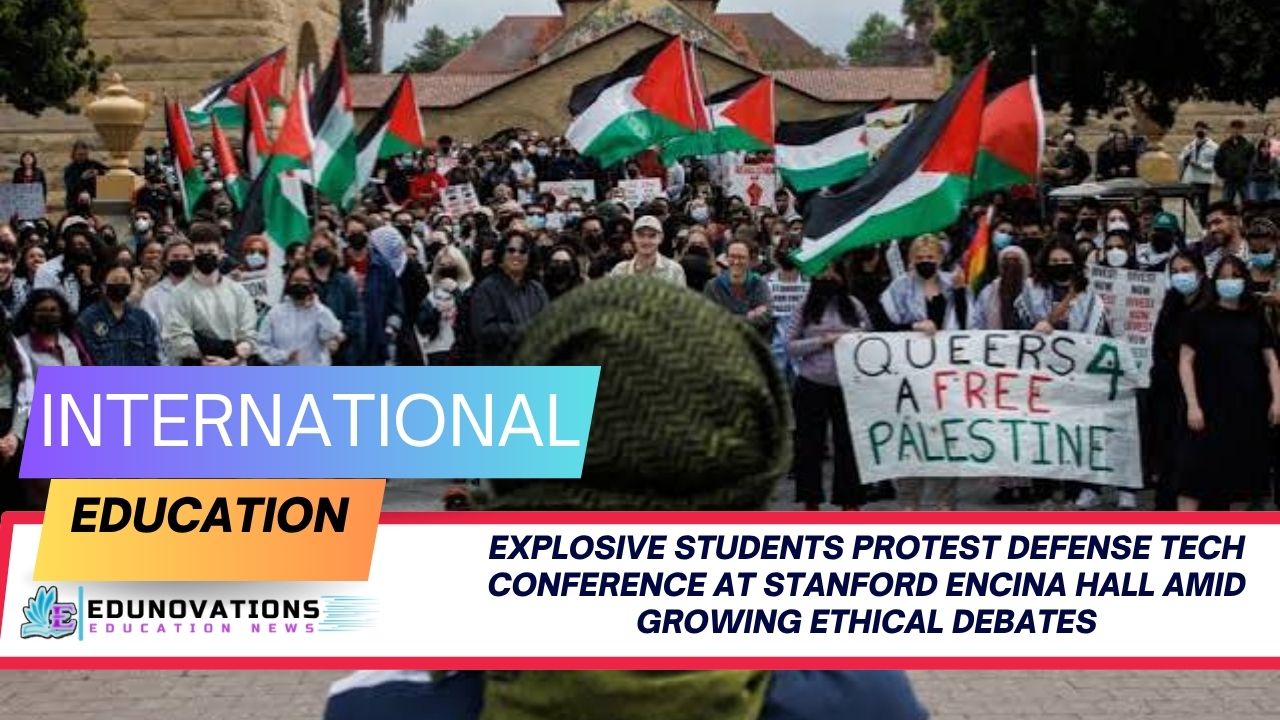
The tension culminated during a morning tabling session outside a major campus hub. While corporate representatives displayed promotional imagery and physical models of advanced reconnaissance drones, a dedicated group of student demonstrators gathered across the thoroughfare to make their voices heard.
Opting for a peaceful yet striking visual display, the demonstrators utilized artistic props, hand-painted signage, and a theatrical puppet representation of a prominent Silicon Valley billionaire and co-founder of a major data analytics firm. Their banners, bearing stark warnings, aimed to disrupt the standard recruitment pipeline by forcing attendees and passersby to confront the downstream human costs of military-industrial expansion.
Despite the provocative nature of the protest, organizers were careful to adhere strictly to institutional time, place, and manner policies. By refraining from amplified sound systems and ensuring walkways remained unobstructed, the demonstration avoided administrative crackdowns while maintaining a steady visual presence. Observers noted that while the gathering was modest in size, its symbolic impact resonated across the wider campus community, sparking intense digital debates and campus-wide discussions.
The Ethical Debate: Talent Funnels and Global Conflicts
The core grievance articulated by student organizers centers on what they describe as a systemic “funneling” mechanism. According to campus activists, universities possess an ethical duty to direct intellectual capital toward sustainable development, climate action, and humanitarian innovation rather than defense technologies.
Critics of the defense recruitment pipeline argue that modern warfare is increasingly automated, relying on artificial intelligence to streamline targeting and surveillance. When top-tier engineering programs supply the labor force for these innovations, universities inadvertently become active participants in global conflicts.
Supporters of defense industry engagement, on the other hand, maintain that technological superiority is vital for national security and democratic preservation. Proponents argue that private-public collaboration ensures that ethical, constitutional democracies retain a technological edge against authoritarian adversaries. Furthermore, corporate representatives often emphasize that many dual-use technologies developed for defense applications eventually yield life-saving civilian advancements, ranging from disaster response robotics to advanced medical imaging diagnostics.
To explore these multi-faceted arguments in greater depth, learners can access free educational texts and downloadable guides through platforms offering Downloads of Free NCERT PDFs and structured visual frameworks via NCERT Mind Maps. Additionally, multimedia breakdowns and expert commentary can be explored through specialized educational video repositories like Videos.
Broader Perspectives and Expert Insights on University Partnerships
The debate over corporate recruitment on college campuses is mirrored in broader discussions across higher education governance. Industry analysts frequently point out that modern research universities rely heavily on private partnerships to fund expensive laboratory infrastructure, quantum computing centers, and advanced AI research hubs that federal grants alone cannot fully sustain.
However, ethicists and sociologists urge university leadership to implement stricter ethical review boards for corporate partnerships. Establishing transparent guidelines can help institutions distinguish between civilian-centric technology development and offensive military contracting. Without such guardrails, universities risk alienating student bodies and faculty members who feel their academic labor is being co-opted for geopolitical ends.
Educational institutions aiming to modernize their digital communication, streamline administrative workflows, or build robust web portals for campus discourse often partner with professional software and IT developers such as Mart Ind Infotech to ensure secure and efficient online engagement.
Toppers Use Mind Maps to score more than 95%
NCERT Class 11th Commerce Mind Maps
Add to cartOriginal price was: ₹999.00.₹199.00Current price is: ₹199.00.NCERT Class 12th Chemistry Mind Maps
Add to cartOriginal price was: ₹199.00.₹75.00Current price is: ₹75.00.NCERT Class 12th Commerce Mind Maps
Add to cartOriginal price was: ₹999.00.₹199.00Current price is: ₹199.00.NCERT Class 12th Science Mind Maps
Add to cartOriginal price was: ₹999.00.₹199.00Current price is: ₹199.00.NCERT Mind Maps For Class 10th
Add to cartOriginal price was: ₹999.00.₹199.00Current price is: ₹199.00.





Purchase Today
Frequently Asked Questions
1. What was the main reason behind the students protest defense tech conference at stanford encina hall?
The demonstration was organized to protest the presence of defense contracting firms and military AI startups recruiting student talent on campus, with activists arguing that such industries contribute to global conflicts and human suffering.
2. Which prominent tech figure was targeted during the campus demonstration?
A prominent Silicon Valley investor and co-founder of a major defense-linked data analytics firm was visually targeted through artistic props and satirical signage during the rally.
3. How did the student organizers ensure their demonstration remained peaceful?
Organizers intentionally limited the size of the group, avoided amplified sound systems, and refrained from blocking pedestrian pathways or roadways, successfully complying with campus time and place restrictions.
4. What arguments do proponents of defense tech conferences make?
Supporters argue that defense industry engagement supports national security, fosters critical technological innovation, and provides valuable career opportunities for engineering and computer science graduates.
5. What role do student activist groups play in modern university policies?
Student coalitions help raise ethical awareness, challenge institutional complicity in controversial industries, and pressure university administrations to re-evaluate their corporate partnership guidelines.
6. Why are dual-use technologies a central point of discussion in these protests?
Dual-use technologies possess applications in both civilian sectors and military operations, making it challenging to draw a clear ethical boundary regarding their research and development.
7. How do universities balance corporate partnerships with academic freedom?
Most major universities maintain open-door policies for legal enterprises while allowing peaceful campus demonstrations, thereby attempting to balance free expression with institutional partnerships.
8. What impact do such protests have on student recruitment pipelines?
While protests rarely halt conferences entirely, they raise public visibility around recruitment practices, prompting students to critically evaluate their career choices and potential employers.
9. Where can students find more educational resources regarding modern political and social movements?
Students can utilize academic portals, online study notes, current affairs updates, and structured course materials to analyze the socioeconomic and political implications of institutional policies.
10. What measures do universities take to maintain safety during campus demonstrations?
Campus security and administration typically monitor protests to ensure public safety, protect free speech rights, and prevent disruptions to official university events.