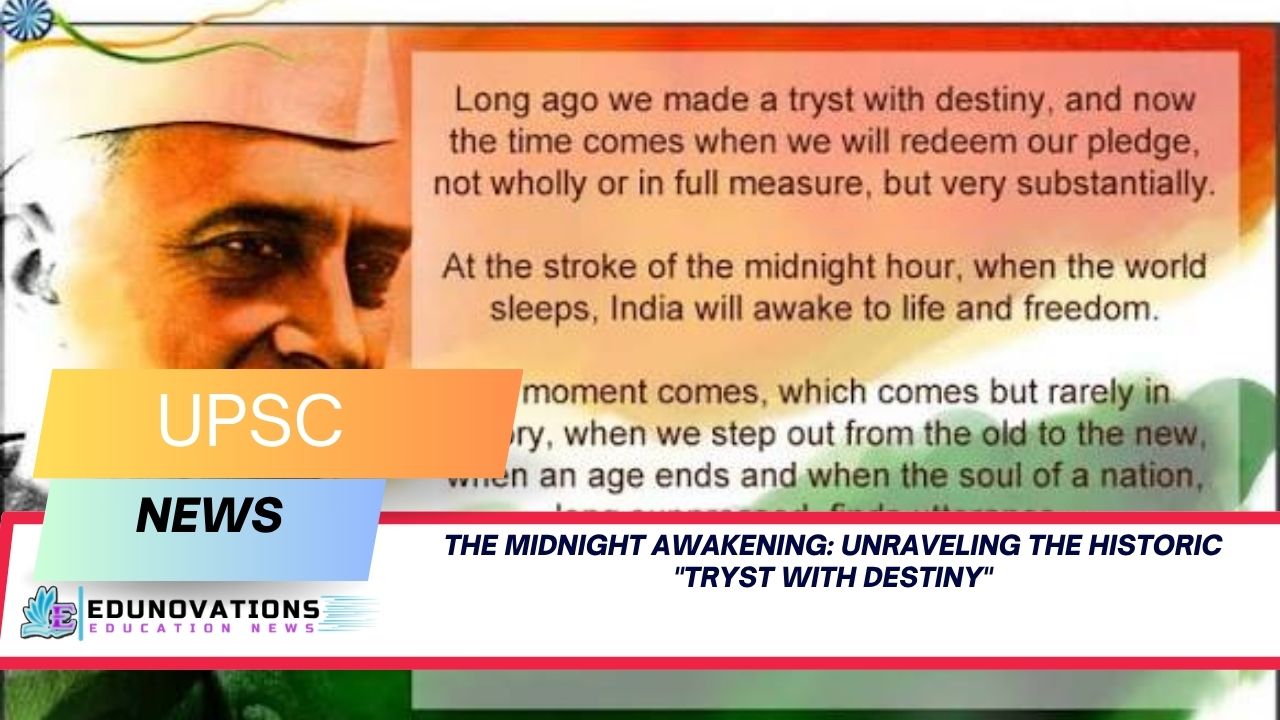
The annals of history are often defined by singular moments that alter the course of nations. For India, the transition from colonial subjugation to sovereign statehood is inextricably linked to one such moment
The annals of history are often defined by singular moments that alter the course of nations. For India, the transition from colonial subjugation to sovereign statehood is inextricably linked to one such moment: the stroke of midnight on August 14–15, 1947. As the world watched, India’s first Prime Minister, Jawaharlal Nehru, stood before the Constituent Assembly to articulate the aspirations of millions. Central to the discourse of historians and curious citizens alike remains the question: Why was Nehru’s Tryst with Destiny speech delivered at midnight?
To understand this event, one must look beyond the mere act of speaking; one must delve into the psychological, political, and symbolic weight of a midnight hour that marked the birth of the world’s largest democracy.
The Atmospheric Significance of the Midnight Hour
The transition of power from the British Empire to the Indian dominion was not merely a bureaucratic exchange of files. It was an emotional and existential rebirth. The choice of midnight was deliberate. For many, the night symbolizes the end of a long, dark period of colonialism—a night of struggle, sacrifice, and pain—while the dawn represents a fresh start.
Why was Nehru’s Tryst with Destiny speech delivered at midnight? The answer lies in the intense desire of the Indian leadership to mark the exact moment of the exit of the British Raj. By convening the Constituent Assembly as the clock ticked toward 12:00 AM, the leaders ensured that the very first breath of an independent India was taken under the stewardship of its own people.
For students and aspirants preparing for competitive examinations, understanding these nuances is critical. For structured resources, explore our NCERT Courses and stay updated with Current Affairs.
Understanding the “Tryst”
The word “tryst” suggests an appointment or a secret meeting. By using this terminology, Jawaharlal Nehru was not speaking as a politician, but as a visionary communicating with the collective consciousness of his countrymen.
The Meaning of Tryst with Destiny in Indian independence history goes deep into the philosophical commitments made by the nation to its own future. Nehru framed the struggle for freedom not just as a victory over the British, but as a meeting with the destiny that India had long been denied. This was a promise of equality, social justice, and economic upliftment that would guide the nation for decades.
For those tracking the broader context, comprehensive Notes and well-curated MCQ’s offer deeper insights into this transformative era.
The Architecture of Independence
The Historical significance of the midnight transfer of power 1947 cannot be overstated. When we ask, Why was Nehru’s Tryst with Destiny speech delivered at midnight?, we must also consider the atmosphere within the Constituent Assembly. The air was thick with the trauma of Partition, the anxiety of communal riots, and the immense pressure of building a country from scratch.
Jawaharlal Nehru addressed these challenges with eloquence. He emphasized that freedom was not an end in itself, but the beginning of a relentless journey toward the eradication of poverty, ignorance, and disease. Schools seeking to modernize their digital infrastructure to support such historical education can seek professional guidance from Mart Ind Infotech.
The Core Messages of the 1947 Address
When analyzing the text of the speech, the What was the primary message of Nehru’s 1947 midnight speech? question brings us to his focus on responsibility. He explicitly stated that the service of India means the service of the millions who suffer. It meant ending the poverty and ignorance that had plagued the country under colonial rule.
If you are looking for visual aids, our Videos on this topic provide a clearer picture, while our Syllabus tracks how this history fits into modern curricula.
Integrating Constitutional Aspirations
The link between Nehru’s Tryst with Destiny speech and the Indian Constitution is profound. The values echoed in the speech—justice, liberty, equality, and fraternity—became the foundational pillars of the Constitution of India. The speech essentially acted as a preamble to the democratic ideals that the Constituent Assembly would go on to codify in the years that followed.
Many historians have noted that Nehru’s oratorical prowess served to unify a fractured country. In his own words, though not at the midnight hour, but in similar contexts, he often reminded his peers that the diversity of India was its greatest strength.
The Necessity of Deep Study
In an era where information is abundant but wisdom is rare, students must prioritize high-quality resources. Whether you are downloading Free NCERT PDFs or studying NCERT Mind Maps, the focus must remain on connecting historical events like the midnight speech to their lasting impact on modern policy and societal structure.
Why was Nehru’s Tryst with Destiny speech delivered at midnight? It was because the gravity of the occasion demanded a break from the ordinary. A day-time announcement would have felt too much like a mundane administrative act. The midnight hour offered a sense of sanctity—a moment of prayer, a moment of reflection, and a moment of transition.
Reflecting on the Legacy
The legacy of the speech remains etched in the Indian psyche. Even today, on every Independence Day, snippets of that midnight address are played across news channels and school assemblies. It serves as a reminder that the struggle for freedom was not just about removing the British, but about empowering the weakest of the weak.
As we continue to investigate Why was Nehru’s Tryst with Destiny speech delivered at midnight?, we see that it effectively set the tone for a nation that was to be governed by the rule of law. The speech was a clarion call for unity at a time when the nation was being torn apart by the tragic realities of Partition.
Toppers Use Mind Maps to score more than 95%
NCERT Class 11th Commerce Mind Maps
Add to cartOriginal price was: ₹999.00.₹199.00Current price is: ₹199.00.NCERT Class 12th Chemistry Mind Maps
Add to cartOriginal price was: ₹199.00.₹75.00Current price is: ₹75.00.NCERT Class 12th Commerce Mind Maps
Add to cartOriginal price was: ₹999.00.₹199.00Current price is: ₹199.00.NCERT Class 12th Science Mind Maps
Add to cartOriginal price was: ₹999.00.₹199.00Current price is: ₹199.00.NCERT Mind Maps For Class 10th
Add to cartOriginal price was: ₹999.00.₹199.00Current price is: ₹199.00.





Purchase Today
Frequently Asked Questions
- Why was Nehru’s Tryst with Destiny speech delivered at midnight? It was delivered at midnight to symbolize the exact moment of transition from colonial rule to independent statehood, marking a clean break between the past and the future.
- What is the deeper Meaning of Tryst with Destiny in Indian independence history? It refers to the long-awaited appointment India had with its own freedom, where the nation finally reclaimed its sovereignty after centuries of struggle.
- What is the Historical significance of the midnight transfer of power 1947? It signified the end of the British Raj and the legal birth of India as a sovereign nation, setting the stage for the creation of the Constitution.
- What was the primary message of Nehru’s 1947 midnight speech? The core message was that independence brought with it immense responsibilities to alleviate poverty, inequality, and communal tension to build a just society.
- How do we connect Nehru’s Tryst with Destiny speech and the Indian Constitution? The democratic values, rights, and vision articulated in the speech provided the philosophical foundation for the preamble and articles of the Indian Constitution.
- Why did the Constituent Assembly meet at night? The Assembly met to formalize the transfer of power, ensuring that independence was declared exactly when the British legal authority expired.
- Did Nehru face challenges while preparing for this speech? Yes, he was balancing the joy of freedom with the profound pain of the ongoing Partition, which influenced the somber and responsible tone of the speech.
- How can students better understand this historical event? Students should utilize official notes and detailed syllabus guides to understand the historical context surrounding August 15, 1947.
- Was the midnight timing unique to India? Yes, while other countries have their own independence traditions, the “midnight” symbolism is uniquely tied to the transfer of power in India as planned by the Mountbatten administration.
- Why is this speech still relevant today? It remains relevant because it continues to remind citizens and leaders alike of the unfinished tasks of social justice and national unity.