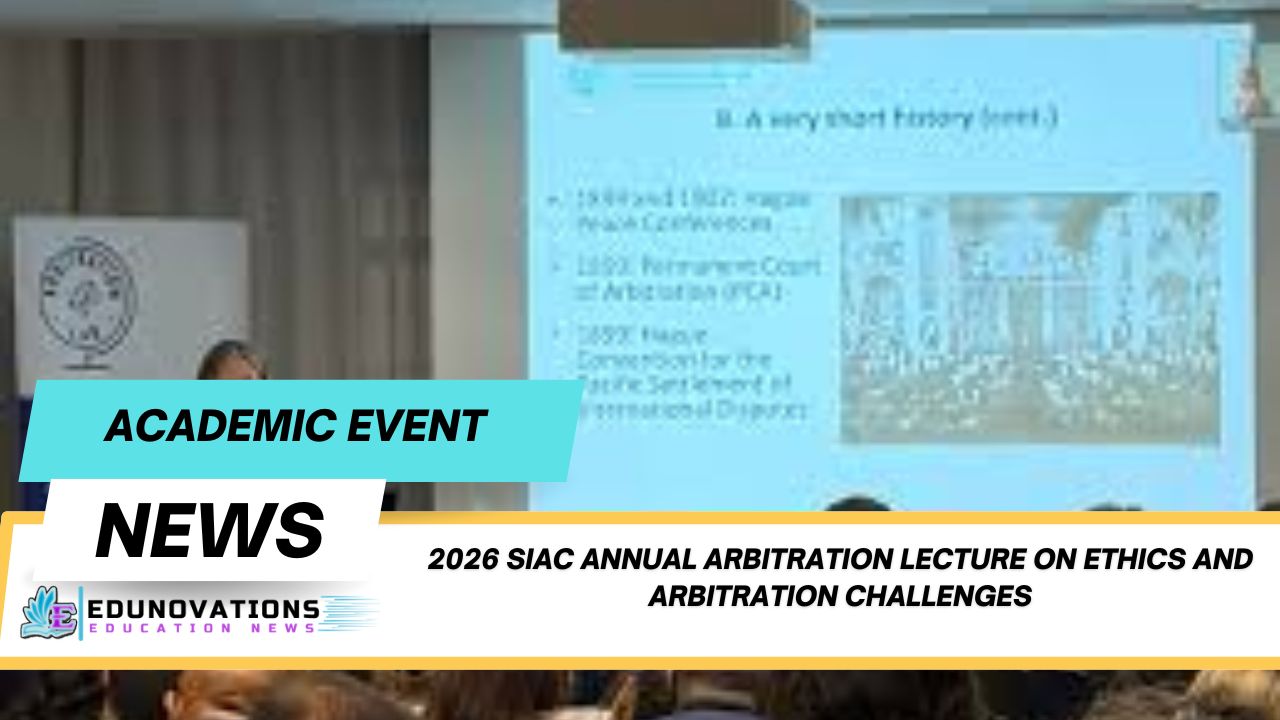
Explore the 2026 SIAC Annual Arbitration Lecture on ethics and arbitration challenges at NLSIU, featuring Mr. V K Rajah SC.
The 2026 SIAC Annual Arbitration Lecture on ethics and arbitration challenges was hosted by the National Law School of India University (NLSIU), Bengaluru, in collaboration with the Singapore International Arbitration Centre (SIAC). The event, held on April 25, 2026, at the Aurora Auditorium, Prestige Falcon Towers, Bengaluru, attracted legal experts, students, and professionals from across the country.
Overview of the Lecture
The lecture, titled “Ethical Theatre: Soft Law, Hard Truths – The Present Challenge of Arbitration Ethics”, was delivered by Mr. V K Rajah SC, an esteemed international arbitrator from Duxton Hill Chambers, Singapore. It emphasized the crucial need for ethical governance and accountability in international arbitration, highlighting how soft law alone cannot ensure enforcement or credibility.
International arbitration, while rich in codes of conduct, often faces challenges in enforcement. Mr. Rajah SC highlighted that without credible oversight, arbitration can become mere theatre. He stressed that the legitimacy of arbitration is dependent on public legal orders, state recognition, and judicial supervision. Confidentiality should never serve as a shield for unethical practices.
Key Ethical Challenges in Arbitration
The lecture underlined three persistent structural issues:
- No Democratic Anchor: Arbitration lacks a mechanism that represents wider public interest.
- Non-uniform Enforceability: Ethical standards are inconsistent across jurisdictions.
- Absence of Centralized Discipline: Institutions often compete, prioritizing market share over accountability.
Soft law, while comforting institutions, cannot replace hard enforcement. Mr. Rajah SC argued that structural reforms must include clear consequences for ethical lapses, transparency in decision-making, and institutional courage.
Expert Insights and Recommendations
Drawing from his extensive experience, Mr. Rajah SC proposed four essential reforms for ethical arbitration:
- Consequences That Bite: Arbitrators and institutions must face tangible repercussions for unethical practices.
- Transparency in Decisions: Public access to arbitration rulings ensures accountability.
- Checks on Repeat Conflicts: Systems must prevent recurring ethical violations.
- Institutional Courage: Arbitration bodies must uphold standards even at the cost of market competition.
These insights resonate with ongoing reforms in investor–state arbitration and signal the importance of credibility in high-value public contracts globally.
About the Speaker: Mr. V K Rajah SC
Mr. V K Rajah SC is a distinguished figure in international law, having served as Attorney-General of Singapore and Judge of Appeal. His expertise spans commercial arbitration across Asia, and he has been a pivotal figure in shaping Singapore’s legal sector. Notably, he chaired the 2007 Committee to Develop the Singapore Legal Sector, introducing transformative reforms to legal services, education, and dispute resolution.
He also serves as Chairman of the National Advisory Council on the Ethical Use of AI and Data and has a medical ethics professorship named after him at the National University of Singapore. His career highlights the intersection of ethics, law, and governance in both national and international contexts.
Event Significance
The lecture served as a platform to:
- Discuss challenges in international arbitration ethics.
- Provide insights into soft law limitations and the need for enforceable standards.
- Promote knowledge sharing among legal practitioners, scholars, and students.
- Encourage reform initiatives to enhance transparency and accountability in arbitration.
Attendees emphasized the importance of understanding arbitration not just as a private mechanism but as an institution reliant on public trust and legitimacy.
Broader Context: NLSIU & SIAC Partnership
The partnership between NLSIU and SIAC represents a commitment to fostering legal education and professional development in arbitration. The lecture series is a significant step in providing students and legal professionals with direct access to international arbitration insights.
The 2026 SIAC Annual Arbitration Lecture on ethics and arbitration challenges reinforces NLSIU’s role as a thought leader in legal education and SIAC’s position as a global dispute resolution hub.
How Students and Professionals Benefit
Participants gained:
- Deep understanding of arbitration ethics in high-stakes international disputes.
- Exposure to best practices in enforcement and transparency.
- Opportunity to network with legal experts and practitioners.
- Practical insights for applying ethical standards in real-world arbitration cases.
This knowledge is particularly valuable for students pursuing NCERT courses, preparing for legal exams, or seeking guidance from authoritative resources such as NCERT Notes and NCERT Mind Maps.
Internal & External Resources
For students aiming to deepen their understanding:
- Explore Current Affairs for global arbitration developments.
- Access free NCERT PDFs for legal and ethical studies.
- Use MCQs for practice on arbitration topics.
- Watch Videos explaining complex arbitration concepts.
- Check Syllabus for course alignment.
For authoritative external references, Mart Ind Infotech offers expert guidance for schools and institutions on legal workshops and training.
Conclusion
The 2026 SIAC Annual Arbitration Lecture on ethics and arbitration challenges at NLSIU was more than a seminar—it was a crucial discussion on strengthening the ethical foundations of international arbitration. By integrating enforceable standards, promoting transparency, and fostering institutional courage, the arbitration community can ensure legitimacy and public trust.
The insights shared by Mr. V K Rajah SC provide a roadmap for reform and education, offering legal professionals, scholars, and students the tools to navigate the complex ethical landscape of arbitration effectively.
Toppers Use Mind Maps to score more than 95%
NCERT Class 11th Commerce Mind Maps
Add to cartOriginal price was: ₹999.00.₹199.00Current price is: ₹199.00.NCERT Class 12th Chemistry Mind Maps
Add to cartOriginal price was: ₹199.00.₹75.00Current price is: ₹75.00.NCERT Class 12th Commerce Mind Maps
Add to cartOriginal price was: ₹999.00.₹199.00Current price is: ₹199.00.NCERT Class 12th Science Mind Maps
Add to cartOriginal price was: ₹999.00.₹199.00Current price is: ₹199.00.NCERT Mind Maps For Class 10th
Add to cartOriginal price was: ₹999.00.₹199.00Current price is: ₹199.00.


Purchase Today
FAQs
- What is the focus of the 2026 SIAC Annual Arbitration Lecture on ethics and arbitration challenges?
The lecture focused on ethical challenges in international arbitration and the limitations of soft law. - Who delivered the 2026 SIAC Annual Arbitration Lecture at NLSIU?
Mr. V K Rajah SC, International Arbitrator and former Attorney-General of Singapore. - What are the key ethical challenges in arbitration discussed?
No democratic anchor, non-uniform enforceability, and absence of centralized discipline. - What reforms did Mr. V K Rajah SC recommend?
Clear consequences for ethical lapses, transparency, checks on repeat conflicts, and institutional courage. - Why is transparency important in international arbitration?
It ensures accountability, legitimacy, and prevents unethical practices. - How does soft law differ from enforceable standards in arbitration?
Soft law guides conduct but lacks enforcement power, whereas enforceable standards ensure compliance. - How can students benefit from attending such lectures?
By understanding arbitration ethics, networking with experts, and applying insights in practice. - What is the significance of NLSIU and SIAC collaboration?
It promotes legal education, professional development, and global arbitration standards. - Where was the 2026 SIAC Annual Arbitration Lecture held?
Aurora Auditorium, Prestige Falcon Towers, Bengaluru. - How can one access resources related to arbitration ethics and courses?
Through NCERT courses, notes, mind maps, and videos provided on educational platforms.