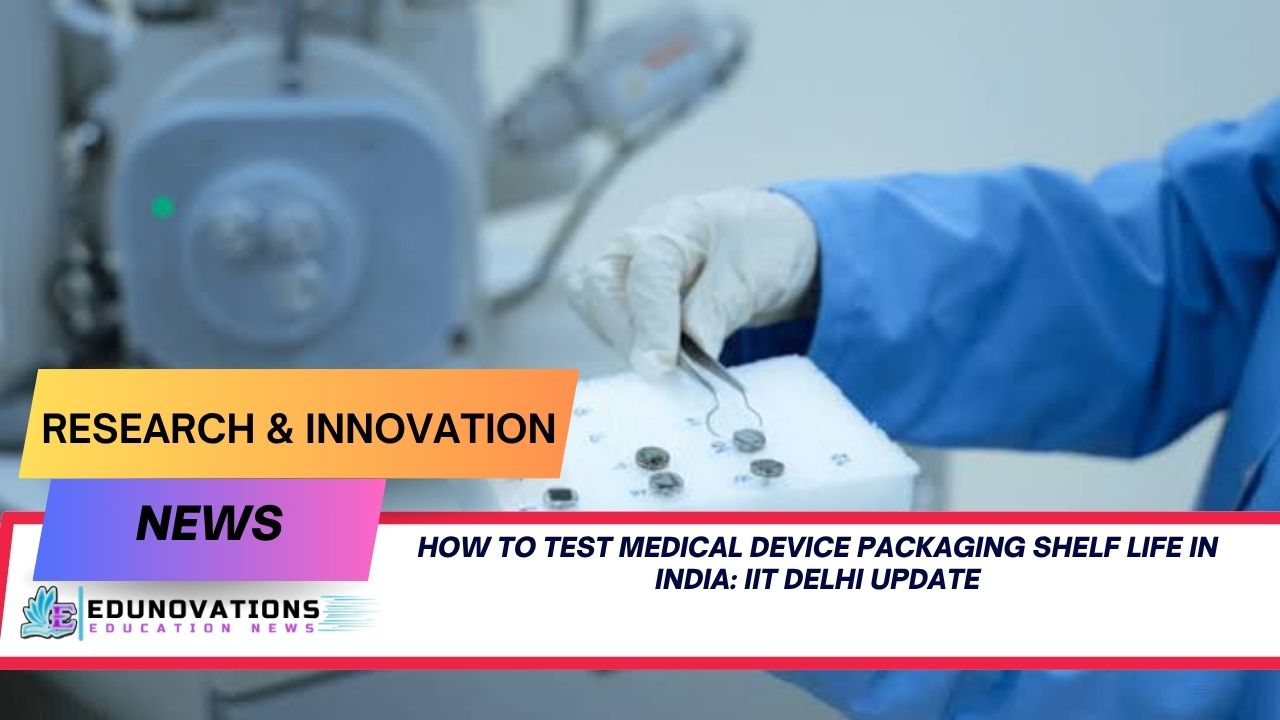
Learn how to test medical device packaging shelf life in India with our comprehensive guide, highlighting IIT Delhi’s newly inaugurated, state-of-the-art mPragati MedTech facilities.
The landscape of biomedical engineering and healthcare manufacturing in India is undergoing a massive paradigm shift. As the nation transitions from being an import-dependent consumer to a self-reliant global manufacturer, academic and governmental institutions are stepping up to build structural foundations. In a monumental move for the indigenous healthcare sector, the Indian Institute of Technology Delhi (IIT Delhi) recently announced the inauguration of a state-of-the-art Computer Numerical Control (CNC) and Sterilization & Packaging lab at its mPragati platform.
The cutting-edge hub was officially inaugurated by Dr. Rajiv Bahl, who serves as the Secretary to the Government of India, Department of Health Research, and Director General of the Indian Council of Medical Research (ICMR). This launch comes at a time when healthcare startups and researchers face massive hurdles in regulatory approvals, sterile validation, and structural engineering. For many rising businesses and biomedical startups, understanding how to test medical device packaging shelf life in India remains a primary obstacle to commercialization. This newly established national translational platform directly addresses these industrial gaps, paving the way for a more robust, compliant, and accelerated domestic medical ecosystem.
The Strategic Vision Behind mPragati and ICMR’s Collaborative Push
The newly unveiled facilities at the mPragati platform represent more than just advanced machinery; they embody a strategic alignment with the national vision of Atmanirbhar Bharat (Self-Reliant India). Historically, Indian medical device innovators have struggled to bridge the gap between initial laboratory concepts and marketplace commercialization. According to medical industry statistics, India has traditionally relied on imports for nearly 70% to 80% of its high-tech medical electronic devices and precision implants. This dependency not only escalates healthcare costs for the average citizen but also stalls domestic scientific growth.
During the inauguration ceremony, Dr. Rajiv Bahl emphasized that translating laboratory research into clinically deployable, commercialized products is the core mission of modern translational biomedical research. By creating a unified ecosystem where prototype development, engineering validation, and structural packaging testing occur under one roof, the institution drastically reduces the developmental cycle for life-saving devices.
The event witnessed the presence of key administrative and research pioneers, including Dr. Suchita Markan, Head of Innovation and Translation Research at ICMR; Prof. Rangan Banerjee, Director of IIT Delhi; Prof. Ashwini Agrawal, Dean of R&D; Prof. Manidipa Banerjee, Head of the Central Research Facility (CRF); and Prof. Dinesh Kalyanasundaram, the Coordinator of mPragati, IIT Delhi.
Understanding the Packaging and Sterility Imperative for MedTech Startups
For any medical device creator, conceptualizing a product is only the first fraction of the journey. The true test lies in maintaining absolute sterility until the product reaches the surgeon’s hands or the patient’s bedside. This reality highlights the widespread industry question of how to test medical device packaging shelf life in India to satisfy strict regulatory requirements set by bodies like the Central Drugs Standard Control Organization (CDSCO).
When a medical instrument or molecular diagnostic kit degrades on a storage shelf due to environmental exposure, it puts human lives at risk. Consequently, validation protocols mandate a series of rigorous procedures:
- Accelerated Aging Tests: Using specialized environmental and stability chambers to subject products to elevated temperatures and humidity levels, simulating years of shelf storage within a few weeks.
- Package Integrity Testing: Utilizing dye penetration, bubble emission, and vacuum decay tests to verify that microscopic breaches do not exist in the seals.
- Seal Strength Analysis: Executing tensile testing to guarantee that the vacuum or sterile pouch can withstand transit vibrations without bursting open.
The newly introduced Sterilization & Packaging Facility at mPragati provides exactly this type of end-to-end infrastructure. It offers a comprehensive workspace for the execution, validation, and regulatory formatting of medical devices, diagnostics, and biomedical products. By establishing an accessible, centralized hub, the platform removes the financial barrier for smaller startups that previously had to ship prototypes overseas just to get certified shelf-life data.
Micro-Precision: Advanced CNC Machining for Medical Implants
Beyond packaging, the physical structural integrity of a medical device dictates its clinical success. Standard industrial machine shops lack the specialized environments and technical certifications required to handle medical-grade materials. To solve this, the newly inaugurated CNC facility at IIT Delhi provides highly specialized, state-of-the-art precision machining tailored exclusively for medical implants, surgical instruments, dental devices, and complex diagnostic components.
The facility is outfitted with advanced multi-axis machining tools, Swiss-type turning units, and high-speed milling equipment. These systems support both patient-specific custom implants (such as cranial or maxillofacial plates) and standardized mass-produced components. Crucially, the facility ensures that all fabrication utilizes certified, biocompatible materials. This capability effectively bridges a historical gap in the domestic supply chain, allowing creators to turn highly complex digital blueprints into tangible, safe, and sterile prototypes ready for preclinical evaluations.
Unpacking the Molecular Diagnostics and Sterilization Architecture
The technological footprint of the new facility extends deep into biological testing and validation. Sterilization cannot be detached from biological verification; a device is only verified as sterile if biological indicators prove that microscopic life has been completely eradicated.
The sterilization sector of the mPragati facility features advanced systems, including Ethylene Oxide (EtO) systems and steam autoclaves. These setups are paired with high-precision laser welding, laser marking tools, and high-security vacuum packaging units built with built-in batch coding and absolute product traceability systems.
Complementing the mechanical engineering side is a massive biological and molecular testing framework. This layout includes:
- Amplification & Analytical Tools: High-speed thermal cyclers, real-time PCR systems, and High-Performance Liquid Chromatography (HPLC) platforms.
- Protein & Cellular Analysis: Trans-Blot systems, gel electrophoresis equipment, gel documentation systems, and high-speed ultracentrifuges.
- Cellular Culturing & Imaging: Carbon dioxide (CO₂) incubators, advanced biosafety cabinets designed for mammalian cell culture, and high-resolution fluorescence microscopy systems.
This combined infrastructure allows researchers to conduct comprehensive analytical testing, molecular diagnostics, biological validation, and strict quality control under a single roof. This setup ensures that when innovators analyze how to test medical device packaging shelf life in India, they can simultaneously evaluate the chemical stability of the reagents inside their diagnostic kits.
Educational and Technological Integration for Future Innovators
The development of such high-end infrastructure directly influences the educational and research paradigms of the country. Academic frameworks are increasingly integrating these industrial advancements into their learning structures. For students, researchers, and competitive exam aspirants aiming to master biomedical fields, staying updated with these practical advancements is essential. Accessing comprehensive academic resources like NCERT Courses and tracking Current Affairs provides a foundation for understanding national scientific policies and technological breakthroughs.
Furthermore, student innovators often require specialized study guides to contextualize how engineering principles apply to modern medical frameworks. Utilizing structured Notes and testing domain knowledge via MCQ’s can greatly accelerate educational development. For those who learn better through visual mediums, checking educational Videos on complex engineering mechanics can break down topics like multi-axis CNC milling or PCR testing workflows. Keeping an eye on the official academic Syllabus ensures that academic research lines up with national technological benchmarks. Additionally, foundational references are available through Downloads of Free NCERT PDFs and highly conceptual NCERT Mind Maps to help synthesize interdisciplinary sciences.
As educational institutions grow, their operational needs scale up as well. To display these research achievements and streamline admissions, institutions require robust online portals. If you run a school or an academy and need a state-of-the-art web platform, you can secure an excellent Website for Schools Contact by reaching out to Mart Ind Infotech to establish your digital presence.
The Broader Impact on India’s Medical Economy
The establishment of the mPragati facility significantly lowers the entry barrier for emerging healthcare businesses. When a startup understands the parameters of how to test medical device packaging shelf life in India, they gain the ability to accurately project their product’s commercial viability. It minimizes reliance on foreign testing labs, retains intellectual property within domestic borders, and drastically drives down the final retail cost of medical devices for patients. By fostering local innovation, India is rapidly positioning itself to become a global exporter of high-quality, verified, and strictly regulated medical technologies.
Toppers Use Mind Maps to score more than 95%
NCERT Class 11th Commerce Mind Maps
Add to cartOriginal price was: ₹999.00.₹199.00Current price is: ₹199.00.NCERT Class 12th Chemistry Mind Maps
Add to cartOriginal price was: ₹199.00.₹75.00Current price is: ₹75.00.NCERT Class 12th Commerce Mind Maps
Add to cartOriginal price was: ₹999.00.₹199.00Current price is: ₹199.00.NCERT Class 12th Science Mind Maps
Add to cartOriginal price was: ₹999.00.₹199.00Current price is: ₹199.00.NCERT Mind Maps For Class 10th
Add to cartOriginal price was: ₹999.00.₹199.00Current price is: ₹199.00.





Purchase Today
Frequently Asked Questions (FAQs)
1. Why is it essential to know how to test medical device packaging shelf life in India?
Knowing how to test medical device packaging shelf life in India ensures that medical products remain completely sterile and safe for patient use throughout their stated storage timeframe, fulfilling the stringent quality mandates set by the CDSCO.
2. Where can to find certified biocompatible cnc machining services for custom medical implants?
Innovators can find certified biocompatible cnc machining services at specialized national translational hubs, such as the newly inaugurated mPragati facility at IIT Delhi, which offers multi-axis milling and Swiss-type turning for medical-grade materials.
3. What does the eto sterilization validation process for medical devices involve?
The eto sterilization validation process for medical devices involves exposing the packaged product to Ethylene Oxide gas under controlled temperature, humidity, and pressure conditions, followed by biological testing to confirm total microbial eradication.
4. Are there any specialized indigenous medical device prototyping facilities in delhi for early-stage startups?
Yes, the newly launched mPragati facility at IIT Delhi stands as one of the premier indigenous medical device prototyping facilities in delhi, providing startups with mechanical fabrication, sterilization, and molecular validation systems.
5. What is the fundamental equipment needed for molecular diagnostics lab setup in a medical institution?
The fundamental equipment needed for molecular diagnostics lab setup includes real-time PCR systems, thermal cyclers, gel electrophoresis units, high-speed ultracentrifuges, biosafety cabinets, and stability chambers for reagent validation.
6. How do stability chambers assist when determining how to test medical device packaging shelf life in India?
Stability chambers simulate accelerated aging environmental conditions by elevating temperature and humidity, allowing manufacturers to observe how packaging seals and diagnostic components degrade over time.
7. Why should medical device startups avoid standard manufacturing workshops for components?
Standard machine shops lack the cleanroom environments, material traceability, and access to certified biocompatible cnc machining services required to prevent cross-contamination of surgical devices or implants.
8. How does the mPragati platform at IIT Delhi accelerate the eto sterilization validation process for medical devices?
mPragati integrates advanced Ethylene Oxide systems with precision laser sealing and biological testing labs, letting developers sterilize and test their device validation profiles in a single location.
9. What makes indigenous medical device prototyping facilities in delhi critical for national healthcare?
These specialized regional hubs reduce dependency on imported medical electronics, lower development costs for local entrepreneurs, and ensure products are designed according to Indian climatic and healthcare needs.
10. Can small diagnostic businesses use the equipment needed for molecular diagnostics lab setup at IIT Delhi?
Yes, translational platforms like mPragati at IIT Delhi are designed to act as national shared facilities, allowing startups, academic researchers, and small businesses access to top-tier diagnostic and analytical instruments.