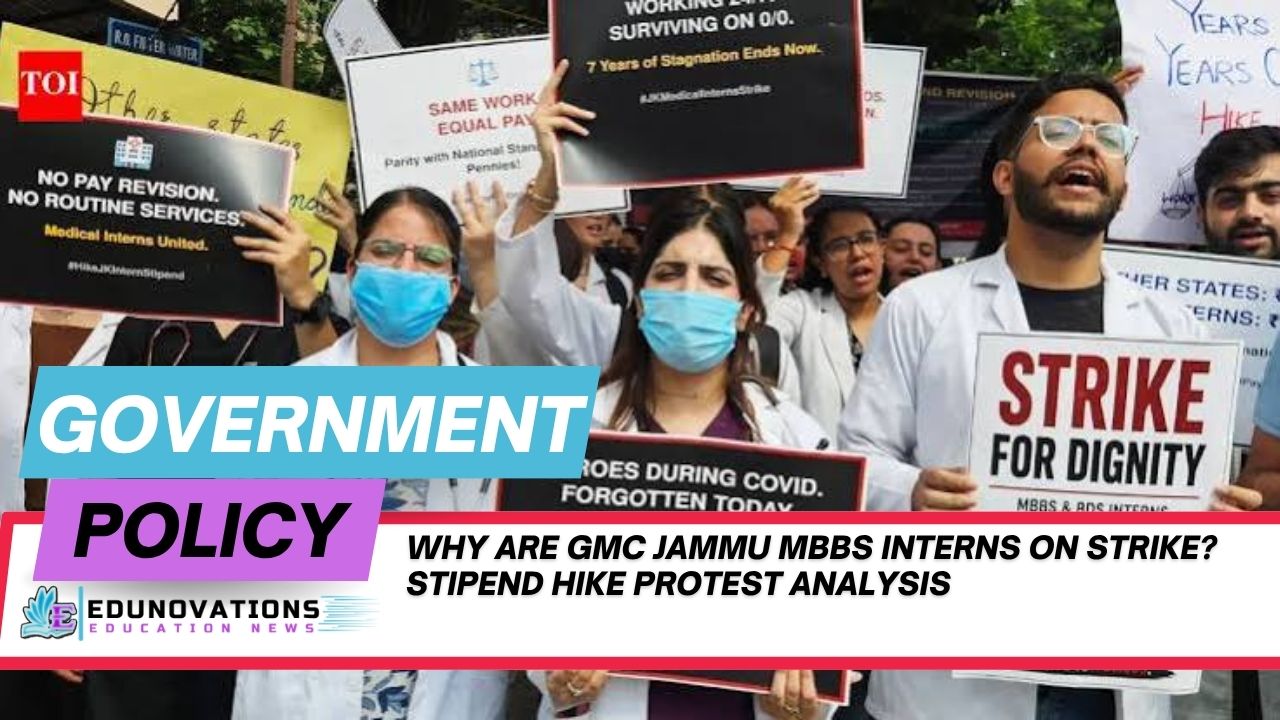
Discover why are GMC Jammu MBBS interns on strike in J&K. Learn about stipend disparities, political reactions, and national medical education standard impacts.
The public healthcare infrastructure across government medical colleges in Jammu and Kashmir faces significant operational strain as hundreds of trainee doctors have downed diagnostic tools and clinical equipment. Healthcare services at premier institutions, including Government Medical College (GMC) Jammu and associated clinical facilities, experienced immediate disruptions following an indefinite work boycott launched by undergraduate medical and dental graduates.
To understand the core cause of the turmoil, one must analyze why are GMC Jammu MBBS interns on strike across the union territory. The primary catalyst driving the regional medical standoff is the persistent disparity in monthly compensation compared to institutions across other Indian states. Budding medical professionals undergo mandatory 12-month rotating internships after clearing rigorous academic evaluations. They argue that their current monthly payout fails to meet basic living standards and does not reflect their heavy clinical workload.
Escalating Agitation Across Jammu & Kashmir Medical Colleges
The strike officially began after multiple representations submitted to administrative authorities yielded no tangible outcome. The agitation quickly gained momentum across all major government medical and dental colleges across Jammu and Kashmir.
Protesting interns gathered outside hospital administration blocks, holding placards and chanting slogans demanding immediate government intervention. Trainee doctors emphasize that they routinely handle intensive 24-hour shifts, emergency triage duties, ward patient care, and mandatory rural postings without adequate financial compensation.
Key Factors Behind the Medical Boycott
- Seven Years of Fixed Stipends: Monthly stipends for medical interns in the union territory have remained fixed at ₹12,300 since 2017.
- National Compensation Disparity: Interns in neighboring states and central government institutions earn between ₹25,000 and ₹45,000 per month for identical duties.
- Delayed Official Recommendations: A high-level departmental committee recommended increasing monthly stipends to ₹25,000 in 2023 for the 2025–26 session, but implementation remains pending.
- Severe Inflationary Pressures: Rising living costs, expensive medical equipment, accommodation expenses, and transport fees have made living on ₹12,300 per month increasingly difficult.
Students preparing for competitive examinations like NEET PG can review comprehensive study resources, including updated Syllabus details and high-yield NCERT Courses, to understand the academic pathway required before entering clinical practice.
Statistical Overview: The Financial Disparity in Medical Internships
The core issue fueling the protest is the significant gap between the monthly compensation offered to medical graduates in Jammu and Kashmir and that provided by other state governments or central healthcare institutions across India.
| State / Healthcare Institution | Monthly MBBS Intern Stipend (Approx. INR) | Revision Status / Last Updated |
| Central Government Hospitals (AIIMS/VMMMC) | ₹30,000 – ₹30,070 | Periodically Revised |
| Karnataka State Medical Colleges | ₹30,000 – ₹45,000 | Revised via State Healthcare Norms |
| Assam State Medical Colleges | ₹31,000 | Implemented Recently |
| Delhi State Government Hospitals | ₹26,300 – ₹30,000 | Standardized Allowance |
| Punjab State Medical Colleges | ₹15,000 – ₹18,000 | Periodic Hikes Applied |
| Jammu & Kashmir (Current Rate) | ₹12,300 | Stagnant Since 2017 |
Medical aspirants revising basic medical subjects can test their knowledge using targeted MCQs and access detailed Notes to build strong theoretical foundations early in their career.
Analyzing the Ground Reality: Workload vs. Compensation
To understand why are GMC Jammu MBBS interns on strike, one must look at the day-to-day duties expected of a rotating medical intern in India’s public health system.
Medical internships are not purely academic observer programs. Under National Medical Commission (NMC) regulations, an internship is an intensive, hands-on clinical training phase during which junior doctors function as primary healthcare responders.
1. Emergency Department Triage
Interns are often the first point of contact for emergency patients entering casualty wards in major tertiary care facilities such as GMC Jammu or GMC Srinagar. They record vital statistics, administer preliminary life-support care, process emergency blood tests, and coordinate with senior resident doctors.
2. High Patient Load and Ward Duties
In overcrowded government hospitals, interns handle routine patient monitoring, dress complex wounds, manage pre-operative and post-operative care, and maintain medical records. A single intern often manages dozens of patients during a single night shift.
3. Rural Postings and Mobility Expenses
The compulsory rotating medical internship requires spending several months at Primary Health Centres (PHCs) and Community Health Centres (CHCs) in rural regions. Interns must pay out-of-pocket for accommodation, daily transport, and food while receiving a stipend that breaks down to less than ₹400 per day.
For medical entrance candidates seeking conceptual clarity on human physiology and biology, studying concise visual tools like NCERT Mind Maps can significantly speed up theoretical preparation.
Political and Executive Leadership Responses
The strike has attracted attention from regional political leaders, healthcare administrators, and civil society groups across the union territory.
Tariq Hameed Karra Urges Immediate Administrative Relief
Jammu and Kashmir Pradesh Congress Committee (JKPCC) President Tariq Hameed Karra wrote an official letter to Chief Minister Omar Abdullah requesting swift and sympathetic intervention on behalf of the striking doctors.
“The demands raised by our young medical and dental interns are entirely genuine and deserve immediate administrative redressal. Our doctors form the backbone of the public healthcare delivery system, working under high pressure for minimal financial returns. Expecting medical professionals to perform grueling 24-hour shifts on a stipend fixed seven years ago is unreasonable. I strongly urge Chief Minister Omar Abdullah to implement the recommended stipend hike to ₹25,000 without delay.” — Tariq Hameed Karra, JKPCC Chief & Senior Political Leader
Student Union Representatives Voice Concerns
Protesting student representatives from GMC Jammu highlighted that despite formal assurances given by administrative committees in past years, official implementation directives were never issued.
“We are not demanding an extraordinary luxury allowance; we are simply asking for parity with our peers working in other states. When we serve identical shift hours and carry out the same medical procedures, why should medical interns in J&K receive less than half of what interns in central institutions earn? We will maintain our peaceful strike until an official government order raising our stipend is issued.” — Protesting Medical Intern, GMC Jammu
Staying up to date with regional policy decisions and governance updates is essential for competitive exam candidates, who can track real-time developments through daily Current Affairs summaries.
Institutional Infrastructure and Educational Technology in Healthcare
The ongoing dispute underlines broader systemic challenges in managing large educational and healthcare institutions across India. As medical colleges expand intake capacities under updated National Medical Commission guidelines, administrative workflows, payroll tracking, and student communications require modern technological infrastructure.
Developing scalable digital platforms, institutional websites, and student management portals requires specialist technical execution. Schools, colleges, and medical academies seeking robust custom portal development can consult specialized IT providers like Mart India Infotech to build tailored enterprise web solutions.
Broad Impact on Healthcare Delivery and Public Services
The prolonged work boycott by medical and dental interns has created immediate operational bottlenecks across major hospitals in Jammu, Srinagar, Anantnag, Baramulla, and Rajouri.
                   [ WORK BOYCOTT INITIATED ]
                               │
            ┌──────────────────┴──────────────────┐
            ▼                                     ▼
   [ Outpatient Departments ]           [ Inpatient Wards ]
   • Prolonged waiting times           • Senior residents overworked
   • Sample collection delays          • Administrative paperwork backlog
            │                                     │
            └──────────────────┬──────────────────┘
                               ▼
            [ Public Healthcare Service Bottlenecks ]
Prolonged Waiting Hours in Outpatient Departments
With junior interns absent from routine patient intake desks, senior resident doctors and consultants must manage both routine administrative entries and direct patient care, leading to longer patient waiting times in Outpatient Departments (OPDs).
Heavy Strain on Senior Medical Staff
Senior Residents (SRs) and Junior Residents (JRs) have been forced to take over routine clinical administrative duties normally handled by interns, including writing case sheets, executing blood draws, and tracking diagnostic reports.
Educational Disruptions
The strike halts formal clinical skill acquisition for graduating students. Every day spent on strike extends their mandatory training calendar, which can delay their eligibility for post-graduate entrance exams, state medical council registrations, and professional practice.
Students preparing for academic admissions can review free study materials and downloadable resources via Free NCERT PDFs to maintain academic progress during institutional disruptions. Candidates looking for comprehensive visual explanations can also watch dedicated tutorials on Videos platforms tailored for medical entrance preparation.
Systemic Solutions for Medical Internship Compensation in India
Addressing the persistent compensation disputes in government medical colleges requires structural updates to national and state-level healthcare policy frameworks.
                     [ PROPOSED SYSTEMIC REFORMS ]
                                   │
      ┌────────────────────────────┼────────────────────────────┐
      ▼                            ▼                            ▼
[ Inflation-Linked Pay ]  [ Uniform National Pay ]   [ Automated Disbursements ]
  Annual Indexing Norms     Central NMC Mandates        Direct Benefit Transfers
1. Uniform National Minimum Stipend Framework
The National Medical Commission (NMC) could establish a binding national floor for monthly medical intern stipends across all states and union territories, tied directly to central pay commission norms.
2. Automatic Inflation-Linked Revisions
Instead of keeping stipends fixed for multi-year periods, state medical departments should introduce annual cost-of-living adjustments aligned with consumer price indices.
3. Direct Benefit Transfer (DBT) Systems
Streamlining payment infrastructure using direct administrative transfers can eliminate bureaucratic delays, ensuring trainee doctors receive their monthly allowances on time without administrative backlogs.
Toppers Use Mind Maps to score more than 95%
NCERT Class 11th Commerce Mind Maps
Add to cartOriginal price was: ₹999.00.₹199.00Current price is: ₹199.00.NCERT Class 12th Chemistry Mind Maps
Add to cartOriginal price was: ₹199.00.₹75.00Current price is: ₹75.00.NCERT Class 12th Commerce Mind Maps
Add to cartOriginal price was: ₹999.00.₹199.00Current price is: ₹199.00.NCERT Class 12th Science Mind Maps
Add to cartOriginal price was: ₹999.00.₹199.00Current price is: ₹199.00.NCERT Mind Maps For Class 10th
Add to cartOriginal price was: ₹999.00.₹199.00Current price is: ₹199.00.





Purchase Today
Frequently Asked Questions (FAQs)
1. Why are GMC Jammu MBBS interns on strike in Jammu and Kashmir?
GMC Jammu MBBS interns are on strike to demand an immediate increase in their monthly stipend from ₹12,300 to ₹30,000, pointing out that their current pay has remained unchanged for seven years despite rising living costs and heavy clinical workloads.
2. What is the current j and k mbbs intern stipend current rate 2026?
The j and k mbbs intern stipend current rate 2026 stands at ₹12,300 per month, which protesting medical graduates highlight as one of the lowest stipend rates among public medical colleges in India.
3. How does the bds intern stipend demand in jammu and kashmir compare with MBBS demands?
The bds intern stipend demand in jammu and kashmir matches the MBBS demand for a uniform increase to ₹30,000 per month, as dental interns complete identical compulsory rotating training schedules and rural service mandates.
4. Where can I find a state wise mbbs intern stipend list in india for comparison?
A state wise mbbs intern stipend list in india shows significant variation, ranging from ₹12,300 in Jammu and Kashmir to over ₹30,000 in central institutions and states like Karnataka and Assam.
5. How much stipend do mbbs interns get in gmc across different states?
When asking how much stipend do mbbs interns get in gmc institutions across India, amounts vary from ₹12,300 in J&K up to ₹26,000–₹30,000 in central government medical colleges and high-performing state networks.
6. Has the J&K government previously agreed to increase medical intern stipends?
Yes, a high-level administrative committee appointed by the Health and Medical Education Department recommended in 2023 that monthly stipends be raised to ₹25,000 for the 2025–26 academic year, but the order has not yet been formally implemented.
7. How long are medical interns expected to perform daily shifts in public hospitals?
Medical and dental interns regularly work 8- to 12-hour routine hospital shifts, along with mandatory 24-hour emergency casualty duties and overnight ward calls during their compulsory 12-month rotation.
8. Which political figures have supported the striking medical interns in J&K?
JKPCC Chief Tariq Hameed Karra officially supported the striking interns by writing a letter to Chief Minister Omar Abdullah, requesting immediate administrative action to address their stipend demands.
9. Are emergency medical services affected by the intern strike in Jammu and Kashmir?
While senior medical officers, junior residents, and senior residents continue managing critical emergency wards, overall hospital workflows, routine diagnostic tracking, and OPD operations face noticeable delays due to the absence of interns.
10. What step is required to end the indefinite medical intern protest?
Protesting interns at GMC Jammu and other regional medical colleges have stated they will end their work boycott once the government issues an official notification revising their monthly stipend in line with committee recommendations.