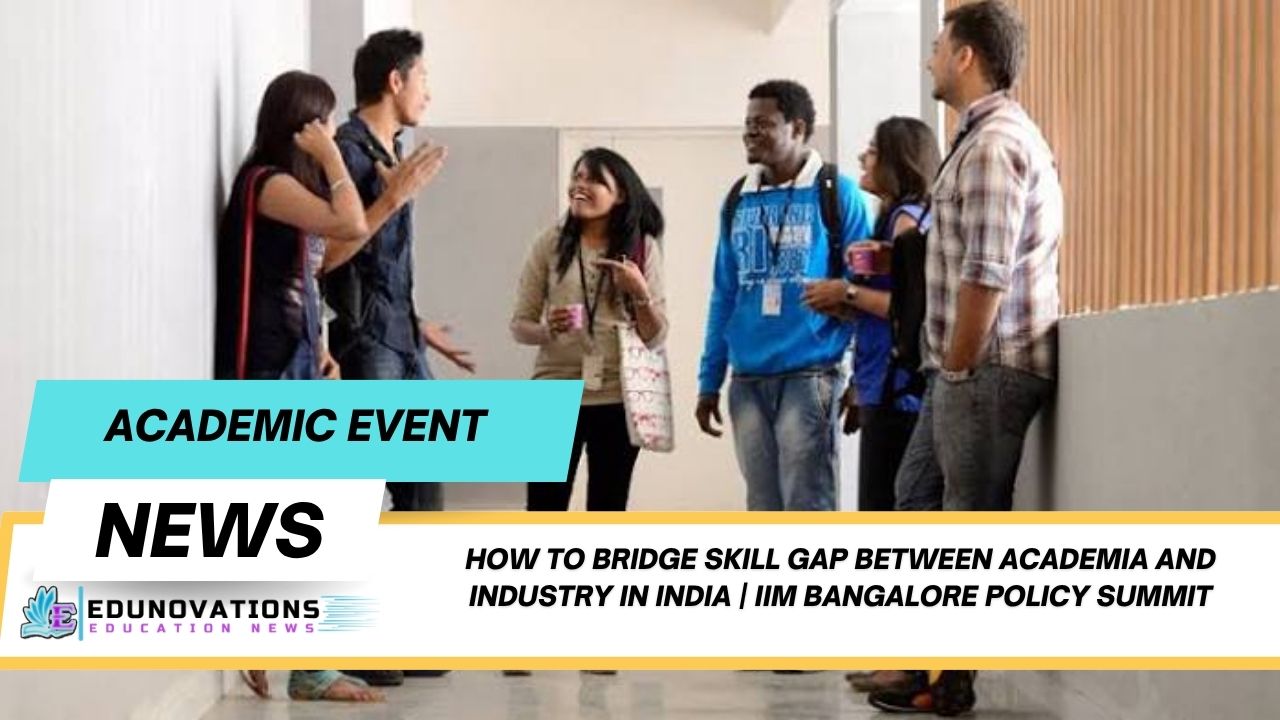
Discover how to bridge skill gap between academia and industry in india through insights from the XXI CPP Public Policy Conference at IIM Bangalore.
As the nation navigates rapid technological disruption and demographic shifts, understanding how to bridge skill gap between academia and industry in india emerged as one of the central thematic pillars during the high-level deliberations. With over 490 competitive research paper submissions received—from which 76 full papers and 64 poster presentations were rigorously selected—the conference showcased cutting-edge empirical research spanning human capital development, rural infrastructure sustainability, digital public goods, and sustainable economic governance.
Understanding how to bridge skill gap between academia and industry in india requires an integrated approach across policy formulation, curriculum redesign, and corporate responsibility. A primary takeaway echoed across every panel was that building a self-reliant economy cannot remain a government initiative alone; rather, it demands a synchronized tri-partite synergy among academia, state institutions, and enterprise leaders.
One of the most impactful discussions of the conference focused on workforce transformation and talent development. The panel, titled “Bridging the Skill Gap: Aligning Industry, Academia and Government for a Future-Ready Workforce,” was moderated by Prof. Sankarshan Basu of IIM Bangalore’s Finance & Accounting department. The expert panel comprised NN Rao, Technical Advisor to the Karnataka Skill Development Authority (KSDA) and University Court Member of Delhi Skill and Entrepreneurship University (DSEU); Dr. B. S. Satyanarayana, Vice Chancellor of Dayananda Sagar University; and F. R. Singhvi, Joint Managing Director of Sansera Engineering Ltd.
Identifying the Root Causes of Skill Mismatch
Opening the deliberations, technical expert NN Rao highlighted alarming structural realities within the current employment landscape. Industry surveys consistently indicate that more than 90% of job applicants lack essential role-specific technical skills, compounded by noticeable deficits in foundational soft skills such as critical thinking, professional communication, and collaborative problem-solving.
According to NN Rao, the disconnect stems from multiple systemic friction points:
- Curriculum Lag: Higher education institutions often operate on outdated academic syllabi that fail to keep pace with dynamic industrial shifts and modern technology stacks.
- Geographical and Wage Disparities: Structural gaps in regional economic development restrict access to high-quality vocational training, causing significant wage mismatches between rural and urban centers.
- Mutual Trust Deficits: Historical mistrust between industrial enterprises and academic governing bodies continues to obstruct meaningful joint research and cooperative internship models.
- Intervention Gaps: While state-level initiatives aim to resolve social challenges and support startup scaling, the lack of active co-design between companies and educators hinders program execution.
To systematically address these educational gaps, students and educators are increasingly turning to structured learning materials. Aspirants preparing for competitive national examinations and policy studies rely heavily on standard academic resources, such as complete NCERT Courses and tailored revision notes to build strong foundational knowledge.
Re-Engineering Higher Education: Job Readiness vs. Career Readiness
A key outcome of the conference was distinguishing short-term employability from long-term career resilience. Addressing the audience, Dr. B. S. Satyanarayana emphasized that the traditional lifespan of acquired technical knowledge has shortened dramatically due to rapid technological evolution. Consequently, institutions must shift their focus from producing merely “job-ready” candidates to cultivating “career-ready” professionals who possess lifelong adaptability.
       TRADITIONAL EDUCATION vs. FUTURE-READY LEARNING

┌───────────────────────────────┐     ┌───────────────────────────────┐
│     Traditional Model         │     │      Future-Ready Model       │
├───────────────────────────────┤     ├───────────────────────────────┤
│ • Rote-memorization focus     │  ──►│ • Immersive & experiential    │
│ • Fixed, static curricula     │  ──►│ • Multidisciplinary learning  │
│ • Compliance-driven metrics   │  ──►│ • Trust & innovation focus    │
│ • Siloed academic domains     │  ──►│ • Co-created industry projects│
└───────────────────────────────┘     └───────────────────────────────┘
When evaluating how to bridge skill gap between academia and industry in india, Dr. Satyanarayana noted that institutional frameworks must embrace project-based, multidisciplinary learning environments. Experiential learning bridges abstract theoretical concepts and real-world application, instilling the critical thinking skills required by modern businesses. He further stressed that educational systems must prioritize quality, affordability, and institutional trust over rigid compliance culture.
Analyzing how to bridge skill gap between academia and industry in india also requires examining historical industrial frameworks. Providing an industrial perspective, F. R. Singhvi traced how bureaucratic regulatory structures historically bred institutional risk aversion and reduced proactive corporate investment in human capital. However, he emphasized that recent policy reforms and India’s booming startup ecosystem offer a powerful foundation for change.
Singhvi argued that private enterprise must share responsibility for talent development by increasing spending on corporate training, apprenticeships, and soft-skills workshops. By building an enterprisewide culture rooted in transparency and ethical values, industry can help transform a traditionally risk-averse workforce into an innovative, agile talent pool.
Comprehensive Policy Synthesis & Strategic Recommendations
To contextualize the conference findings within broader national strategies, the table below synthesizes key policy challenges, empirical observations, and actionable solutions discussed across the summit sessions:
| Policy Focus Area | Key Structural Challenge | Panel Insights & Observations | Proposed Strategic Action Plan |
| Workforce Skill Alignment | Over 90% of graduates lack market-ready technical and life skills. | Severe disconnect between academic curricula and evolving industry needs; persistent wage and skill disparities. | Establish mandatory joint industry-academia curriculum boards and expand project-based experiential learning models. |
| National Education Strategy | Outdated compliance-focused educational administration. | Shift required from short-term “job readiness” to sustainable “career readiness” and dynamic problem-solving. | Modernize institutional accreditation to reward industry co-creation, collaborative R&D, and vocational integration. |
| Rural Water Infrastructure | Ensuring long-term sustainability after infrastructure deployment. | Transitioning from asset creation under Jal Jeevan Mission to long-term resource management and community ownership. | Implement community-led water governance, institutionalize local technical maintenance, and establish water-quality monitoring. |
| Self-Reliant Economy | Fragmented implementation across government departments. | Achieving Atmanirbhar Bharat and Viksit Bharat 2047 requires multi-stakeholder ownership beyond public sector mandates. | Build integrated policy frameworks linking higher education innovation directly with public welfare and enterprise growth. |
Institutional Interventions and National Policy Frameworks
Summarizing the session on human capital, Prof. Sankarshan Basu revealed that the Taskforce set up by the Government of India in 2024 to examine skill gaps across 13 key economic verticals is being actively revitalized. This revived taskforce will focus on national skill-gap mapping, updating qualification packs, and standardizing vocational training to meet global benchmarks.
Understanding how to bridge skill gap between academia and industry in india requires tracking these macro-level government initiatives alongside academic updates. Students, researchers, and policy aspirants can stay informed on structural developments through curated daily Current Affairs updates and comprehensively structured Notes designed for public administration studies.
Furthermore, educational institutions seeking to upgrade their digital infrastructure and web presence to facilitate collaborative learning can explore professional technology services through external web development partners like Mart India Infotech.
Sustainable Rural Infrastructure: Lessons from Jal Jeevan Mission
Beyond skill development, the XXI CPP International Conference examined critical themes in sustainable public infrastructure. A key panel, titled “Jal Jeevan Mission: From Pipeline to Policy – Ensuring Sustainability Beyond Har Ghar Jal,” was moderated by Prof. Gopal Naik, Chairperson and Jal Jeevan Mission Chair Professor at CPP, IIM Bangalore. The panel featured senior policy architects, including Shri Parameswaran Iyer, Former Executive Director of the World Bank and key leader in India’s national sanitation and water drives.
                  JAL JEEVAN MISSION TRANSITION MODEL

   Phase I: Infrastructure                Phase II: Sustainability
┌───────────────────────────┐          ┌───────────────────────────┐
│ • Pipeline Installation   │          │ • Source Sustainability   │
│ • Tap Connections         │  ──────► │ • Community Ownership     │
│ • Asset Construction      │          │ • Decentralized Operations│
│ • Initial Coverage Goals  │          │ • Water Quality Oversight │
└───────────────────────────┘          └───────────────────────────┘
Transitioning from Coverage to Conservation
While the initial phase of the Jal Jeevan Mission focused successfully on infrastructure deployment—delivering piped water tap connections to millions of rural households under the Har Ghar Jal initiative—the panel stressed that long-term success depends on policy sustainability.
The key sustainability pillars identified during the sessions include:
- Source Sustainability: Implementing recharge systems, rainwater harvesting, and catchment management to prevent source depletion.
- Community Ownership: Empowering local Gram Panchayat user groups and Pani Samitis to operate, maintain, and manage local water supply infrastructure.
- Financial and Operational Resilience: Developing equitable tariff structures and training local technicians to ensure prompt maintenance and operational reliability.
- Water Quality Monitoring: Establishing community-level testing laboratories and leveraging IoT-enabled monitoring systems to guarantee safe drinking water standards.
For candidates preparing for competitive public policy examinations, mastering these complex infrastructure models is essential. Students can practice targeted exam preparation using specialized public administration MCQs, review video lectures on Videos, and align their study plans with official examination guides available on Syllabus.
Actionable Strategy: How Academia and Industry Can Co-Create Value
To successfully bridge systemic skill gaps, educational institutions and corporate stakeholders must move beyond traditional corporate social responsibility (CSR) initiatives and adopt structural co-creation strategies.
1. Embedded Industry Fellowships & Faculty Immersion
Academic institutions should introduce structured faculty immersion programs that allow educators to work within industrial settings periodically. Reciprocally, corporate leaders should serve as professors-of-practice, bringing live case studies, real-world operational challenges, and contemporary tools into classroom environments.
2. Modular & Stackable Micro-Credentials
Rather than relying solely on rigid 4-year degree programs, universities should integrate flexible, industry-certified micro-credentials. These stackable certificates enable students to gain specialized skills in high-demand fields such as data science, artificial intelligence, renewable energy engineering, and digital public infrastructure management.
3. Joint Incubators and Applied Research Hubs
Corporate R&D centers should collaborate directly with university incubators to solve pressing industrial and social challenges. Establishing shared research laboratories allows students to work on real-world industry problems while providing enterprises access to innovative academic research.
To support foundational learning across school and university levels, candidates can download comprehensive study materials via free NCERT PDFs and visually review complex concepts using structured NCERT Mind Maps.
The Road to Viksit Bharat 2047: A Shared Vision
The XXI International Conference on Public Policy & Management at IIM Bangalore reinforced that India’s journey toward Atmanirbhar Bharat and Viksit Bharat 2047 requires coordinated action across all governance tiers. Achieving these national goals depends on addressing core challenges in human capital, structural skill mismatches, and rural infrastructure management.
By fostering deeper collaboration among government bodies, academic leaders, and corporate enterprises, India can build a resilient, future-ready workforce capable of driving long-term economic growth and self-reliance.
Toppers Use Mind Maps to score more than 95%
NCERT Class 11th Commerce Mind Maps
Add to cartOriginal price was: ₹999.00.₹199.00Current price is: ₹199.00.NCERT Class 12th Chemistry Mind Maps
Add to cartOriginal price was: ₹199.00.₹75.00Current price is: ₹75.00.NCERT Class 12th Commerce Mind Maps
Add to cartOriginal price was: ₹999.00.₹199.00Current price is: ₹199.00.NCERT Class 12th Science Mind Maps
Add to cartOriginal price was: ₹999.00.₹199.00Current price is: ₹199.00.NCERT Mind Maps For Class 10th
Add to cartOriginal price was: ₹999.00.₹199.00Current price is: ₹199.00.


Purchase Today
Frequently Asked Questions (FAQs)
1. How to bridge skill gap between academia and industry in India effectively?
Bridging the skill gap requires structural collaboration: universities must update curricula alongside corporate partners, incorporate mandatory project-based learning, host industry leaders as professors-of-practice, and emphasize soft skills and career adaptability over theoretical memorization.
2. What were the primary themes of the XXI International Conference on Public Policy at IIM Bangalore?
The central theme of the 2026 XXI CPP Conference was ‘Atmanirbhar Bharat’ (Self-Reliant India). Key discussion areas included workforce skill development, industry-academia-government integration, post-implementation sustainability of the Jal Jeevan Mission, and strategic policy frameworks for Viksit Bharat 2047.
3. What is the key distinction between industry ready vs career ready skills difference for students?
“Industry-ready” refers to possessing specific technical skills required for an immediate job role. In contrast, “career-ready” emphasizes broader adaptability—equipping students with foundational knowledge, critical thinking, communication skills, and lifelong learning habits necessary to navigate evolving industry landscapes.
4. What challenges exist in maintaining Jal Jeevan Mission sustainability challenges after Har Ghar Jal?
Primary challenges include ensuring water source recharge, maintaining long-term financial viability, empowering local community management (Pani Samitis), training local maintenance technicians, and ensuring continuous water quality testing across rural supply networks.
5. How can students find an atmanirbhar bharat public policy case studies and paper format?
Students and researchers can access policy case studies and academic paper formats through university portals like IIM Bangalore’s Centre for Public Policy (CPP), academic research repositories, and specialized civil service educational resources.
6. What steps are required when learning how to prepare research paper for public policy conference 2026?
To prepare a public policy research paper, select a relevant policy domain, conduct rigorous qualitative or quantitative data analysis, ground your arguments in empirical evidence, follow the conference’s submission guidelines, and present clear, actionable policy recommendations.
7. Why is experiential learning critical for higher education in India?
Experiential and project-based learning bridges theoretical knowledge and practical execution. It allows students to apply academic concepts to real-world business and governance problems, building problem-solving capabilities and improving overall employability.
8. What role does the Government of India play in workforce skill alignment?
The government acts as a key facilitator by establishing national taskforces for skill-gap mapping, funding vocational training initiatives through state skill development missions, creating regulatory frameworks that encourage industry-academia partnerships, and supporting startup ecosystems.
9. How does structural skill mismatch impact the Indian economy?
Skill mismatches lead to underemployment, lower industrial productivity, extended hiring cycles for enterprises, and reduced international competitiveness. Addressing these gaps is crucial to maximizing India’s demographic dividend.
10. How do academic conferences like CPP IIMB influence national public policy?
Conferences like CPP IIMB bring together scholars, industry leaders, and public administrators to evaluate policy outcomes, present empirical research, identify structural gaps, and propose evidence-based frameworks that directly inform state and national policymaking.