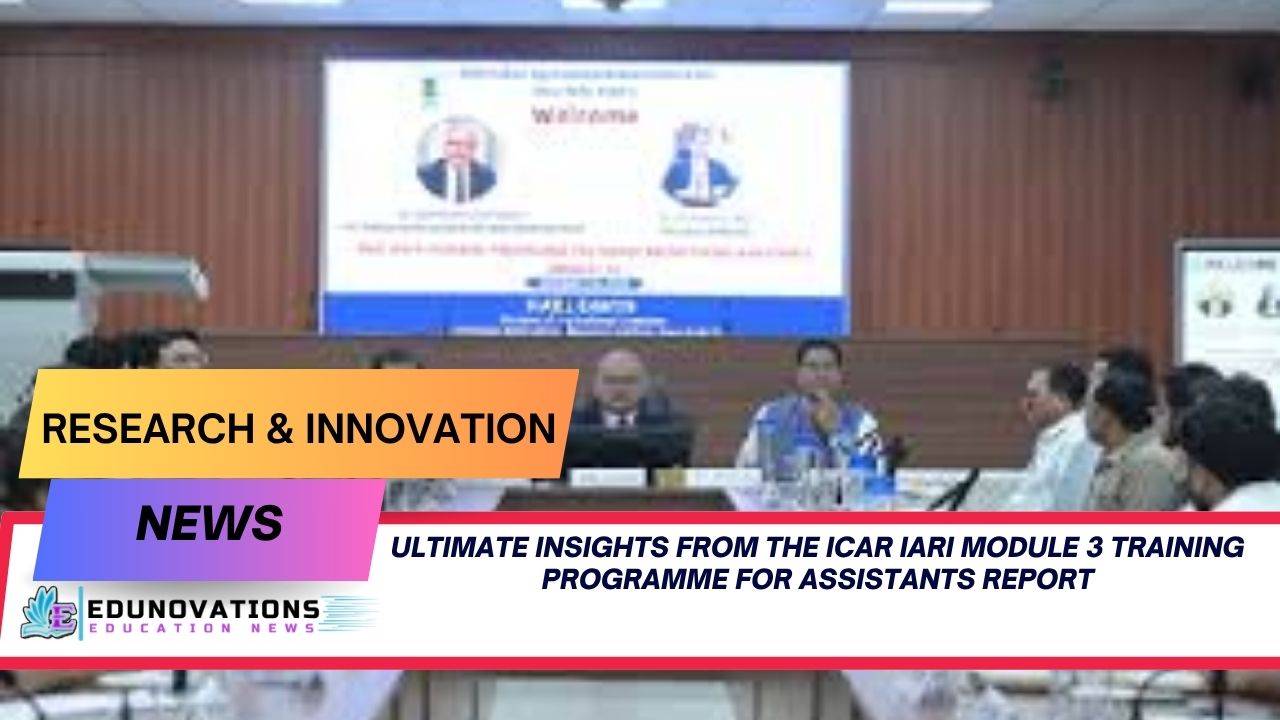
In an era defined by rapid technological leaps and shifting bureaucratic demands, public institutions face mounting pressure to modernize.
In an era defined by rapid technological leaps and shifting bureaucratic demands, public institutions face mounting pressure to modernize. Capacity building is no longer just an optional HR exercise; it is the cornerstone of effective governance. Recently, a significant milestone in administrative reform was achieved as the premier agricultural research institution in the capital wrapped up a landmark professional development initiative. The comprehensive ICAR IARI Module 3 training programme for assistants report sheds light on how India’s top scientific bodies are revolutionizing their internal governance, aligning with national digitalization goals, and fostering collaborative work cultures.
The Genesis of Reform Utsav and Administrative Modernization
Administrative efficiency in massive research organizations like the Indian Council of Agricultural Research (ICAR) directly influences the speed and quality of agricultural innovations reaching farmers. Bureaucratic bottlenecks can stall critical research grants, delay infrastructural upgrades, and slow down policy execution. Recognizing this, the Council introduced targeted administrative revamps under the banner of “Reform Utsav.”
As part of this nationwide administrative overhaul, the first batch of the ICAR IARI Module 3 training programme for assistants report highlights a meticulously structured 12-day capacity-building initiative. Held from 05 to 16 October 2026 at the ICAR–Indian Agricultural Research Institute (IARI) in New Delhi, the program was specifically curated to enhance the administrative knowledge, professional competence, and functional efficiency of assistants working across diverse ICAR institutions.
To support lifelong learning, professional development, and competitive exam preparation for aspirants entering public service, platforms such as Edunovations Notes provide comprehensive study materials. Similarly, educators and students seeking structured curricula can explore the latest updates via Edunovations Syllabus.
Demographics and Multi-Institutional Representation
One of the most striking aspects of this training initiative was its broad multi-institutional footprint. Rather than training personnel in isolated silos, the program brought together 50 administrative assistants from various specialized research bodies across the ICAR ecosystem.
The participant breakdown included:
- ICAR–IARI (New Delhi): 16 participants
- ICAR Headquarters: 24 participants
- ICAR–IASRI: 3 participants
- ICAR–NBPGR: 3 participants
- ICAR–NIPB: 2 participants
- ICAR–NRIIPM: 1 participant
- ICAR–NIAEPR: 1 participant
This cross-pollination of administrative talent allowed participants to share unique institutional experiences, standardize best practices, and develop a synchronized understanding of complex government accounting, establishment rules, and procurement guidelines. For learners looking to test their comprehension of public governance and general studies, practicing regularly through Edunovations MCQ’s and staying updated with Edunovations Current Affairs is highly recommended.
Cost-Effective Knowledge Delivery: Leveraging Internal Resource Persons
A major bottleneck in government training programs is often the exorbitant cost of external logistics, travel allowances, and hospitality. The recent training module pioneered a cost-effective model by drawing heavily upon internal intellectual capital.
A total of 28 expert resource persons—predominantly drawn from ICAR Headquarters and Delhi-based ICAR research institutes—delivered rigorous lectures and interactive sessions. By utilizing in-house experts, the Council successfully minimized travel expenditure and logistics overheads while adhering strictly to government economy measures and expenditure rationalization mandates. Crucially, this financial prudence was achieved without compromising the academic and operational depth of the curriculum.
For school administrators and educational institutions seeking customized digital infrastructure and robust web portals to manage virtual training programs, partnering with technology leaders like Martin Das Infotech provides reliable IT solutions.
Digital Transformation: AI for Smarter Administration
The digital age demands a paradigm shift from paper-heavy record-keeping to intelligent, data-driven automation. A standout highlight of the training schedule was a special expert lecture titled “AI for Smarter Administration,” delivered by Shri Gyanendra Dev Tripathi, IAS, Hon’ble Additional Secretary, DARE & Secretary, ICAR.
Shri Gyanendra Dev Tripathi emphasized that artificial intelligence and machine learning are no longer futuristic concepts reserved for tech labs; they are practical tools capable of streamlining file tracking, automating routine noting, predicting administrative delays, and enhancing transparency in government workflows.
“Artificial intelligence holds immense potential to radically transform public sector governance, eliminate bureaucratic red tape, and foster proactive, citizen-centric administration,” noted Shri Gyanendra Dev Tripathi, IAS. His extensive background in public administration and policy execution underscores the urgency of integrating tech-driven governance into agricultural research management.
To explore deeper conceptual frameworks in computer science, technology, and modern sciences, students can access curated video modules on Edunovations Videos. Furthermore, foundation-level learners can benefit greatly from structured academic content available at NCERT Courses and free downloadable references at Free NCERT PDFs.
Cultivating a Positive Workplace Culture
While technology streamlines processes, human capital remains the beating heart of any institution. In his inspiring keynote address, Dr. Ch Srinivasa Rao, Director, ICAR–IARI, New Delhi, spoke extensively on “Creating a Positive Environment in the Organisation.”
Dr. Srinivasa Rao highlighted that administrative efficiency is intrinsically linked to workplace morale, psychological safety, and mutual respect among colleagues. He stressed the importance of effective internal communication, active listening, constructive conflict resolution, and collaborative teamwork.
“A positive institutional environment is the bedrock of scientific breakthroughs. When administrative staff feel valued and supported, their commitment to facilitating world-class agricultural research multiplies exponentially,” stated Dr. Ch Srinivasa Rao.
To visualize complex administrative hierarchies, workflows, and operational frameworks, professionals often rely on conceptual mapping tools akin to NCERT Mind Maps.
Practical Exposure and Field Visits
Administrative officers cannot manage research infrastructure effectively if they remain confined to office desks. To bridge the gap between file-pushing and ground-level scientific operations, an immersive field visit was organized on 08 October 2026.
Participants toured three of IARI’s flagship research and technological facilities:
- Nanaji Deshmukh Plant Phenomics Centre: A state-of-the-art facility utilizing high-throughput phenotyping platforms to study plant responses to environmental stresses.
- Centre for Protected Cultivation Technology (CPCT): Showcasing modern greenhouse technologies, soil-less cultivation, and precision farming techniques designed to maximize crop yields.
- Integrated Farming System (IFS): Demonstrating sustainable agricultural models that integrate crop production, horticulture, dairy, and fishery to optimize resource recycling.
This hands-on exposure provided administrative assistants with a profound appreciation of the scientific endeavours they administratively support, fostering a deeper sense of organizational purpose.
Rigorous Evaluation, Group Dynamics, and Valedictory Insights
Modern training must be measurable. To evaluate the tangible impact of the curriculum, rigorous pre-training and post-training assessments were conducted. Detailed participant feedback was collected at multiple intervals to gauge comprehension levels and identify areas for iterative refinement in upcoming training modules.
The concluding days featured interactive group presentation activities designed to promote collaborative problem-solving, articulate shared learnings, and apply administrative concepts to real-world institutional scenarios.
The grand valedictory session took place on 16 October 2026, graced by Dr. Shanti Kumar Sharma, ADG (HRM), ICAR, who served as the Chief Guest, alongside Chairperson Dr. Ch Srinivasa Rao. In his concluding remarks, Dr. Shanti Kumar Sharma lauded the participants for their enthusiastic engagement and emphasized that continuous human resource management (HRM) is vital for maintaining the global standing of Indian agricultural science.
Toppers Use Mind Maps to score more than 95%
NCERT Class 11th Commerce Mind Maps
Add to cartOriginal price was: ₹999.00.₹199.00Current price is: ₹199.00.NCERT Class 12th Chemistry Mind Maps
Add to cartOriginal price was: ₹199.00.₹75.00Current price is: ₹75.00.NCERT Class 12th Commerce Mind Maps
Add to cartOriginal price was: ₹999.00.₹199.00Current price is: ₹199.00.NCERT Class 12th Science Mind Maps
Add to cartOriginal price was: ₹999.00.₹199.00Current price is: ₹199.00.NCERT Mind Maps For Class 10th
Add to cartOriginal price was: ₹999.00.₹199.00Current price is: ₹199.00.


Purchase Today
Frequently Asked Questions (FAQs)
1. What was the main objective of the ICAR IARI Module 3 training programme for assistants report?
The primary objective was to enhance the administrative knowledge, professional competence, and functional efficiency of assistants working across various ICAR institutions under the Reform Utsav initiative.
2. When and where was the training programme conducted?
The training programme was conducted from 05 to 16 October 2026 at the ICAR–Indian Agricultural Research Institute (IARI), New Delhi.
3. How many participants attended the first batch of this training module?
A total of 50 administrative assistants from various ICAR institutions and headquarters participated in the first batch.
4. Who delivered the special lecture on “AI for Smarter Administration”?
The special lecture on artificial intelligence in governance was delivered by Shri Gyanendra Dev Tripathi, IAS, Hon’ble Additional Secretary, DARE & Secretary, ICAR.
5. Which research facilities were visited during the practical exposure component?
Participants visited the Nanaji Deshmukh Plant Phenomics Centre, the Centre for Protected Cultivation Technology (CPCT), and the Integrated Farming System (IFS).
6. Who presided over the valedictory session of the training programme?
The valedictory session was chaired by Dr. Ch Srinivasa Rao (Director, ICAR–IARI), with Dr. Shanti Kumar Sharma, ADG (HRM), ICAR, serving as the Chief Guest.
7. How were expenditure and logistics managed for this training initiative?
Expenses were minimized by drawing 28 expert resource persons predominantly from ICAR Headquarters and Delhi-based institutes, aligning with Council-mandated economy measures.
8. What methods were used to assess the effectiveness of the training?
The effectiveness was measured using pre-training and post-training assessments, alongside structured feedback collected from participants at different stages of the program.
9. What key message did Dr. Ch Srinivasa Rao share with the participants?
Dr. Ch Srinivasa Rao emphasized the creation of a positive organizational environment through teamwork, mutual respect, effective communication, and a constructive workplace culture.
10. How does this training benefit the overall agricultural research system in India?
By upgrading administrative capabilities, streamlining procurement and establishment procedures, and fostering digital governance, the training ensures smoother operational support for vital agricultural research.