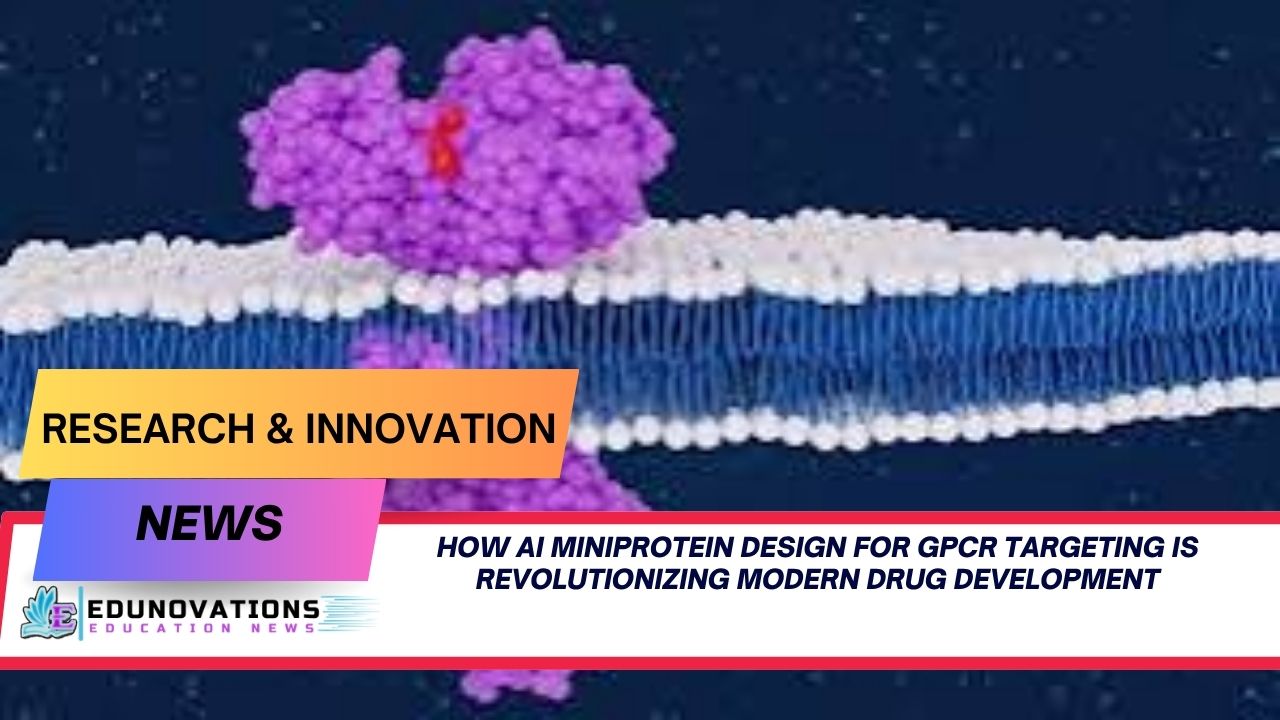
Discover how ai miniprotein design for gpcr targeting is revolutionizing medicine. Learn how scientists at IIT Kanpur and Nobel Laureate David Baker’s lab engineered custom molecules to block key drug receptors.
The landscape of pharmaceutical research is undergoing a seismic shift. In a landmark scientific collaboration, researchers at the Indian Institute of Technology Kanpur (IIT Kanpur) have partnered with the world-renowned laboratory of Nobel Laureate Prof. David Baker at the University of Washington to pioneer a breakthrough technique in computational biology. The team has successfully demonstrated how artificial intelligence can create custom-engineered, synthetic proteins from scratch to bind with pinpoint accuracy to crucial cellular receptors.
Published in the prestigious journal Nature, the landmark study titled “De novo design of miniproteins targeting GPCRs” marks a pivotal leap forward in molecular engineering. By leveraging cutting-edge machine learning algorithms and advanced structural imaging, the joint research team has proven that targeted protein therapeutics can bypass the costly, slow, and labor-intensive trial-and-error methods that have historically defined drug discovery.
Understanding the GPCR Bottleneck in Pharmaceutical Development
To appreciate the magnitude of this breakthrough, one must first look at G protein-coupled receptors (GPCRs). GPCRs represent the largest and most functionally diverse family of cell-surface membrane proteins in the human genome. Acting as biological gatekeepers or switches, these receptors sit embedded within cell membranes, receiving external molecular signals—such as hormones, neurotransmitters, and sensory stimuli—and translating them into downstream cellular responses.
Because of their pervasive influence on human physiology, GPCRs serve as the direct targets for roughly one-third of all FDA-approved prescription medicines. From hypertension medications and antihistamines to antipsychotics and pain therapeutics, GPCR modulation is vital to modern medical care.
However, traditional drug discovery aimed at GPCRs faces severe chemical and structural limitations:
- Structural Dynamics: GPCRs are notoriously flexible, shape-shifting entities. They adopt multiple active and inactive conformations within lipid membranes, making them difficult to lock into a specific state.
- The “Undruggable” Pocket Problem: Standard synthetic small-molecule drugs are often too small or lack the required chemical surface area to selectively differentiate between closely related receptor subtypes, leading to severe off-target toxicity.
- Antibody Oversizing: Monoclonal antibodies—while highly specific—are massive molecular structures (roughly 15 times larger than a miniprotein). Their sheer physical bulk prevents them from accessing deep hydrophobic binding pockets hidden within cell-surface receptors.
To overcome these structural hurdles, scientists turned to computational molecular modeling. The integration of high-performance artificial intelligence algorithms has allowed researchers to map these complex binding sites with sub-angstrom precision, setting the stage for custom biological design.
How AI Miniproteins Work: Bridging Small Molecules and Monoclonal Antibodies
Miniproteins are engineered chains of fewer than 100 amino acids. They occupy a biological “Goldilocks zone” in drug architecture: compact enough to access deep, buried active sites within membrane receptors, yet large and rigid enough to establish extensive contact networks with high binding affinity.
       [ TRADITIONAL DRUG MODALITIES vs. ENGINEERED MINIPROTEINS ]

+-------------------------+-------------------------+-------------------------+
|     Small Molecules     |    Monoclonal Abs       |     AI Miniproteins     |
+-------------------------+-------------------------+-------------------------+
| • Deep pocket penetration| • Exceptional specificity| • Deep pocket penetration|
| • Poor target selectivity| • Cannot reach pockets   | • High target selectivity|
| • Frequent side effects | • Massive molecular size| • Compact & ultra-stable|
+-------------------------+-------------------------+-------------------------+
Rather than screening millions of random synthetic chemical compounds across physical assay trays—a process that can take years and cost tens of millions of dollars—the research team used generative AI algorithms to construct molecular architectures entirely de novo (from scratch).
These deep learning frameworks evaluate billions of amino acid sequence combinations in silico, scoring their folding stability, free-energy landscapes, and geometric compatibility against structural models of target GPCRs. Once the software calculates the optimal candidate structures, only the highest-scoring miniprotein sequences are synthesized and validated in laboratory environments.
“Designing proteins that activate or inhibit GPCRs requires getting the geometry of the receptor interface exactly right,” stated Nobel Laureate Prof. David Baker, Director of the Institute for Protein Design at the University of Washington. “For the first time, the speed of AI is beginning to match the experimental power of synthetic biology. That changes the fundamental question from ‘What has nature already made?’ to ‘What else is possible and how can we test it?'”
Spotlight on Specific Targets: CXCR4 and CCR5 Receptors
To demonstrate the real-world utility of their platform, the researchers designed custom miniproteins explicitly optimized to bind to two heavily studied chemokine receptors: CXCR4 and CCR5.
Both of these GPCRs play critical roles in major human pathologies:
- CXCR4 (C-X-C Chemokine Receptor Type 4): Widely overexpressed in more than 20 types of human cancers, CXCR4 drives tumor cell migration, metastasis, vascularization, and therapeutic resistance. Blocking CXCR4 effectively traps malignant cells, preventing them from spreading through bloodstream pathways.
- CCR5 (C-C Chemokine Receptor Type 5): Best known as the primary co-receptor used by the Human Immunodeficiency Virus (HIV-1) to gain entry into human T-cells. Blocking CCR5 physically prevents viral envelope glycoproteins from initiating cell fusion.
By deploying custom miniproteins engineered to lock into the specific binding pockets of CXCR4 and CCR5, the collaborative team successfully demonstrated picomolar binding affinities, effectively shutting down downstream cellular signaling.
High-Resolution Cryo-EM Imaging at IIT Kanpur
Validating a computer-generated protein design requires direct visual proof at the atomic level. This crucial validation was spearheaded by Prof. Arun K. Shukla and his research team at the Indian Institute of Technology Kanpur (including lead researchers Dr. Ramanuj Banerjee, Manisankar Ganguly, Annu Dalal, Sudha Mishra, and Shachie Sinha).
Using state-of-the-art Cryogenic Electron Microscopy (Cryo-EM) facilities at IIT Kanpur, the team successfully froze the miniprotein-receptor complexes in vitreous ice and captured three-dimensional atomic density maps.
+-------------------------------------------------------------------------+
|                        THE CRYO-EM VALIDATION PATHWAY                    |
|                                                                         |
|  [ AI Computational Design ]  -->  [ Recombinant Protein Expression ]   |
|                                                  |                      |
|  [ Atomic 3D Density Map ]   <--  [ Cryo-EM Vitrification & Imaging ]   |
+-------------------------------------------------------------------------+
The Cryo-EM images provided unambiguous physical proof: the AI-designed miniproteins nested precisely inside the deep binding pocket of the CXCR4 receptor, matching the computer-predicted structural models down to fractions of a nanometer.
“The function of GPCRs is regulated by complex structural interactions within cell membranes,” noted Prof. Arun K. Shukla of IIT Kanpur during related GPCR structural investigations. “Visualizing these interactions using cutting-edge Cryo-EM technology opens up entirely novel directions for improving existing therapeutics by lowering off-target side effects and discovering new medicines for complex disease conditions.”
This visual confirmation proves that generative AI models do not simply produce theoretical constructs—they generate physically viable, highly potent biological tools.
Economic and Clinical Implications for Global Healthcare
The transition from physical drug screening to computational design represents a monumental shift for the global pharmaceutical sector.
       [ TRADITIONAL VS. AI-DRIVEN DRUG DISCOVERY TIMELINES ]

TRADITIONAL PHARMA PIPELINE:
[ Physical Compound Library Screening ] ---> [ Lead Optimization ] ---> [ Preclinical ]
|===================== 3 to 5 Years =====================|

AI MINIPROTEIN PIPELINE:
[ In Silico AI Design ] -> [ Targeted Synthesis ] -> [ Preclinical ]
|======= 6 to 12 Months =======|
The economic and operational benefits include:
- Drastic Cost Reductions: Traditional drug discovery pipelines spend hundreds of millions of dollars synthesizing and testing chemical libraries that yield a 99% failure rate. AI design reduces physical candidate testing to a targeted handful of high-probability leads.
- Accelerated Timelines: Target-to-lead discovery cycles that historically required 3 to 5 years can now be accomplished in months.
- Lowered Side-Effect Profiles: Because AI miniproteins establish extensive, highly specific hydrogen bonds and hydrophobic interactions across a target receptor’s surface, off-target binding to unintended cellular receptors is minimized.
While these engineered miniproteins represent laboratory breakthroughs rather than immediate retail therapies, preclinical pipelines are already moving rapidly. Additional academic context, educational modules, and research documentation regarding advanced biotechnology concepts can be explored through specialized learning pathways, including curated NCERT Courses and comprehensive study references available in our digital Notes Section.
Key Technical Milestones: Summary Table
| Scientific Metric / Dimension | Traditional Small Molecules | Monoclonal Antibodies | AI-Engineered Miniproteins |
| Molecular Mass | < 500 Daltons | ~150,000 Daltons | 3,000 – 10,000 Daltons |
| Target Selectivity | Moderate to Low | High | Ultra-High |
| Pocket Accessibility | Deep Pockets Only | Surface Epitopes Only | Deep & Shallow Pockets |
| Production Time | 3 – 5 Years (Screening) | 1 – 2 Years (Immunization) | Weeks (In Silico Design) |
| Primary GPCR Targets | CXCR4, CCR5, Rhodopsin | Extracellular Loops | CXCR4, CCR5, and 11+ GPCRs |
| Structural Validation | X-ray Crystallography | X-ray / NMR | Cryo-EM Visualization |
Preparing the Next Generation of Scientists and Institutions
As bio-computational tools continue to mature, the integration of artificial intelligence into biological sciences is rapidly becoming a core component of STEM curricula worldwide. Students preparing for advanced competitive examinations and higher education research can track evolving scientific developments in our regularly updated Current Affairs Section.
To master foundational biological principles, students can review targeted practice modules in our MCQ Portal, watch step-by-step video lectures in our Video Library, or check official curriculum guidelines in the Syllabus Directory.
For complete academic study resources, download standard textbook references via our Free NCERT PDFs Portal and visually review complex cellular pathways using detailed NCERT Mind Maps. Educational institutes and research centers looking to build modern digital portals to showcase breakthroughs can consult professional development teams like Mart India Infotech to build secure, scalable academic web applications.
The Road Ahead: From In Silico Design to Clinical Practice
The joint study by IIT Kanpur and the David Baker lab provides a clear roadmap for the future of medicine. By combining generative machine learning, synthetic biology, and high-resolution cryo-electron microscopy, scientists have demonstrated that human ingenuity supported by AI can systematically unlock receptor targets previously deemed unreachable.
As these custom miniproteins enter preclinical animal models and human clinical trials over the coming decade, the paradigm of drug discovery has fundamentally changed: we no longer need to find the right key among millions of random chemicals—we can simply print the exact key we need.
Toppers Use Mind Maps to score more than 95%
NCERT Class 11th Commerce Mind Maps
Add to cartOriginal price was: ₹999.00.₹199.00Current price is: ₹199.00.NCERT Class 12th Chemistry Mind Maps
Add to cartOriginal price was: ₹199.00.₹75.00Current price is: ₹75.00.NCERT Class 12th Commerce Mind Maps
Add to cartOriginal price was: ₹999.00.₹199.00Current price is: ₹199.00.NCERT Class 12th Science Mind Maps
Add to cartOriginal price was: ₹999.00.₹199.00Current price is: ₹199.00.NCERT Mind Maps For Class 10th
Add to cartOriginal price was: ₹999.00.₹199.00Current price is: ₹199.00.



Purchase Today
Frequently Asked Questions (FAQs)
1. What is the significance of ai miniprotein design for gpcr targeting?
It allows scientists to computationally design small, highly specific protein molecules that fit precisely into complex cell receptors (GPCRs), bypassing years of expensive manual chemical screening.
2. How do ai miniproteins block cxcr4 receptors?
AI miniproteins are engineered with specific 3D geometries that match the deep binding pocket of the CXCR4 receptor, physically occupying the site and preventing cancer cells from receiving signals that promote metastasis.
3. What role do de novo miniproteins in computational drug discovery play?
They serve as custom-designed biological keys created entirely from scratch using computer algorithms, offering higher target selectivity than traditional small-molecule drugs and better pocket penetration than large antibodies.
4. How are ai designed proteins targeting ccr5 and cxcr4 synthesized?
Algorithms first calculate the optimal amino acid sequences. These sequences are then synthesized via recombinant DNA technology or automated peptide synthesis and validated in living cells and structural imaging systems.
5. How de novo protein design speeds up drug discovery timelines?
Instead of physically testing millions of synthetic chemical compounds in lab assays, AI models simulate billions of structural interactions in minutes, allowing researchers to synthesize and test only the top-performing candidate molecules.
6. What makes GPCRs so difficult to target with traditional drugs?
GPCRs are embedded within lipid cell membranes and constantly change shapes. Small molecules often lack selectivity causing side effects, while large antibodies cannot enter the deep binding cavities of the receptor.
7. What was IIT Kanpur’s specific contribution to this research?
IIT Kanpur provided critical structural validation using high-resolution Cryo-Electron Microscopy (Cryo-EM), capturing atomic-level 3D visualizations of the engineered miniprotein bound directly to the CXCR4 receptor.
8. Are these AI-designed miniproteins currently available as medical treatments?
No, these miniproteins are currently in the early proof-of-concept and preclinical stages. They must undergo extensive toxicity testing, animal studies, and human clinical trials before becoming approved pharmaceuticals.
9. Which Nobel Laureate co-led this computational protein research?
Prof. David Baker of the University of Washington, who was awarded the Nobel Prize in Chemistry in 2024 for his pioneering work in computational protein design, co-led the study alongside international collaborators including IIT Kanpur.
10. Can this AI technique be applied to other diseases besides HIV and cancer?
Yes. Because GPCRs regulate a vast range of physiological functions, this method can be adapted to design targeted miniprotein therapeutics for metabolic conditions, cardiovascular diseases, neurological disorders, and chronic inflammation.