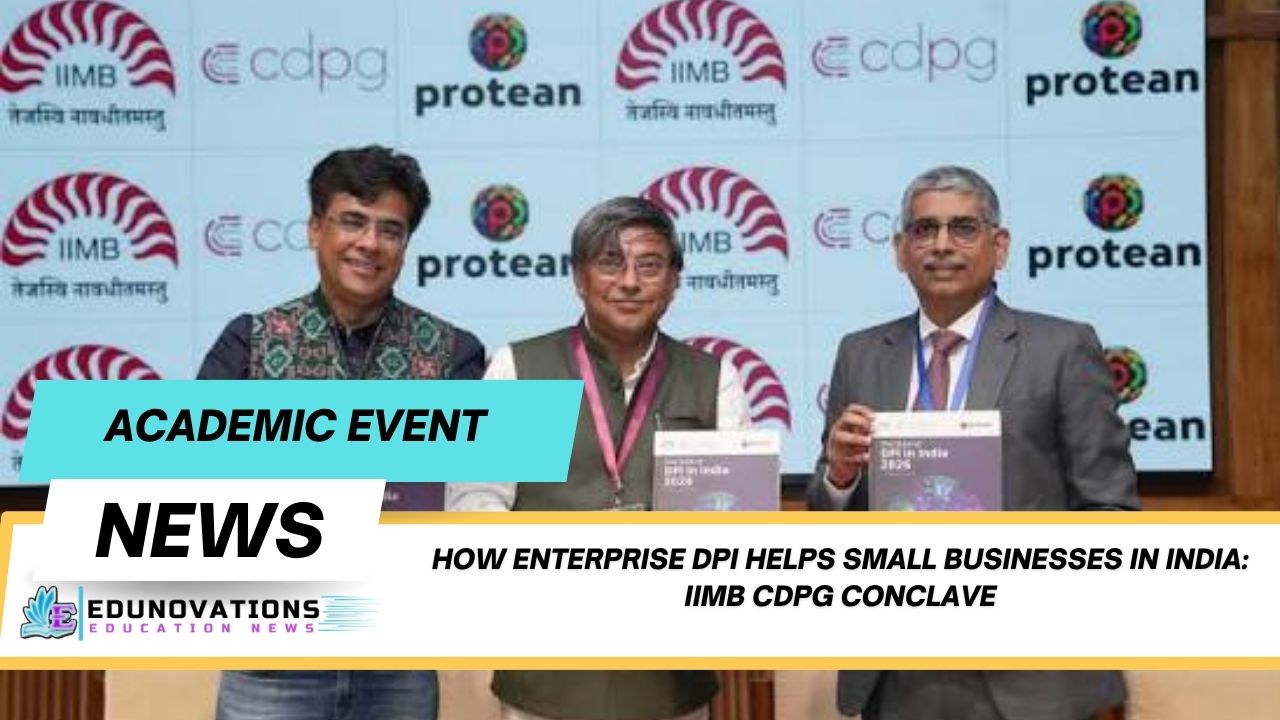
Discover how enterprise DPI helps small businesses in India, along with key insights on AI, education, and finance from the IIM Bangalore CDPG Conclave 2026.
Empowering India’s Digital Future: How Enterprise DPI Helps Small Businesses in India and Transforms Governance
The Indian Institute of Management Bangalore (IIMB) hosted a benchmark gathering of policy architects, technology leaders, and academic scholars at the prestigious Center for Digital Public Goods (CDPG) Annual Conclave 2026. Organised in strategic partnership with the eGov Foundation on the vibrant IIMB campus in Bengaluru, the conclave centered on a pivotal theme: ‘Envisioning the Next Generation of Public Services in India.’ The event provided a holistic evaluation of how Digital Public Infrastructure (DPI), open-data architecture, and artificial intelligence (AI) are fundamentally restructuring public service delivery, corporate compliance, and socio-economic empowerment across urban and rural India.
As public service delivery undergoes rapid digitization, understanding how enterprise DPI helps small businesses in India has become essential for entrepreneurs, MSMEs, and public sector strategists seeking to reduce administrative friction and foster competitive growth. Throughout the summit, delegates thoroughly debated how India’s foundational digital rails—which previously transformed citizen identity and peer-to-peer retail payments—must now evolve into corporate domain applications. Analyzing how enterprise DPI helps small businesses in India provides valuable insights into how micro, small, and medium enterprises can bypass fragmented bureaucratic processes through unified digital identities and interoperable regulatory frameworks.
Unpacking the CDPG Conclave 2026: Vision and Foundational Imperatives
The flagship conclave opened with high-impact keynotes that critically evaluated the real-world operational realities of emerging technologies against their theoretical promises. Delivering the inaugural address, Prof. U. Dinesh Kumar, Director-in-charge at IIM Bangalore, urged policy architects to maintain rigorous scrutiny when deploying artificial intelligence in governance.
“AI systems are fundamentally probabilistic and inherit the strengths and weaknesses of the data beneath them,” remarked Prof. U. Dinesh Kumar. He cited international cautionary examples, including the landmark Dutch childcare benefits scandal, to emphasize how flawed underlying data models and automated algorithms can lead to severe social consequences if left unmonitored.
Following the opening address, Mr. Viraj Tyagi, Chief Executive Officer of the eGov Foundation, delivered the opening plenary speech focusing on actionable data systems and scalable infrastructure. Highlighting tangible administrative victories, Mr. Tyagi pointed to Andhra Pradesh’s successful rollout of the DigiT portal. The state reduced statutory municipal service delivery timelines dramatically from 114 days in 2016 down to just 12 days by 2025.
“Technology alone is not enough; you need to build local capacity, catalyse the ecosystem, and use digital public goods to facilitate service delivery and co-creation at scale,” explained Mr. Viraj Tyagi. He further emphasized that AI must be leveraged strictly as a decision-support system to empower human judgment rather than replacing human agency entirely in welfare and public access programs.
Students and research scholars looking to understand these foundational policy frameworks can supplement their academic preparations with comprehensive study tools, including NCERT Courses and specialized downloadable NCERT Notes.
Sectoral Breakdown: Five Tracks Reshaping India’s Socio-Economic Landscape
The day-long conclave examined five foundational sectors of the Indian economy. Experts from commercial enterprises, academic institutions, and grassroots NGOs presented evidence-based policy frameworks across dedicated sectoral panels.
Track 1: Commerce & Enterprise Modernization
The Commerce panel, moderated by Bachi Allamsetty from Networks for Humanity, brought together industry leaders including Karthikeyan Arumugam (DIGIIT Business Services), Ravi Haldipur (eSamudaay), and Rishi Agrawal (TeamLease RegTech). Panelists agreed that while individual citizens benefit from unified digital identities like Aadhaar, Indian businesses continue to struggle with disjointed regulatory filings and siloed registration requirements.
Analyzing how enterprise DPI helps small businesses in India reveals that small firms often waste substantial capital maintaining separate compliance portals for local municipal bodies, state tax boards, and central licensing authorities. The emergence of Enterprise DPI promises to bridge this gap by offering a single reusable digital identity for businesses. By creating open digital networks, shared infrastructure drastically lowers entry barriers for micro-enterprises while leaving product design, pricing models, and market expansion to free-market competition.
For educational institutions and regional businesses seeking robust, scalable web infrastructure, consulting leading technology partners like Mart Ind Infotech helps build competitive, compliant digital platforms.
Track 2: Education, Skill Mobility, and Institutional Inclusion
The Education panel, moderated by Prof. Mukta Kulkarni, Dean of Programmes at IIMB, examined the intersection of open digital protocols and educational equity. The panel featured Anand Gautam (EkStep Foundation), Ayushi Khare (Indus Action), Prof. Dwarika Prasad Uniyal (Founding Pro Vice Chancellor, RV University), and Harnam Shankar (RightWalk Foundation).
Panelists argued that while digitizing academic credentials is a positive step forward, digital marksheets alone cannot solve educational inequality. Digital academic records must be seamlessly paired with portable scholarships, mentorship opportunities, and institutional support systems that follow the learner across regional boundaries.
“India needs a kind of revolution to create scale, access and value—a triangle that is very difficult to achieve in higher education,” stated Prof. Dwarika Prasad Uniyal.
To address systemic challenges in higher education, legacy government platforms must overcome privacy concerns and technical differences to achieve true system interoperability. Candidates preparing for competitive national examinations can stay updated on evolving education policies by reviewing daily curated Current Affairs and taking targeted online MCQ’s Practice Tests.
Track 3: Agricultural Digitalization and Scalability by Design
The Agriculture panel was led by Chaitrali Bhoi of CDPG and featured Abhishek Sankritik (Finternet), Anilkumar SG (Samunnati), J. Satyanarayana (Center for the Fourth Industrial Revolution India, World Economic Forum), and Prashanth Mehra (Platform Commons Foundation).
The panel discussed why many promising agri-tech pilots fail to scale across India’s diverse agricultural landscape. They recommended shifting analytical focus from individual farm plots to broader household data and farmer producer organizations (FPOs).
   ┌─────────────────────────────────────────────────────────────┐
   │             CRITICAL PILLARS OF AGRI-DPI SCALE              │
   ├──────────────────────────────┬──────────────────────────────┤
   │ Scalability Framework        │ Practical Implementation     │
   ├──────────────────────────────┼──────────────────────────────┤
   │ Integrated Data Layers       │ Unifies land, weather, market│
   │ Household-Level Focus        │ Tracks full farm revenue     │
   │ FPO Digital Enablement       │ Aggregates smallholder power │
   │ Legal & Ownership Clarity    │ Secures tenant farmer rights │
   └──────────────────────────────┴──────────────────────────────┘
“Value, technology, ownership and legal support will be the ingredients of great scale,” highlighted J. Satyanarayana, calling on digital architects to adopt “scalability by design” from day one.
Track 4: Healthcare, WASH, and Outcome-Focused Financing
The Healthcare and WASH (Water, Sanitation, and Hygiene) session was moderated by Divya Raj (eGov Foundation) and featured Amrita Agarwal (Bill & Melinda Gates Foundation), Johnson Topno (PHIA Foundation), and Prasad Sudhakar (TANUH AI-CoE for Healthcare, IISc).
Panelists confronted the gap between technological rollouts and actual rural health improvements. Persistent challenges—such as poor internet connectivity in remote villages, severe healthcare worker shortages, and low public trust—continue to hinder last-mile delivery.
       TRADITIONAL HEALTHCARE VS. OUTCOME-BASED FINANCING

┌───────────────────────────────┐     ┌───────────────────────────────┐
│     OLD MODEL: ACTIVITY       │     │     NEW MODEL: OUTCOMES       │
├───────────────────────────────┤     ├───────────────────────────────┤
│ • Total clinic visits logged  │ vs  │ • Reduction in disease rate   │
│ • Volume of medicine issued   │     │ • Faster rural response time  │
│ • Total budget expended       │     │ • Patient recovery metrics    │
└───────────────────────────────┘     └───────────────────────────────┘
“When we start obsessing less about the spend and the activity, and more about outcomes, then we will rewire how the funding is happening,” asserted Amrita Agarwal.
Track 5: Financial Services and Account Aggregator Networks
The final session focused on Financial Services and was chaired by Prof. R. Srinivasan, Chairperson of CDPG at IIM Bangalore. The panel included Abhisar Sharma (NeSL Asset Data Limited), B.G. Mahesh (Chief Executive Officer, Sahamati), and Ramakrishna NK (Founder, Rang De).
The discussion focused on how the Account Aggregator (AA) framework, paired with non-financial data points like gig-economy earnings and utility bill payments, can help expand credit access to first-time borrowers and unregistered business owners.
                  ACCOUNT AGGREGATOR DATA FLOW MODEL

  ┌──────────────────┐       Consent Stream       ┌──────────────────┐
  │ Financial Data   ├───────────────────────────►│ Account          │
  │ Providers (FIPs) │                            │ Aggregator (AA)  │
  └──────────────────┘                            └─────────┬────────┘
                                                            │
                                  Secure Frictionless       │
                                  Data Consent Share        │
                                                            ▼
  ┌──────────────────┐                            ┌──────────────────┐
  │ MSME / Borrower  │◄───────────────────────────┤ Financial Data   │
  │ Credit Access    │     Instant Credit Grant   │ Users (FIUs)     │
  └──────────────────┘                            └──────────────────┘
Panelists cautioned that rapid automated lending solutions must be paired with fair pricing structures and strong consumer financial literacy to prevent predatory lending practices.
“For me, in five years, in any form of financial services, irrespective of the licence, it should happen only through AA by design, not through mandate,” stated B.G. Mahesh.
Summarizing the session, Prof. R. Srinivasan observed: “We’ve been so focused on responsible lending that we have not focused on responsible borrowing.”
For students studying economic policy and financial frameworks, structured visual tools like NCERT Mind Maps and video lectures on Edunovations Video Lessons offer clear breakdowns of complex monetary systems.
Valedictory Address: Building Secure and Scalable Entrepreneurial Systems
The conclave concluded with a virtual valedictory address delivered by Mr. V.R. Govindarajan, Co-Founder and Executive Chairman of Perfios. He encouraged young founders and researchers to leverage India’s robust digital infrastructure.
“This is undoubtedly the best time to be an entrepreneur, especially in India,” affirmed Mr. V.R. Govindarajan. “The Digital Public Goods already built in India provide proven and tested infrastructure on which innovative ideas can flourish.”
However, Mr. Govindarajan emphasized that data privacy, user consent, regulatory compliance, and universal accessibility must be built into product architectures from day one rather than added as an afterthought. He advised entrepreneurs to treat evolving regulatory guidelines as competitive moats rather than administrative hurdles.
Strategic Summary of Panel Insights
| Sector Track | Panel Moderator | Industry & Policy Experts | Primary Focus & Takeaways |
| Commerce | Bachi Allamsetty | Karthikeyan Arumugam, Ravi Haldipur, Rishi Agrawal | Enterprise DPI, single corporate identity, lowering onboarding friction for MSMEs |
| Education | Prof. Mukta Kulkarni | Anand Gautam, Ayushi Khare, Prof. Dwarika Prasad Uniyal, Harnam Shankar | Credential portability, student scholarships, cross-platform system interoperability |
| Agriculture | Chaitrali Bhoi | Abhishek Sankritik, Anilkumar SG, J. Satyanarayana, Prashanth Mehra | Farm-household data aggregation, scalable agri-tech models, FPO empowerment |
| Healthcare/WASH | Divya Raj | Amrita Agarwal, Johnson Topno, Prasad Sudhakar | Shift to outcome-based financing, last-mile health worker support, rural connectivity |
| Financials | Prof. R. Srinivasan | Abhisar Sharma, B.G. Mahesh, Ramakrishna NK | Account Aggregator consent frameworks, MSME credit expansion, responsible borrowing |
Academic Preparation and Policy Learning Resources
As India expands its digital infrastructure, mastering policy frameworks and government initiatives has become essential for academic success and competitive exam preparation. Students can access dedicated learning modules designed for competitive excellence:
- Review detailed exam requirements using Exam Syllabus Guides.
- Access downloadable textbooks via Free NCERT PDFs Download.
- Test your subject knowledge across current affairs and general studies with interactive Online MCQs.
Understanding how enterprise DPI helps small businesses in India equips researchers, students, and entrepreneurs with actionable knowledge about India’s rapidly evolving digital economy.
Toppers Use Mind Maps to score more than 95%
NCERT Class 11th Commerce Mind Maps
Add to cartOriginal price was: ₹999.00.₹199.00Current price is: ₹199.00.NCERT Class 12th Chemistry Mind Maps
Add to cartOriginal price was: ₹199.00.₹75.00Current price is: ₹75.00.NCERT Class 12th Commerce Mind Maps
Add to cartOriginal price was: ₹999.00.₹199.00Current price is: ₹199.00.NCERT Class 12th Science Mind Maps
Add to cartOriginal price was: ₹999.00.₹199.00Current price is: ₹199.00.NCERT Mind Maps For Class 10th
Add to cartOriginal price was: ₹999.00.₹199.00Current price is: ₹199.00.





Purchase Today
Frequently Asked Questions (FAQs)
1. How enterprise DPI helps small businesses in India to grow rapidly?
Enterprise DPI streamlines operations for small businesses by unifying fragmented corporate registrations into a single reusable digital identity. This reduces compliance costs, eliminates administrative paperwork, and accelerates access to formal credit markets.
2. What role does role of dpi and ai in higher education inclusion india play according to experts?
The combination of DPI and AI enables the secure transfer of digital academic credentials alongside portable scholarships and financial support. This ensures students can access educational opportunities across state lines without losing verified academic records.
3. How account aggregator ecosystem improves msme credit access without traditional collateral?
The Account Aggregator network securely transfers verified, consent-based cash-flow data—such as GST filings, utility payments, and digital transaction history—to financial institutions, allowing lenders to grant collateral-free cash-flow loans to MSMEs.
4. What are the key challenges in scaling agritech digital public goods india across rural markets?
Primary challenges include fragmented land ownership records, highly localized climate conditions, low digital literacy among smallholders, and pilot solutions that fail to scale effectively across diverse regional environments.
5. What were the key outcomes of the cdpg annual conclave 2026 iim bangalore key takeaways session?
Key takeaways emphasized shifting healthcare metrics toward outcome-based financing, adopting “scalability by design” in agricultural tech, building single business identities through Enterprise DPI, and embedding consent and privacy protections directly into startup infrastructure.
6. Who hosted the CDPG Annual Conclave 2026 in Bengaluru?
The conclave was hosted by the Center for Digital Public Goods (CDPG) at the Indian Institute of Management Bangalore (IIMB) in strategic partnership with the eGov Foundation.
7. Why did Prof. U. Dinesh Kumar urge caution regarding AI adoption in governance?
Prof. U. Dinesh Kumar highlighted that AI models are inherently probabilistic and reflect the quality of their training data. He warned that flawed underlying datasets can lead to severe social biases and administrative errors if left unmonitored.
8. How did the DigiT portal transform municipal service delivery times in Andhra Pradesh?
As shared by Viraj Tyagi of the eGov Foundation, Andhra Pradesh’s DigiT portal dramatically reduced municipal service turnaround times from 114 days in 2016 to just 12 days by 2025 using trusted digital infrastructure.
9. What is responsible borrowing in the context of Account Aggregator financial networks?
As highlighted by Prof. R. Srinivasan, responsible borrowing emphasizes educating consumers and small businesses to avoid over-leverage and predatory debt traps as instant, automated digital credit becomes widely available.
10. How can entrepreneurs turn data privacy regulations into a competitive advantage?
According to Mr. V.R. Govindarajan, embedding consent management, user privacy, and regulatory compliance into software design from day one helps startups build trust with users and regulators, creating a durable competitive moat.