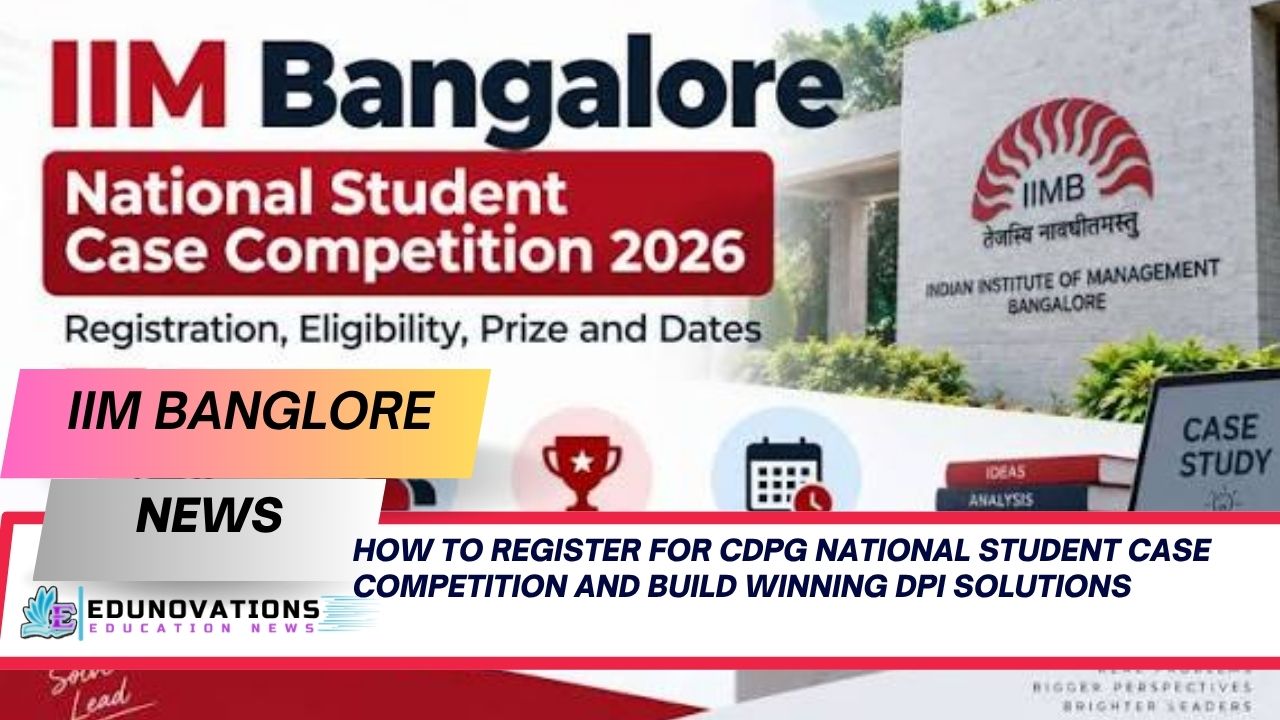
The landscape of India’s digital transformation reached another monumental benchmark as the Center for Digital Public Goods (CDPG) at IIM Bangalore
The landscape of India’s digital transformation reached another monumental benchmark as the Center for Digital Public Goods (CDPG) at IIM Bangalore successfully concluded its inaugural nationwide challenge. Spanning three distinct tracks—Technology & Design, Policy & Regulation, and Governance & Ecosystem—the national student case competition brought together 2,250 bright minds from 450 teams across premier institutions including IIT Jodhpur, Dhirubhai Ambani University, Nirma University, Thapar Institute, Rajiv Gandhi Institute of Petroleum Technology, IIM Sambalpur, and IIM Bangalore.
With India’s Account Aggregator network crossing 500 million consented data shares and Digital Public Infrastructure (DPI) underpinning everything from daily payments to healthcare verification, understanding how to analyze, build, and pitch DPI-enabled products is now a core requirement for next-generation innovators. This comprehensive guide unpacks the entire journey, details step-by-step registration pathways, breaks down winning solutions, and provides actionable frameworks for students preparing for future national case studies.
Mastering the Registration Process and Preliminary Rounds
Navigating a top-tier academic contest requires a thorough understanding of procedural requirements and submission standards. Aspiring participants frequently search for how to register for CDPG national student case competition to ensure their entries fulfill structural, technical, and regulatory prerequisites.
+-------------------------------------------------------------------------+
|                  STAGE I: CASE ANALYSIS & AUDIT                         |
|  - Deconstruct existing DPI systems (e.g., Digi Yatra, Aadhaar, UPI)   |
|  - Perform regulatory & privacy risk assessment                         |
|  - Address data governance, purpose limitation, and user consent       |
+-------------------------------------------------------------------------+
                                   |
                                   v
+-------------------------------------------------------------------------+
|                STAGE II: PROTOTYPING & SANDBOX BUILD                    |
|  - Integrate live APIs using Perfios-Anumati Account Aggregator sandbox |
|  - Develop customer-backward financial wellness workflows              |
|  - Build interactive user interfaces (WhatsApp, Mobile Apps, Dashboards)|
+-------------------------------------------------------------------------+
                                   |
                                   v
+-------------------------------------------------------------------------+
|                 STAGE III: NATIONAL FINALS & PITCH                      |
|  - Present live functional prototypes to academic & industry leaders   |
|  - Defend unit economics, scalability models, & compliance safeguards   |
+-------------------------------------------------------------------------+
Eligibility and Team Formation Rules
To qualify for registration, teams must adhere to explicit composition criteria:
- Team Size: Exactly 3 to 5 full-time undergraduate, postgraduate, or doctoral students.
- Interdisciplinary Composition: Highly recommended to blend technology, business strategy, economics, and public policy domains to effectively address multi-faceted DPI challenges.
- Institutional Verification: Valid institutional email addresses and official student identification cards are mandatory during the initial online portal submission.
Phase 1: Institutional Case Audit & Regulatory Framework
In the opening round, teams are presented with a complex, real-world case study centering on established public technology stacks. During the 2026 inaugural edition, teams examined the systemic implications of extending Digi Yatra—a biometric-enabled airport processing system—into secondary public and commercial sectors.
Participants were required to deliver a comprehensive policy and design dossier addressing:
- Purpose Limitation: Ensuring biometric and credential data is strictly utilized for the designated service without scope creep.
- Interoperability: Architecting open standards that prevent vendor lock-in while maintaining seamless service delivery.
- Citizen Consent Safeguards: Building explicit, revocable, and audit-friendly consent frameworks aligned with current data protection mandates.
Phase 2: Live Prototyping in Technical Sandboxes
Teams advancing past the conceptual audit enter the functional implementation phase. Here, abstract strategy gives way to live engineering. Competitors receive sandbox access to simulate actual financial transaction logs, account aggregator feeds, and consent management flows. The technical brief demands a fully working service flow alongside a viable go-to-market business model.
Analyzing the Track Breakdown and National Winners
To understand the standards set at the summit, one must analyze the top-performing solutions recognized by the esteemed judging panel. The national competition awarded top honors across three distinct tracks, each taking home ₹1 lakh in cash prizes, alongside a special Jury’s Choice award of ₹50,000.
| Track Name | Winning Team | Institution | Winning Solution | Core Technology / Mechanism |
| Technology & Design | Champagne-Papi | IIM Bangalore (PGP) | SAHAY | WhatsApp conversational interface for quarterly expense planning |
| Policy & Regulation | Pungibunch | IIM Bangalore (BBA DBE) | Anumati | Consented financial data engine for risk identification & guidance |
| Governance & Ecosystem | Case Crackers | Dhirubhai Ambani University | Sambhal | Consent-first financial timing engine built on Account Aggregator stack |
| Jury’s Choice Award | Team Nexus | IIT Jodhpur | Paarivar CFO | Comprehensive family financial management dashboard |
For complete academic syllabus details and exam preparations related to public administration and economic policy, students can explore NCERT Courses and review updated exam structures on the Edunovations Syllabus Portal.
Architectural Breakdown of Winning Solutions
Understanding how top teams design their product architecture is crucial for anyone studying IIM Bangalore CDPG national case competition 2026 winners. The 2026 national finals highlighted a massive shift toward customer-backward, consent-first financial technology.
1. Track 1 Winner: SAHAY (Technology & Design)
Developed by Team Champagne-Papi from IIM Bangalore’s PGP program, SAHAY addresses a widespread challenge facing aspiring middle-class households: short-term cash flow volatility and unplanned quarterly expenses.
- Interface Choice: Rather than forcing users to download a standalone application, SAHAY operates natively within WhatsApp, leveraging high daily active usage patterns.
- Data Integration: Utilizes the Account Aggregator sandbox to pull consented bank statements, recurring bill schedules, and income patterns.
- Nudge Engine: Generates predictive warnings 30, 60, and 90 days ahead of major obligations (such as school fees, insurance premiums, and agricultural inputs), converting reactive stress into structured savings.
2. Track 2 Winner: Anumati (Policy & Regulation)
Created by Team Pungibunch from IIM Bangalore’s digital business degree program, this solution focused squarely on regulatory alignment and consent security.
- Risk-Based Data Sharing: Implements strict data minimization techniques, pulling only the precise financial metrics required for credit evaluation.
- Consumer Empowerment: Provides clear visual dashboards detailing which institutions hold data access, allowing citizens to revoke consent with a single tap.
3. Track 3 Winner: Sambhal (Governance & Ecosystem)
Engineered by Team Case Crackers from Dhirubhai Ambani University, Sambhal addresses liquidity management for semi-formal earning households.
- Timing Engine: Analyzes cash inflow cycles against mandatory outflow timelines to optimize bill payment schedules without incurring penalty fees.
- Institutional Alignment: Works in harmony with local cooperative banks and self-help group ecosystems to expand formal credit lines.
4. Special Recognition: Income Saathi & Nirnay
Other noteworthy solutions included Income Saathi by Team DIGI Ops (IIM Sambalpur), which consolidated irregular income streams for gig workers across multiple delivery and ride-hailing platforms into a single unified financial ledger. Meanwhile, Team Catalyst from Nirma University introduced Nirnay, a decision engine utilizing bank-led distribution channels to deliver hyper-localized financial advice.
Students preparing research papers on these themes can access comprehensive study materials through Free NCERT PDF Downloads and review foundational concepts on Edunovations Notes.
Step-by-Step Guide: How to Build DPI Enabled Financial Solutions for Case Study
Developing a winning entry requires moving beyond basic slide decks to build functional, compliant digital tools. When exploring how to build DPI enabled financial solutions for case study challenges, teams should follow a structured five-step innovation blueprint.
       [ STEP 1: Identify Target Archetype & Financial Friction ]
                                  |
                                  v
       [ STEP 2: Configure API Endpoints in AA Sandbox ]
                                  |
                                  v
       [ STEP 3: Embed Privacy-by-Design & Data Minimization ]
                                  |
                                  v
       [ STEP 4: Build Conversational or Low-Friction UI ]
                                  |
                                  v
       [ STEP 5: Establish Unit Economics & Scalability Models ]
Step 1: Identify the Specific Target Archetype
Avoid broad target demographics such as “the general public.” Focus on well-defined socio-economic cohorts facing explicit financial friction:
- Gig economy workers with variable daily income.
- Micro-entrepreneurs lacking collateral for traditional bank loans.
- Rural households managing seasonal agricultural cash flows.
Step 2: Implement Technical Sandboxes
Mastering a Perfios Anumati account aggregator sandbox case study guide is essential for validating service flows.
- Register for sandbox API keys.
- Mock user consent flows by simulating financial information provider (FIP) responses.
- Render real-time financial health indicators using aggregated transaction payloads.
Step 3: Embed Privacy-by-Design Principles
Modern DPI applications must satisfy stringent regulatory scrutiny. Solutions must demonstrate:
- Explicit Purpose Specification: Clearly state why data is being requested.
- Strict Expiration: Set automated data purge routines once the evaluation cycle completes.
- Encrypted Transmission: Utilize end-to-end payload encryption across all intermediate nodes.
For technical education modules and practice question banks covering digital economics, visit Edunovations MCQs and explore interactive video tutorials on Edunovations Videos.
Expert Commentary and Industry Perspectives
The national case competition brought together prominent figures from academia, fintech, and digital governance to evaluate student innovations.
Prof. R Srinivasan, Chairperson of the Centre for Digital Public Goods (CDPG) and Strategy area faculty at IIM Bangalore, highlighted the broader vision driving the competition:
“With the first edition of the CDPG National Student Case Competition, we wanted to introduce students to the many dimensions of DPI and, in the process, build a deeper sense of curiosity and pride in what India has created. It was important to us that students encounter DPI not only as a technology story, but as a space where policy, governance, technology, and design come together—and perhaps see nation-building as a career in which they can play a role.”
Evaluating the finalists across all tracks, Srikanth Rajagopalan, Chief Executive Officer of Anumati by Perfios AA, emphasized the technical depth demonstrated by participants:
“Across the teams, what came through consistently was the amount of hard work and depth that went into building working prototypes. Seeing students leverage live sandbox environments to solve real household financial challenges demonstrates the immense potential of India’s open finance ecosystem.”
The grand jury panel also included Sundar Natarajan (Head of Strategy, Communications & Institutional Relations at Digi Yatra Foundation), Ashish Mittal (Founder of DigiGo), and Prof. Deepak Chandrashekar (Strategy Area Faculty at IIM Bangalore). Their collective feedback underscored that future digital services must balance seamless user experience with absolute transparency.
To stay updated on national policy developments, macroeconomic trends, and competitive exam preparation, check out Edunovations Current Affairs and visual learning aids on NCERT Mind Maps. Educational institutions seeking dedicated portal solutions and web infrastructure can consult Mart Ind Infotech for professional web development services.
Strategic Framework for Future Applicants
Teams aiming to excel in upcoming national competitions should align their preparation with the proven strategies of former winners who utilized IIMB case competition strategy and design track solutions.
+-------------------------------------------------------------------------+
|                  THE WINNING FOUR-PILLAR FRAMEWORK                      |
+-------------------------------------------------------------------------+
|  1. DEEP PROBLEM DEFINITION                                             |
|     Focus on specific, unaddressed market failures rather than          |
|     generic financial literacy concepts.                                |
|                                                                         |
|  2. WORKING API PROTOTYPES                                              |
|     Demonstrate real-time sandbox data flows rather than static         |
|     wireframe mockups.                                                  |
|                                                                         |
|  3. COMPREHENSIVE COMPLIANCE MATRIX                                     |
|     Map every data point directly to regulatory frameworks and privacy  |
|     statutes.                                                           |
|                                                                         |
|  4. SUSTAINABLE UNIT ECONOMICS                                          |
|     Prove that service acquisition costs are viable within middle-class |
|     household margins.                                                  |
+-------------------------------------------------------------------------+
- Conduct Empirical Groundwork: Successful teams surveyed target user groups to identify genuine behavioural pain points before writing code or building presentation decks.
- Prioritize Minimal Friction Interfaces: Complex applications often fail to gain traction among low-tech demographics. Solutions utilizing familiar channels like WhatsApp or USSD repeatedly score higher in usability assessments.
- Validate Business Viability: A solution must be economically self-sustaining. Clearly articulate distribution costs, API transaction expenses, and revenue-sharing mechanisms between banks, aggregators, and service providers.
Toppers Use Mind Maps to score more than 95%
NCERT Class 11th Commerce Mind Maps
Add to cartOriginal price was: ₹999.00.₹199.00Current price is: ₹199.00.NCERT Class 12th Chemistry Mind Maps
Add to cartOriginal price was: ₹199.00.₹75.00Current price is: ₹75.00.NCERT Class 12th Commerce Mind Maps
Add to cartOriginal price was: ₹999.00.₹199.00Current price is: ₹199.00.NCERT Class 12th Science Mind Maps
Add to cartOriginal price was: ₹999.00.₹199.00Current price is: ₹199.00.NCERT Mind Maps For Class 10th
Add to cartOriginal price was: ₹999.00.₹199.00Current price is: ₹199.00.




Purchase Today
Frequently Asked Questions (FAQs)
1. What are the key steps for how to register for CDPG national student case competition events?
To complete your registration, form an eligible team of 3 to 5 verified students, select your preferred competition track, create an account on the official event portal, and submit your preliminary case audit before the announced deadline.
2. What made the IIM Bangalore CDPG national case competition 2026 winners stand out to the judges?
The winning teams stood out by presenting fully working software prototypes integrated with real sandbox APIs, demonstrating strong data privacy safeguards, and providing scalable, economically viable business models tailored to underserved Indian households.
3. Where can engineering and business students find a reliable Perfios Anumati account aggregator sandbox case study guide?
Students can access sandbox documentation, sample API keys, and developer guides directly through the official developer portals of Perfios and Anumati AA, or through educational case repositories published by academic centers like CDPG IIM Bangalore.
4. How to build DPI enabled financial solutions for case study presentations that score high in technical evaluation?
To score high, focus on integrating live sandbox data, implementing strict user consent mechanisms, ensuring end-to-end data encryption, and demonstrating how open public infrastructure lowers customer acquisition costs.
5. What are the best preparation methods when studying IIMB case competition strategy and design track solutions?
Analyze past winning submissions, practice building rapid prototypes in open API sandboxes, conduct field research with target user demographics, and ensure your solution balances sleek user design with complete regulatory compliance.
6. Who is eligible to participate in the CDPG National Student Case Competition?
Full-time undergraduate, postgraduate, and doctoral students enrolled in recognized higher education institutions across engineering, management, public policy, technology, and finance disciplines are eligible to participate.
7. What cash prizes were awarded at the CDPG National Student Case Competition 2026?
The competition awarded a total prize pool featuring ₹1 lakh to each of the three track winners, alongside a special Jury’s Choice award of ₹50,000 to Team Nexus from IIT Jodhpur.
8. How does the Account Aggregator (AA) framework protect citizen privacy?
The Account Aggregator framework operates on a consent-first model. Data is encrypted in transit, cannot be viewed or stored by the aggregator itself, and can only be shared with specified financial institutions after explicit user approval.
9. Can students from different academic departments form a single team?
Yes, cross-disciplinary teams comprising students from engineering, management, and policy backgrounds are highly encouraged, as DPI challenges require expertise across technology, governance, and business strategy.
10. Why is Digital Public Infrastructure (DPI) crucial for future case study competitions?
DPI serves as the foundational backbone for modern governance and fintech in India. Case competitions focus heavily on DPI because it presents complex, real-world opportunities to scale public goods through innovative private sector applications.