Discover how to apply for JST LOTUS programme India Japan research exchange, eligibility requirements, funding perks, and how IIIT Hyderabad scholars excel.
International research collaborations serve as a key pillar for global technological innovation and academic progress. The recent selection of researchers from premier Indian institutes for high-profile international research delegations highlights the growing strength of cross-border academic partnerships. For doctoral candidates, postgraduate researchers, and scientific scholars seeking top-tier exposure, learning how to apply for jst lotus programme india japan research exchange has emerged as a crucial step toward unlocking fully funded international research opportunities.
This detailed guide delves into the foundational framework of the LOTUS initiative, dissecting its core application processes, eligibility benchmarks, financial grants, and long-term academic benefits. Drawing insights from recent success stories—including researchers from prestigious institutions like the International Institute of Information Technology, Hyderabad (IIIT Hyderabad)—this article provides a complete blueprint for young Indian scientists looking to participate in world-class research exchanges with leading Japanese institutions.
Unveiling the JST LOTUS Exchange Initiative
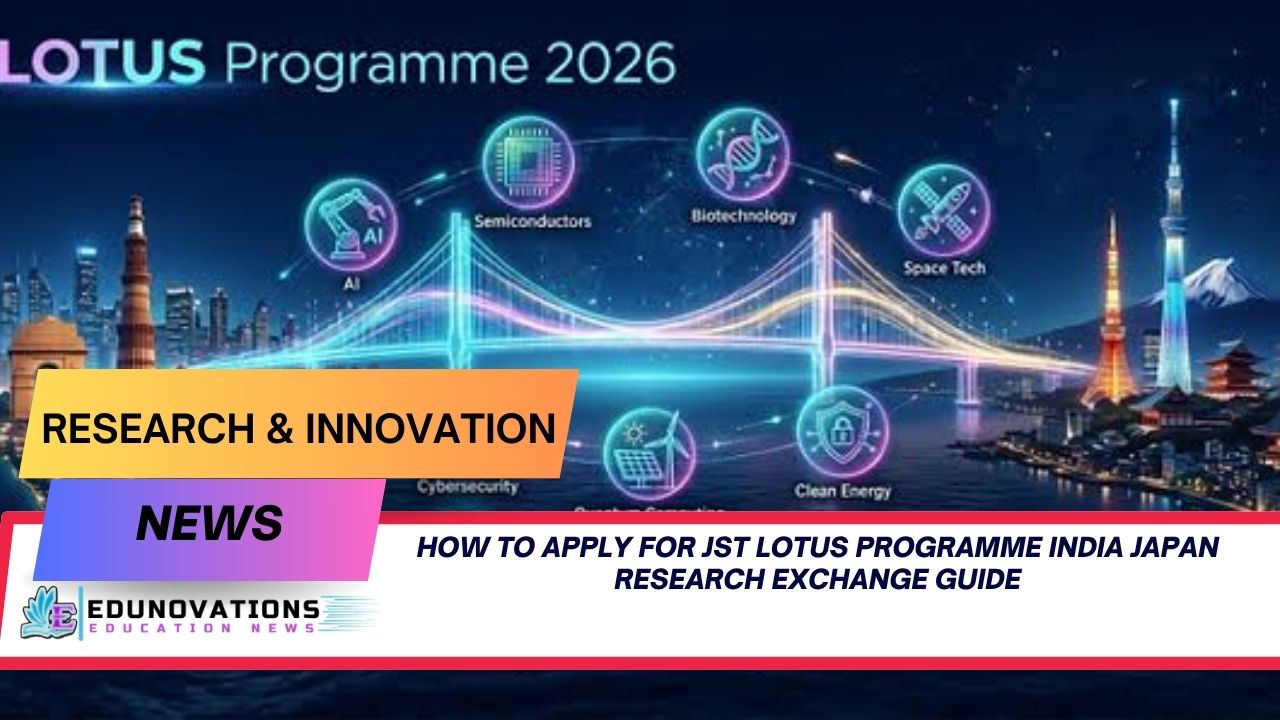
The JST LOTUS Programme, structured under the broader framework of the Japan Science and Technology Agency (JST), is a flagship initiative designed to foster collaborative scientific inquiry between Japan and partner Asian nations, particularly India. Short for Lotus: Long-term Opportunities for Technical and Universal Sciences, the programme aims to bridge the gap between Indian academic research and Japan’s advanced industrial and technological ecosystems.
Through structured exchange visits, young scholars gain direct access to state-of-the-art laboratory infrastructure, specialized supercomputing resources, robotics testbeds, and advanced materials manufacturing facilities across top Japanese universities and national laboratories. By encouraging joint intellectual contributions, the initiative actively aligns with international education strategies that aim to elevate bilateral scientific production between India and Japan.
Key Objectives of the JST LOTUS Framework
- Collaborative Scientific Discovery: Facilitating high-impact joint research projects in cutting-edge domains such as Artificial Intelligence, Quantum Computing, Smart Infrastructure, Biotechnology, and Sustainable Energy.
- Academic & Professional Mobility: Enabling young Indian PhD candidates and young faculty members to work alongside eminent Japanese researchers and laboratory directors.
- Technology Transfer & Commercialization: Building sustainable pathways for converting laboratory innovations into practical applications that address global societal challenges.
- Cultural & Methodological Exchange: Exposing Indian scholars to Japanese research methodologies, precise quality engineering standards, and industry-academia synergy model structures.
For candidates who want to build a solid academic foundation before applying for international research fellowships, accessing comprehensive study resources is essential. You can systematically prepare through NCERT Courses to strengthen core fundamental concepts in mathematics, physics, and computer science.
Decoding the Selection Process: Lessons from IIIT Hyderabad
A prime illustration of academic excellence within this program is the selection of promising researchers from top-tier technical institutions across India. For instance, Vivek Madhavaram, a dedicated scholar working under specialized research domains at IIIT Hyderabad, was officially selected to participate in this coveted scientific exchange.
The selection of Vivek Madhavaram highlights the high caliber of research originating from Indian higher education centers. Candidates selected for the initiative undergo an extensive multi-tier evaluation process that assesses not only their academic credentials but also their ongoing research projects, peer-reviewed publications, and the strategic alignment of their proposed work with Japan’s scientific priorities.
What Evaluators Look For in Candidates
- Research Originality & Novelty: Applicants must present a project proposal that addresses complex technical problems using innovative methodologies.
- Relevance to Bilateral Goals: The research work must demonstrate direct synergy with priority domains designated jointly by Indian and Japanese funding agencies.
- Institutional Recommendation: Candidates require strong endorsements from their home institutions, demonstrating their capacity to act as effective academic ambassadors.
- Feasibility & Expected Impact: Proposals must outline clear short-term laboratory goals and long-term targets for joint publication or patent filing.
Understanding these benchmarks is vital for candidates determining how to apply for jst lotus programme india japan research exchange successfully. Building a stellar academic profile requires staying updated on national research policies, government fellowships, and global educational trends—all of which are regularly tracked in our updated Current Affairs portal.
Eligibility Criteria and Application Prerequisites
To ensure a seamless selection procedure, candidates must review the structured requirements established by the funding bodies. While specific guidelines may vary slightly depending on the exact program cycle, the standard prerequisites for Indian scholars are clearly defined.
       +--------------------------------------------------------+
       |   JST LOTUS Programme: Standard Qualification Path     |
       +--------------------------------------------------------+
                                   |
                                   v
       +--------------------------------------------------------+
       | 1. Enrollment: Enrolled in PhD / Postdoc at recognized |
       |    Indian Institute (e.g., IITs, IIITs, IISc, NITs).  |
       +--------------------------------------------------------+
                                   |
                                   v
       +--------------------------------------------------------+
       | 2. Academic Record: Minimum 75% or equivalent CGPA in  |
       |    Postgraduate & Undergraduate degrees.               |
       +--------------------------------------------------------+
                                   |
                                   v
       +--------------------------------------------------------+
       | 3. Domain Alignment: Research focus in AI, Materials,  |
       |    Clean Energy, Robotics, or Data Science.            |
       +--------------------------------------------------------+
                                   |
                                   v
       +--------------------------------------------------------+
       | 4. Research Endorsement: Formal NOC & Recommendation  |
       |    from Thesis Supervisor & Head of Department.        |
       +--------------------------------------------------------+
Essential Document Checklist for Applicants
- Detailed Curriculum Vitae (CV): Highlighting peer-reviewed journal papers, conference proceedings, patents, and academic honors.
- Comprehensive Research Proposal: A structured 5-to-10-page document covering abstract, problem statement, methodology, expected deliverables, and laboratory requirements in Japan.
- Letter of Acceptance / Host Consent: Written consent from a host professor or laboratory director at a participating Japanese university or research institute.
- Letters of Recommendation (LoRs): At least two strong recommendations from senior professors who can attest to the applicant’s research acumen.
- Statement of Purpose (SoP): A concise narrative explaining how participation in the exchange will advance the scholar’s career and contribute to broader scientific knowledge.
Scholars preparing their application packages can streamline their revision of core theoretical principles by downloading structured Notes to review key concepts in advanced computing, data structures, and scientific research methodologies.
Step-by-Step Application Roadmap
Navigating international scholarship systems can feel overwhelming without a clear blueprint. To help you master how to apply for jst lotus programme india japan research exchange, follow this simplified chronological workflow:
Phase 1: Pre-Application Preparation (6 to 8 Months Prior)
- Identify Host Laboratories: Research Japanese institutions specializing in your area of study (e.g., University of Tokyo, Kyoto University, Tokyo Institute of Technology, or RIKEN).
- Initiate Peer Contact: Reach out directly to Japanese professors via formal academic email, referencing their recent papers and detailing how your project complements their current laboratory work.
- Secure Host Consent: Obtain an official letter of invitation or conditional acceptance from the host professor indicating their willingness to guide your exchange period.
Phase 2: Proposal Drafting & Institutional Vetting (3 to 4 Months Prior)
- Draft the Joint Proposal: Co-develop the research framework alongside your Indian guide and Japanese host mentor.
- Gather Institutional Approval: Submit your research plan to your institute’s Dean of International Relations or Research & Development (R&D) cell for internal approval.
- Consolidate Supporting Documents: Translate necessary certificates, verify transcripts, and format references according to JST guidelines.
Phase 3: Formal Portal Submission & Screening (Application Deadline Window)
- Submit Portal Application: Register on the official portal during the open call window, uploading all mandatory PDF attachments.
- Institutional Verification: Ensure your home institution digitally signs and verifies the submission before the official cutoff date.
- Interview & Selection: Shortlisted candidates may be invited for a virtual technical interview before a joint committee of Indian and Japanese experts.
Applicants preparing for competitive academic assessments and institutional selection exams can practice using targeted MCQ’s to test their conceptual depth and analytical skills.
Scientific Domains and Strategic Importance of the Collaboration
The partnership between Indian academic institutions like IIIT Hyderabad and Japanese research entities covers several critical technical frontiers. By focusing on emerging technologies, both nations accelerate their national scientific capabilities while preparing scholars to solve high-impact industrial challenges.
| Strategic Priority Area | Key Research Focus | Target Applications |
| Artificial Intelligence & ML | Deep Learning, NLP, Computer Vision | Smart Cities, Autonomous Navigation, Healthcare Diagnostics |
| Robotics & Automation | Humanoid Robotics, Soft Robotics, Haptics | Industrial Automation, Disaster Response, Surgical Tools |
| Advanced Materials | Nanotechnology, Superconductors, Semiconductors | Next-Gen Microchips, Solar Cells, Energy Storage |
| Clean Energy & Climate | Hydrogen Fuel Cells, Carbon Capture, Smart Grids | Sustainable Urban Ecosystems, Green Mobility |
| Biotechnology & Health | Computational Genomics, Drug Discovery | Precision Medicine, Vaccine Development, Bioinformatics |
To gain visual clarity on how these interdisciplinary research domains connect, students and researchers can utilize detailed NCERT Mind Maps to map out complex sub-disciplines visually.
Financial Coverage, Grants, and Scholar Support
One of the most attractive aspects of scientific exchanges under the JST umbrella is their comprehensive financial support structure. Scholars selected for these fellowships receive robust funding, ensuring they can focus entirely on their scientific investigations without financial stress.
Financial Provisions Typically Covered:
- Round-Trip International Travel: Fully funded economy-class airfare from the scholar’s home city in India to the host institution in Japan.
- Monthly Living Allowance: A standardized stipend designed to cover accommodation, food, local transport, and daily living costs in Japan.
- Research & Bench Fees: Financial support provided to host laboratories to cover operational expenses, chemical reagents, computational equipment, and specialized software licenses.
- Medical & Travel Insurance: Complete health coverage for the duration of the international stay.
- Conference & Publication Support: Additional grants allocated for presenting joint research findings at international scientific symposia.
Researchers interested in visual walk-throughs of international application procedures, host professor outreach strategies, and academic portfolio building can watch expert-led lectures and tutorials via our dedicated Videos channel.
Perspectives from Academic Leaders
Prominent educators and institutional leaders consistently emphasize the value of international research exposure. Discussing the importance of global exchange programs for Indian research scholars, leading academics note:
“International exchanges do not merely expose students to advanced hardware and experimental tools; they transform how young scholars approach scientific problems. When an Indian PhD candidate collaborates within a Japanese laboratory environment, they merge rigorous theoretical foundations with precision-driven engineering. This synergy accelerates breakthroughs and builds lifelong research networks across borders.”
For educational institutions looking to build modern digital portals to highlight student achievements, showcase research fellowships, and streamline institutional announcements, working with expert web developers is key. If you Need Website for Schools Contact Mart Ind Infotech for custom, SEO-friendly web development solutions tailored to academic organizations.
Building a Competitive Profile for Future Scientific Fellowships
For researchers planning to learn how to apply for jst lotus programme india japan research exchange in upcoming selection cycles, building a strong application profile is a multi-year journey. Here are actionable strategies to enhance your competitiveness:
1. Maintain a Rigorous Publication Record
Focus on publishing your core research in peer-reviewed journals indexed in Scopus or Web of Science. High-impact publications validate your ability to execute research and present findings clearly.
2. Master Relevant Technical Tools & Software
Familiarize yourself with industry-standard simulation software, programming frameworks (such as PyTorch, TensorFlow, MATLAB, or ROS), and statistical analysis suites relevant to your specialization.
3. Track Official Academic Syllabi and Exam Patterns
Ensure your fundamental coursework aligns with global standards. Scholars preparing for eligibility tests, entrance assessments, or departmental qualifications can check the latest updated Syllabus to keep their preparation focused and accurate.
4. Build a Clean Digital Research Presence
Maintain updated profiles on ResearchGate, Google Scholar, ORCID, and LinkedIn. Japanese host professors frequently inspect an applicant’s digital footprint to assess past research output and academic consistency before agreeing to act as host mentors.
5. Access Free Academic Resources for Ongoing Preparation
Consistent study and access to high-quality reference materials are essential for maintaining academic excellence. You can secure essential learning materials through Downloads of Free NCERT PDFs to build solid foundational knowledge across core science subjects.
Toppers Use Mind Maps to score more than 95%
NCERT Class 11th Commerce Mind Maps
Add to cartOriginal price was: ₹999.00.₹199.00Current price is: ₹199.00.NCERT Class 12th Chemistry Mind Maps
Add to cartOriginal price was: ₹199.00.₹75.00Current price is: ₹75.00.NCERT Class 12th Commerce Mind Maps
Add to cartOriginal price was: ₹999.00.₹199.00Current price is: ₹199.00.NCERT Class 12th Science Mind Maps
Add to cartOriginal price was: ₹999.00.₹199.00Current price is: ₹199.00.NCERT Mind Maps For Class 10th
Add to cartOriginal price was: ₹999.00.₹199.00Current price is: ₹199.00.


Purchase Today
10 Frequently Asked Questions (FAQs)
Q1: How to apply for jst lotus programme india japan research exchange as an Indian student?
To apply, review the official call for proposals published on the JST or participating institutional portals. Secure a host professor acceptance letter from a Japanese university, draft a comprehensive joint research proposal, obtain an NOC from your home institute, and complete the digital application form before the deadline.
Q2: What is the primary focus of the JST LOTUS program?
The program promotes bilateral research collaboration between India and Japan across critical scientific domains including Artificial Intelligence, Robotics, Advanced Materials, Sustainable Energy, and Biotechnology.
Q3: Are undergraduate students eligible to apply for the fellowship?
Typically, the fellowship prioritizes registered PhD scholars, post-doctoral fellows, and early-career faculty members who demonstrate active research output and ongoing doctoral thesis work.
Q4: Is knowledge of the Japanese language mandatory for selection?
No, fluency in Japanese is generally not mandatory. High proficiency in English—both spoken and written—is required, as international scientific research and lab communication are conducted primarily in English.
Q5: What financial benefits are provided to selected scholars?
Selected scholars receive round-trip international airfare, a monthly stipend to cover accommodation and living costs, comprehensive travel and health insurance, and laboratory support funds.
Q6: How long does the JST LOTUS research exchange typically last?
Duration varies based on the specific grant category, ranging from short-term research visits (few weeks to 3 months) to long-term collaborative stays (6 to 12 months).
Q7: Can scholars from private Indian universities apply?
Yes, scholars enrolled in recognized private or government higher education institutions (such as IITs, IIITs, NITs, IISERs, and UGC-approved universities) can apply, provided they meet all academic and research criteria.
Q8: What role do host professors in Japan play during the application process?
Host professors are critical. They must review your research proposal, confirm that their laboratory has the necessary facilities to support your work, and issue an official letter of acceptance prior to final submission.
Q9: How can IIIT Hyderabad scholars leverage this fellowship?
Scholars from institutions like IIIT Hyderabad can utilize the fellowship to work with top Japanese scientists, test their algorithms or engineering models on advanced hardware, and co-author high-impact research papers.
Q10: Where can I find foundational study materials to prepare for research eligibility exams?
You can access structured learning modules, syllabus updates, practice questions, and reference guides at Edunovations to build strong subject mastery for academic assessments.