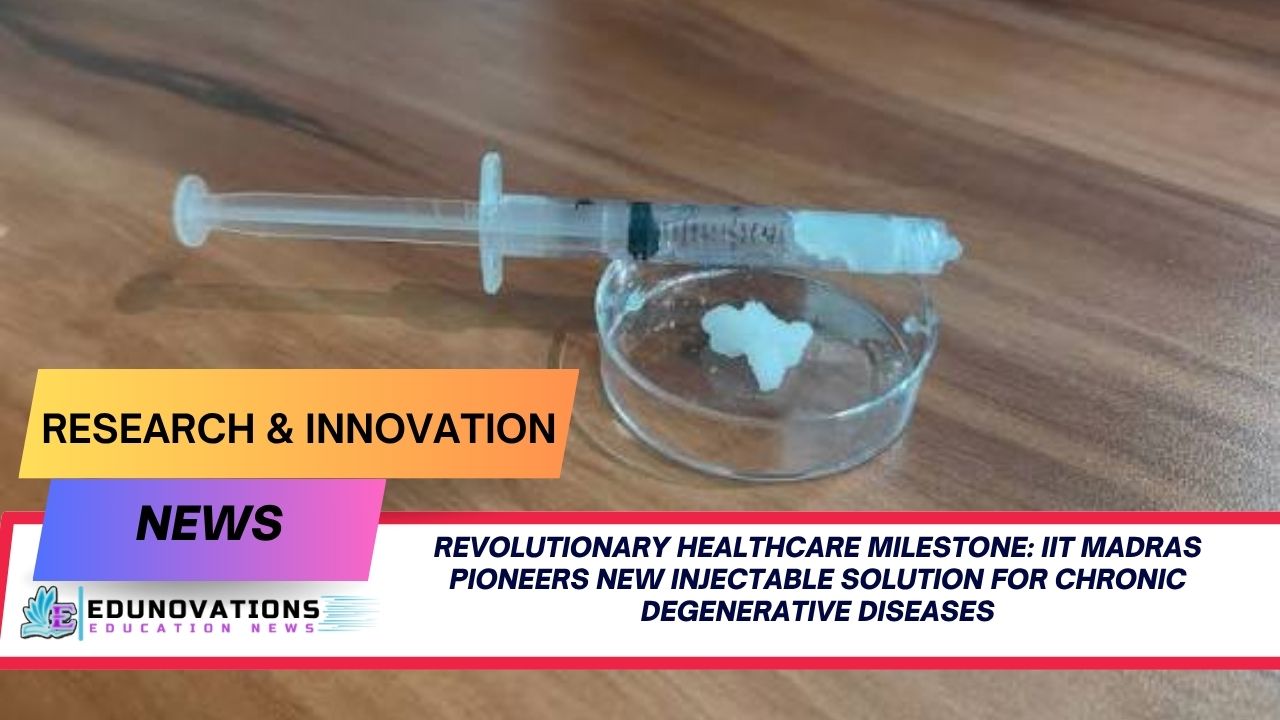
Discover how the revolutionary cost of injectable hydrogel for fibrosis could drop by 85% thanks to a landmark biomedical breakthrough engineered by IIT Madras.
In a monumental stride for global biomedical engineering, the Indian Institute of Technology Madras (IIT Madras) has announced the development of a patented, smart-tuned biomaterial that promises to disrupt how chronic degenerative illnesses are managed. Pioneered at the elite Tissue Engineering and Biomaterials Laboratory within the Department of Biotechnology, this advanced clinical innovation replaces agonizing weeks of repeated systemic medications with a singular, precisely targeted localized dose.
The primary breakthrough focuses on an economic and clinical transformation, heavily driving down the anticipated cost of injectable hydrogel for fibrosis treatments globally. By utilizing a highly synchronized combination of indigenous natural compounds, this medical advancement directly challenges the financial monopoly of multi-thousand-dollar therapies, paving the way for a highly localized, patient-centric delivery mechanism.
The Crushing Global Burden of Fibroproliferative Diseases
To appreciate the gravity of this biomedical milestone, one must look at the sobering epidemiological statistics surrounding organ tissue degeneration. Fibroproliferative illnesses—which include pulmonary fibrosis, liver cirrhosis, chronic kidney disease, and myocardial scarring—characterize an over-activation of the body’s healing mechanism where healthy functional tissue is permanently replaced by rigid, non-functional internal scars.
According to global healthcare data, these progressive conditions collectively contribute to nearly 45% of all human deaths worldwide. The conventional medical response has historically relied on heavy, systemic courses of oral anti-inflammatory drugs or anti-fibrotic agents. Unfortunately, patients frequently endure weeks of arduous daily pills, which must navigate the digestive tract and bloodstream, leading to systemic toxicity, severe gastrointestinal side effects, and an incredibly low concentration of active medication actually reaching the targeted organ.
A Radical Realignment of Global Healthcare Economics
The most profound socio-economic element of this innovation lies in its democratization of high-end specialized medicine. Currently, an advanced, specialized course of local anti-fibrotic therapy carries an astronomical economic burden, typically demanding between USD 2,000 and USD 3,000 per therapeutic course. For millions of families globally, and particularly across developing nations, this creates an insurmountable financial barrier.
With the breakthrough engineered at the Tissue Engineering and Biomaterials Laboratory, researchers project that the localized, patient-ready cost of injectable hydrogel for fibrosis care can plummet drastically to approximately USD 300. This staggering 85% to 90% reduction in financial toxicity directly bridges the gap between state-of-the-art academic research and scalable, real-world public health equity. It shifts the therapeutic paradigm from premium-priced chronic management to an affordable, accessible clinical reality.
Engineering Nature: The Structural Science Behind the Hydrogel Matrix
The architectural brilliance of this patented technology lies in its unique, dual-polymer natural blueprint. Rather than utilizing expensive, hazardous synthetic polymers that often trigger adverse immune rejections, the research team engineered a fully biocompatible hybrid system.
The Power of Sericulture and Marine Biotechnology
By harvesting natural fibroin polymers from traditional silk cocoons and blending them with premium structural polysaccharides extracted directly from marine seaweed, the team formed an intricate cross-linked network. This strategic amalgamation leverages India’s massive domestic sericulture infrastructure and its rapidly expanding, government-backed marine bioeconomy.
[Silk Cocoon Fibroin] + [Seaweed Polysaccharides]
                      │
                      ▼
       [Hybrid Biocompatible Matrix]
                      │
          (Liquid at Room Temperature)
                      │
                      ▼ (Injected into Body)
       [Triggers Thermal Phase Transition]
                      │
                      ▼
         [Smart Hydrogel Solidification]
This structural combination creates a uniquely supportive microenvironment for tissue healing. Instead of merely acting as a passive vehicle for pharmaceuticals, the natural matrix actively interfaces with the surrounding cellular matrix. It provides mechanical support to the damaged area, absorbs inflammatory cellular exudates, and systematically promotes a favorable environment for healthy cell growth while actively halting the hyper-proliferation of rigid scar tissue.
Intelligent Bio-Responsiveness: How the Liquid-to-Gel System Works
The true operational genius of the platform lies in its “smart-tuned” thermodynamic properties, which allow it to behave dynamically within the human body. At normal room temperature, the hybrid formulation maintains a highly fluid, injectable liquid state, allowing clinicians to administer it smoothly using a standard, minimally invasive fine-gauge syringe. However, the moment the fluid enters the human tissue, it undergoes an instantaneous thermal phase transition.
Autonomous On-Demand Drug Release
Reacting to natural basal body temperature, the formulation seamlessly thickens into a localized, highly contour-conforming solid gel matrix. This newly-formed gel matrix anchors itself securely within the compromised tissue pocket, functioning as an intelligent, autonomous slow-release pharmaceutical vault.
Furthermore, the hydrogel is engineered with specialized bio-responsive degradation kinetics. In standard environments, the gel degrades slowly and evenly over several days. However, when it encounters localized, disease-related inflammation spikes, the matrix opens up slightly to release higher, protective doses of anti-inflammatory and anti-fibrotic molecules on-demand. Once its therapeutic purpose is served, the entire matrix biodegrades naturally into benign, non-toxic metabolic byproducts, leaving absolutely zero harmful synthetic residues behind.
Breaking New Ground in Cellular Biology and “Omics” Research
To definitively validate the safety and internal mechanics of this platform, the multi-institutional research team executed a groundbreaking, first-of-its-kind “omics” study. By comprehensively analyzing the cellular genome, transcriptome, and proteomic variations, the scientists mapped the exact behavioral changes that occur when diseased cells interact with the biomaterial.
The data conclusively demonstrated that these smart-tuned hydrogels do not merely mask symptoms; they actively inhibit the progression of fibrosis by regulating the structural mechanical properties and deep cellular metabolism of neighboring myofibroblasts. This prevents cells from hardening and turning into rigid tissue, providing solid proof of true regenerative healing at a molecular scale.
Expanding Horizons: Combating Sarcopenia and Age-Related Muscle Loss
While the initial target remains the global fight against tissue scarring, secondary follow-up studies have revealed an incredibly promising secondary frontier for this platform: the treatment of age-related muscle wasting, clinically known as sarcopenia.
Sarcopenia currently impacts an estimated 10% to 16% of the global elderly population, causing a progressive, highly debilitating loss of skeletal muscle mass, stability, and physical independence. Currently, the global medical community possesses zero approved, targeted pharmacological treatments specifically for this condition. Initial exploratory research indicated that when this smart hydrogel is applied directly to aged, degenerated muscle models, it helps revive localized tissue dynamics. By providing structural support and delivering vital regenerative cues directly to failing satellite muscle cells, the gel opens up a historic pathway to treating age-related mobility decline.
Commercialization Pathways and the Future of Clinical Deployment
As the laboratory phase concludes with exceptional milestones, the institution is shifting focus toward massive commercial scalability, safety scaling, and domestic regulatory frameworks.
Moving forward, the next critical phase of development will entail rigorous, advanced preclinical testing inside complex disease models and specialized patient-derived organoids. These studies will focus heavily on fine-tuning specific drug release kinetics, completing extensive long-term systemic safety evaluations, scaling up sterile manufacturing practices, and preparing comprehensive regulatory portfolios for human translational trials. The academic body is currently planning real-world deployment channels via direct technology transfers, corporate industrial licensing, or the cultivation of dedicated deep-tech biomedical startups.
One of the most immediate clinical settings envisioned for this gel is direct integration into surgical workflows. Surgeons will be able to apply the fluid directly to highly vulnerable internal organ sites or deep tissue layers immediately before closing a wound, ensuring localized protection and preventative anti-scarring therapy without needing further medical procedures.
Educational & Interactive Resources
For researchers, students, and medical professionals looking to explore the foundational sciences behind this breakthrough, the following educational pathways offer extensive material:
- Enhance your understanding of biomaterials and foundational sciences via specialized NCERT Courses and download extensive learning guides directly via Downloads of Free NCERT PDFs.
- Master complex structural layouts and cellular pathways using comprehensive NCERT Mind Maps or check your understanding of biotechnology concepts using interactive MCQ’s.
- Access comprehensive academic notes through our repository of Notes or cross-reference institutional examination patterns utilizing the official Syllabus portal.
- Stay updated on nationwide scientific policy changes via our dedicated Current Affairs engine or watch detailed video explanations via our curated Videos hub.
(Note: Educational institutions seeking to upgrade their online digital platforms to support advanced remote learning can contact “Mart Ind Infotech” via Need Website for Schools Contact to build interactive academic spaces.)
Toppers Use Mind Maps to score more than 95%
NCERT Class 11th Commerce Mind Maps
Add to cartOriginal price was: ₹999.00.₹199.00Current price is: ₹199.00.NCERT Class 12th Chemistry Mind Maps
Add to cartOriginal price was: ₹199.00.₹75.00Current price is: ₹75.00.NCERT Class 12th Commerce Mind Maps
Add to cartOriginal price was: ₹999.00.₹199.00Current price is: ₹199.00.NCERT Class 12th Science Mind Maps
Add to cartOriginal price was: ₹999.00.₹199.00Current price is: ₹199.00.NCERT Mind Maps For Class 10th
Add to cartOriginal price was: ₹999.00.₹199.00Current price is: ₹199.00.





Purchase Today
Frequently Asked Questions (FAQs)
What is the estimated cost of injectable hydrogel for fibrosis treatment compared to current therapies?
The current clinical standard for specialized anti-fibrotic treatments is remarkably expensive, ranging from USD 2,000 to USD 3,000 per therapeutic course. The newly developed biomaterial platform from IIT Madras is projected to drop the estimated cost of injectable hydrogel for fibrosis care to roughly USD 300, rendering advanced targeted therapy affordable for the general public.
How do the silk cocoon and seaweed hydrogel benefits improve patient recovery?
The unique silk cocoon and seaweed hydrogel benefits include excellent natural biocompatibility, high structural resilience, and natural tissue healing support. It provides an optimal physical microenvironment that encourages healthy cell multiplication while actively preventing cellular scarring.
Can a biocompatible hydrogel for muscle loss help patients suffering from sarcopenia?
Yes. Preclinical follow-up studies demonstrate that applying a biocompatible hydrogel for muscle loss can help treat sarcopenia, an age-related condition affecting 10% to 16% of the elderly population that currently has no approved pharmacological cure.
From a clinical perspective, how do injectable hydrogels treat fibrosis locally?
When exploring how do injectable hydrogels treat fibrosis, the secret lies in local delivery. The fluid is injected directly at the disease site, turning into a gel at body temperature. This provides a slow, steady release of medicine right where it is needed, avoiding the side effects of oral pills.
What makes affordable localized fibrosis treatment alternatives better than daily oral medication?
Traditional options require weeks of daily pills that lose strength as they pass through the stomach and liver. These new affordable localized fibrosis treatment alternatives offer a single, targeted injection that works right at the source of inflammation for several days without harmful chemical residues.
Is the IIT Madras hydrogel safe for long-term use inside the human body?
Yes, the hydrogel is entirely biodegradable and biocompatible. It is engineered to dissolve gradually inside the tissue over a period of days and breaks down into harmless, natural metabolic byproducts that the human body disposes of naturally.
When will this injectable hydrogel become widely available in hospitals?
The technology is currently transitioning into advanced preclinical testing phases involving disease models and patient-derived organoids. Widespread hospital availability will follow the successful completion of human clinical trials and subsequent medical regulatory approvals.
How does the hydrogel adapt to changing inflammation levels?
The hydrogel features an intelligent, bio-responsive matrix. When localized tissue inflammation rises, the cross-linked gel network adapts to increase drug release rates, providing automated, on-demand therapy.
Can this hydrogel be used during standard surgical procedures?
Yes. One of its main applications is direct use during surgery. Surgeons can apply the liquid hydrogel directly to an organ or tissue site right before closing a wound to prevent internal scarring and adhesions.
Who are the main scientists behind this major biomedical breakthrough?
This patented technology was co-authored by Ms. Varshiny Gopinath (Research Scholar) and Prof. Vignesh Muthuvijayan from the Department of Biotechnology at IIT Madras, in collaboration with Prof. Mahadevan Rajasekaran from the University of California San Diego Health.