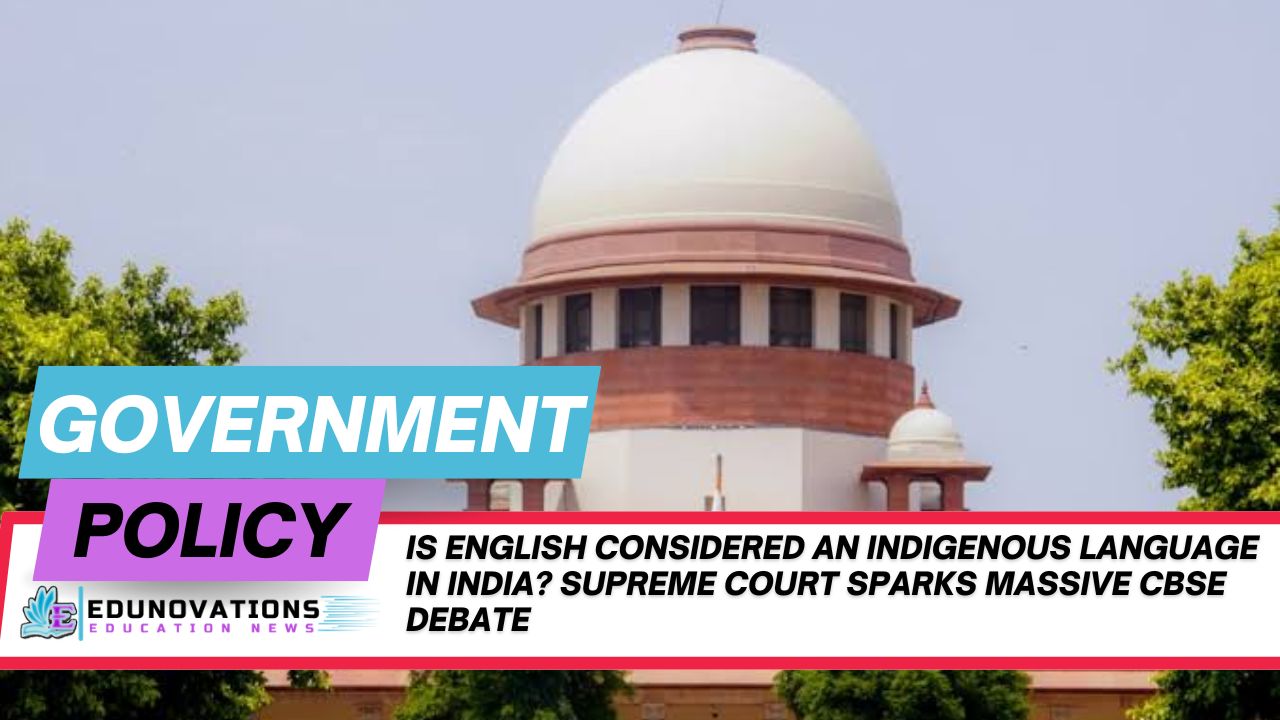
Explore the groundbreaking Supreme Court debate: Is English considered an indigenous language in India? Analyze CBSE’s controversial language policy and its real-world educational impact.
The Linguistic Clash: Supreme Court Questions CBSE Over ‘Native’ Language Classification
The legal corridors of New Delhi recently witnessed a profound intellectual battleground when the Supreme Court of India challenged the Central Board of Secondary Education (CBSE) on its strict classification of languages. At the heart of this legal storm is a question that challenges the very fabric of Indian national identity: Is English considered an indigenous language in India?
During a high-profile hearing, a three-judge Bench headed by Chief Justice of India Surya Kant, along with Justice Joymalya Bagchi, scrutinized a controversial CBSE circular. The board’s framework categorized English alongside European and Middle Eastern tongues like Spanish and Arabic as “non-native.” This sparked immediate outrage and deep legal debates. The Supreme Court’s critical inquiry asks whether a language spoken on Indian soil for over three centuries, and actively used for official governance in multiple states, can really be pushed to the margins as a foreign import.
As educators, parents, and policy experts dissect this judicial stance, the question remains: Is English considered an indigenous language in India or is it a permanent colonial artifact?
Inside the Controversial CBSE Three-Language Scheme
The dispute originates from a CBSE circular issued on July 10, which differentiates between traditional “Bharatiya Bhashas” (such as Hindi, Sanskrit, Tamil, and Punjabi) and “non-native” languages. Under this mandate, Class 9 students are required to study at least two languages native to India. This policy immediately sparked outrage. Many families found themselves asking: Is English considered an indigenous language in India under the strict eyes of the law?
By classifying English as non-native, the CBSE effectively removed it from the primary list of local languages. This forces schools to restructure their academic curricula abruptly. The sudden advancement of the National Education Policy (NEP) 2020 and the National Curriculum Framework for School Education (NCF-SE) 2023 timelines has left academic systems scrambling.
CBSE Language Classification Framework (July 10 Circular)
├── Bharatiya Bhashas (Native): Hindi, Sanskrit, Tamil, Telugu, etc.
└── Non-Native Languages: English, German, French, Spanish, Arabic
The abrupt shift has pushed parents to look for comprehensive academic resources. For students navigating these complex changes, downloading structured NCERT Courses and analyzing the updated Syllabus has become highly critical to keeping up with class requirements.
Why Is the CBSE Three-Language Scheme Being Challenged?
To understand why is CBSE three language scheme being challenged, one must look at the immense resource crunch faced by schools across India. Senior advocate Gopal Sankaranarayanan, representing concerned parents and students, pointed out the stark realities on the ground. He highlighted that while there are 22 Scheduled languages under the Constitution of India, textbooks are actively available for only three of them.
This creates a massive logistical nightmare. If a school wishes to comply fully and offer all 22 languages, it would theoretically need to hire 22 separate language teachers. For many smaller or budget-restricted private schools, this is a human resource impossibility. In this climate of academic confusion, school administrators are seeking professional digital support. To build efficient online portals and portals that handle complex scheduling, many institutions are looking to design dedicated platforms; if you need website for schools contact Mart Ind Infotech to build scalable infrastructure.
Furthermore, senior advocate Mukul Rohatgi, appearing for another set of Class 9 students, emphasized the unfair academic pressure on young teenagers. Expecting a student to pick up a completely new language, gain sudden proficiency, and write board-level examinations is highly impractical. This issue is a major reason why is CBSE three language scheme being challenged in court.
The Judicial Critique: Debating “Native” vs. “Indigenous”
The Supreme Court’s reaction to CBSE’s terminology was swift and critical. Justice Joymalya Bagchi pointed out that the term “native” carries colonial baggage. He noted that neither the Indian Constitution nor statutory law books use the word “native.” Instead, legal texts rely on terms like “mother tongue,” “regional language,” or “Indian language.”
This distinction brings us back to the core query: Is English considered an indigenous language in India?
During the heated courtroom exchanges, Justice Bagchi noted that English has been integrated into the administrative, legal, and educational fabric of India for over 300 years. It is the official language of states like Nagaland and Meghalaya. To treat it as a foreign tongue equivalent to German or French ignores historical reality.
For students preparing for competitive national exams, these constitutional and judicial debates are highly relevant. Keeping up with detailed Current Affairs and revising specialized Notes is essential for mastering these complex legal and social topics.
How Will CBSE Implement the Three-Language Policy Safely?
A key question on every educator’s mind is: how will CBSE implement three language policy without causing widespread academic disruption? In an official affidavit, the CBSE acknowledged the resource limitations but proposed several “practical” workarounds.
The board suggested that schools could:
- Engage retired teachers with functional linguistic proficiency.
- Hire suitably qualified postgraduates as temporary instructors.
- Utilize cooperative “Sahodaya clusters” to share teaching resources.
- Rely on virtual and hybrid classrooms to bridge physical teacher gaps.
CBSE Interim Staffing Strategy
┌────────────────────────────────────────────────────────┐
│  Retired Teachers  ──► Functional Classroom Teaching  │
├────────────────────────────────────────────────────────┤
│  Postgraduates     ──► Subject Matter Experts         │
├────────────────────────────────────────────────────────┤
│  Sahodaya Clusters ──► Shared Regional Resources      │
└────────────────────────────────────────────────────────┘
Despite these suggestions, critics argue that temporary staff cannot replace certified, full-time language educators. This operational gap makes many ask: Is English considered an indigenous language in India simply because it is the only practical medium of instruction that avoids these staffing bottlenecks? For those seeking structured study guides to self-navigate these shifts, downloading Free NCERT PDFs can help bridge the gap.
E-E-A-T Insights: The Deep Socio-Economic Impact of the Language Ruling
The debate over whether is English considered an indigenous language in India is not merely academic; it has massive real-world consequences for student equity. Sociologist and education historian Dr. Devendra Gupta comments:
“English in India has undergone a process of vernacularization. It is no longer just the language of the colonizer; it is the language of upward social mobility, global commerce, and inter-state communication.”
If English is sidelined, students from lower economic backgrounds—who rely heavily on affordable school curricula—might face disadvantages compared to privileged peers with access to private coaching. This social divide is why the debate over whether is English considered an indigenous language in India remains so emotionally charged.
To visualize these complex linguistic paths and constitutional laws, students find it highly effective to use visual aids. Studying with specialized NCERT Mind Maps helps simplify these multi-layered legal structures.
NCERT’s Preparations and the Path Forward
In its defense, the National Council of Educational Research and Training (NCERT) filed an affidavit stating that it has already begun preparing, vetting, and distributing textbooks in all 22 Scheduled languages. While learning materials for Hindi, Sanskrit, Marathi, and Urdu are already live, the rest are expected to roll out gradually.
Yet, the central puzzle remains unsolved. If a student chooses to study English, does that choice isolate them from their peer group under the new national policy? When assessing the core question—Is English considered an indigenous language in India—the Supreme Court is forcing the nation to define what truly makes a language “Indian.”
To prepare for future changes and test your understanding of these evolving policies, practicing high-yield MCQ’s and watching interactive Videos is an excellent way to consolidate your knowledge.
Toppers Use Mind Maps to score more than 95%
NCERT Class 11th Commerce Mind Maps
Add to cartOriginal price was: ₹999.00.₹199.00Current price is: ₹199.00.NCERT Class 12th Chemistry Mind Maps
Add to cartOriginal price was: ₹199.00.₹75.00Current price is: ₹75.00.NCERT Class 12th Commerce Mind Maps
Add to cartOriginal price was: ₹999.00.₹199.00Current price is: ₹199.00.NCERT Class 12th Science Mind Maps
Add to cartOriginal price was: ₹999.00.₹199.00Current price is: ₹199.00.NCERT Mind Maps For Class 10th
Add to cartOriginal price was: ₹999.00.₹199.00Current price is: ₹199.00.

Purchase Today
10 FAQs on the CBSE Three-Language Scheme and Legal Controversy
1. Is English considered an indigenous language in India according to the Supreme Court?
The Supreme Court has questioned CBSE’s classification but has not made a final, binding declaration. The bench, led by Justice Joymalya Bagchi, pointed out that English has been spoken in India for 300 years and is used officially by several states, meaning its place is highly distinct from other foreign languages.
2. Why is CBSE three language scheme being challenged by parents?
The scheme is being challenged due to a severe shortage of qualified teachers, lack of available textbooks in all 22 scheduled languages, and the immense pressure it places on Class 9 students to suddenly learn a third language.
3. How will CBSE implement three language policy amid teacher shortages?
CBSE has suggested using retired teachers, employing qualified postgraduates on a flexible basis, sharing resources via Sahodaya school clusters, and relying on virtual or hybrid online classes.
4. Where can I find the official CBSE native vs non native language list pdf?
The list is officially published on the academic website of the CBSE. Many educational portals also host the CBSE native vs non native language list pdf along with curriculum guides for easy downloading.
5. Why did the Supreme Court object to the word “native”?
Justice Bagchi stated that the word “native” is loaded with colonial meaning. He emphasized that Indian constitutional and statute books use terms like “mother tongue” or “regional language” rather than “native.”
6. When was the three-language scheme originally supposed to be implemented?
According to senior advocate Shyam Divan, the policy was originally scheduled for implementation in 2030, but was unexpectedly advanced to the 2026-2027 academic year.
7. Which states in India use English as their official language?
English is an official language in several Indian states, particularly in the northeastern region, including Nagaland, Mizoram, and Meghalaya.
8. Are textbooks available for all 22 Scheduled languages?
Currently, NCERT has released books for only a few languages like Hindi, Sanskrit, Marathi, and Urdu. Textbooks for the remaining scheduled languages are still in development.
9. What percentage of CBSE schools are already compliant with the three-language scheme?
CBSE claims that 47.3% of its 28,848 schools already offer two or more native Indian languages and are fully compliant without requiring extra staffing.
10. When is the next Supreme Court hearing on this matter?
The three-judge Bench has scheduled the next comprehensive hearing on this dispute for July 22, 2026.