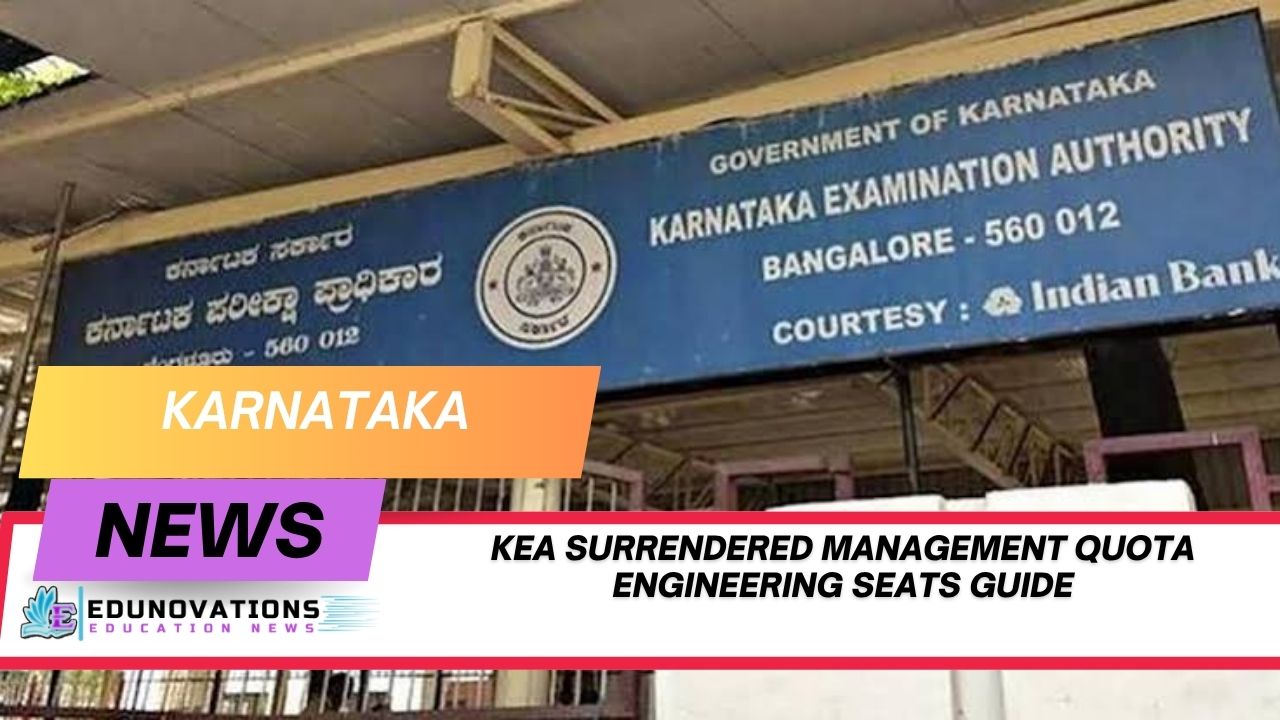
Learn how to get surrendered management quota seats in KEA counseling. Discover KEA engineering fees, seat structures, and admissions rules.
The Karnataka state government has made a monumental decision that will fundamentally change how engineering admissions are conducted across private and deemed universities in the state. In a bold policy move designed to curb seat blocking, lack of transparency, and exorbitant admissions processes, the state government has officially ordered that management quota engineering seats in private and deemed universities will now be filled directly through the Karnataka Examinations Authority (KEA).
This landmark administrative shift arrives precisely as the KEA has initiated its Centralised Entrance Test (CET) counseling process for professional courses for the 2026-27 academic session. Under the new directive, any private or deemed university intending to surrender its management quota seats must formally do so within 15 days of the commencement of the first round of CET counseling.
To help prospective students make sense of this changing environment, this article breaks down how to get surrendered management quota seats in KEA, explores the new fee structures, and analyzes what this means for students trying to navigate admissions this year.
The Core Seat Distribution System Explained
To fully appreciate the scope of this new government mandate, it is essential to understand the complex seat-sharing formulas governing Karnataka’s engineering landscape. The state contains 28 private universities and 11 deemed universities, representing a massive portion of the higher education sector.
For the 2026-27 academic cycle, a staggering 37,690 engineering seats are available in private universities, while 2,400 seats are open across deemed institutions.
┌────────────────────────────────────────────────────────┐
│             KARNATAKA ENGINEERING SEATS 2026-27        │
├───────────────────────────┬────────────────────────────┤
│    Private Universities   │     Deemed Universities    │
│        37,690 Seats       │         2,400 Seats        │
└───────────────────────────┴────────────────────────────┘
These seats are historically filled through distinct pathways based on consensual agreements with the Karnataka Unaided Private Engineering Colleges Association (KUPECA), minority college associations, and independent university mandates:
- KUPECA Member Colleges: Under the standard agreement, these institutions surrender 45% of their total seats to the state government to be filled as government quota seats via KEA CET counseling. The remaining seats are divided into COMED-K seats (30%), Non-Resident Indian or NRI quota seats (15%), and standard management quota seats (10%).
- Minority Institutions: Colleges operating under the Karnataka Religious and Linguistic Minority Professional Colleges Association (KRLMPCA) and the Association of Minority Professional Colleges in Karnataka (AMPCK) allocate 40% of their intake as government quota seats. The remaining balance is split into association-specific entrance test seats (30%), NRI quota seats (20%), and management quota seats (10%).
- Private Universities: Private universities reserve 40% of their engineering seats for the state government quota, leaving the remaining 60% of their intake to be designated and filled as management quota seats.
- Deemed Universities: Unlike other categories, deemed universities do not have a mandatory government quota allocation. Historically, 100% of their seats are designated as management quota, typically filled through individual university entrance tests or via national Joint Entrance Examination (JEE) ranks.
Because these institutions often struggle to fill their expensive management and NRI allocations—particularly in non-IT branches—thousands of seats are surrendered back to the government every year.
How to Get Surrendered Management Quota Seats in KEA
For thousands of engineering aspirants, learning how to get surrendered management quota seats in KEA is the absolute best way to secure a seat at a drastically reduced cost. When private and deemed universities fail to fill their allotted seats through direct admission or COMED-K rounds, they are forced to surrender them to the state pool.
If you are aiming to secure one of these highly coveted surrendered seats, you must follow the structured steps below:
Step 1: Track the Surrender Window
The state government has established a strict timeline. All private and deemed universities must officially surrender their unfilled management quota seats to the KEA within 15 days of the start of the first round of CET option entry and counseling. Keep a close watch on the official KEA portal during this fortnight.
Step 2: Register for KEA Counseling
You must be registered with the KEA and have a valid KCET rank. Even if your rank is not in the top tier, you are eligible to participate in the subsequent seat allocation rounds where these surrendered seats are introduced.
Step 3: Monitor Seat Matrix Updates
Before the second round and casual vacancy rounds, the KEA publishes an updated, seat-by-seat matrix. This document specifically highlights newly added “surrendered management seats” that have been converted into the general pooling system.
Step 4: Strategic Option Entry
During the option entry window, prioritize colleges that have surrendered seats in your desired branch, such as Computer Science Engineering (CSE) or Information Science. Because these seats are now governed by KEA, they will be allotted strictly based on merit and category rules, entirely bypassing the arbitrary selection processes of private college boards.
Students who want to stay updated on the absolute latest mock allotments and counseling dates should check the daily updated Current Affairs portal. If you need reference materials to boost your rank for the upcoming season, you can access comprehensive Notes and practice with targeted MCQs to ensure you secure the highest rank possible.
KEA Engineering Fees for Private and Deemed Universities
The most appealing aspect of this governmental intervention is the standardized fee structure. Unfilled management quota seats that are surrendered to the KEA are filled under standardized, state-regulated fee structures, protecting students from the predatory pricing of direct institutional admission.
For the current 2026-27 academic year, the state government has officially permitted a 7.5% fee hike for government quota engineering seats in private colleges. However, a significant gap remains between these regulated seats and standard management seats:
- Government Quota Seats in Private/Deemed Universities: The annual tuition fee has been systematically fixed at ₹88,000 (specifically ranging between ₹87,825 for Type-2 and ₹87,935 for Type-1 colleges). This represents the most affordable pathway for middle-class families.
- COMED-K / Private Quota Seats: For students entering through the private association exam, the fees are drastically higher, ranging from ₹2,15,000 to ₹3,02,182 per year, depending on the tier and categorization of the college.
- Direct Management Quota Seats: If a student attempts to bypass KEA entirely and buy a management seat directly from a top-tier private university, tuition fees can balloon to ₹2.5 lakh to ₹7 lakh per year for highly demanded computer science courses.
┌─────────────────────────────────────────────────────────────────┐
│              ANNUAL ENGINEERING TUITION FEES (2026)             │
├──────────────────────────────┬──────────────────────────────────┤
│ KEA Government Quota Seat    │ ~ ₹88,000                        │
│ COMED-K Private Quota Seat   │ ₹2,15,000 to ₹3,02,182           │
│ Direct Management Quota Seat │ ₹2,50,000 to ₹7,000,000+         │
└──────────────────────────────┴──────────────────────────────────┘
This massive price disparity makes understanding how to get surrendered management quota seats in KEA incredibly important. When a seat is surrendered to KEA, it is offered to general merit and category students at the government-approved rate, saving families lakhs of rupees over a four-year degree program.
Can Deemed Universities in Karnataka Fill Seats Without JEE?
A common point of confusion among engineering applicants is whether these elite deemed institutions can bypass national standardized exams for admissions.
Historically, deemed universities in the state maintained total autonomy over their admissions processes. Because they are not bound by state-mandated government quotas, they filled 100% of their seats through their own entrance exams or by selecting candidates who secured valid ranks in the national Joint Entrance Examination (JEE).
However, with the implementation of the new government order, the administrative landscape is shifting. Deemed universities that choose to surrender their unfilled seats to the state pool must allow KEA to fill those vacancies using the standard state CET rankings.
If a student asks, “Can deemed universities in Karnataka fill seats without JEE?” the answer is now a definitive yes, provided those seats are surrendered to the KEA. When a deemed university surrenders its management seats, the requirement for a JEE rank is completely waived for those specific seats, and they are allocated to local students based strictly on their KCET scores.
To gain a competitive edge and secure top-tier seats in these prestigious institutions, high school students are highly encouraged to build a flawless academic foundation. You can master your fundamentals by enrolling in targeted NCERT Courses and utilizing free educational resources like Downloads of Free NCERT PDFs alongside highly visual NCERT Mind Maps. Additionally, reviewing the official exam pattern on the Syllabus page and watching detailed explanations via Videos can dramatically improve your KCET rank.
Understanding the Difference Between KEA Government Quota and Management Quota
It is incredibly common for parents and candidates to confuse the various entry pathways. To ensure you make an informed choice during the choice-filling rounds, it is vital to analyze the difference between KEA government quota and management quota options:
- Seat Allocation & Merit Basis: KEA government quota seats are allocated strictly based on state merit rankings (KCET) and the state’s reservation policies (such as OBC, SC, ST, Rural, and Kannada Medium quotas). Conversely, direct management quota seats do not require a high rank and are filled at the discretion of the college management, often on a first-come, first-served basis.
- Financial Liability: The difference in financial burden is immense. A government quota seat costs around ₹88,000 per year, whereas a standard management quota seat in the exact same classroom can cost up to seven times more, with additional development fees charged under the table.
- Surrendered Seat Transition: The magic happens when a management seat is surrendered. Once a private university surrenders its management quota seats, those seats lose their “management” price tag and are offered as KEA government quota seats, matching the lower fee structure and merit-based allocation of the general pool.
How to Apply for Karnataka Engineering Management Quota Seats
If you have decided that you want to pursue the management quota path—either directly through a college or by waiting for the KEA surrendered seat rounds—you must follow a precise roadmap to avoid missing deadlines:
Option A: Applying for Regular Management Seats (Direct Admission)
- Contact the Institution: Visit the campus of your preferred private or deemed university directly.
- Submit Credentials: Provide your Class 12 marks card, along with your KCET, COMED-K, or JEE scorecard.
- Pay the Premium Fee: Secure the seat by paying the premium management tuition fee directly to the college’s administrative office.
Option B: Applying for Surrendered Management Seats (Via KEA)
- KEA Registration: Complete your online registration on the official KEA portal (
cetonline.karnataka.gov.in). - Document Verification: Successfully complete the mandatory physical or online document verification process to obtain your secret key and verification slip.
- Monitor Vacancy Announcements: Watch the KEA announcements closely after the completion of Round 1 counseling to identify surrendered seat numbers.
- Lock Options: Enter your college options in the online portal, ensuring you select the codes representing the newly converted government seats.
For educational institutions looking to streamline their own digital presence and help students navigate these complex online admissions processes, having a fast, reliable website is critical. Schools and colleges can reach out to Mart Ind Infotech, a leading professional web development agency, to build high-performance, SEO-optimized educational portals.
Expert Insights: Streamlining Engineering Education in Karnataka
The implementation of this direct-fill order is closely tied to the recommendations of the Prof. S. Sadagopan Committee, which was commissioned by the state to streamline and clean up the engineering admission sector.
The executive director of the KEA, H. Prasanna, commented on the current rollout of the policy:
“Currently, the CET counselling process is under way and if private and deemed universities surrender management quota seats as per the government’s decision, they will be filled through KEA itself. This ensures that merit is preserved and deserving students can access these seats at a standardized government-fixed fee.”
Historically, private institutions exploited a loophole where they would artificially expand their intake in highly demanded computer science and engineering (CSE) streams—sometimes carrying 3,000 to 3,500 seats in a single college. When these seats remained unfilled, they were sold off via third-party brokers under the guise of management seats. By forcing these seats back into the central KEA pool within a tight 15-day window, the state has effectively put an end to this unregulated commercialization of engineering education.
Toppers Use Mind Maps to score more than 95%
NCERT Class 11th Commerce Mind Maps
Add to cartOriginal price was: ₹999.00.₹199.00Current price is: ₹199.00.NCERT Class 12th Chemistry Mind Maps
Add to cartOriginal price was: ₹199.00.₹75.00Current price is: ₹75.00.NCERT Class 12th Commerce Mind Maps
Add to cartOriginal price was: ₹999.00.₹199.00Current price is: ₹199.00.NCERT Class 12th Science Mind Maps
Add to cartOriginal price was: ₹999.00.₹199.00Current price is: ₹199.00.NCERT Mind Maps For Class 10th
Add to cartOriginal price was: ₹999.00.₹199.00Current price is: ₹199.00.





Purchase Today
Frequently Asked Questions (FAQs)
1. How to get surrendered management quota seats in KEA counseling rounds?
To get these seats, you must register on the KEA portal, complete document verification, and carefully monitor the updated seat matrix published right before Round 2. Once the private colleges surrender their unfilled management seats, they are added directly to the KEA seat pool, allowing you to opt for them during your option entry.
2. What are the official KEA engineering fees for private and deemed universities?
For the 2026-27 academic year, the government-fixed fee for KEA government quota engineering seats in private and deemed universities is approximately ₹88,000 per year. In contrast, standard management quota fees can range from ₹2.5 lakh to over ₹7 lakh annually.
3. Can deemed universities in Karnataka fill seats without JEE ranking?
Yes, deemed universities can fill seats without JEE if they choose to surrender their unfilled management quota seats to the KEA. Once surrendered, these seats are allocated to students based entirely on their state CET (KCET) rankings.
4. What is the difference between KEA government quota and management quota?
The primary differences lie in merit requirements and costs. KEA government quota seats are merit-based, require a state CET rank, and cost around ₹88,000 per year. Management quota seats do not strictly require high ranks but feature significantly higher tuition fees paid directly to the college.
5. How to apply for Karnataka engineering management quota seats through the official KEA channel?
You must register for KEA counseling, verify your documents, and wait for the counseling rounds to begin. If colleges surrender their management seats within the mandated 15-day window, you can apply for them by entering those specific college codes during the KEA choice-filling phase.
6. When is the deadline for private colleges to surrender management seats to KEA?
The state government has issued an order requiring all private and deemed universities to surrender their unfilled management quota seats within 15 days of the commencement of the first round of CET counseling.
7. Why did the government step in to fill management quota seats via KEA?
The government implemented this system based on the Prof. S. Sadagopan Committee report to streamline engineering admissions, limit seat-blocking practices, and prevent colleges from charging under-the-table fees for unfilled seats.
8. What happens to COMED-K seats that are not filled in the first round?
As seen in previous years, if COMED-K or private university seats remain unfilled after the initial rounds, they are surrendered to the KEA to be filled as general government-quota seats at the standard ₹88,000 fee rate.
9. Is there a seat cap on Computer Science Engineering (CSE) admissions this year?
Yes, under the recommendations of the Prof. S. Sadagopan Committee, the government has imposed strict seat caps on CSE and related IT branches to prevent over-allocation and maintain the quality of education.
10. Can out-of-state students apply for KEA surrendered management seats?
No, seats filled through the KEA CET counseling process are primarily reserved for Karnataka domicile candidates who meet the state’s eligibility criteria, unless specifically opened up in subsequent casual vacancy rounds for non-domicile candidates.