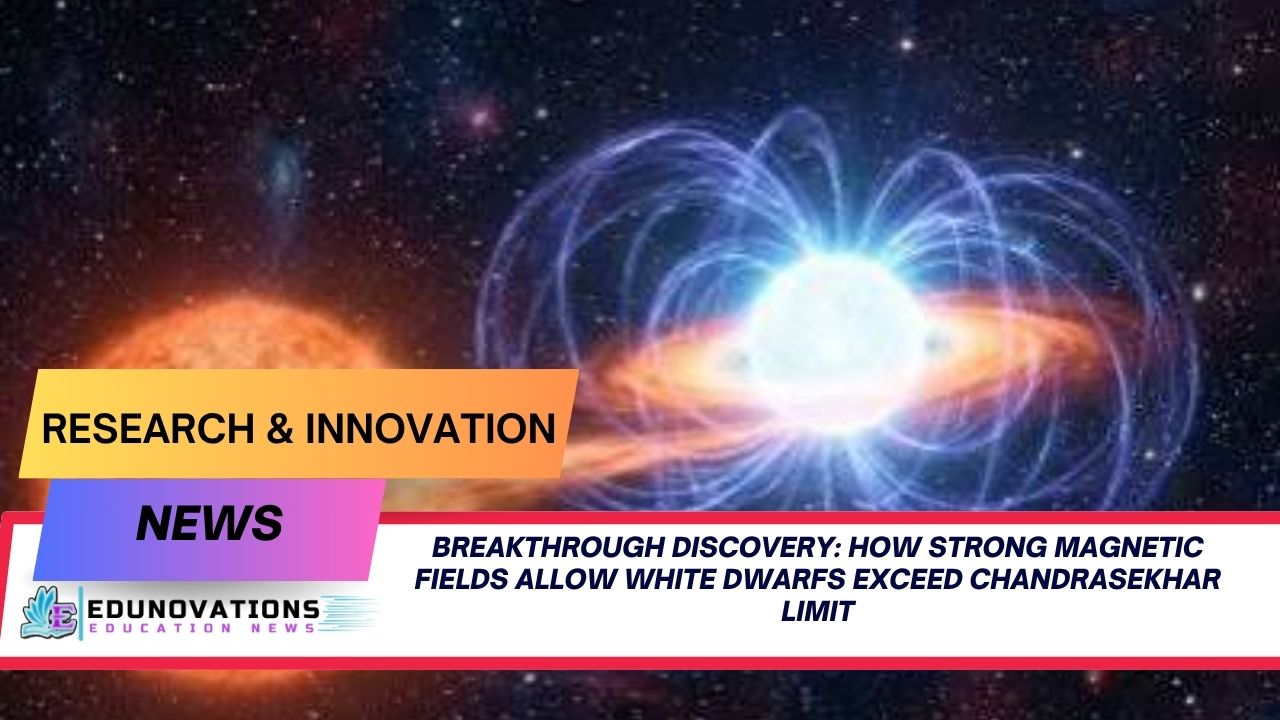
When dying stars exhaust their nuclear fuel, they shed their outer envelopes and leave behind dense stellar remnants known as white dwarfs.
When dying stars exhaust their nuclear fuel, they shed their outer envelopes and leave behind dense stellar remnants known as white dwarfs. For decades, astrophysics rested upon a fundamental cornerstone: the Chandrasekhar limit. Established as a steadfast boundary around 1.4 times the mass of the Sun, this threshold dictated the absolute ceiling for non-magnetized white dwarf stars, governing how these objects evolve and culminating in standard Type Ia supernovae used to measure cosmic distances. However, groundbreaking astrophysical simulations conducted by researchers at the Indian Institute of Science (IISc) have challenged this long-held paradigm. Their findings reveal that magnetic fields allow white dwarfs exceed chandrasekhar limit parameters, supporting stellar masses up to an astonishing 2.4 times the mass of the Sun.
This revelation transforms our understanding of stellar evolution, galactic mechanics, and the cosmological distance ladders utilized to calculate the expansion rate of the universe. To truly comprehend this discovery, students and space enthusiasts can explore comprehensive study materials, such as structured NCERT Courses, up-to-date Current Affairs, and detailed revision Notes to master advanced physics concepts.
The Historical Significance of the Chandrasekhar Limit
Formulated in the early 1930s by Nobel laureate Subrahmanyan Chandrasekhar, the traditional mass limit revolutionized theoretical astrophysics. Without rapid rotation or strong magnetization, a white dwarf relies entirely on electron degeneracy pressure to counteract its own immense inward gravitational collapse. As matter accumulates onto a carbon-oxygen white dwarf—often via accretion from a binary companion star—the core contracts, density increases, and temperatures rise.
Once the stellar core approaches approximately 1.4 solar masses, carbon ignition is triggered, resulting in a catastrophic thermonuclear runaway known as a Type Ia supernova. Because these explosions were long thought to occur at a remarkably uniform mass threshold, astronomers relied on their consistent peak luminosity as “standard candles” to measure vast intergalactic distances.
Yet, anomalies began appearing in observational data. Over the years, astronomers identified unusually over-luminous Type Ia supernovae pointing toward progenitor systems with masses stretching up to 2.8 solar masses. Theorists speculated for decades that intense magnetic fields could provide the necessary internal pressure support, but proving an actual physical evolutionary pathway remained an elusive goal.
Tracking the Evolutionary Pathway: Inside the IISc Study
To solve this long-standing astrophysical mystery, a research team from the Department of Physics at the Indian Institute of Science—featuring lead author Zenia Zuraiq and corresponding author Professor Banibrata Mukhopadhyay—embarked on advanced numerical simulations. Their work successfully traced how a magnetized star evolves from its main-sequence phase all the way into a super-Chandrasekhar white dwarf.
The team modified STARS, a premier stellar evolution computer code originally developed at the University of Cambridge. By incorporating magnetic field effects and intricate white dwarf cooling mechanisms, the researchers modeled a binary star system where a carbon-oxygen white dwarf steadily accumulates matter from a companion star.
As mass accretion proceeds, the white dwarf contracts under gravity. This contraction dramatically compresses and intensifies the internal magnetic field. The magnified magnetic field generates powerful Lorentz forces and magnetic pressure that act alongside electron degeneracy pressure, helping the star resist gravitational collapse and accommodate far greater mass than previously deemed possible.
Key Simulation Outcomes:
- Mass Expansion: A carbon-oxygen white dwarf originating from an 8-solar-mass main-sequence star reached a remarkable mass limit of about 2.4 solar masses.
- Radius Anomalies: The simulations successfully accounted for why certain observed white dwarfs exhibit unexpectedly large radii relative to their mass, directly linking this phenomenon to internal magnetic effects.
- Cosmological Implications: Recognizing that progenitor stars possess varying magnetic properties changes how astronomers interpret supernova luminosity data when mapping cosmic expansion.
For learners building a strong foundation in stellar mechanics, checking out interactive MCQ’s and explanatory Videos can simplify complex astrophysical principles.
Expert Insights and Scientific Perspectives
The implications of this study extend far beyond theoretical mathematics, prompting discussions across the global astronomy community. Dr. Banibrata Mukhopadhyay notes that the conceptual seed for this research was planted years ago when exploring whether magnetic pressures could fundamentally bypass standard mass caps. Subsequent collaboration with international theorists helped refine the STARS modeling framework, validating decades of theoretical predictions.
Prominent astrophysicists worldwide have frequently commented on the interplay between magnetic fields and stellar remnants. Nobel laureate and theoretical physicist Kip Thorne has often emphasized that magnetic fields in compact objects frequently dictate phenomena that defy simple Newtonian approximations, underscoring the vital role of magneto-hydrodynamics in modern astronomy. Similarly, observational data from space-borne observatories like the Chandra X-ray Observatory continue to validate that magnetic white dwarfs possess unique structural properties that demand revised theoretical models.
Educational institutions seeking to upgrade their digital infrastructure to support advanced science research portals can explore professional web design solutions through Mart India Infotech.
Re-evaluating Cosmic Distance Ladders
Type Ia supernovae serve as vital cosmic markers used to calculate the accelerating expansion of the universe and dark energy dynamics. If a significant subset of these stellar explosions originates from magnetized super-Chandrasekhar progenitors with diverse mass profiles, astronomers must re-calibrate luminosity-distance calculations. Accounting for magnetic diversity ensures higher precision in modern cosmology, refining our understanding of the universe’s age and expansion velocity.
Students preparing for competitive examinations can align their study schedules with the latest academic Syllabus, download free study material via NCERT PDFs, and structure complex concepts using visual NCERT Mind Maps.
Toppers Use Mind Maps to score more than 95%
NCERT Class 11th Commerce Mind Maps
Add to cartOriginal price was: ₹999.00.₹199.00Current price is: ₹199.00.NCERT Class 12th Chemistry Mind Maps
Add to cartOriginal price was: ₹199.00.₹75.00Current price is: ₹75.00.NCERT Class 12th Commerce Mind Maps
Add to cartOriginal price was: ₹999.00.₹199.00Current price is: ₹199.00.NCERT Class 12th Science Mind Maps
Add to cartOriginal price was: ₹999.00.₹199.00Current price is: ₹199.00.NCERT Mind Maps For Class 10th
Add to cartOriginal price was: ₹999.00.₹199.00Current price is: ₹199.00.





Purchase Today
Frequently Asked Questions (FAQs)
1. What is the traditional Chandrasekhar limit for white dwarfs?
The traditional Chandrasekhar limit is approximately 1.4 times the mass of the Sun, beyond which non-magnetized white dwarfs cannot maintain stability against gravitational collapse.
2. How do magnetic fields allow white dwarfs exceed chandrasekhar limit thresholds?
Strong internal magnetic fields generate supplemental magnetic pressure and Lorentz forces that help the stellar core counteract extreme gravity, allowing it to support more mass.
3. What maximum mass did the IISc simulations achieve for magnetized white dwarfs?
The recent IISc simulations demonstrated that a magnetized carbon-oxygen white dwarf could successfully grow up to approximately 2.4 solar masses.
4. Which institution conducted this groundbreaking white dwarf study?
The study was conducted by researchers from the Department of Physics at the Indian Institute of Science (IISc), in collaboration with international theoretical astrophysicists.
5. Who are the lead researchers behind the IISc super-Chandrasekhar study?
The study was led by PhD student Zenia Zuraiq as first author and Professor Banibrata Mukhopadhyay as the corresponding author.
6. What computer code was modified to simulate these stellar pathways?
The research team modified STARS, an advanced stellar evolution computer code originally developed at the University of Cambridge.
7. How do super-Chandrasekhar white dwarfs impact Type Ia supernovae?
Because these white dwarfs have higher and more diverse mass limits, their resulting supernova explosions exhibit varying luminosity profiles, affecting cosmic distance measurements.
8. Why do some white dwarfs have larger radii than expected?
According to the IISc findings, internal magnetic field effects provide outward pressure that increases the physical radius of certain low-mass white dwarfs.
9. Where was this scientific study officially published?
The research findings were published in The Astrophysical Journal Letters, a leading peer-reviewed journal for astrophysical research.
10. What role do binary systems play in white dwarf mass accumulation?
In a binary system, a white dwarf steadily accumulates matter from a companion star, increasing its core density, contracting its structure, and intensifying its internal magnetic field.