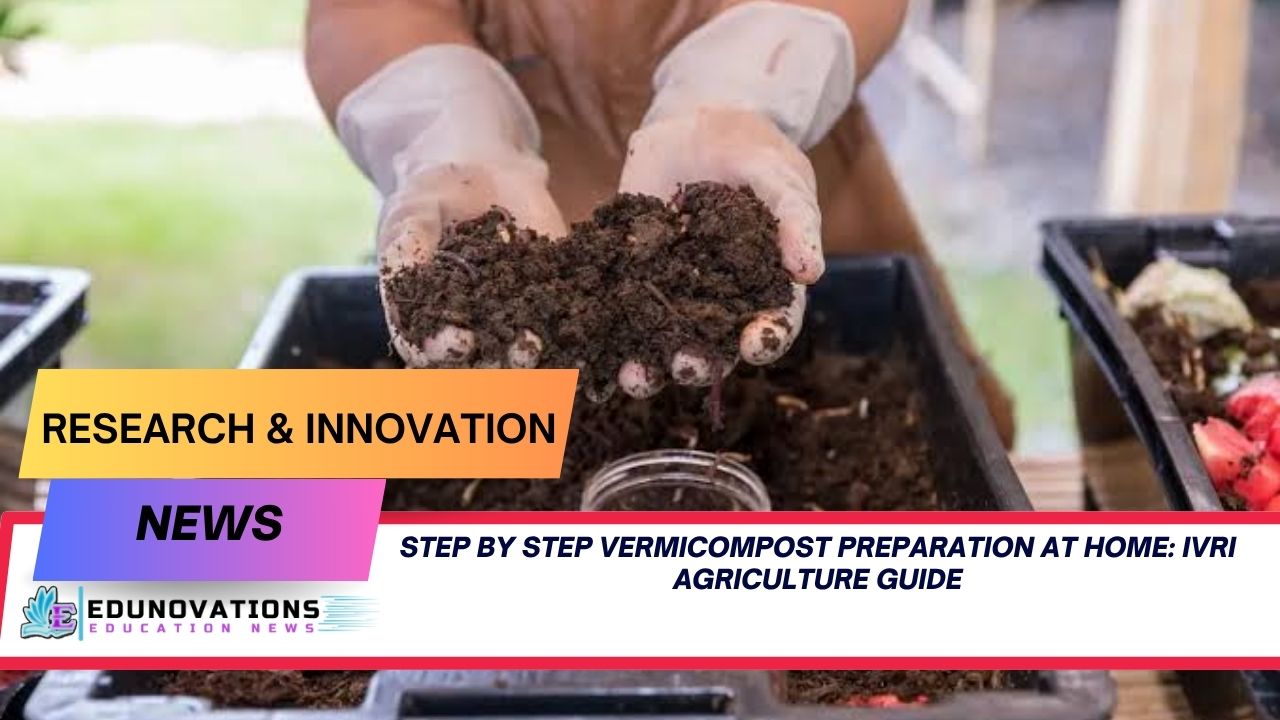
Learn the step by step vermicompost preparation at home based on ICAR-IVRI’s agricultural campaign to boost soil health and shift to natural farming.
Revolutionary “Kheti Bachao Abhiyaan” Launches in West Bengal: A Masterclass on Step by Step Vermicompost Preparation at Home
KOLKATA — In an era heavily defined by shifting climate patterns, post-war macroeconomic resource fluctuations, and an urgent global dialogue on sustainable food supplies, agricultural research institutions are stepping directly onto the frontlines. The Eastern Regional Station (ERS) of the ICAR-Indian Veterinary Research Institute (ICAR-IVRI), based in Kolkata, recently organized an extensive and highly impactful awareness program under the nationwide campaign “Kheti Bachao Abhiyaan” (Save Farming Campaign).
The field-level initiative took place at Baghadanga village, situated within the Habra-I block of the North 24 Parganas district in West Bengal. Designed to provide localized, actionable scientific knowledge directly to vulnerable rural populations, the program saw targeted attendance from dozens of scheduled caste and tribal agriculturalists. A total of 27 progressive farmers, encompassing 20 men and 7 women representing the clusters of Baghadanga, Kumra, Gelapole, and Makaltala villages, participated in the intensive session.
The expert delegation was spearheaded by top-tier agricultural scientists from ICAR-IVRI, including Dr. Arnab Sen, Head of the Regional Centre (HoRC); Dr. Bimalendu Mondal, Principal Scientist; and Dr. G. K. Das, Principal Scientist. Together, these authorities delivered a comprehensive, field-validated blueprint aimed at changing how local agrarian communities handle soil nutrition, ecosystem management, and multi-income generation.
The Chemical Conundrum: Restoring Distressed Agricultural Soils
The underlying catalyst for the “Kheti Bachao Abhiyaan” lies in the severe, multi-decade structural degradation of regional agricultural lands. Addressing the assembly on short notice, Dr. Arnab Sen placed heavy scientific emphasis on the immediate geopolitical and ecological challenges facing modern growers. Global trade bottlenecks and regional supply instability have triggered severe post-war scarcity and high costs for synthetic inputs.
More importantly, Dr. Sen issued an urgent warning regarding the profound, cascading adverse effects that the indiscriminate application of chemical fertilizers inflicts on long-term soil integrity. The chemical runoff and residual toxicity from excessive nitrogen, phosphorus, and potassium (NPK) inputs create a dangerous domino effect, directly threatening human health and causing severe public health issues through water contamination and bioaccumulation in the food chain.
To combat these urgent issues, the scientific panel collective stated that agriculturalists must pivot rapidly toward systematic land diagnostic measures. The experts emphasized the critical necessity of routine soil testing and advocated for a balanced, minimal application of chemical fertilizers integrated with bio-fertilizers. Land diagnostic testing acts as an ecological health checkup, ensuring that growers apply only the exact nutrient volumes required by the land, preventing heavy economic waste and sub-surface toxicity.
Reviving Ancient Roots Through Modern Scientific Natural Farming
The transition toward sustainable agriculture does not require abandoning established productivity metrics; rather, it blends historical wisdom with modern biological sciences. Principal Scientist Dr. Bimalendu Mondal presented a detailed historical retrospective to the gathered farmers, mapping out India’s ancient and highly successful heritage of organic land stewardship. Dr. Mondal requested that the modern generation actively accept and adopt the old agricultural and allied practices performed in previous decades.
Historically, rural ecosystems functioned as self-sustaining, zero-waste loops where livestock waste directly fueled crop yields, and crop residues served as livestock feed. To scale these methodologies cleanly in the modern era, the scientific team provided direct, practical guidance on preserving long-term soil health through natural farming techniques, specifically detailing the preparation of vermicompost and bio-fertilizers using locally available organic manures.
The core training component was designed to show that any grower, regardless of capital, can easily execute a step by step vermicompost preparation at home to completely replace high-cost chemical alternatives. By utilizing readily available domestic waste, cattle manure, and specific earthworm species such as Eisenia fetida, agricultural communities can systematically convert raw bio-waste into highly valuable microbial humus.
For students and competitive exam aspirants looking to dive deeper into the official curriculum mapping of these biogeochemical cycles, check out NCERT Courses and download highly detailed structured materials from NCERT Mind Maps. Keeping abreast of these environmental governance policies is vital for competitive readiness, which you can easily track via Current Affairs.
Micro-Economics of Collective Composting and Mixed Ecosystems
A highly practical element highlighted during the ICAR-IVRI field workshops was the economic optimization of organic output. Dr. Arnab Sen strongly advocated for the rapid setup of green organic composting infrastructure in villages on a collective, cooperative basis. When smallholders pool their agricultural residues and bovine manure, they can generate massive volumes of premium organic fertilizer.
This collective model yields distinct economic advantages:
- Quality Verification: Pooled resources make it easier to test batch quality and ensure uniform nutrient distribution.
- Premium Pricing: Certified organic outputs fetch a much higher price in urban consumer markets once they meet quality standards.
- Input Independence: Villages can completely eliminate their reliance on external corporate chemical supply lines.
Simultaneously, Dr. G. K. Das expanded the sustainable development framework by detailing advanced animal husbandry practices alongside standard agricultural operations. True agricultural resilience relies on diversification. By integrating dairy farming, goat rearing, or poultry setups with traditional cropping systems, small farmers secure a continuous, daily cash flow while ensuring a steady supply of raw manure for their step by step vermicompost preparation at home. This mixed ecosystem model acts as an economic buffer against crop failures and volatile market prices.
To explore the theoretical definitions of integrated farming systems or download academic study guides on agricultural economics, view the comprehensive resources available at Notes and explore the core educational framework via Syllabus.
The Broader Impact: E-E-A-T and Policy Perspectives
The “Kheti Bachao Abhiyaan” aligns perfectly with India’s national mission on sustainable agriculture and global climate change adaptation goals. High-ranking policy advocates have frequently noted that regional training programs are the single most effective way to transfer laboratory breakthroughs directly into real-world fields.
Former agricultural policy advisors have frequently commented on this paradigm, stating:
“The long-term food security of developing nations depends entirely on restoring our biological foundations. Programs like those run by ICAR-IVRI demonstrate that when scientists engage directly with tribal and marginal farmers, the adoption rate of sustainable practices increases exponentially.”
By providing direct, hands-on field training, the scientists gave participants the confidence and technical understanding to adopt vermicomposting and balanced fertilization practices. This work lays the essential groundwork for restored soil vitality and safer, eco-friendly crop yields across the region.
For institutional bodies, educational groups, or schools looking to build specialized digital platforms to distribute these vital eco-learning modules to the next generation, you can find professional development support via external web developers like Mart Ind Infotech.
Toppers Use Mind Maps to score more than 95%
-
NCERT Class 11th Commerce Mind Maps
Add to cartOriginal price was: ₹999.00.₹199.00Current price is: ₹199.00. -
NCERT Class 12th Chemistry Mind Maps
Add to cartOriginal price was: ₹199.00.₹75.00Current price is: ₹75.00. -
NCERT Class 12th Commerce Mind Maps
Add to cartOriginal price was: ₹999.00.₹199.00Current price is: ₹199.00. -
NCERT Class 12th Science Mind Maps
Add to cartOriginal price was: ₹999.00.₹199.00Current price is: ₹199.00. -
NCERT Mind Maps For Class 10th
Add to cartOriginal price was: ₹999.00.₹199.00Current price is: ₹199.00.




Purchase Today
Frequently Asked Questions (FAQs)
1. Why is a step by step vermicompost preparation at home considered better than standard pit composting?
A step by step vermicompost preparation at home utilizes specialized earthworms to accelerate the decomposition process. This results in a final product that has significantly higher microbial activity, better moisture retention, and more readily available plant nutrients than standard composted manure.
2. How exactly can a beginner learn how to reduce chemical fertilizer use in soil safely?
To learn how to reduce chemical fertilizer use in soil without dropping crop yields, you must take a phased approach. Start by conducting a soil test, replacing 25% of synthetic nitrogen with bio-fertilizers or vermicompost in the first season, and gradually increasing the organic proportion as soil microbial life recovers.
3. What makes the importance of routine soil testing for crop yield so critical for low-income farmers?
The importance of routine soil testing for crop yield lies in precise resource allocation. Instead of blindly purchasing expensive, generalized NPK chemical fertilizers, a soil test tells the farmer exactly which micro or macro-nutrients are lacking, preventing unnecessary spending and protecting soil health.
4. How does implementing sustainable animal husbandry tips for small farmers improve overall crop production?
When smallholders apply sustainable animal husbandry tips for small farmers, they create a highly efficient closed-loop system. The livestock produce a steady supply of dung and urine, which serve as the primary raw inputs needed for bio-fertilizers and home vermicomposting setup.
5. What are the core components of a natural farming techniques for beginners guide?
A foundational natural farming techniques for beginners guide focuses on minimal soil disturbance, continuous organic mulching, diverse crop rotations, and the complete replacement of synthetic chemical inputs with natural, home-brewed microbial solutions like Jeevamrutha or vermicompost.
6. What types of organic waste can be used when starting a step by step vermicompost preparation at home?
You can use non-greasy kitchen vegetable scraps, fruit peels, dried leaves, shredded cardboard, and aged cow dung. Avoid meat scraps, dairy, oils, and diseased plant materials, as these can attract pests and create foul odors in your home setup.
7. Can we completely eliminate chemical fertilizers overnight using natural farming techniques for beginners guide?
An immediate shift can sometimes cause a temporary drop in yield if the soil is severely degraded. It is highly recommended to follow a structured natural farming techniques for beginners guide that advocates for a gradual, systematic transition over 2 to 3 cropping cycles.
8. How frequently should a farmer acknowledge the importance of routine soil testing for crop yield?
Soil testing should ideally be carried out once every two years, or before planting high-demand cash crops. This ensures accurate tracking of soil health trends and adjustments to organic application rates.
9. Where can students access self-assessment tools on these sustainable agricultural frameworks?
Students studying agricultural topics can access highly targeted self-assessment modules and mock exams online through MCQ’s and supplement their visual understanding through interactive lectures via Videos. Free academic book access is also readily open for all students at Downloads of Free NCERT PDFs.
10. What earthworm species are recommended for a step by step vermicompost preparation at home?
The most efficient species for a step by step vermicompost preparation at home is Eisenia fetida (commonly known as the Red Wiggler). Unlike regular deep-burrowing earthworms, these surface-dwellers thrive on organic waste and tolerate wide temperature ranges.