Artificial intelligence has officially crossed the threshold from a convenient study assistant to a disruptive force capable of rewriting the fundamental rules of higher education.
Artificial intelligence has officially crossed the threshold from a convenient study assistant to a disruptive force capable of rewriting the fundamental rules of higher education. Recently, a major development shook the academic community when a berkeley math professor stops grading homework ai use became a viral talking point across campuses nationwide. As generative AI tools like ChatGPT, Claude, and specialized math solvers become increasingly sophisticated, traditional assessment methods are crumbling under the weight of automated perfection.
For decades, homework assignments served as the holy grail of student evaluation. They measured a learner’s dedication, comprehension, and ability to struggle through complex theoretical problems. Today, however, that struggle has been outsourced to algorithms capable of generating step-by-step proofs in fractions of a second. This paradigm shift forces educational institutions to rethink how they test knowledge, evaluate mastery, and maintain academic integrity in an era where anyone can bypass the learning curve with a single prompt.
The AI Revolution in Higher Education
The rapid integration of generative artificial intelligence into student workflows has caught many university faculties off guard. While students celebrate the unprecedented availability of instant homework assistance, professors find themselves fighting a losing battle against automated academic dishonesty. When students can feed complex algebraic equations or calculus proofs into an AI model and receive flawless answers instantly, the traditional incentive structure of homework collapses.
Educational researchers note that cheating has evolved from simple peer collaboration or answer-sharing websites to hyper-personalized AI tutoring that mimics genuine student reasoning. This technological leap has profound implications. Instructors who rely on take-home assignments to gauge baseline understanding are discovering that submitted work no longer reflects actual cognitive effort. Consequently, higher education is witnessing a growing ideological split between traditionalists clinging to old evaluation models and progressive educators advocating for radical curricular overhauls.
For students and educators seeking supplementary academic tools, exploring structured digital resources like our NCERT Courses can provide foundational clarity, while staying updated on institutional policy changes through Current Affairs helps keep academic communities informed on modern educational trends.
Inside the Classroom Disruption at UC Berkeley
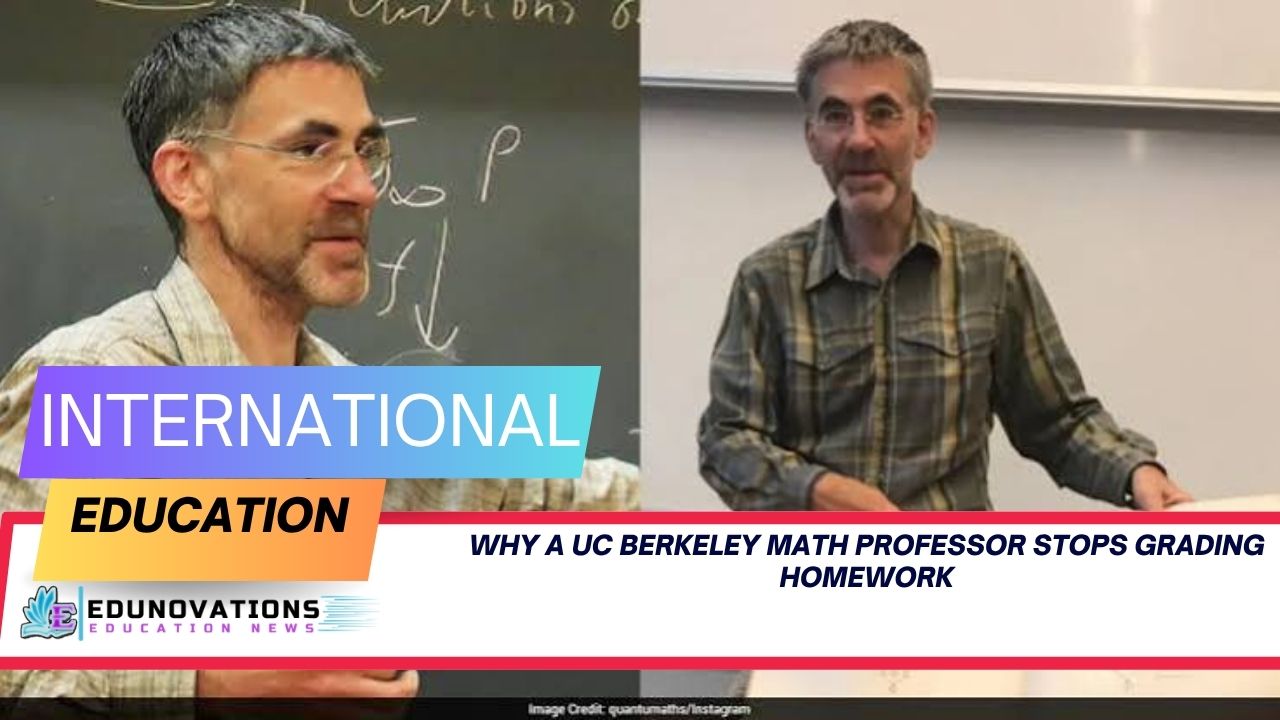
At the heart of this discussion is a high-profile decision made within the mathematics department at the University of California, Berkeley. Recognizing the near-universal adoption of automated problem-solvers among students, faculty leadership confronted an uncomfortable reality: grading homework was no longer an effective indicator of student learning.
When a berkeley math professor stops grading homework ai use makes headlines, it highlights the broader tension between technological innovation and academic evaluation. Rather than spending countless hours verifying whether homework submissions were authored by a human mind or an artificial neural network, educators are choosing to abandon routine homework grading altogether. This move is not an endorsement of skipping assignments, but rather a pragmatic surrender to a system where verifying authenticity has become practically impossible without invasive surveillance software.
Institutions navigating these digital transformations often require robust institutional infrastructure. For educational organizations or school boards looking to modernize their digital presence, partnering with a professional development partner like Mart Ind Infotech for tailored web solutions ensures academic platforms remain secure and accessible.
Shifting Pedagogical Paradigms: Beyond Traditional Grading
The decision by a prominent UC Berkeley mathematician sheds light on an existential crisis facing academia: What is the purpose of homework if the answers are entirely automated? Historically, homework served three primary purposes:
- Reinforcing classroom lectures through repetitive practice.
- Providing formative feedback to help students correct misconceptions.
- Contributing a minor percentage toward a student’s final course grade.
However, when advanced language models and computer algebra systems can effortlessly complete complex multi-variable calculus assignments, the first two purposes are severely undermined. Students who rely entirely on AI bypass the cognitive struggle necessary for true mathematical comprehension. Meanwhile, professors find themselves trapped in an endless arms race of developing AI-resistant problem sets, only to see new algorithms solve them weeks later.
To bridge learning gaps and reinforce conceptual clarity without relying on vulnerable online homework portals, educators frequently recommend structured revision materials. Students can access comprehensive study guides through our dedicated Notes library or test their actual retention levels using interactive MCQs.
Expert Insights and Broader Academic Perspectives
The dilemma faced by university faculty is part of a larger conversation involving leading figures in science, technology, and pedagogy. Experts across the globe are weighing in on how artificial intelligence is transforming cognitive development and educational standards.
Dr. Terrence Tao, a renowned mathematician and Fields Medalist, has frequently commented on the dual nature of artificial intelligence in mathematical research and education. While acknowledging that AI tools can accelerate certain exploratory phases of problem-solving, Dr. Tao has emphasized that relying on automated systems too early stunts a student’s mathematical intuition. According to his perspective, the struggle of grappling with a difficult proof or getting stuck on a challenging equation is where genuine mathematical maturity is forged. When students bypass this friction via automated solvers, they miss out on developing the resilience required for advanced scientific inquiry.
Similarly, educational philosopher Dr. Howard Gardner notes that educational assessment must evolve beyond rote memorization and procedural calculation. “If a machine can replicate the task entirely, then the task is no longer a measure of human intelligence; it is a measure of technological access,” Gardner observes.
To visualize complex academic frameworks and retain foundational theories, learners can explore visual learning aids available through NCERT Mind Maps or watch detailed visual breakdowns via our curated Videos portal.
Reimagining Assessment: Oral Exams and In-Class Evaluations
As universities grapple with the obsolescence of take-home assignments, educators are experimenting with alternative evaluation methods to restore integrity to grading systems. Some of the most promising shifts include:
- In-Class Proctored Exams: Returning heavily to traditional blue-book examinations where digital devices are strictly prohibited, ensuring that grades reflect individual cognitive capability.
- Oral Examinations and Viva Voce: Requiring students to verbally explain their reasoning, methodology, and problem-solving steps to a teaching assistant or professor.
- Process-Oriented Portfolios: Evaluating students based on their iterative drafts, collaborative discussions, and reflective journals rather than final computed answers.
- Project-Based Learning: Assigning open-ended, real-world application projects that require unique contextual synthesis rather than standard algorithmic computation.
These adjustments aim to re-establish trust between educators and learners. For students who want to stay aligned with evolving academic criteria, reviewing official curriculum guidelines via Syllabus documentation is essential. Furthermore, learners looking for supplemental reference books can access a wide array of educational resources through our Free NCERT PDFs Download hub.
Toppers Use Mind Maps to score more than 95%
-
NCERT Class 11th Commerce Mind Maps
Add to cartOriginal price was: ₹999.00.₹199.00Current price is: ₹199.00. -
NCERT Class 12th Chemistry Mind Maps
Add to cartOriginal price was: ₹199.00.₹75.00Current price is: ₹75.00. -
NCERT Class 12th Commerce Mind Maps
Add to cartOriginal price was: ₹999.00.₹199.00Current price is: ₹199.00. -
NCERT Class 12th Science Mind Maps
Add to cartOriginal price was: ₹999.00.₹199.00Current price is: ₹199.00. -
NCERT Mind Maps For Class 10th
Add to cartOriginal price was: ₹999.00.₹199.00Current price is: ₹199.00.


Purchase Today
Frequently Asked Questions
1. Why did the UC Berkeley math professor stop grading homework?
The decision stemmed from the widespread adoption of advanced artificial intelligence tools by students, which made it nearly impossible to verify whether submitted homework represented original student effort or automated generation.
2. How does AI impact traditional college math homework?
Generative AI models and specialized math solvers can instantly solve complex calculus, algebra, and logic problems, bypassing the critical cognitive struggle required for genuine learning.
3. Are other universities following UC Berkeley’s lead?
Yes, professors across various institutions in STEM fields are re-evaluating grading weights, shifting away from take-home assignments toward in-class exams and oral defenses.
4. What are the alternative assessment methods being adopted by professors?
Instructors are increasingly utilizing oral examinations, in-class closed-book testing, project-based portfolios, and interactive peer evaluations to accurately measure student understanding.
5. How can students truly learn math if AI can solve everything?
Students must use AI as an explanatory tutor rather than an answer generator, focusing on conceptual understanding, derivation steps, and active problem-solving practice.
6. Do these grading changes affect final course grades?
While policies vary by instructor, many professors are decreasing the percentage weight of homework in final grade calculations and increasing the weight of proctored exams.
7. What do prominent mathematicians say about AI in education?
Leading mathematicians emphasize that struggling through difficult equations is vital for building mathematical intuition, warning that over-reliance on AI stunts cognitive growth.
8. How are universities addressing academic integrity regarding AI?
Universities are updating honor codes, investing in AI detection tools (with varying degrees of reliability), and redesigning assignments to focus on personalized human experiences.
9. Where can students find reliable academic study resources?
Students can utilize structured digital platforms like Edunovations for comprehensive courses, notes, practice MCQs, and syllabus guides to support their academic journey.
10. Will homework completely disappear from higher education?
Homework is unlikely to vanish entirely, but its format and grading weight are undergoing a massive transformation to adapt to the realities of generative artificial intelligence.