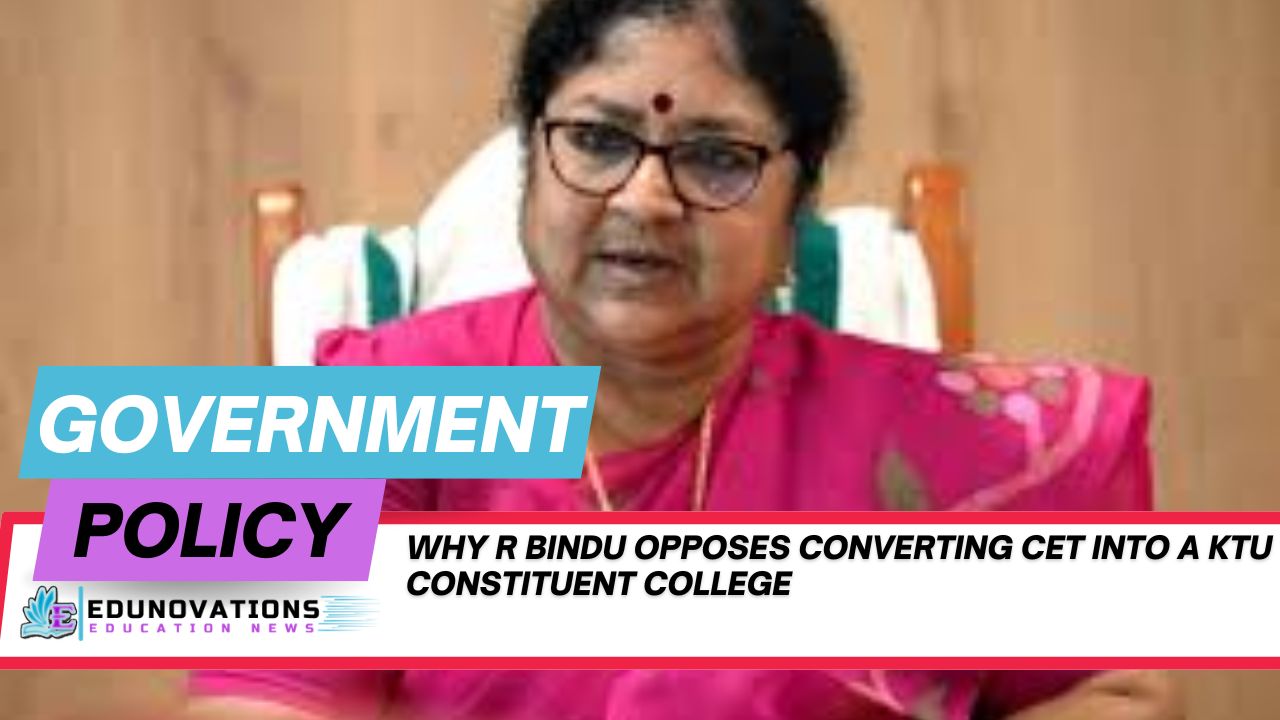
Discover why former minister R Bindu warns against making CET a constituent college of KTU, threatening autonomy, funding, and higher education stability.
The landscape of higher education in southern India has always been fiercely guarded, built upon decades of careful policy-making, substantial public funding, and institutional identity. Recently, the higher education sector in Kerala found itself at the center of a roaring controversy following radical proposals to alter the administrative framework of its premier technical institutions. At the heartbeat of this debate is a fierce institutional pushback. Why R Bindu opposes converting CET into a KTU constituent college has transformed from a localized administrative disagreement into a state-wide discussion regarding institutional autonomy, bureaucratic overreach, and the safety of public financial allocations.
As aspirants, educators, and policy researchers constantly track academic developments, understanding these structural changes is crucial. Students preparing for competitive exams often rely on structured modules, and just as candidates look up comprehensive study resources like Notes or practice through MCQ’s, policymakers and educational analysts must evaluate structural shifts with equal analytical rigor. This comprehensive analysis breaks down the friction between the College of Engineering Trivandrum (CET) and the APJ Abdul Kalam Technological University (KTU), exploring the grave concerns raised by prominent political and academic figures.
Understanding the Structural Debate in Kerala’s Technical Sector
To fully comprehend the gravity of the ongoing dispute, one must look closely at the institutional history of the institutions involved. Founded back in 1939, the College of Engineering Trivandrum (CET) has spent over eight decades cementing its reputation as a crown jewel of engineering education in the region. It has nurtured generations of technocrats, researchers, and global industry leaders. On the other side stands the APJ Abdul Kalam Technological University (KTU), established relatively recently as an affiliating university designed to streamline technical education across the state.
The core of the current conflict arose when suggestions were floated to convert CET from its current direct state-governed autonomous standing into a constituent college under KTU. Proponents of the move argued that such a merger could help pool resources and stabilize administrative workflows. However, critics were quick to point out the hidden perils of such an institutional marriage. For those keeping track of broader governance metrics, curriculum updates, and academic frameworks, checking regular updates via Syllabus trackers reveals how deeply intertwined institutional identity is with uniform academic delivery.
The Core Objections Raised by Former Minister R Bindu
Former minister for higher education R Bindu came down heavily on the proposal, labeling it as a flawed maneuver that could potentially destabilize decades of academic growth. According to her detailed statements, transforming CET into a constituent unit of KTU would fundamentally undermine the college’s hard-earned autonomy.
- Disruption of Independent Development: CET has charted an independent growth trajectory, fostering specialized research clusters and maintaining direct administrative synergy with the state government. Absorbing it into a larger university framework risks reducing its administrative agility.
- The Risk of Budgetary Diversion: One of the most alarming warnings issued concerned government fiscal allocations. Transferring CET’s dedicated financial grants to KTU could open the floodgates for fund redirection to cover structural deficits elsewhere within the university system.
- Concealing Structural Deficiencies: Bindu asserted that the proposal primarily functions as a smokescreen to mask KTU’s own academic and infrastructural shortcomings. Rather than establishing a robust, independent central campus with advanced research facilities of national standing, absorbing an already successful college is viewed as a shortcut.
For students who require visual learning aids or conceptual breakdowns during their academic journeys, utilizing tools like NCERT Mind Maps helps structure complex topics cleanly—a clarity that administrative bodies often fail to apply when merging distinct institutional cultures.
Assessing Institutional Autonomy and Financial Vulnerabilities
When elite academic institutions lose their direct line of governance, the ripple effects are felt across faculty retention, research funding procurement, and student placements. CET has traditionally functioned under the direct oversight of the state government, allowing it to preserve a democratic balance and responsive local administration.
Transitioning this control to a university structure where the elected state government’s direct administrative influence is constrained—while other external chancellorial authorities retain heavy sway—introduces unwanted administrative bottlenecks. Institutional experts from organizations like Mart Ind Infotech often emphasize that digital transparency and clean structural workflows are essential for modern administrative institutions to thrive without friction. When bureaucratic layers multiply, institutional efficiency naturally plummets.
Furthermore, the argument presented by bodies like the Save University Forum—which claimed that merging budgets would ensure affordable education and continued development—was sharply criticized by R Bindu as a “dangerous” narrative. She maintained that sacrificing an established institution like CET merely to bail out a struggling university sets a hazardous precedent for public education policies across the country.
The Path Forward: Strengthening KTU Without Compromising CET
Instead of absorption strategies that cannibalize legacy institutions, educational reformers suggest a more sustainable roadmap. KTU should focus on cultivating its own permanent academic campus, establishing advanced central research departments, and building independent centers of excellence that can stand shoulder-to-shoulder with national institutes.
Students and educators who wish to stay updated on policy reforms, governance changes, and daily educational updates can reference resources such as Current Affairs and video tutorials available on Videos. Additionally, learners searching for foundational textbook references can explore platforms offering NCERT Courses and options for Downloads of Free NCERT PDFs to maintain a strong grip on core concepts.
Toppers Use Mind Maps to score more than 95%
NCERT Class 11th Commerce Mind Maps
Add to cartOriginal price was: ₹999.00.₹199.00Current price is: ₹199.00.NCERT Class 12th Chemistry Mind Maps
Add to cartOriginal price was: ₹199.00.₹75.00Current price is: ₹75.00.NCERT Class 12th Commerce Mind Maps
Add to cartOriginal price was: ₹999.00.₹199.00Current price is: ₹199.00.NCERT Class 12th Science Mind Maps
Add to cartOriginal price was: ₹999.00.₹199.00Current price is: ₹199.00.NCERT Mind Maps For Class 10th
Add to cartOriginal price was: ₹999.00.₹199.00Current price is: ₹199.00.





Purchase Today
Frequently Asked Questions (FAQs)
- Why R Bindu opposes converting CET into a KTU constituent college?Former minister R Bindu opposes the conversion because she believes it will compromise CET’s autonomy, disrupt its independent growth path, and expose its budgetary allocations to the risk of diversion.
- What is the primary concern regarding CET’s budget if merged with KTU?The main concern is that government financial allocations meant explicitly for CET’s infrastructure and development could be siphoned off to cover KTU’s internal financial deficits and operational gaps.
- How does the proposed merger affect institutional governance?Shifting CET from direct state government control to a university structure potentially limits the elected government’s administrative influence while altering the balance of power concerning institutional decisions.
- What arguments did the Save University Forum present regarding the merger?The Save University Forum argued that transferring CET’s budgetary allocations to KTU would guarantee the college’s continued development while keeping education affordable, a claim strongly disputed by critics.
- What structural flaws does KTU face according to critics?Critics point out that KTU has largely remained an affiliating and examination-conducting body, falling short of developing a comprehensive permanent campus, strong research wings, or national centers of excellence.
- When was the College of Engineering Trivandrum (CET) founded?CET was established in 1939 and has decades of legacy as a premier technical education provider in Kerala.
- What alternative solution has been suggested instead of merging CET?Experts and leaders have suggested that KTU should independently build its own research infrastructure, faculty capacity, and permanent campus rather than absorbing pre-existing successful colleges.
- How does this debate impact general engineering students?Uncertainty over administrative changes, degree-granting autonomy, and funding allocation can cast a shadow on campus recruitment, research funding, and overall academic morale.
- What role does administrative autonomy play for institutions like CET?Autonomy allows engineering colleges to adapt quickly to industry needs, attract direct research grants, and maintain high standards of academic flexibility without bureaucratic delays.
- Where can students find more reliable study material and policy updates?Students can explore educational portals providing specialized academic notes, test preparation modules, and current affairs analysis to stay informed on institutional changes.