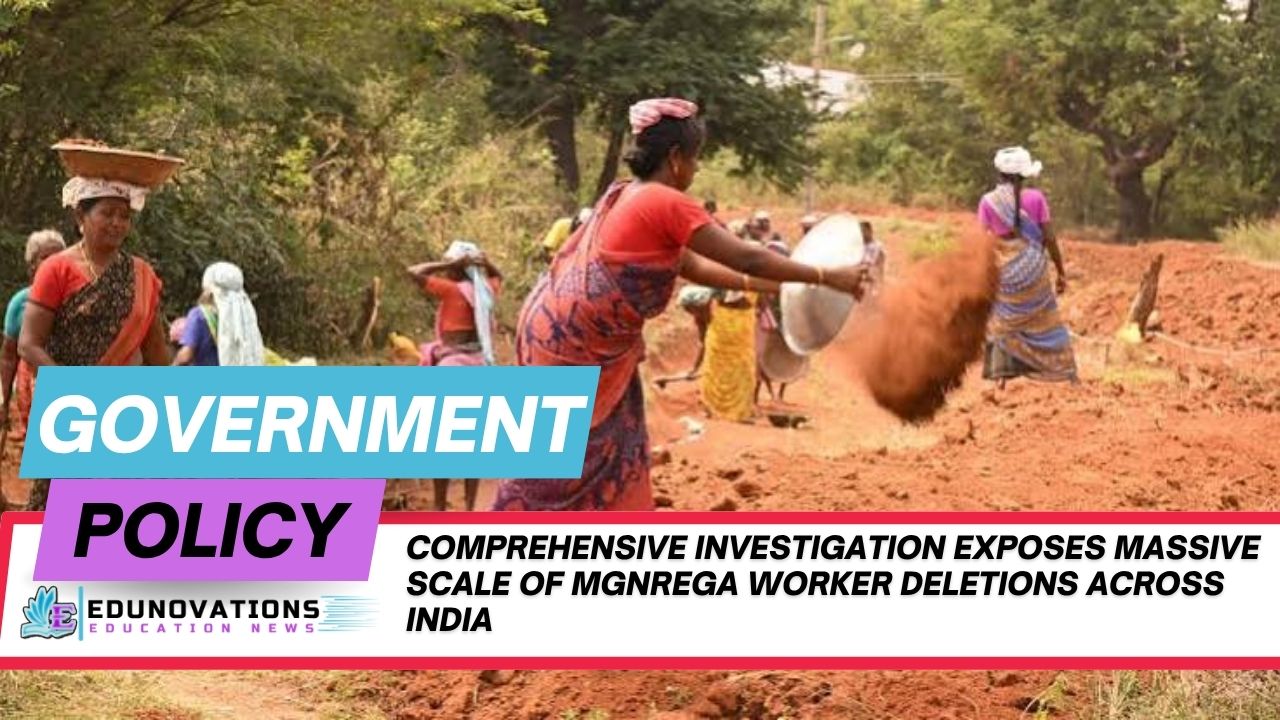
The digital transformation of India’s public welfare architecture has fundamentally reshaped how millions of rural citizens access their statutory entitlements.
The digital transformation of India’s public welfare architecture has fundamentally reshaped how millions of rural citizens access their statutory entitlements. Among these initiatives, the Mahatma Gandhi National Rural Employment Guarantee Act (MGNREGA) stands as the world’s largest rights-based wage employment program, guaranteeing up to 100 days of manual work per rural household every year. However, a recent high-profile academic discourse hosted by the National Law School of India University (NLSIU) JSW Centre for the Future of Law has brought to light a deeply concerning administrative crisis. Detailed examination of mgnrega worker deletion statistics study metrics reveals that millions of vulnerable workers have been removed from official rolls under questionable and often illegal administrative pretexts.
As transparency advocates, researchers, and civil society organizations scrutinize the intersection of technology and social welfare, understanding the mechanics behind these widespread removals becomes essential. For students and researchers looking to deepen their foundational knowledge on Indian governance, policies, and public administration, exploring structured learning resources like NCERT Courses can provide robust context. Furthermore, tracking evolving policy updates through dedicated Current Affairs portals helps contextualize how digital administrative changes affect marginalized communities nationwide.
The Digital Shift and Emergence of Exclusionary Systems
The implementation of welfare administration systems has increasingly relied on algorithmic tools and centralized electronic registries. Over recent years, administrative directives pushed for the mandatory linking of biometric authentication and the Aadhaar-based payment system (ABPS) to process wage disbursements. While proponents argued that digital integration would curb leakages and eliminate administrative bottlenecks, ground-level realities point to an alarming surge in systemic exclusions.
When digital authentication bottlenecks occur—ranging from biometric mismatches and seeding errors to server downtimes—workers find their accounts frozen or deactivated. The empirical research presented at the NLSIU workshop, spearheaded by prominent researchers from LibTech India, exposed a sobering reality. By analyzing a random sample of 21 blocks spanning over 5.29 lakh worker deletions between 2017 and October 2024, the study laid bare the scale of administrative attrition.
Scholars preparing for competitive examinations or academic essays can benefit greatly by structuring their study notes with verified Notes and practicing targeted MCQ’s to test their understanding of Indian public policy frameworks and welfare laws.
Unraveling the Grounds for Removal: The “Unwilling to Work” Fallacy
One of the most startling revelations emerging from the granular analysis of mgnrega worker deletion statistics study data involves the categorization of reasons behind worker purges. Under MGNREGA statutory guidelines, a worker’s job card can only be canceled under very specific circumstances, such as the duplication of cards, permanent migration of the household, death of the worker, or sustained inactivity over prolonged periods without demand for work.
However, the empirical findings demonstrate that nearly two-thirds of workers deleted nationally between 2022 and October 2024 were removed on the grounds of being “unwilling to work.” Legal experts and labour rights activists emphasize that “unwillingness to work” is an administrative classification that lacks explicit statutory backing under the MGNREGA framework. Furthermore, cluster bootstrap statistical modeling yielded a 95% confidence interval of 58% to 73% for these wrongful removals.
To visualize complex administrative data structures and statutory frameworks effectively, students often rely on conceptual study aids. Free educational tools such as NCERT Mind Maps offer structured visual breakdowns of administrative procedures. Additionally, comprehensive Syllabus guides help learners track key institutional topics across various academic disciplines.
Empirical Evidence from Sampled Blocks
The investigative report did not merely rely on macro-level assumptions; it examined deep micro-level data across 21 administrative blocks. The findings revealed that nearly 30% of workers deleted over the preceding five years under the pretext of being unwilling to work had actually demanded and performed work during that window, collectively contributing an astounding 19.29 lakh person-days of labor.
This stark contradiction highlights profound flaws in accountability and due process within digital welfare administration. When local functionaries alter digital database statuses to meet performance quotas or clear technological backlogs, real families lose their legally guaranteed social safety nets. For comprehensive multimedia explanations regarding India’s legislative history and socio-economic policies, students can explore curated Videos. For those seeking offline study materials, accessing Downloads of Free NCERT PDFs provides valuable foundational reading on constitutional rights and legal frameworks.
Expert Insights and Civil Society Perspectives
The discussions at the NLSIU workshop were led by distinguished experts whose extensive field research has consistently shed light on transparency deficits in rural policies.
Chakradhar Buddha, a Senior Researcher and co-founder of LibTech India, has spent years documenting how technology-driven mandates intersect with social protection and Adivasi rights. Commenting on the systemic friction caused by digital welfare rollouts, Buddha noted:
“When administrative software and rigid algorithmic mandates are prioritized over statutory guarantees, the law itself gets subverted through the back door. Digital systems must be designed to serve entitlements, not to invent arbitrary technical reasons to strip vulnerable citizens of their legally mandated right to work.”
Co-speaker Rajendran Narayanan, who teaches at Azim Premji University and is a founding member of LibTech India, emphasized the parallels between employment database purges and electoral roll revisions. Narayanan stated:
“The large-scale deletion of legitimate workers without due process mirrors administrative overreaches seen elsewhere in digital governance. Accountability cannot be outsourced to opaque algorithms or unverified database flags. If public policy fails to protect the constitutional right to work, it undermines the very bedrock of democratic welfare administration in India.”
Broader Technological Parallels and Governance Challenges
The issues highlighted in the MGNREGA worker deletion study extend far beyond rural employment schemes; they point toward a broader structural challenge in modern digital governance. As public institutions increasingly digitize welfare distribution, public distribution systems, and electoral rolls, the risk of bureaucratic disenfranchisement grows exponentially.
When software design lacks consultation with grassroots stakeholders, systemic exclusions become normalized under the guise of modernization. Ensuring constitutional compliance requires that digital architectures incorporate robust grievance redressal mechanisms, transparent notification protocols, and mandatory auditing before any beneficiary is purged from state registries. Ensuring technological infrastructure meets rigorous, secure, and scalable standards requires specialized enterprise solutions. For instance, organizations seeking professional web infrastructure and software development support frequently partner with industry leaders like [Need Website for Schools Contact https://www.martindiainfotech.com/ “Mart Ind Infotech”] to build resilient digital systems.
Toppers Use Mind Maps to score more than 95%
-
NCERT Class 11th Commerce Mind Maps
Add to cartOriginal price was: ₹999.00.₹199.00Current price is: ₹199.00. -
NCERT Class 12th Chemistry Mind Maps
Add to cartOriginal price was: ₹199.00.₹75.00Current price is: ₹75.00. -
NCERT Class 12th Commerce Mind Maps
Add to cartOriginal price was: ₹999.00.₹199.00Current price is: ₹199.00. -
NCERT Class 12th Science Mind Maps
Add to cartOriginal price was: ₹999.00.₹199.00Current price is: ₹199.00. -
NCERT Mind Maps For Class 10th
Add to cartOriginal price was: ₹999.00.₹199.00Current price is: ₹199.00.





Purchase Today
Frequently Asked Questions (FAQs)
- What does the mgnrega worker deletion statistics study reveal about rural job cards? The study reveals that nearly two-thirds of workers deleted nationally between 2022 and October 2024 were removed under the unpermitted category of being “unwilling to work,” undermining statutory employment guarantees.
- How does the aadhaar based payment system impact on mgnrega implementation? Mandatory ABPS linking has introduced technical bottlenecks, biometric authentication failures, and database errors, frequently resulting in the wrongful deletion or freezing of active worker accounts.
- What are the legal implications of the illegal deletion of mgnrega workers unwillingness to work? Removing workers under the pretext of unwillingness to work lacks explicit backing under the MGNREGA statute, raising serious concerns regarding legal compliance, procedural due process, and state accountability.
- What insights does the libtech india mgnrega worker removal report provide? The report utilizes empirical data from 21 sampled blocks to demonstrate that 30% of workers categorized as unwilling to work had actually contributed 19.29 lakh person-days of labor.
- Why is digital welfare administration accountability india a critical topic of discussion? It highlights the governance risks when automated algorithms and digital databases override statutory entitlements without proper consultation, transparency, or accessible grievance redressal mechanisms.
- Who are the key researchers behind the LibTech India MGNREGA study? The research features insights from prominent experts including Chakradhar Buddha, Senior Researcher at LibTech India, and Rajendran Narayanan, faculty member at Azim Premji University and founding member of LibTech India.
- What statistical confidence interval was established for MGNREGA worker deletions? A cluster bootstrap applied to the sampled blocks yielded a 95% confidence interval of 58% to 73% for workers removed under invalid statutory grounds.
- How do digital exclusions affect rural workers dependent on MGNREGA? Wrongful deletions abruptly sever households from their guaranteed wage employment, threatening rural livelihoods, household financial security, and basic economic survival.
- What institutional body hosted the workshop discussing these MGNREGA deletions? The workshop was organized by the JSW Centre for the Future of Law at the National Law School of India University (NLSIU), Bengaluru.
- What broader administrative parallels were drawn during the academic workshop? Speakers noted striking parallels between large-scale MGNREGA worker deletions and electoral roll purges observed during administrative revisions of voter lists.