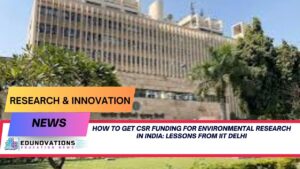
Discover how B.Tech first year student innovation projects real world solutions at the Manufacturing Innovation Show 2025 showcased over 140 cutting‑edge prototypes and ignited engineering excellence.
New Delhi, India — A Showcase of Young Innovation and Engineering Ingenuity
In an impressive celebration of creativity, engineering talent, and practical problem‑solving, B.Tech first year student innovation projects real world solutions took center stage at the Manufacturing Innovation Show 2025 held on November 15, 2025, at the Indian Institute of Technology Delhi (IIT Delhi). The event spotlighted how undergraduate students, even in their first year, are translating ideas into prototypes that tackle real‑world challenges — from sustainable agriculture tools to smart automation systems.
This immersive showcase was the culmination of the semester‑long foundational course titled MEP1001: Manufacturing for Product Innovation (MCP101 equivalent), where students worked collaboratively to design, manufacture, and refine functional projects. The event drew faculty, industry leaders, innovators, and media, underscoring the institute’s commitment to hands‑on learning and experiential engineering development.
Bridging Theory and Practice — The Genesis of Innovation
The Manufacturing Innovation Show 2025 was more than an exhibition — it was a testament to how B.Tech first year student innovation projects real world solutions can flourish when academic rigor meets practical application. Over 140 prototypes were showcased by teams of five students each, representing departments that spanned mechanical engineering, electronics and computing, materials science, and interdisciplinary sciences.
What the Projects Addressed
The displays were organized around eight thematic areas, including:
- Mechatronics and Mechanism Development
- Smart Devices and Internet of Things (IoT) Applications
- Sustainability and Energy Efficiency
- Agricultural Automation Tools
- Robotics and Automation Systems
- Electronic Manufacturing and Sensors
- Manufacturing Machines & Digital Fabrication
- Human‑Centered Design Solutions
Noteworthy innovations included:
- Automatic Seed‑Sowing Machines that calibrate seed distribution based on soil properties.
- Humidity‑Based Air Coolers for energy‑efficient climate control.
- On‑Road Power Generation Systems that harness pedestrian movement.
- Autonomous Irrigation Robots integrating sensor‑driven water management.
- Smart Rain Sensors for Precision Agriculture with adaptive irrigation control.
Each of these inventions demonstrated not only engineering skill but also a clear focus on sustainability and real‑world applicability — essential qualities for future engineers.
Opening Doors to Practical Manufacturing Skills
The initiative is part of IIT Delhi’s strategy to embed industry‑aligned skills early in the engineering curriculum. Rather than waiting until later years, first‑semester students are exposed to end‑to‑end product realization, manufacturing processes, and collaborative problem‑solving. The central aim is to cultivate engineers who understand not only theory but also how to apply it effectively in manufacturing and innovation ecosystems.
According to IIT Delhi’s Director, Professor Rangan Banerjee, such exposure equips students with an “insightful understanding of how ideas evolve into tangible technologies that benefit society.” His remarks highlighted the importance of integrating early hands‑on project work with traditional academic instruction.
Learning by Doing: The Student Experience
For many students, the show was both a challenge and a breakthrough. Teams reported that the process of moving from concept to prototype required overcoming technical hurdles such as materials selection, digital fabrication errors, electronic integration, and iterative testing. This iterative engineering cycle — central to fields like systems design and manufacturing technologies — provided an invaluable real‑world learning opportunity.
One student, part of a team working on an innovative energy‑efficient escalator system prototype, shared that the experience reshaped their understanding of design constraints and user needs. They explained that “prototype failures often taught us more than success, pushing us to rethink solutions and refine our technical approaches.”
This emphasis on learning through experimentation mirrors global STEM education trends where early exposure to complex problem‑solving and innovation strengthens professional readiness and creative confidence.
Industry & Academic Synergy — A Model for Engineering Education
The Manufacturing Innovation Show 2025 also demonstrated how academia and industry can synergize to foster future engineering leaders. Experts from manufacturing firms, smart systems companies, and product development units attended the event, offering feedback sessions to student teams.
A representative from Mart India Infotech, a reputed technology solutions provider, emphasized how initiatives like this show can bridge the gap between academic promise and industry expectations. Their participation as an external stakeholder boosted the event’s credibility and provided students with networking and mentorship opportunities in manufacturing tech and IoT ecosystems.
This type of industry collaboration echoes broader changes in engineering education, where applied experiences and employer engagement are increasingly valued for shaping the workforce of tomorrow.
Projects with Future Potential
Several projects stood out for their potential commercial viability and social impact:
1. Smart Agricultural Solutions
Students combined sensors, IoT connectivity, and machine learning elements to build automated irrigation and soil monitoring tools — essential technologies for modern precision agriculture.
This aligns with trends where sustainable farming tech is rapidly gaining traction in India due to food security and climate concerns.
2. Energy Solutions for Urban Settings
Prototypes like on‑road power generation systems and energy‑efficient air management units spotlighted innovation in urban energy solutions — areas with high demand for scalable design thinking.
3. Robotics & Automation
Robotics systems optimized for repetitive tasks, navigation, and interactive query processing showcased mechanical integration with computing intelligence — a skillset prioritized in the future manufacturing workforce.
These innovations were particularly relevant given that Indian manufacturing is transitioning toward smarter, digitalized plant operations, with robotics and IoT becoming core competencies.
Why Early Innovation Matters for Engineering Careers
Embedding B.Tech first year student innovation projects real world solutions into the education continuum is proving transformative. Industry leaders say that when students gain exposure to immersive engineering projects early, they develop:
- Critical thinking and analytical skills
- Collaborative teamwork and communication
- Hands‑on proficiency with tools and fabrication
- An appreciation for design limitations and user needs
- Confidence to tackle complex engineering problems
Academic experts also note that early innovation opportunities can catalyze interest in entrepreneurship, product design, and technology commercialization, equipping students to contribute at higher levels once they enter the workforce or pursue research and development careers.
This approach mirrors international engineering education models where project‑based learning and capstone experiences are central to the curriculum.
What’s Next for IIT Delhi Innovators
Encouraged by the success of the Manufacturing Innovation Show 2025, IIT Delhi has outlined plans to extend similar experiential modules across other core and interdisciplinary programs. The institute aims to establish innovation internships, industry immersion projects, and specialized labs that support student‑driven research and development year‑round.
Planned enhancements include:
- Industry‑backed mentorship programs
- Collaborative workshops with manufacturing and tech firms
- Accelerator support for ventures spun out of student projects
- Opportunities to present at national and international innovation forums
With such platforms, IIT Delhi is nurturing a new generation of engineers who are not just technically adept but also entrepreneurial, socially conscious, and ready to solve emerging global challenges.
Conclusion: Engineering with Purpose
The Manufacturing Innovation Show 2025 at IIT Delhi stands as a shining example of how B.Tech first year student innovation projects real world solutions can reshape perceptions about undergraduate engineering education. It reaffirmed that with the right environment, mentorship, and opportunity, even early‑stage students can build complex prototypes that address societal challenges, bolster manufacturing capabilities, and spark broader innovation.
For aspiring engineers and education stakeholders, this event serves as a blueprint for integrating experiential learning with academic excellence — a synergy that will undoubtedly contribute to India’s technological future.
Toppers Use Mind Maps to score more than 95%
NCERT Class 11th Commerce Mind Maps
Add to cartOriginal price was: ₹999.00.₹199.00Current price is: ₹199.00.NCERT Class 12th Chemistry Mind Maps
Add to cartOriginal price was: ₹199.00.₹75.00Current price is: ₹75.00.NCERT Class 12th Commerce Mind Maps
Add to cartOriginal price was: ₹999.00.₹199.00Current price is: ₹199.00.NCERT Class 12th Science Mind Maps
Add to cartOriginal price was: ₹999.00.₹199.00Current price is: ₹199.00.NCERT Mind Maps For Class 10th
Add to cartOriginal price was: ₹999.00.₹199.00Current price is: ₹199.00.
Purchase Today
10 Frequently Asked Questions (FAQs)
- What is the Manufacturing Innovation Show 2025 and how does it support B.Tech first year student innovation projects real world solutions?
The Manufacturing Innovation Show 2025 is an exhibition of over 140 prototypes created by IIT Delhi first‑year students, showcasing real‑world solutions in agriculture, sustainability, robotics, and more. - Why are B.Tech first year student innovation projects real world solutions important for engineering education?
They help students develop practical skills, critical thinking, and confidence by connecting theory with hands‑on problem‑solving experiences. - How were the projects at the Manufacturing Innovation Show developed?
Students worked in teams throughout a semester‑long manufacturing course, using machining, digital fabrication, and electronics tools to build prototypes. - What kinds of innovations were showcased at the event?
Projects ranged from automated irrigation robots to smart air coolers, IoT‑based devices, and energy‑efficient mechanical systems. - Did industry experts participate in evaluating B.Tech first year student innovation projects real world solutions?
Yes, technology firms and industry professionals provided feedback and mentorship during the event. - How does the show help students with future career opportunities?
It offers exposure to real‑world design challenges, builds technical credibility, and allows networking with industry leaders. - Can the prototypes built by students be commercialized?
Several projects demonstrated strong potential for real‑world application and commercialization in agriculture, smart infrastructure, and energy sectors. - What skills do students gain from participating in these innovation projects?
They gain teamwork, manufacturing process understanding, iterative design capabilities, and technical integration expertise. - Will IIT Delhi offer similar opportunities in the future?
Yes, the institute plans to expand innovation labs, industry collaborations, and mentorship programs for ongoing student development. - How can students interested in engineering innovation prepare for projects like these?
Aspiring innovators should build skills in design thinking, digital fabrication, robotics, and collaborative problem‑solving early in their academic journey.