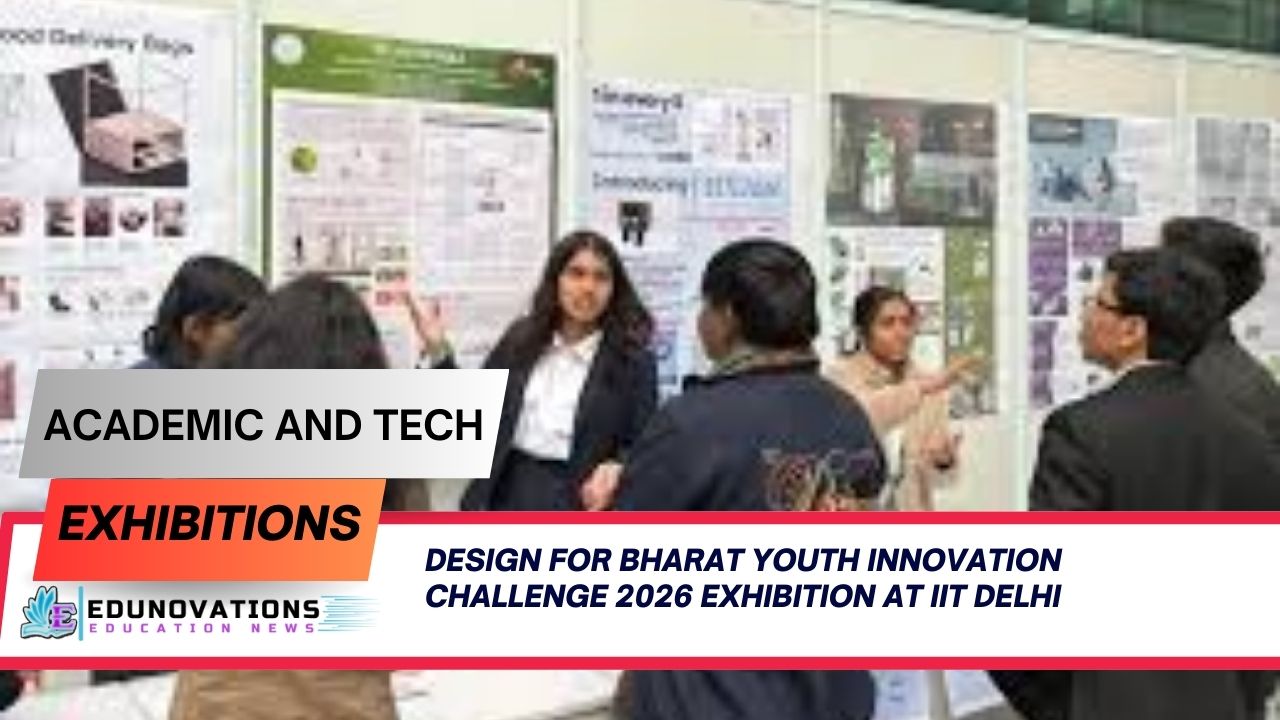
Explore the Design for Bharat Youth Innovation Challenge 2026 exhibition at IIT Delhi, where young innovators presented groundbreaking designs in India’s national youth innovation challenge.
In a landmark celebration of creativity and youth empowerment, the Design for Bharat Youth Innovation Challenge 2026 exhibition took center stage at the prestigious Indian Institute of Technology Delhi campus. This national platform brought together visionary young talent from across India to showcase innovative design solutions aimed at solving real‑world challenges aligned with the vision of a Viksit Bharat@2047 — a developed and inclusive India. The event, part of the broader Viksit Bharat Young Leaders Dialogue 2026, highlighted how young innovators are driving design thinking and change at a critical moment in India’s progress toward 2047.
This landmark event witnessed participation from top young teams whose prototypes, models, and conceptual posters embodied India’s aspirations for innovation, sustainability, and social impact. In addition to fostering innovation, the challenge illustrated the power of collaborative learning, creative problem‑solving, and design thinking among tomorrow’s leaders.
A National Platform for Innovation and Youth Leadership
The Design for Bharat Youth Innovation Challenge 2026 exhibition served as a prominent stage for young innovators aged between 18 and 29 from all walks of life, including students, professionals, and social entrepreneurs, to present their unique design solutions. These projects reflected a blend of creativity, practicality, and an understanding of India’s socio‑economic and cultural landscapes.
Organized by the Ministry of Youth Affairs and Sports under the Viksit Bharat Young Leaders Dialogue 2026, the exhibition is part of a national initiative aimed at nurturing youth leadership through the intersection of innovation, design, and public policy.
Participants at the exhibition were selected through a rigorous screening process where hundreds of entries were evaluated based on originality, feasibility, impact potential, and alignment with the goals of a developed India. From this competitive pool, 19 teams were shortlisted and invited to present their work at IIT Delhi in front of an expert jury comprising design professionals, academic faculty, and industry leaders.
Design with Purpose: Young Innovators Take the Stage
The exhibition showcased a wide variety of design projects addressing key challenges facing India today. These included solutions targeting urban sustainability, inclusive education, rural healthcare, renewable energy, and community‑centric design interventions. Students and young professionals presented models and prototypes that not only demonstrated technical skill but also emphasized user–centric approaches to solving societal problems.
For many participants, this was an opportunity to blend academic knowledge with practical problem‑solving. The exhibition became a vibrant space where ideas met implementation — and where youthful imagination met strategic design thinking.
One standout theme throughout the exhibition was the emphasis on “design with purpose” — a philosophy encouraging participants to look beyond aesthetics and focus on solutions that are socially relevant and scalable. This type of design thinking reinforces the idea that innovation must be contextually grounded in local realities to make a tangible difference.
Judges and Specialist Feedback
A distinguished panel of judges evaluated the showcased projects based on criteria that included creativity, feasibility, sustainability, and alignment with national priorities. Their assessments were rooted in a deep understanding of design theory, practical application, and social relevance.
According to experts, the overall quality of entries this year reflects a new generation of problem solvers who can balance technical excellence with a strong sense of social commitment. Many jury members emphasized the importance of iterative design — where continuous user feedback and testing play a crucial role in refining solutions.
“Design thinking is not just about form or function — it’s about impact,” said one panel judge, whose career spans academia and design consulting. He explained that initiatives like the Design for Bharat Youth Innovation Challenge 2026 exhibition are vital in equipping young minds with tools to think critically, address systemic challenges, and contribute to nation‑building.
Such expert perspectives not only validate the participants’ efforts but also serve as powerful learning moments for all young innovators present at the event.
Bridging Innovation with National Vision
The exhibition was emblematic of the broader objectives of the Viksit Bharat Young Leaders Dialogue 2026, a reimagined version of the National Youth Festival that focuses on empowering youth across India with skills, leadership qualities, and platforms for meaningful contribution to national progress.
The Viksit Bharat Young Leaders Dialogue 2026 emphasizes multidisciplinary engagement. In addition to the Design for Bharat track, the initiative includes:
- Viksit Bharat Challenge Track
- Cultural & Innovation Track
- Hack for a Social Cause / Tech Track
- Diaspora Youth Participation Track
These diverse tracks ensure comprehensive participation, enabling youth to express creativity, technical innovation, leadership insight, and social consciousness.
The national dialogue signifies a holistic approach to youth development, encouraging participants not just to innovate, but also to lead — to think critically, act collaboratively, and engage with societal goals.
Innovative Designs with Real‑World Impact
Among the 19 teams that presented at IIT Delhi, several projects stood out for their forward‑thinking solutions:
Smart Water Management Interface
This project featured an IoT‑enabled water monitoring prototype designed to improve rural water distribution systems. With real‑time feedback and predictive maintenance algorithms, it demonstrated how technological design can directly address water scarcity — a pressing issue in many Indian states.
Affordable Healthcare Access Model
Another team showcased a modular health‑care kiosk system that brings basic diagnostic tools to underserved communities. The kiosk design includes an integrated telemedicine interface, which allows remote connectivity with certified medical professionals — expanding access to essential health services.
Renewable Energy Solutions for Rural Schools
A third notable design offered a solar‑powered microgrid system for schools in remote locations. This system supports uninterrupted learning environments powered by clean energy — transforming educational infrastructure and supporting environmental sustainability.
Each project reflected deep research and an understanding of user needs — two essential elements of effective design thinking.
Amplifying Youth Voices & Encouraging Future Innovators
A unique aspect of the Design for Bharat Youth Innovation Challenge 2026 exhibition was its role as a learning platform. Alongside the competition, participants attended design thinking workshops and mentorship sessions led by industry experts, faculty members from design disciplines, and experienced innovators.
These sessions emphasized:
- User‑centric design approaches
- Rapid prototyping and iterative testing
- Collaboration across disciplines
- Real‑world problem identification
By integrating these insights into their creative processes, participants gained valuable skills that extend beyond the exhibition walls.
Moreover, students from diverse academic backgrounds — ranging from product design and engineering to social sciences and entrepreneurship — interacted and collaborated, fostering a cross‑disciplinary exchange of ideas that is essential for innovation ecosystems.
What This Means for India’s Innovation Landscape
The success of platforms like the Design for Bharat Youth Innovation Challenge 2026 exhibition signals a shift in India’s innovation landscape. By investing in youth talent and creating national platforms for idea generation and implementation, India is nurturing a culture of home‑grown problem solvers and industry‑ready innovators.
Experts see this event as a microcosm of India’s broader mission to harness the energy and creativity of its young population. By embedding youth into national conversations about design, technology, sustainability, and social change, the country moves closer to its vision of a Viksit Bharat — an India that is prosperous, inclusive, and future‑focused.
Moreover, initiatives like this inspire a culture of continuous innovation outside academic environments. Universities, startups, design firms, and policy bodies are encouraged to integrate youth‑centric design challenges into their frameworks — serving as catalysts for collaborative innovation ecosystems.
Looking Ahead: The National Stage Awaits
While the exhibition at IIT Delhi marked a critical milestone, the journey for many participants has just begun. A select number of standout projects will advance to the final national round, where they will compete on larger platforms and potentially gain mentorship, funding opportunities, and industry partnerships.
For many young innovators, these opportunities offer pathways to launch startups, secure research collaborations, or enter professional design roles with greater confidence and visibility.
Closing Thoughts
The Design for Bharat Youth Innovation Challenge 2026 exhibition reaffirmed the potency of youth creativity in shaping India’s future. As the event concluded at IIT Delhi, it left behind not just memories of innovative projects, but also a renewed sense of optimism about the role of design in societal transformation.
This national initiative demonstrated that with the right platforms, mentorship, and encouragement, young design thinkers can not only envision solutions but also build them — contributing meaningfully to India’s long‑term developmental goals.
Toppers Use Mind Maps to score more than 95%
NCERT Class 11th Commerce Mind Maps
Add to cartOriginal price was: ₹999.00.₹199.00Current price is: ₹199.00.NCERT Class 12th Chemistry Mind Maps
Add to cartOriginal price was: ₹199.00.₹75.00Current price is: ₹75.00.NCERT Class 12th Commerce Mind Maps
Add to cartOriginal price was: ₹999.00.₹199.00Current price is: ₹199.00.NCERT Class 12th Science Mind Maps
Add to cartOriginal price was: ₹999.00.₹199.00Current price is: ₹199.00.NCERT Mind Maps For Class 10th
Add to cartOriginal price was: ₹999.00.₹199.00Current price is: ₹199.00.




Purchase Today
Frequently Asked Questions (FAQs)
- What was the Design for Bharat Youth Innovation Challenge 2026 exhibition about?
It was a national design competition held at IIT Delhi where young innovators showcased design solutions to real‑world challenges. - Who participated in the Design for Bharat Youth Innovation Challenge 2026 exhibition?
Young innovators aged 18–29, including students and professionals from across India. - Which venue hosted the national design for bharat youth innovation challenge 2026 exhibition?
The exhibition was held at the Indian Institute of Technology Delhi campus. - What key themes were addressed at the design for bharat youth innovation challenge 2026 exhibition?
Projects addressed sustainability, healthcare access, clean energy, and inclusive educational designs. - How does the design for bharat youth innovation challenge 2026 exhibition relate to youth leadership development?
It is part of the Viksit Bharat Young Leaders Dialogue, fostering design thinking and leadership skills among youth. - What opportunities came from the national design for bharat youth innovation challenge 2026 event?
Selected teams may advance to national rounds, receive mentorship, and access innovation networks. - How were projects evaluated in the design for bharat youth innovation challenge 2026 exhibition?
Projects were judged by experts based on creativity, feasibility, social impact, and alignment with national goals. - What is the long‑term impact of the design for bharat youth innovation challenge 2026 exhibition?
It strengthens India’s innovation ecosystem and prepares young leaders for future design challenges. - Is the design for bharat youth innovation challenge 2026 exhibition part of a larger youth initiative?
Yes, it is an integral part of the Viksit Bharat Young Leaders Dialogue 2026 initiative. - Where can I learn more about national youth innovation challenges similar to the design for bharat youth innovation challenge 2026?
Visit national innovation portals and youth programs that host innovation and leadership platforms.