In an extraordinary move to bridge empirical financial auditing with academic scholarship, the Office of the Comptroller and Auditor General (CAG) of India and the Indian Council of Social Science Research (ICSSR)
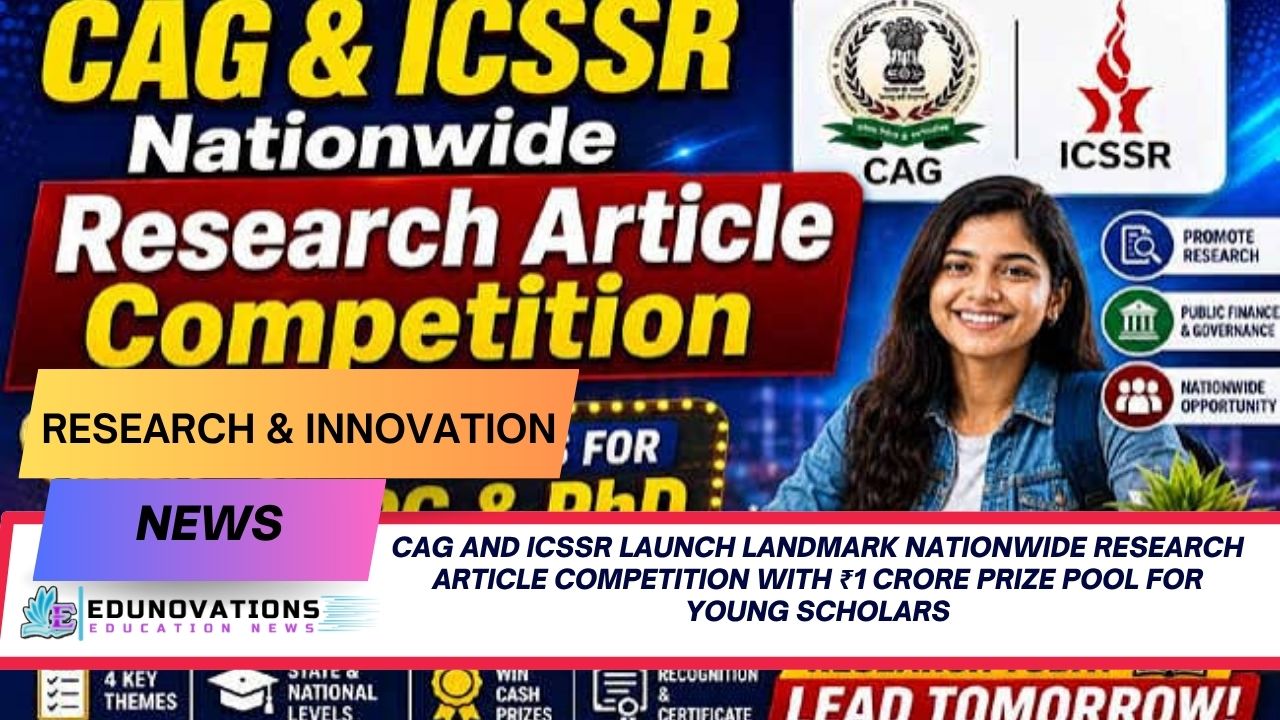
In an extraordinary move to bridge empirical financial auditing with academic scholarship, the Office of the Comptroller and Auditor General (CAG) of India and the Indian Council of Social Science Research (ICSSR) have officially launched a landmark nationwide initiative. This prestigious academic contest invites undergraduate, postgraduate, and doctoral students across 28 states and 3 Union Territories to delve into public finance data, analyze fiscal governance, and author empirical research articles grounded in official CAG Audit Reports.
Beyond creating a robust platform for intellectual discourse, the initiative boasts a total cash prize pool of approximately ₹1 crore, making it one of the most lucrative and high-impact academic competitions for higher education scholars in India.
The launch ceremony was spearheaded by Union Minister for Education Shri Dharmendra Pradhan on the 58th Foundation Day of the ICSSR, highlighting the government’s vision to democratize public financial data and encourage evidence-based policy research under the overarching vision of Viksit Bharat 2047.
Understanding the Objective: Bridging Audit Reports and Academic Research
The Comptroller and Auditor General of India serves as the supreme audit authority of the nation, producing extensive compliance and performance audit reports that track government revenues, capital expenditure, and public scheme execution. Historically, these dense financial volumes remained primarily within the domain of legislative committees, policymakers, and public accounts bodies.
By collaborating with the ICSSR—India’s premier body for social science funding and research—the CAG aims to democratize access to public finance data. College students and doctoral candidates are encouraged to transform complex financial figures, state liability disclosures, and systemic audit findings into visually engaging, policy-relevant analytical papers.
Key Takeaway: The competition encourages students to move away from purely theoretical writing and master data-driven academic research using primary administrative and financial audit data published by state and central CAG offices.
Key Themes of the Competition
Participants must align their research submissions with four crucial pillars of national development and economic governance:
- Fiscal Federalism and Governance: Examining inter-governmental transfers, GST compensation, revenue deficit dynamics, public debt sustainability, and state financial management models.
- Skilling, Employment, and MSMEs: Evaluating performance audits related to skill development initiatives, PM Kaushal Vikas Yojana, credit guarantees for micro enterprises, and employment generation frameworks.
- Social Sector Spending: Analyzing public expenditure efficiency across healthcare infrastructure, direct benefit transfer (DBT) schemes, educational outreach, and nutritional safety nets.
- Empowering Urban and Rural Local Bodies: Inspecting the implementation of the 74th and 73rd Constitutional Amendments, municipal revenue generation, urban waste management systems, and Panchayati Raj financial devolution.
Comprehensive Structure, Categories, and Timeline
The competition operates across a dual-tier framework—State/UT Level and National Level—ensuring widespread representation from every corner of the country.
| Level | Target Categories | Submission Window | Cash Awards (1st / 2nd / 3rd) |
| State / UT Level | UG/PG Category & Doctoral Category | 01 July – 31 August 2026 | ₹75,000 / ₹50,000 / ₹25,000 |
| National Level | Top Qualifying Papers from State Level | 01 August – 30 September 2026 | ₹1,25,000 / ₹1,00,000 / ₹75,000 |
To ensure complete fairness, submissions undergo a rigorous double-blind peer review by committees of academic experts, senior economists, and public audit specialists. Evaluators assess papers strictly based on policy relevance, methodological rigour, originality, clear data visualization, and realistic policy recommendations.
Submission Guidelines and Academic Standards
To maintain standard publication quality, the organizers have mandated strict formatting rules:
- Word Count: 4,000 to 5,000 words for Undergraduate and Postgraduate students; 5,000 to 6,000 words for Doctoral candidates.
- Format & Citation: Submissions must be uploaded online in PDF format following MLA 9th Edition citation style, double-spaced in 12-point Times New Roman font.
- Strict Originality: Co-authorship is strictly prohibited; only individual entries accompanied by an official institutional Bonafide Certificate are accepted.
- Language Rules: State/UT entries accept regional scheduled languages and English, whereas National level submissions must be submitted in English or Hindi.
- Zero Integrity Compromise: Plagiarism and any unauthorized use of generative AI tools will lead to immediate disqualification.
For scholars looking to build a strong foundation before writing, consulting structured academic notes or mastering foundational principles is essential. You can access comprehensive NCERT Notes to refresh core concepts in economics and public administration, or review the detailed UPSC & State PSC Syllabus to understand macro-governance frameworks.
Step-by-Step Guide for Participants
- Access Theme-Specific Audit Reports: Visit the official nodal AG office website for your state or the central CAG portal to download published compliance and performance audit reports.
- Formulate a Clear Problem Statement: Identify specific operational bottlenecks, fiscal discrepancies, or policy gaps highlighted in the audit reports.
- Draft the Core Research Framework: Structure your manuscript into standard academic sections—Introduction, Theoretical Background, Problem Statement, Research Methodology, Data Analysis, Discussion, and Policy Recommendations.
- Leverage Supplementary Educational Resources: Hone your analytical understanding by referring to specialized academic lectures and reading material. For foundational preparation, explore NCERT Online Courses or download Free NCERT PDFs to ground your theoretical review.
- Review and Submit Online: Ensure your identity is omitted from the body of the PDF to comply with blind review guidelines, attach your Bonafide Certificate, and submit before the designated state or national deadline.
Expert Insights and Official Perspectives
Launching the initiative on ICSSR’s Foundation Day, Union Education Minister Shri Dharmendra Pradhan emphasized that engaging young scholars with empirical audit data strengthens democracy from the ground up. He noted that encouraging university students to critically evaluate public spending fosters a culture of transparency, accountability, and evidence-based policy design.
Educational experts also highlight that this initiative transforms public financial management from an abstract classroom topic into an actionable skill set. Scholars who master empirical auditing frameworks gain a competitive edge in competitive examinations, academic research fellowships, and public policy careers.
To stay abreast of daily developments in public policy, economic reforms, and government notifications, researchers can follow daily updates on Current Affairs. Additionally, aspirants preparing for national competitive exams alongside their research can test their conceptual clarity using online Interactive MCQs, watch conceptual Educational Videos, or utilize simplified visual aids like NCERT Mind Maps.
Why This Competition Matters for Aspiring Researchers
Participating in this national venture offers unmatched benefits for higher education scholars:
- Substantial Financial Recognition: With individual national cash awards reaching up to ₹1.25 lakh, participants receive tangible support for their academic journey.
- National Exposure: Winning entries will be honored on National Audit Diwas at the CAG Headquarters in New Delhi, putting scholars in direct contact with top economists, policy advisors, and public auditors.
- Publication & Academic Prestige: Highlighting original research based on primary government audit data substantially elevates a scholar’s academic CV for future Ph.D. admissions and international research fellowships.
Educational institutions and schools seeking to upgrade their digital footprint and learning platforms can partner with authoritative development agencies like Mart India Infotech to build modern educational portals.
Toppers Use Mind Maps to score more than 95%
NCERT Class 11th Commerce Mind Maps
Add to cartOriginal price was: ₹999.00.₹199.00Current price is: ₹199.00.NCERT Class 12th Chemistry Mind Maps
Add to cartOriginal price was: ₹199.00.₹75.00Current price is: ₹75.00.NCERT Class 12th Commerce Mind Maps
Add to cartOriginal price was: ₹999.00.₹199.00Current price is: ₹199.00.NCERT Class 12th Science Mind Maps
Add to cartOriginal price was: ₹999.00.₹199.00Current price is: ₹199.00.NCERT Mind Maps For Class 10th
Add to cartOriginal price was: ₹999.00.₹199.00Current price is: ₹199.00.





Purchase Today
Frequently Asked Questions (FAQs)
1. What is the main objective of the CAG-ICSSR research competition?
The primary objective is to engage undergraduate, postgraduate, and doctoral scholars in analyzing public finance, governance, and social spending using official CAG Audit Reports to promote evidence-based policy research.
2. How can students learn how to write research article based on cag audit reports effectively?
Students should start by downloading official CAG audit reports from the CAG or state AG portals, selecting a specific theme, isolating quantitative audit data, and following standard academic structure covering problem statements, methodology, data analysis, and policy recommendations.
3. What are the cash prizes offered under the cag icssr research competition prize money and eligibility criteria?
The total prize pool is approximately ₹1 crore. State-level winners receive ₹75,000 (1st), ₹50,000 (2nd), and ₹25,000 (3rd). National-level winners receive ₹1,25,000 (1st), ₹1,00,000 (2nd), and ₹75,000 (3rd). Full-time enrolled UG, PG, and Ph.D. students are eligible.
4. Which official topics are covered under cag icssr research competition themes fiscal federalism topics?
The competition focuses on four official themes: Fiscal Federalism and Governance; Skilling, Employment, and MSMEs; Social Sector Spending; and Empowering Urban and Rural Local Bodies.
5. Where can I find the official cag icssr research article competition submission guidelines pdf?
Submission guidelines, formatting templates, and rules are published on the central ICSSR website (icssr.org) and the respective state Principal Accountant General (A&E) portals.
6. What is the step-by-step process for how to submit entry for cag research competition national level?
Top-ranking entries from the state-level evaluation automatically qualify or can be submitted through the dedicated national portal window between 01 August and 30 September 2026 in PDF format with an institutional Bonafide Certificate.
7. Are co-authored research papers allowed in this competition?
No. The competition permits individual entries only. Co-authored papers will be disqualified during preliminary screening.
8. What font and citation styles are mandatory for submission?
Articles must be double-spaced in 12-point Times New Roman font using the MLA 9th Edition citation style in PDF format.
9. Can students submit research papers in regional Indian languages?
For the State/UT level, submissions are accepted in scheduled regional languages as well as English. However, entries at the National level are restricted strictly to English and Hindi.
10. How are research entries evaluated by the panel?
Submissions undergo a double-blind peer review by expert committees that score papers on policy relevance, research methodology, originality, analytical quality, and practical policy recommendations.