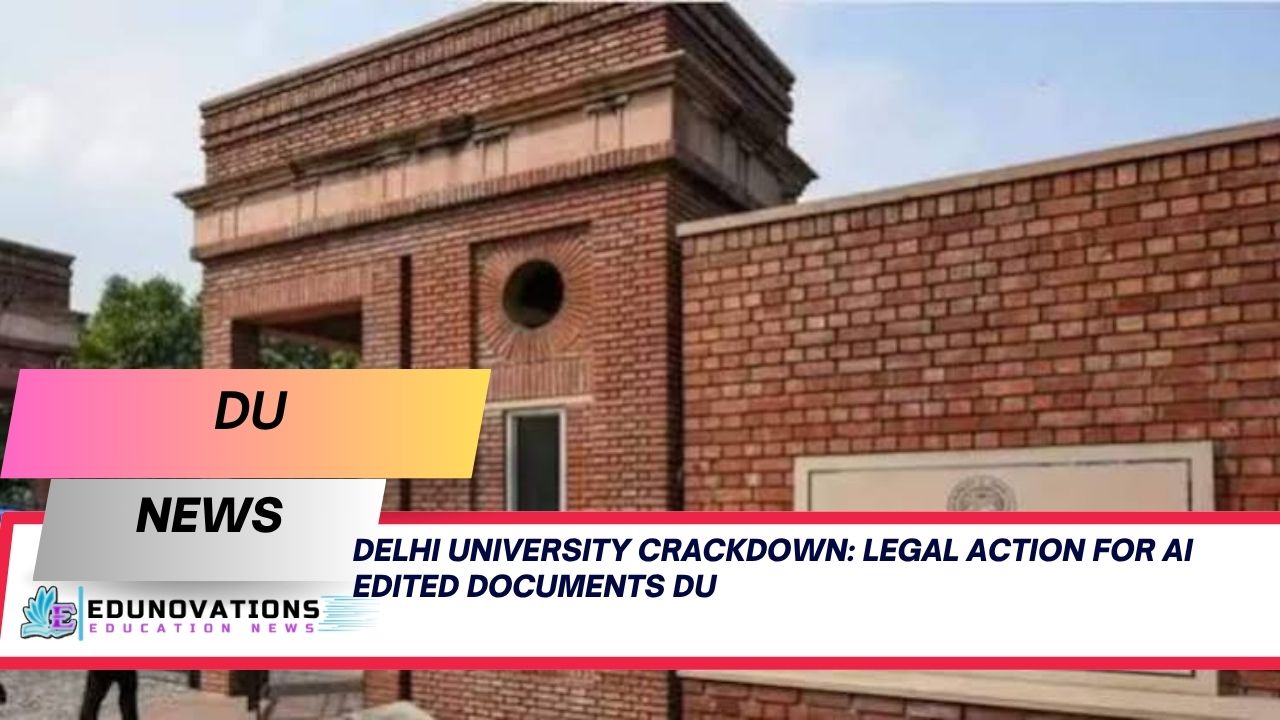
Delhi University issues a strict advisory warning applicants against submitting AI edited documents DU. Discover rules, verification processes, and key compliance tips.
The admission process at higher education institutions across India is undergoing unprecedented scrutiny as artificial intelligence tools become widely accessible. Delhi University has officially issued a public advisory cautioning candidates against uploading fraudulent, modified, or synthetic certificates during their undergraduate and postgraduate application cycles. The administration confirmed that applicants found submitting manipulated mark sheets or certificates will face immediate cancellation of candidature without refund, alongside potential criminal prosecution.
With more than 90,000 seats across various colleges and departments, the university relies heavily on its digital portal—the Common Seat Allocation System (CSAS)—to review student credentials. However, during recent verification rounds, college verification committees flagged multiple instances where digital records, category certificates, and mark sheets appeared artificially enhanced or altered using editing software.
To maintain transparency and preserve institutional integrity, administrative bodies are enforcing stringent digital audit protocols while coordinating with cyber law experts to address instances of forgery.
Escalating Scrutiny Across University CSAS Verification Rounds
The decision to issue a campus-wide legal warning follows a series of discrepancies identified during preliminary document scrutiny across top colleges. According to Prof. Haneet Gandhi, Dean of Admissions at Delhi University, verification teams across multiple faculties discovered suspicious files uploaded during registration.
Key Verification Findings in Recent CSAS Allocations:
-----------------------------------------------------------------------
1. Mismatched QR Codes   : Scanning digital certificates redirected to unrelated profiles.
2. Synthetic Enhancement : AI tools used to alter marks, dates, and authority seals.
3. ECA Quota Anomalies   : Edited participation certificates uploaded for sports & arts.
4. Category Modifications: Invalid non-creamy layer (NCL) or EWS dates artificially edited.
-----------------------------------------------------------------------
Speaking on the ongoing verification challenges, Prof. Haneet Gandhi emphasized that while colleges are working tirelessly to verify thousands of candidates, detecting deeply edited files requires advanced digital measures. She noted that instances of manipulated files were not isolated to a single quota but appeared across general, reserved, and Extra-Curricular Activities (ECA) categories.
“Several candidates applying for various Undergraduate and Postgraduate programmes have been found uploading artificial intelligence-generated, digitally altered, or heavily edited documents,” the official public notice stated. “Applicants are strictly warned that such practices undermine the integrity of the admission process.”
To streamline preparation and stay updated on underlying educational guidelines, candidates can check the complete DU Admission Syllabus to align their academic portfolios accurately.
How Digital Manipulation and AI-Altered Records are Detected
Modern university admission portals do not rely solely on manual visual checks. Higher education institutions have integrated automated forensic verification tools capable of inspecting file metadata, image compression layers, and cryptographic signatures embedded within officially issued PDFs.
       +-------------------------------------------------------+
       |   Candidate Uploads Document to CSAS Admission Portal |
       +-------------------------------------------------------+
                                   |
                                   v
       +-------------------------------------------------------+
       | Automatic Metadata & Forensic Image Compression Check |
       +-------------------------------------------------------+
                                   |
                                   v
       +-------------------------------------------------------+
       |    QR Code Verification & Central Database Cross-Check |
       +-------------------------------------------------------+
                        /                     \
            [Valid Data]                       [Discrepancy Flagged]
                 |                                        |
                 v                                        v
  +----------------------------+         +----------------------------------+
  | Application Approved for   |         | Instant Rejection, Seat Cancelled|
  | Seat Allocation & Payment  |         | & Legal Referral for Fraud       |
  +----------------------------+         +----------------------------------+
When an applicant edits a PDF or JPEG using image software or generative AI tools to sharpen blurry text, change a date, or adjust marks, the underlying metadata preserves the editing history. Furthermore, official government documents—such as Class 10 and 12 mark sheets issued by CBSE or state boards, caste certificates, and Income and Asset Certificates—contain embedded QR codes.
During the verification phase, admissions officers scan these codes using central database APIs. If the scanned output displays a different name, roll number, or issuer detail than what appears on the uploaded image, the system immediately flags the file as forged.
Penalties and Legal Consequences for Submission of Fraudulent Documents
Submitting forged, modified, or synthetic documents to a central university carries severe administrative and legal consequences under Indian penal provisions and IT laws. Delhi University has outlined a strict zero-tolerance enforcement protocol:
- Cancellation of Candidature: Registration is revoked immediately without prior notice at any stage of the academic year.
- Forfeiture of Admission Fees: Fees paid during allocation or college enrollment will not be refunded.
- Permanent Revocation of Degrees: If document forgery is discovered after a student completes their degree, the university reserves the right to annul the degree retroactively.
- Criminal Action Under IT Act: Submitting altered digital files constitutes identity fraud and forgery under the Information Technology Act and applicable sections of the Bharatiya Nyaya Sanhita (BNS).
For aspirants seeking structured study resources to ensure their qualifying examination scores reflect genuine merit, access curated NCERT Courses and download official study aids directly.
Best Practices for Applicants Uploading Certificates on the CSAS Portal
Navigating the document upload process correctly prevents accidental flags caused by poor scanning or compression artifacts. Applicants should follow these essential verification guidelines:
1. Upload Direct Scans of Original Physical Copies
Never use photo-editing applications to “enhance,” clean up, or alter scanned images. Use a standard physical scanner or high-resolution mobile scanner to capture the original document under clear lighting.
2. Avoid Modifying Generated PDF Files
Refrain from converting PDFs through unverified third-party online tools, as these utilities can strip cryptographic signatures or alter file headers, making authentic files appear suspicious to automated verification engines.
3. Verify Validity Dates for Category Certificates
Certificates such as OBC-NCL (Other Backward Classes – Non-Creamy Layer) and EWS (Economically Weaker Section) must be issued on or after the official cutoff date specified in the bulletin of information (typically April 1 of the admission year). Uploading an older certificate with a manually updated date will trigger automatic rejection.
Students looking to strengthen their general awareness and academic background during the admission cycle can review daily Current Affairs Articles for comprehensive coverage.
Step-by-Step Document Preparation Protocol for CSAS
| Step | Action Required | Verification Standard |
| Step 1 | Retrieve original physical documents | Ensure no physical damage, lamination reflection, or missing official stamps. |
| Step 2 | Perform clean digital scan | Save as clear PDF or JPEG within prescribed file size limits (50 KB to 500 KB). |
| Step 3 | Check QR Code readability | Test the QR code using a standard smartphone scanner to verify it links correctly. |
| Step 4 | Cross-check credentials | Confirm name, parent details, and date of birth match exact Class 10 records. |
| Step 5 | Final review before submission | Ensure no digital filters, touch-ups, or editing tools were applied to the file. |
To prepare thoroughly for competitive entrance exams and academic assessments, candidates can download Free NCERT PDFs and practice with targeted Subject MCQs to build strong subject mastery.
Additionally, educational institutions looking to upgrade their digital infrastructure and secure admission portals can consult web development experts at Mart Ind Infotech for enterprise web solutions.
Expert Insights on Integrity in Digital Education Infrastructure
Academic administrators emphasize that while AI tools offer immense utility in learning, using them to alter formal credentials damages institutional trust. Dean Prof. Haneet Gandhi noted that the university is evaluating an AI-powered automated verification system for upcoming admission cycles to detect anomalies before manual allocation begins.
“It is not a simple task to verify every single certificate for over 90,000 students,” Prof. Gandhi stated. “We will look at developing an AI tool for upcoming admissions so that such cases can be filtered out completely.”
To supplement visual learning and stay updated on structural examination changes, candidates can review detailed Video Lectures and revise complex topics using concise NCERT Mind Maps.
Guidelines for Handling Incorrect Document Rejections
If an applicant inadvertently uploads an illegible scan or faces an administrative query during the CSAS verification round, they should respond promptly through official channels:
- Monitor the CSAS Dashboard Daily: Check for college queries raised under the verification tab during allocation rounds.
- Submit Original Supporting Files: If a document is flagged for poor clarity, re-upload an unedited, high-resolution original copy immediately within the stipulated deadline.
- Contact College Helpdesks: Reach out to the official nodal officers listed on the college portal rather than seeking unauthorized third-party assistance.
- Utilize Standard Revision Material: Ensure all academic submissions reflect authentic test scores. Aspirants can reference updated Revision Notes to stay prepared for ongoing counseling requirements.
Toppers Use Mind Maps to score more than 95%
NCERT Class 11th Commerce Mind Maps
Add to cartOriginal price was: ₹999.00.₹199.00Current price is: ₹199.00.NCERT Class 12th Chemistry Mind Maps
Add to cartOriginal price was: ₹199.00.₹75.00Current price is: ₹75.00.NCERT Class 12th Commerce Mind Maps
Add to cartOriginal price was: ₹999.00.₹199.00Current price is: ₹199.00.NCERT Class 12th Science Mind Maps
Add to cartOriginal price was: ₹999.00.₹199.00Current price is: ₹199.00.NCERT Mind Maps For Class 10th
Add to cartOriginal price was: ₹999.00.₹199.00Current price is: ₹199.00.




Purchase Today
Frequently Asked Questions (FAQs)
What happens if you upload fake documents in DU CSAS?
If a candidate submits fake or altered certificates on the CSAS portal, their application is rejected immediately, any allocated seat is cancelled, fees are forfeited, and the university may initiate criminal legal action under applicable laws.
How to verify if certificate is valid for DU admission?
Candidates should ensure their category or academic certificates are issued by recognized authorities, contain clear official seals, and feature functional QR codes that redirect to valid government records upon scanning.
Can DU reject admission for digitally edited documents?
Yes, Delhi University strictly prohibits uploading digitally altered or modified files. Any certificate showing signs of photo-editing, digital filters, or AI alteration will result in immediate disqualification.
How to upload clean scanned certificates for DU CSAS?
Scan the original physical document using a flatbed scanner or a high-quality scanner app in natural light. Do not apply filters, edit text, or compress files using unauthorized editing software.
What are the DU rules on AI altered category certificates?
Delhi University treats AI-altered category certificates as document fraud. Uploading edited SC, ST, OBC-NCL, EWS, or PwBD certificates results in registration cancellation and total disqualification from reserved quota seats.
Will DU refund the admission fee if an application is rejected for fake documents?
No, the university explicitly states in its bulletin of information that no admission or registration fees will be refunded if candidature is cancelled due to fraudulent or manipulated records.
How does Delhi University detect AI-edited mark sheets?
The university utilizes metadata forensic checks, QR code verification systems, and cross-database validation against central and state examination boards to detect altered text, dates, or marks.
Can a candidate re-upload a clear document if the original upload is flagged for poor quality?
If a college verification committee raises a query regarding document clarity (without suspecting fraud), the applicant is given a specific window on their CSAS portal to upload a clear scan of the original document.
Are older OBC-NCL certificates accepted during DU CSAS registration?
No, caste and financial certificates like OBC-NCL and EWS must be issued on or after April 1 of the relevant admission year by a competent authority to be considered valid for seat allocation.
What legal sections apply if someone submits forged documents for university admission?
Submitting forged records can attract prosecution under provisions of the Bharatiya Nyaya Sanhita (BNS) covering cheating and forgery, as well as relevant sections of the Information Technology Act for digital fraud.