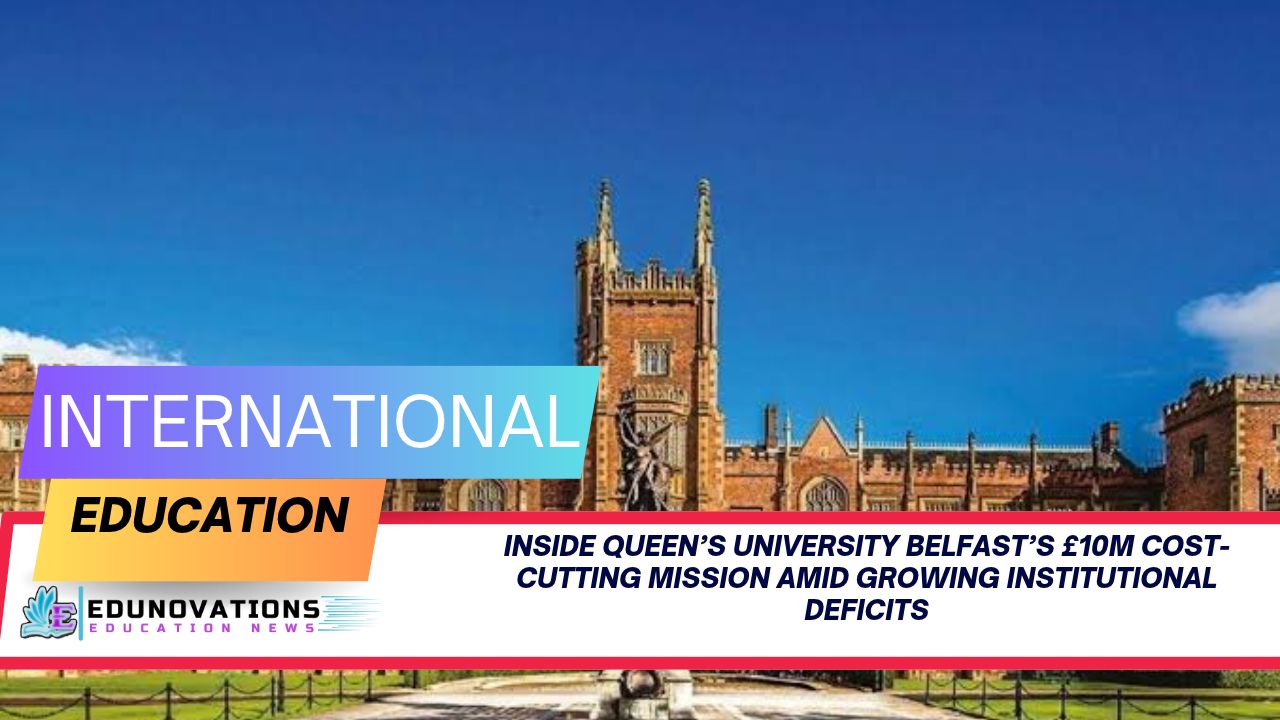
The modern landscape of higher education across the United Kingdom is facing an unprecedented series of economic hurdles, forcing historic institutions to completely re-evaluate their fiscal frameworks.
Introduction to Higher Education Financial Pressures
The modern landscape of higher education across the United Kingdom is facing an unprecedented series of economic hurdles, forcing historic institutions to completely re-evaluate their fiscal frameworks. At the heart of this regional squeeze is Queen’s University Belfast (QUB), a prestigious member of the Russell Group known globally for its academic excellence, cutting-edge research, and massive contribution to the Northern Irish economy. Led by Vice-Chancellor Professor Sir Ian Greer, the university has officially announced a sweeping fiscal adjustment strategy aimed at securing approximately £10 million in savings over the current financial year.
For institutional leaders, educators, and prospective learners alike, monitoring these macroeconomic shocks is vital. Understanding how macroeconomic factors and academic funding constraints affect educational pathways is as crucial as mastering core study materials—whether you are exploring structured NCERT Courses to build a solid academic foundation or keeping up with Current Affairs that shape global economic policies. As institutions like QUB navigate tighter budgets, understanding the broader structural shifts requires comprehensive resources, detailed Notes, and analytical MCQ’s designed to evaluate systemic challenges.
Unpacking the £10 Million Savings Target and Deficit Realities
The drive for £10 million in targeted savings does not emerge in a vacuum; it is the direct consequence of compounding financial deficits from previous cycles. During the preceding academic term, Queen’s University Belfast recorded a staggering institutional deficit of approximately £12.5 million. Although leadership managed to trim this figure down by roughly 30% through early cost containment, ongoing inflationary pressures, escalating service charges, and rigid operational overheads have left little room for complacency.
To achieve stability without compromising its core educational mission, university administration is comprehensively reviewing internal spending frameworks. Areas under strict scrutiny include discretionary departmental budgets, campus amenities, and ancillary service charges spanning parking, childcare facilities, and the Physical Education Centre (PEC).
For students and educators tracking these institutional developments, supplementary visual aids and structured breakdown materials—such as detailed Videos and an updated academic Syllabus—offer clarity on how structural changes ripple across the broader educational ecosystem. Furthermore, academic institutions aiming to optimize administrative efficiency often look toward specialized partners like Mart Ind Infotech to streamline digital infrastructure and modern management systems.
The Root Causes: Public Funding Cuts and Recruitment Shortfalls
A primary driver behind QUB’s current budgetary constraint is the widening gap between projected revenues and actual financial inflows. Most notably, student recruitment income is projected to fall roughly £7 million short of initial institutional targets. This shortfall reflects broader recruitment volatility, shifting international student demographics, and caps on domestic higher education funding within Northern Ireland.
Leading stakeholders have repeatedly warned that higher education in the region faces “death by a thousand cuts” due to prolonged underfunding. Vice-Chancellor Professor Sir Ian Greer has been vocal about these systemic limitations, noting that funding restrictions have severe consequences for local placement capacities. For example, hundreds of prospective students from Northern Ireland have previously faced barriers in securing funded local study spaces, highlighting an urgent need for structural reform and more sustainable government settlements.
Students preparing for competitive examinations or looking for structured study aids can leverage resources such as Free NCERT PDFs to maintain academic momentum despite systemic shifts. Additionally, visual learners can utilize comprehensive NCERT Mind Maps to map out complex socio-economic interdependencies affecting public sector institutions.
Strategic Mitigations: Restricting Recruitment and Protecting Pay Awards
Faced with mounting fiscal strain, Queen’s University Belfast is carefully calibrating its recovery approach to protect its workforce while restoring institutional balance. Unlike previous years where drastic measures were necessary, leadership has emphasized that another widespread university-wide severance scheme is not the preferred path forward.
Instead, recruitment will be tightly restricted wherever possible, allowing natural attrition to help lower personnel overheads organically. Furthermore, Vice-Chancellor Professor Sir Ian Greer confirmed that delivering agreed-upon staff pay awards remains an institutional priority, though their exact implementation timeline remains contingent upon the evolving funding position and upcoming quarterly reviews.
A comprehensive recovery blueprint detailing the exact milestones required to reach a break-even financial state is scheduled to be presented before the University Senate later this year. This strategic roadmap will dictate how QUB balances its world-class research ambitions with fiscal prudence in an increasingly competitive global education market.
Toppers Use Mind Maps to score more than 95%
-
NCERT Class 11th Commerce Mind Maps
Add to cartOriginal price was: ₹999.00.₹199.00Current price is: ₹199.00. -
NCERT Class 12th Chemistry Mind Maps
Add to cartOriginal price was: ₹199.00.₹75.00Current price is: ₹75.00. -
NCERT Class 12th Commerce Mind Maps
Add to cartOriginal price was: ₹999.00.₹199.00Current price is: ₹199.00. -
NCERT Class 12th Science Mind Maps
Add to cartOriginal price was: ₹999.00.₹199.00Current price is: ₹199.00. -
NCERT Mind Maps For Class 10th
Add to cartOriginal price was: ₹999.00.₹199.00Current price is: ₹199.00.





Purchase Today
Frequently Asked Questions
1. What is the main financial target announced by Queen’s University Belfast?
Queen’s University Belfast is aiming to secure approximately £10 million in savings over the current financial year to counteract mounting institutional deficits.
2. Who is the Vice-Chancellor of Queen’s University Belfast guiding this financial strategy?
The university is led by Vice-Chancellor Professor Sir Ian Greer, who has outlined the recovery measures to address ongoing operational challenges.
3. What caused the current financial deficit at QUB?
The deficit is driven by reduced public funding, rising operational costs, and student recruitment income falling roughly £7 million short of initial projections.
4. Are widespread staff layoffs expected under the new savings plan?
No, university leadership has noted that another university-wide severance scheme is not the preferred approach, focusing instead on selective recruitment restrictions and spending reviews.
5. How much was QUB’s deficit in the previous academic year?
The previous year’s institutional deficit stood at approximately £12.5 million, despite a subsequent 30% reduction through early countermeasures.
6. What campus facilities and charges are currently under review?
Spending reviews are examining various ancillary operational expenditures, including parking fees, childcare facility provisions, and Physical Education Centre (PEC) charges.
7. When will the official recovery plan be presented to university governance?
A formal recovery plan outlining the precise path toward breaking even is slated for presentation before the University Senate later this year.
8. How do funding cuts impact domestic student placements in Northern Ireland?
Persistent funding constraints and restricted local spaces have historically left hundreds of local students unable to secure funded undergraduate positions close to home.
9. Are staff pay awards still being prioritized despite the deficit?
Yes, delivering agreed staff pay awards remains a key institutional priority, though their exact rollout depends heavily on the ongoing funding position.
10. Where can students find supplementary educational materials during economic shifts?
Students can access structured learning tools, notes, and curriculum resources through dedicated educational platforms like Edunovations.