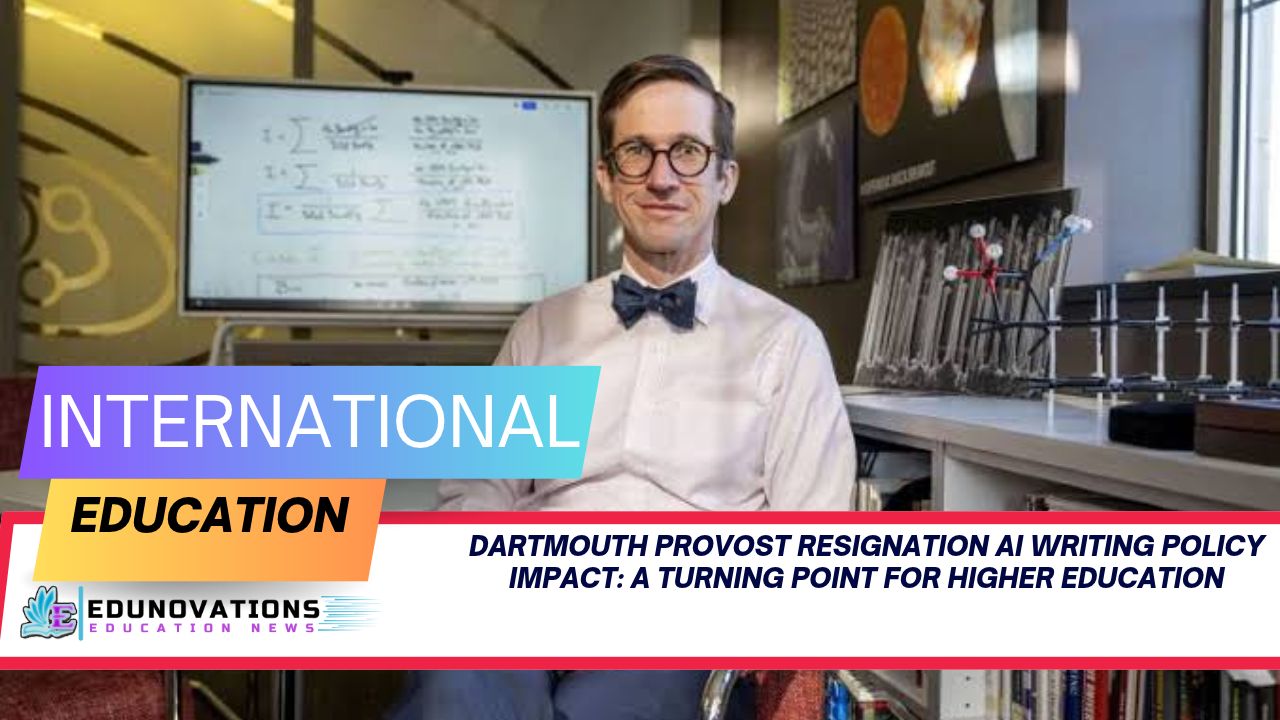
The intersection of artificial intelligence and higher education reached a historic and cautionary milestone following the high-profile departure of Dartmouth College Provost Santiago Schnell.
The intersection of artificial intelligence and higher education reached a historic and cautionary milestone following the high-profile departure of Dartmouth College Provost Santiago Schnell. The controversy, which culminated in his official resignation, centers directly on the Dartmouth provost resignation AI writing policy impact. As generative artificial intelligence tools like large language models become deeply embedded in daily administrative and academic workflows, institutional leaders face unprecedented scrutiny regarding transparency, authenticity, and academic rigor.
This comprehensive analysis explores the events leading up to the resignation, the findings of the faculty-led investigation committee, broader implications for academic governance, and what educators, administrators, and students must understand about institutional ethics in the age of AI. For educators seeking structured support, exploring resources like NCERT Courses can help establish foundational benchmarks for curriculum integrity.
The Anatomy of the Controversy: How the Investigation Unfolded
The controversy surrounding former Dartmouth Provost Santiago Schnell began when advanced text-detection tools and independent journalistic inquiries—notably by media outlets analyzing structural text patterns—flagged high percentages of AI-generated content in his published writings and public op-eds. Specifically, a high-profile guest column written for The Washington Post faced heavy scrutiny after detection systems indicated extensive machine generation.
In response to growing campus outcry and potential disciplinary fallout, Dartmouth President Sian Leah Beilock convened an independent, faculty-led advisory committee. This committee was tasked with reviewing Schnell’s usage of generative text tools across various academic articles and public columns, determining whether he complied with publisher disclosure requirements, and evaluating if his actions breached institutional trust.
The committee’s final review concluded that Schnell had utilized artificial intelligence to a degree that “meaningfully altered his writing,” falling significantly short of Dartmouth’s core academic integrity standards. Although Schnell defended his actions by arguing that the tools merely refined language, enhanced structural clarity, and organized his rough drafts without substituting core intellectual judgment, the committee found his lack of transparency unacceptable for a high-ranking executive. Facing an imminent faculty vote of no-confidence, Schnell chose to resign and step down from the university entirely.
Broader Ramifications for Academic Integrity and Leadership
The fallout from Dartmouth sets a profound precedent across the global academic landscape. Executive leadership positions within higher education carry an immense burden of symbolic representation. When students and junior scholars are held to strict standards regarding original scholarship and citation compliance, administrative leaders must model identical—if not higher—levels of transparency.
To support broader academic policy development, institutions often reference guidelines found through Current Affairs trackers and structured study frameworks like Notes. Furthermore, institutions requiring structural digital upgrades or campus technology implementations frequently collaborate with external enterprise providers like Mart Ind Infotech (“Mart Ind Infotech”) to manage digital policy frameworks securely.
The Double Standard of AI Adoption in Universities
A central irony highlighted by academic commentators is that President Sian Leah Beilock has historically championed an aggressive “more AI” strategy for Dartmouth, encouraging community members to lean into technological innovation. However, the Dartmouth case sharply illustrates the fine line between utilizing AI as a productivity enhancer and outsourcing core authorship.
When administrative leaders cross the line into undisclosed generation, it undermines institutional authority. Scholars tracking these developments often utilize MCQ’s and curriculum Syllabus databases to monitor how educational institutions adapt their honor codes to accommodate generative technology safely.
Expert Perspectives and Institutional Governance
The resignation has triggered widespread debate among academic ethicists, university regents, and faculty senates. Many are asking whether administrative leaders face disproportionate scrutiny or if this event represents a necessary correction for executive accountability.
Prominent commentators have noted that while AI tools can drastically streamline administrative correspondence and literature reviews, blurring the lines of authorship in published commentary destroys public trust. For educators and students desiring downloadable study tools, resources such as Free NCERT PDFs and NCERT Mind Maps offer structured pathways to maintain conceptual clarity without relying on shortcuts. Visual learners can also benefit from checking out curated educational Videos for deeper conceptual breakdowns.
Toppers Use Mind Maps to score more than 95%
-
NCERT Class 11th Commerce Mind Maps
Add to cartOriginal price was: ₹999.00.₹199.00Current price is: ₹199.00. -
NCERT Class 12th Chemistry Mind Maps
Add to cartOriginal price was: ₹199.00.₹75.00Current price is: ₹75.00. -
NCERT Class 12th Commerce Mind Maps
Add to cartOriginal price was: ₹999.00.₹199.00Current price is: ₹199.00. -
NCERT Class 12th Science Mind Maps
Add to cartOriginal price was: ₹999.00.₹199.00Current price is: ₹199.00. -
NCERT Mind Maps For Class 10th
Add to cartOriginal price was: ₹999.00.₹199.00Current price is: ₹199.00.



Purchase Today
10 Frequently Asked Questions (FAQs)
1. What was the main cause behind the Dartmouth provost resignation AI writing policy impact?
The resignation was triggered after a faculty-led review committee concluded that former Provost Santiago Schnell used artificial intelligence to significantly draft and alter his published columns and academic writings without proper disclosure, violating institutional standards of transparency.
2. How was the undisclosed AI usage discovered?
The issue came to light following investigative reports and text-analysis tools—such as Pangram—which flagged high percentages of machine-generated text in prominent public essays written by the provost.
3. What did Santiago Schnell argue in his defense regarding his AI usage?
Schnell defended his actions by maintaining that generative AI was only utilized to refine language, improve structural clarity, and organize his drafts, asserting that it did not substitute his fundamental research or intellectual judgment.
4. How did Dartmouth College leadership respond to the committee’s findings?
President Sian Leah Beilock supported the independent committee’s findings, emphasizing that senior executives must model absolute transparency and human judgment, which ultimately led to Schnell’s resignation.
5. Did the resignation prevent any formal disciplinary actions by the faculty?
Yes. Schnell’s departure preempted a scheduled faculty vote of no-confidence that was slated to occur less than two weeks after the committee released its findings.
6. Who was appointed to replace Santiago Schnell during the transition?
History professor and associate dean of faculty Matthew Delmont was appointed to serve as Dartmouth’s interim provost through June 2028.
7. How does this incident impact broader academic integrity policies globally?
It establishes a strict benchmark requiring university executives, researchers, and administrators to transparently disclose any reliance on generative AI tools in published works, aligning administrative conduct with student honor codes.
8. Are university administrators allowed to use AI at all under new guidelines?
Yes, tools can be used for routine productivity, brainstorming, or administrative efficiency, provided there is clear disclosure and human authorship is not falsely claimed for substantive written works.
9. Where can students and faculty find updated guidelines on ethical AI use?
Academic institutions are rapidly updating their internal policy documents, which can be tracked alongside standard educational frameworks and institutional governance portals.
10. Why is this case considered a major precedent for higher education?
It marks one of the first instances where a top-tier Ivy League executive lost their position explicitly due to the undisclosed, heavy reliance on AI for published writing, signaling a zero-tolerance approach to academic dishonesty at leadership levels.