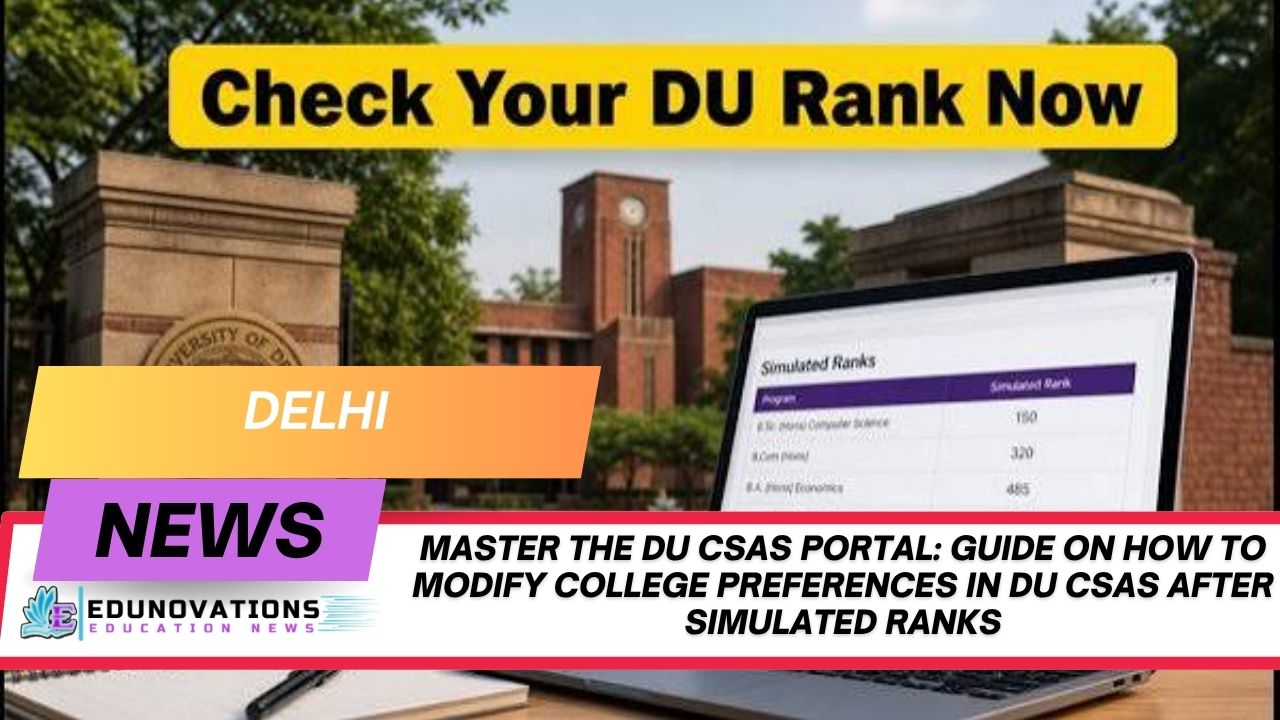
The race for undergraduate admissions at the University of Delhi (UoD) has entered its absolute most critical phase.
The race for undergraduate admissions at the University of Delhi (UoD) has entered its absolute most critical phase. This year, the university has witnessed an unprecedented surge in applications, marking the highest volume of registrations since the implementation of the Common Seat Allocation System (CSAS) in 2022. According to authoritative statements and real-time university data, an impressive 2,73,751 candidates initially signed up for the undergraduate admissions cycle. Out of these total sign-ups, exactly 2,18,284 applicants successfully completed the rigorous initial phase of registration, while 2,06,835 went on to formally lock and submit their specific program and college choices.
With the competitive landscape heating up, understanding the nuances of the dashboard is paramount. For many candidates, their entire strategy shifts the moment the mock data goes live. Understanding exactly how to modify college preferences in du csas can mean the difference between gaining admission to a coveted North Campus college or missing out on a seat entirely. In this extensive journalistic analysis, we explore the data trends, break down the procedural timelines, analyze historical expert insights, and provide a comprehensive roadmap for navigating this high-stakes admissions window.
High-Stakes Analytics: Understanding the Demographics and Course Trends
A deeper analytical look into the official data shared by Delhi University officials reveals staggering trends that directly influence the competition matrix. Out of the 2.18 lakh completed applications, female candidates prominently outpaced male candidates. A total of 1,20,509 women finalized their registration profiles compared to 97,775 men. This indicates that female applicants account for over 55% of the active student pool entering the final preference allocation stage.
       [ 2,73,751 Total Sign-Ups ]
                    │
                    ▼
     [ 2,18,284 Completed Registrations ] ──► (55% Female / 45% Male)
                    │
                    ▼
  [ 2,06,835 Formally Submitted Preferences ]
When it comes to program preferences, traditional highly sought-after humanities, commerce, and science programs continue to dominate the choices submitted via the central dashboard. The most heavily subscribed courses across the 73 distinct undergraduate offerings and 150 unique BA program combinations include:
- Commerce & Economics: Bachelor of Commerce (BCom Hons), BCom Pass, and BA (Hons) Economics.
- Humanities & Social Sciences: BA (Hons) Political Science, BA Programme with History and Political Science, BA (Hons) English, and BA (Hons) History.
- Sciences: BSc (Hons) Zoology, BSc (Hons) Mathematics, and BSc Programme in Life Science.
With hundreds of thousands of candidates targeting these highly competitive spaces, the initial simulation data serves as an invaluable metric to gauge your probability of acceptance before structural locks take full effect.
Decoding the Indicative Metrics: The Significance of Simulated Ranks
The publication of provisional ranks marks the initiation of the critical reordering phase. Many students encounter massive anxiety upon viewing their provisional standings. However, it is vital to know exactly what does du simulated rank mean for admission. University administration and admissions deans have consistently stressed that these ranks are strictly indicative, provisional, and mathematical reflections based purely on the real-time combinations submitted by all 2.06 lakh active applicants up to that specific second.
A simulated rank shows an applicant where they stand in the queue for a particular course-college combination relative to every other student who selected that same option. For example, if a candidate has a simulated rank of 450 for BCom (Hons) at SRCC, it indicates that 449 applicants with higher normalized Common University Entrance Test (CUET) scores have also placed that specific preference combination above or equal to their rank level.
However, this metric is not a legally binding guarantee of admission. The final allocation shifts dynamically during the actual rounds due to multiple variables, including category-specific seat matrices (UR, OBC-NCL, SC, ST, EWS, PwBD), sports or ECA supernumerary quotas, and the widespread rearrangement of lists by thousands of competitive candidates during the short editing window.
Action Plan: Steps to Optimize and Reorder Your CSAS Choices
If your simulated rank is lower than your initial expectations, panic is your worst enemy. Knowing how to modify college preferences in du csas effectively can completely rescue your admission chances. When the revision window opens, the system grants a highly critical final period for candidates to add, delete, reorder, or completely swap their choices.
To execute this properly, log in using your valid CUET registration credentials. Review the courses where your simulated rank places you within a realistic striking distance of the college’s total seat matrix. Experts advise against removing top-tier dream colleges from the summit of your preference list, even if your simulated rank is poor. Since the system allocates choices down from preference number 1 to preference number 100+, keeping elite options at the top carries no mathematical penalty.
However, you must actively broaden your safety net by adding extra South Campus and reliable Off-Campus college options at the lower end of your listing structure. If you fail to add these backup choices during this window, you will have no opportunity to inject new preferences once the actual lists go live.
The Master Admissions Timeline: Key Dates and Deadlines
Adhering to the administrative timelines set by Delhi University is absolutely mandatory. A single minute’s delay can result in immediate disqualification from the subsequent evaluation cycles. Following the closure of the editing phase, the administrative machinery shifts directly to the formal seat assignment phase.
| Admission Landmark Event | Exact Official Date | Precise Deadline and Cut-off Time |
| Preference Editing Window Closes | July 13, 2026 | Strict Closing at 4:59 PM IST |
| First CSAS Allotment Announcement | July 16, 2026 | Exactly at 5:00 PM IST |
| Candidate Seat Acceptance Phase | July 16 to July 18, 2026 | Concludes at 11:59 PM IST on July 18 |
| College Document Verification Window | July 16 to July 20, 2026 | Verification updates close by July 20 |
| Round 1 Admission Fee Payment Deadline | July 21, 2026 | Online payment portal closes at 4:59 PM IST |
| Second Allocation List Release | July 25, 2026 | System updates live at 5:00 PM IST |
| Round 2 Final Fee Payment Completion | July 28, 2026 | Payment portal closes at 4:59 PM IST |
Navigating Post-Allotment Procedures: Accepting and Securing Seats
Once the central algorithm processes the data parameters, the focus shifts to securing your allocated seat. Students must keep track of the du first seat allocation list date and time to immediately verify their status on the dashboard. When the clock strikes 5:00 PM on July 16, every active candidate must check their dynamic login screen.
If you are successfully allocated a seat in the first round, the system presents a clear call-to-action button: “Accept Allotment”. Candidates have a tight window until July 18 to actively press this option. Failing to accept the offered seat within this designated phase will result in your permanent removal from all future rounds of the CSAS 2026 admission ecosystem.
Once you accept, your digital profile is automatically routed to the respective college’s administration desk. The college’s academic committees will rigorously verify your uploaded documentation, including Class 10 and Class 12 certificates, category validity documents, and subject-mapping compliance profiles.
 [ Seat Allocated on July 16 ]
               │
               ▼
 [ Click "Accept Allotment" ] ──► (Must complete by July 18)
               │
               ▼
 [ College Verifies Documents ]
               │
               ▼
 [ Click "Pay Online Fee" ] ──► (Must complete by July 21)
After the college successfully signs off on your verification, the final hurdle is knowing how to accept allocated seat in du round 1 by completing the online financial transaction. The deadline for online payment under this opening round runs until July 21. Only after your transaction receipt is generated is your physical seat officially locked for the upcoming academic session.
Once paid, you face an important decision: you can choose to “Freeze” your seat if you are fully content with the program-college pairing, or you can opt to click the “Upgrade” button. Choosing to upgrade allows you to safely hold your current seat while letting the system check if you qualify for a higher-ranked preference in the next list.
Strategy for Round 2 and Beyond: Managing Deadlines under CSAS
For students who choose the upgrade route or those who did not receive an allotment in the first round, the focus shifts to the subsequent allocation phase. The official roadmap lists the du csas round 2 fee payment deadline as a critical date to watch out for. The second list goes live on July 25, and candidates who receive a fresh or upgraded seat must complete their online transaction workflows before July 28 at 4:59 PM.
During this subsequent phase, tie-breaking protocols become highly relevant. In cases where two or more applicants possess identical normalized CUET scores for a single remaining seat, the university deploys its strict tie-breaking rules. The algorithm first compares the absolute marks obtained by candidates in their Class 12 board examinations. The university has issued a stern advisory warning that any discrepancy, error, or forged data submitted in the Class 12 marks section can cause immediate cancellation of the student’s candidature without any prior institutional warning.
Insights from the Academic Desk: Setting Realistic Expectations
To understand how to modify college preferences in du csas correctly, it is highly useful to examine the strategic advice shared by veteran academic administrators. Professor Haneet Gandhi, the Dean of Admissions at Delhi University, has frequently advised students to prioritize their genuine interests rather than trying to game the system’s numbers. Reflecting on past preference trends, she noted:
“The simulated rank list is merely a navigational compass, not the final destination. Thousands of students mistakenly remove high-ranking institutions from their preference sheets out of fear when they see a low simulated rank. This is a severe strategic error. The CSAS algorithm works sequentially from top to bottom. Students must ensure that their preference list accurately reflects their genuine academic aspirations, combined with a robust selection of realistic backup options further down.”
Furthermore, it is important to note that specific professional and performance-based courses are completely excluded from the simulated rank displays. Ranks are not generated for practical-heavy programs, including BA (Hons) Hindustani Music, BA (Hons) Carnatic Music, BA (Hons) Percussion Music, BSc in Physical Education, Health Education and Sports, and Bachelor of Fine Arts (BFA). Admissions for these programs depend on a combined score derived from both the CUET inputs and mandatory on-campus physical trials and practical evaluations.
Seamless Preparation: Accessing Crucial Educational Resources
Navigating high-stakes university admissions requires top-tier academic alignment and deep conceptual clarity, particularly for those planning future competitive attempts or university domain test adjustments. Candidates looking to solidify their base concepts can access highly structured foundational tools, including specialized NCERT Courses and comprehensive curated digital repositories. For those looking to download official curriculum study guides directly, accessing Downloads of Free NCERT PDFs offers a highly reliable way to build core academic competencies.
Furthermore, students can enhance their subject revision workflows by utilizing advanced visual tools, such as NCERT Mind Maps, which simplify complex structures into easily digestible memory flows. Keeping pace with evolving national parameters is equally crucial, and candidates can easily follow real-time global and national updates via the daily tracker for Current Affairs. To validate your preparation levels under strict simulated exam conditions, practicing via high-yield MCQ’s and reviewing standard structural templates across the official Syllabus maps can keep you ahead of the curve.
To complement theoretical study, you can access detailed, high-definition conceptual explanations through comprehensive Videos and download quick-review summaries via standard Notes libraries. For educational institutions and growing tutorial portals looking to deploy enterprise-grade digital school portals or modern custom registration management frameworks to handle student data smoothly, reaching out to established external systems like Mart Ind Infotech provides high-quality infrastructure support to manage high-traffic student intake cycles efficiently.
Toppers Use Mind Maps to score more than 95%
NCERT Class 11th Commerce Mind Maps
Add to cartOriginal price was: ₹999.00.₹199.00Current price is: ₹199.00.NCERT Class 12th Chemistry Mind Maps
Add to cartOriginal price was: ₹199.00.₹75.00Current price is: ₹75.00.NCERT Class 12th Commerce Mind Maps
Add to cartOriginal price was: ₹999.00.₹199.00Current price is: ₹199.00.NCERT Class 12th Science Mind Maps
Add to cartOriginal price was: ₹999.00.₹199.00Current price is: ₹199.00.NCERT Mind Maps For Class 10th
Add to cartOriginal price was: ₹999.00.₹199.00Current price is: ₹199.00.





Purchase Today
Frequently Asked Questions (FAQs)
Q1: Exactly how to modify college preferences in du csas step-by-step during the edit window?
To modify your choices, log into the official CSAS portal using your CUET application number. Navigate directly to the active Preference Selection dashboard tab. From here, you can use the interactive reordering buttons to move specific college-course choices up or down, add fresh new safety combinations, or delete choices. Ensure you hit the save button to register your updated sequence before the strict closing deadline.
Q2: What does du simulated rank mean for admission if my position appears very low?
Your simulated rank is an indicative, provisional calculation showing your current position in the queue based on the current preference choices locked by all 2.06 lakh applicants. A low simulated rank does not mean you have zero chance of admission. It simply signals that competition is highly intense for that specific combination. This serves as a warning to add more South Campus and Off-Campus backup options to your lower preference slots.
Q3: When is the du first seat allocation list date and time scheduled to go live?
The first official CSAS seat allotment list is scheduled to be announced on July 16, 2026, at precisely 5:00 PM IST. Candidates will need to log into their dashboard to check their allotment status.
Q4: How to accept allocated seat in du round 1 without getting rejected?
Once a seat is assigned to you on July 16, log into the portal and click the prominent “Accept Allotment” button before the July 18 deadline. After the college verifies your documents online, you must complete your fee payment via the dashboard before the July 21 deadline to officially secure your seat.
Q5: What happens if I miss the du csas round 2 fee payment deadline?
If you miss the Round 2 fee payment deadline on July 28, your provisionally assigned seat will be canceled automatically. Additionally, you will be permanently disqualified from participating in any subsequent regular allotment rounds of the CSAS 2026 admission process.
Q6: Can I inject completely new college choices after the first allocation list is published?
No. The university does not allow you to inject completely new preferences during the standard upgrade phases of Round 1 and Round 2. You can only reorder or shuffle the existing options that you locked before the preference window closed. New choices can usually only be added if the university opens a specific “Mid-Entry” window later in the cycle.
Q7: How does the Class 12 board exam tie-breaking system work during seat assignment?
If multiple candidates finish with identical normalized CUET scores for the same seat, the system uses their Class 12 board marks as a tie-breaker. The applicant with the higher percentage across their top board subjects receives priority. Any data discrepancies found in your uploaded Class 12 marks can lead to immediate cancellation of your application.
Q8: Are ranks generated for music or fine arts courses during the simulation phase?
No. Performance-based and practical-heavy programs—such as the BA (Hons) Music variants, BSc in Physical Education, and Bachelor of Fine Arts (BFA)—are completely excluded from the simulated rank list. Allotments for these courses are calculated later using a mix of CUET scores and mandatory on-campus practical trials.
Q9: What is the main difference between clicking the “Freeze” option and the “Upgrade” option?
Clicking “Freeze” locks in your current allotment permanently, confirming you are satisfied and removing you from future upgrade consideration. Clicking “Upgrade” lets you safely retain your current seat while allowing the system to move you up into a higher-ranked preference if a vacancy opens up in later rounds.
Q10: What should I do if my document verification status shows an active query from the college?
You must keep a close watch on your dashboard communication tab between July 16 and July 20. If a college raises an online query regarding your certificates, you must upload the requested clarifications or correct documents immediately within the designated hours to avoid rejection.