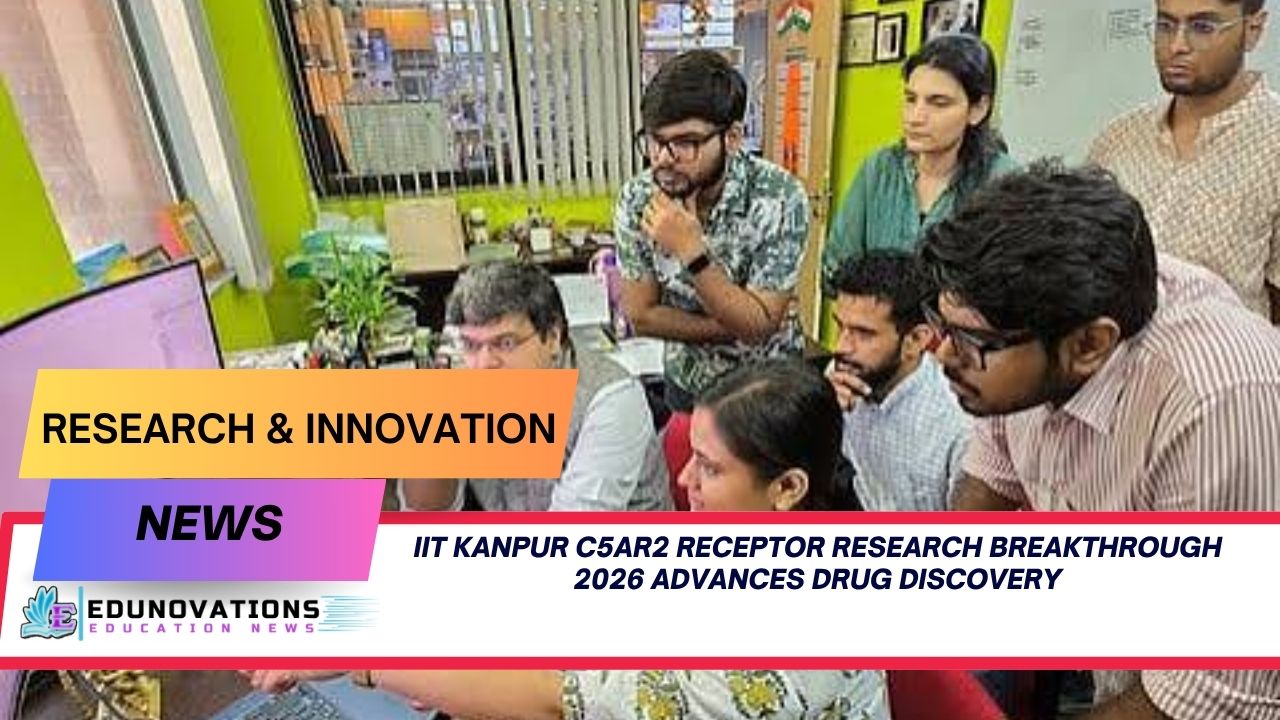
Discover how the iit kanpur c5ar2 receptor research breakthrough 2026 could transform immune disease treatment through groundbreaking structural biology, cryo-EM technology, and precision drug discovery.
The iit kanpur c5ar2 receptor research breakthrough 2026 has emerged as one of India’s most significant biomedical research achievements this year. Scientists at the Indian Institute of Technology Kanpur have successfully uncovered the molecular mechanism behind the immune receptor C5aR2, solving a scientific puzzle that had remained unanswered for years. This breakthrough is expected to accelerate the development of safer and more targeted medicines for inflammatory and immune-related diseases.
The discovery highlights India’s growing contribution to global structural biology and pharmaceutical innovation while strengthening IIT Kanpur’s reputation in molecular medicine.
Why This Discovery Matters
The human immune system depends on a complex network of proteins that protect the body from bacteria, viruses, and other harmful pathogens. One important component is the complement system, which triggers inflammation to eliminate infections.
Among the receptors involved are C5aR1 and C5aR2. While researchers have understood C5aR1 for many years, C5aR2 remained an unusual receptor because it behaves differently from conventional G protein-coupled receptors (GPCRs). Scientists worldwide were unable to explain why this receptor followed a non-traditional signaling pathway.
The latest research has finally provided that answer.
Advanced Cryo-EM Revealed Hidden Structural Differences
Researchers employed cryogenic electron microscopy (cryo-EM), one of the world’s most sophisticated imaging technologies, to visualize the receptor at near-atomic resolution.
The study found that:
- The external structure of C5aR2 closely resembles C5aR1.
- The internal portion differs significantly.
- These structural differences prevent conventional cellular signaling.
- Instead, C5aR2 activates alternative signaling pathways.
This explains why the receptor has behaved differently in previous laboratory studies.
Leadership Behind the Research
The multidisciplinary research was led by Professor Arun K. Shukla, a leading structural biologist from IIT Kanpur’s Department of Biological Sciences and Bioengineering.
Professor Shukla’s laboratory has contributed several internationally recognized discoveries in GPCR biology over the past decade, making this latest achievement another important milestone in receptor biology research.
A New Molecule Could Change Future Drug Development
Beyond solving the receptor mystery, the research team designed a highly selective experimental molecule known as R8Y.
Unlike previous compounds, R8Y specifically binds to C5aR2 without interacting with C5aR1.
This selective targeting is significant because it enables researchers to:
- Study C5aR2 independently.
- Better understand immune signaling.
- Design precision medicines.
- Reduce unwanted side effects.
- Develop next-generation therapeutics.
Animal testing is expected to be the next major phase before potential clinical applications.
International Scientific Collaboration
The project demonstrates the importance of global scientific partnerships.
Researchers collaborated with:
- University of Queensland (Australia)
- University of Tokyo (Japan)
- Kyoto University (Japan)
Funding support came from several prestigious Indian scientific agencies, including:
- Department of Biotechnology
- Department of Science and Technology
- Indian Council of Medical Research
- Anusandhan National Research Foundation
- IIT Kanpur
Such collaborations strengthen India’s position in advanced biomedical research.
Potential Benefits for Healthcare
The findings may eventually contribute to treatments for several chronic conditions involving immune dysfunction, including:
- Autoimmune diseases
- Chronic inflammatory disorders
- Severe bacterial infections
- Immune-mediated tissue damage
- Rare complement system disorders
Although additional laboratory and clinical research remains necessary, experts believe the structural information provides an important foundation for precision drug development.
India’s Growing Role in Biomedical Innovation
Over the last few years, IIT Kanpur has produced several internationally recognized studies involving GPCR biology, receptor signaling, and molecular imaging.
The current breakthrough further demonstrates India’s expanding expertise in:
- Structural biology
- Drug discovery
- Molecular pharmacology
- Precision medicine
- Cryo-electron microscopy
Such research strengthens India’s innovation ecosystem and supports the country’s long-term ambitions in biotechnology and pharmaceutical research.
Expert Perspective
Structural biology has become one of the fastest-growing fields in modern medicine because understanding the three-dimensional architecture of proteins enables scientists to design medicines with remarkable precision.
According to researchers involved in the study, solving the structure of C5aR2 provides scientists with a detailed molecular map that can guide future therapeutic development more efficiently than traditional trial-and-error drug discovery methods.
Looking Ahead
The iit kanpur c5ar2 receptor research breakthrough 2026 is expected to inspire further investigations into immune signaling and receptor biology.
Future work will likely focus on:
- Animal model validation
- Drug optimization
- Safety evaluation
- Clinical translation
- Precision immunotherapy
If successful, the research could contribute to safer medicines that selectively target immune pathways while minimizing adverse effects.
Conclusion
The iit kanpur c5ar2 receptor research breakthrough 2026 represents a landmark achievement in biomedical science. By solving the long-standing mystery surrounding the C5aR2 receptor and introducing the selective molecule R8Y, IIT Kanpur researchers have created new opportunities for precision drug discovery.
While clinical applications will require additional research, the discovery has already attracted international scientific attention and reinforces India’s growing leadership in advanced molecular medicine.
Toppers Use Mind Maps to score more than 95%
NCERT Class 11th Commerce Mind Maps
Add to cartOriginal price was: ₹999.00.₹199.00Current price is: ₹199.00.NCERT Class 12th Chemistry Mind Maps
Add to cartOriginal price was: ₹199.00.₹75.00Current price is: ₹75.00.NCERT Class 12th Commerce Mind Maps
Add to cartOriginal price was: ₹999.00.₹199.00Current price is: ₹199.00.NCERT Class 12th Science Mind Maps
Add to cartOriginal price was: ₹999.00.₹199.00Current price is: ₹199.00.NCERT Mind Maps For Class 10th
Add to cartOriginal price was: ₹999.00.₹199.00Current price is: ₹199.00.




Purchase Today
Frequently Asked Questions (FAQs)
1. What is the IIT Kanpur C5aR2 receptor research breakthrough 2026?
The iit kanpur c5ar2 receptor research breakthrough 2026 refers to a major scientific discovery in which researchers revealed the molecular structure and signaling mechanism of the C5aR2 receptor, opening new possibilities for precision drug development.
2. Why is the C5aR2 receptor important in immune system research?
The c5ar2 immune receptor study molecular cell 2026 shows that C5aR2 plays a key role in regulating immune responses and inflammation, making it a promising target for future therapies against inflammatory and autoimmune diseases.
3. How does the atypical drug target receptor discovery by IIT Kanpur help medicine?
The atypical drug target receptor discovery by iit kanpur provides scientists with detailed structural insights that can help design more targeted drugs with fewer side effects for immune-related disorders.
4. How does the C5aR2 receptor work in immune system research?
Researchers found that C5aR2 behaves differently from traditional G protein-coupled receptors (GPCRs). The how c5ar2 receptor works in immune system research study explains that it activates alternative cellular signaling pathways instead of conventional GPCR signaling.
5. What technology was used in the IIT Kanpur cryo-EM drug discovery research C5aR2 study?
The iit kanpur cryo em drug discovery research c5ar2 project used cryogenic electron microscopy (cryo-EM), an advanced imaging technology that allows scientists to visualize proteins at near-atomic resolution.
6. Who led the IIT Kanpur C5aR2 receptor research breakthrough 2026?
The research was led by Professor Arun K. Shukla and his team at the Department of Biological Sciences and Bioengineering, IIT Kanpur, in collaboration with international researchers.
7. What diseases could benefit from the IIT Kanpur C5aR2 receptor research breakthrough 2026?
The findings may contribute to future treatments for autoimmune diseases, chronic inflammatory disorders, severe infections, and other conditions linked to the human complement system.
8. What is R8Y and why is it significant?
R8Y is a selective experimental molecule developed during the research that specifically targets the C5aR2 receptor, helping scientists better understand its biological functions and supporting future drug discovery efforts.
9. Was the IIT Kanpur C5aR2 receptor research breakthrough 2026 an international collaboration?
Yes. The study involved collaborations with leading international institutions, including researchers from Australia and Japan, demonstrating the global significance of the research.
10. What is the future impact of the IIT Kanpur C5aR2 receptor research breakthrough 2026?
The iit kanpur c5ar2 receptor research breakthrough 2026 is expected to accelerate precision medicine research, improve the understanding of immune signaling, and support the development of next-generation therapies for inflammatory diseases.