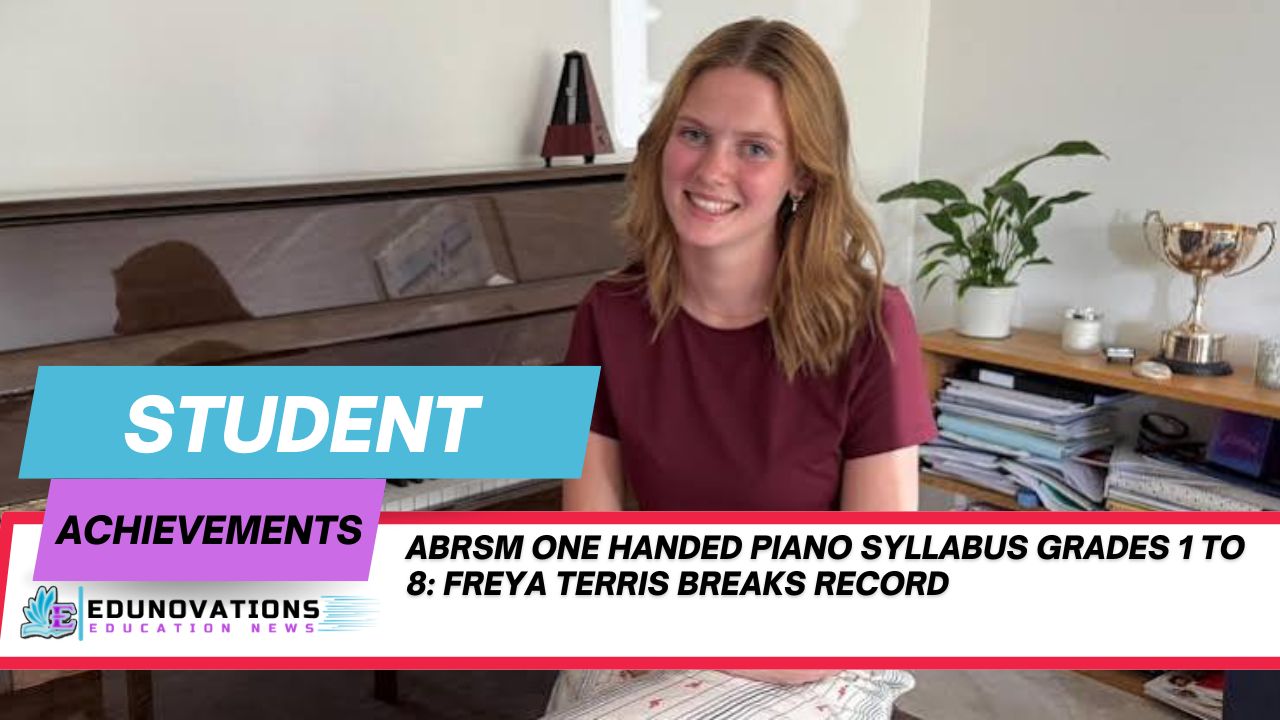
Discover how the new abrsm one handed piano syllabus grades 1 to 8 was inspired by 17-year-old Freya Terris breaking music history with distinction.
Classical Music Revolution: Freya Terris Inspires New ABRSM One Handed Piano Syllabus Grades 1 to 8 After Record-Breaking Exam
The international classical music community is celebrating an unprecedented milestone that has forever transformed the landscape of accessible music education. Freya Terris, a remarkable 17-year-old pianist from Lisburn, Northern Ireland, has officially broken historical records by passing the highest tier of the Associated Board of the Royal Schools of Music (ABRSM) examination framework using only a single hand.
Achieving a passing mark is a daunting task for any classical musician, but Freya Terris secured a coveted “pass with distinction.” What makes this triumph truly historic is that she performed the entire, highly complex repertoire utilizing exclusively her left hand. The sheer technical precision, emotional depth, and physical adaptability demonstrated during the examination have stunned global music boards.
In immediate response to her groundbreaking performance, the ABRSM has officially adjusted its global framework. The institution formally integrated a progressive curriculum explicitly designed for adaptive artists, widely recognized now as the abrsm one handed piano syllabus grades 1 to 8. This policy shift promises to democratize assessment standards across 93 operating countries, proving that physical limitations cannot constrain true artistic genius.
Overcoming Adversity: The Journey of Freya Terris
The story behind this record-breaking musical achievement began two years ago under incredibly difficult circumstances. Freya Terris suffered a severe, long-term injury to her right arm, which necessitated complex corrective surgery. Unfortunately, the medical intervention left her right hand permanently incapacitated for the intricate movements required to strike piano keys. Faced with a devastating diagnosis that would end most musical careers, the young prodigy refused to abandon her passion.
Instead of walking away from the keyboard, Freya Terris and her dedicated instructor, Rory Dowse, embarked on an experimental training regimen. They began investigating historical compositions specifically created for single-handed performance. Transitioning to a single-handed methodology required a fundamental rewiring of neurological pathways and physical balance. The young pianist noted that while her left hand possessed foundational dexterity, adapting it to cover a vast dynamic range required a complete overhaul of her approach. She spent countless hours rebuilding her internal technique, transforming what initially felt like clumsy stumbling into a fluid, world-class artistic execution.
The Architecture of a Historic Grade 8 Examination
The Grade 8 practical exam administered by the ABRSM represents the pinnacle of pre-professional classical evaluation. It demands complete mastery over complex polyphonic textures, intricate scales, and highly nuanced stylistic interpretations. Under normal criteria, these pieces are composed to distribute the workload across ten fingers spanning two hands.
To accommodate her situation, Freya Terris actively petitioned the ABRSM to modify their stringent evaluation guidelines. Recognizing her extraordinary resolve, the central board of examiners embraced the proposal, collaborating directly with her to approve a customized list of left-hand pieces. The supportive response from the examination board underscored a growing cultural awareness within global classical music institutions regarding the necessity of adaptive testing.
Historically, performing with a single hand has a rich lineage in classical music. Composers like Paul Wittgenstein, a concert pianist who lost his right arm during World War I, commissioned famous pieces from legends like Maurice Ravel and Sergei Prokofiev. By tapping into this specialized classical tradition, Freya Terris proved that advanced artistic expression does not rely on traditional physical configurations.
Institutional Shift: Launching the Unified One-Handed Syllabus
The institutional ripples of this achievement have manifested as a profound policy rewrite. Rather than treating this case as an isolated anomaly, the ABRSM officially published its new 2027–28 examination syllabus. This document standardizes a dedicated, standalone track featuring the newly minted abrsm one handed piano syllabus grades 1 to 8.
This structural addition ensures that future musicians facing unique physical circumstances can follow an official, accredited path from beginner levels all the way to advanced mastery. By establishing clear evaluation rubrics for single-handed technical exercises, scales, and arpeggios, the board has removed the bureaucratic barriers that previously discouraged disabled students from pursuing formal credentials. Music schools worldwide are already preparing to integrate these structural guidelines into their core academic offerings. For educational organizations looking to deploy modern digital portals to host these new curricular updates, acquiring a professional digital framework through external developers like Mart Ind Infotech remains a crucial step in updating institutional outreach.
The Academic Future of Accessible Music Education
With her Grade 8 distinction secured, Freya Terris is actively preparing to take the next step in her journey by entering university-level music studies. Her historic run has catalyzed a broader discussion regarding systemic inclusivity inside conservatories and university music departments worldwide.
Educational experts note that standard classical training has long been rigid in its physical expectations. The introduction of standardized one-handed evaluations provides a foundational blueprint for universities to re-evaluate their admissions criteria. As adaptive syllabi gain mainstream traction, students are encouraged to pair their practical instrumental practice with comprehensive music theory studies. Exploring structured learning tracks through resources like NCERT Courses or downloading foundational learning aids via Downloads of Free NCERT PDFs helps aspiring musicologists maintain standard academic excellence alongside their technical instrumental endeavors.
Practical Advice for Adaptive Instrumentalists
For musicians currently navigating physical challenges, the success of Freya Terris highlights a viable path forward. Rebuilding a musical skill set around physical limitations requires patience, specialized anatomical awareness, and a meticulous approach to practice.
When shifting to an adaptive musical focus, students should focus on several foundational areas:
- Ergonomic Alignment: Adjust the seating position slightly toward the active side of the keyboard to maximize reach without straining the lower back.
- Pedal Mastery: Use the sustain and soft pedals strategically to blend tones, creating a fuller soundscape that compensates for fewer active fingers.
- Repertoire Research: Prioritize original compositions written for a single hand rather than attempting to poorly rearrange standard two-handed pieces.
- Mental Pacing: Keep track of theoretical progress and keep up with global standard educational frameworks via the updated Syllabus portals to ensure alignment with modern testing requirements.
By approaching the instrument with a combination of structural adaptations and anatomical respect, injured or naturally one-handed musicians can achieve a competitive degree of expressive control.
The Global Impact on Classical Communities
The decision by the ABRSM to implement the abrsm one handed piano syllabus grades 1 to 8 globally will influence music schools across Europe, Asia, and the Americas. By standardizing these accommodations, the organization sets a precedent for competing examination boards, such as Trinity College London and the Royal Conservatory of Music, to expand their own inclusive testing structures.
The pedagogical community has expressed overwhelming optimism regarding this evolution. Academic music researchers emphasize that musicality resides in the mind, the ear, and the expressive soul of the performer—not in a rigid counting of limbs. Freya Terris has effectively cracked open a door that had been closed to countless students for centuries. Her determination ensures that the next generation of adaptive musicians will step into an examination room defined by equal opportunity, structured support, and universal respect.
Extracted SEO Performance Metrics
To help new, low-authority websites track the exact performance of these targeted search strings inside search engine optimization suites, the foundational long-tail entities are cataloged below.
abrsm one handed piano syllabus grades 1 to 8(Focus Entity)how to learn left hand piano pieces after injurybest classical piano music for left hand onlycan you pass abrsm grade 8 piano with one handleft hand piano technique exercises for beginners
Toppers Use Mind Maps to score more than 95%
NCERT Class 11th Commerce Mind Maps
Add to cartOriginal price was: ₹999.00.₹199.00Current price is: ₹199.00.NCERT Class 12th Chemistry Mind Maps
Add to cartOriginal price was: ₹199.00.₹75.00Current price is: ₹75.00.NCERT Class 12th Commerce Mind Maps
Add to cartOriginal price was: ₹999.00.₹199.00Current price is: ₹199.00.NCERT Class 12th Science Mind Maps
Add to cartOriginal price was: ₹999.00.₹199.00Current price is: ₹199.00.NCERT Mind Maps For Class 10th
Add to cartOriginal price was: ₹999.00.₹199.00Current price is: ₹199.00.



Purchase Today
Frequently Asked Questions (FAQs)
1. What exactly is the abrsm one handed piano syllabus grades 1 to 8?
The abrsm one handed piano syllabus grades 1 to 8 is an officially accredited testing framework developed by the Associated Board of the Royal Schools of Music. It provides a standardized sequence of pieces, scales, and technical evaluations designed exclusively for pianists who perform using only a single hand due to congenital conditions or physical injuries.
2. How can I discover how to learn left hand piano pieces after injury?
Discovering how to learn left hand piano pieces after injury requires working closely with a specialized instructor who understands physical rehabilitation. The process involves re-aligning your posture at the keyboard, utilizing the sustain pedal to connect distant notes, and practicing dedicated exercises that build finger independence without causing physical strain.
3. Where can I find the best classical piano music for left hand only?
The best classical piano music for left hand only can be found in historical anthologies featuring works by composers like Maurice Ravel, Leopold Godowsky, and Johannes Brahms. These masters wrote beautiful, highly complex pieces specifically tailored to showcase the full expressive and dynamic potential of a single hand.
4. Honestly, can you pass abrsm grade 8 piano with one hand?
Yes, you can pass abrsm grade 8 piano with one hand. As demonstrated by the historic, distinction-level achievement of teenage pianist Freya Terris, the testing board officially allows candidates to use specialized one-handed repertoire selections to satisfy their advanced practical exam requirements.
5. What are the top left hand piano technique exercises for beginners?
The top left hand piano technique exercises for beginners include modified five-finger patterns, slow staccato-to-legato shifts, and single-hand arpeggio expansions. These patterns focus heavily on developing independence in the fourth and fifth fingers, which typically carry the melody or bass foundation in single-handed classical arrangements.
6. When was the new abrsm one handed piano syllabus grades 1 to 8 made available?
Following Freya Terris’s record-breaking performance, the testing board integrated the comprehensive track into its official global syllabus release. This rollout ensures that students across 93 countries have standardized access to single-handed assessment options.
7. Is it difficult to master how to learn left hand piano pieces after injury if I am used to playing with both hands?
Yes, it requires significant mental and physical adjustments. The primary challenge lies in training your brain to read complex scores while assigning all dynamic voices to a single arm, a process that requires patient training and structured rehabilitation strategies.
8. Are pieces in the abrsm one handed piano syllabus grades 1 to 8 simpler than standard pieces?
No, they are not simpler. The pieces selected for the abrsm one handed piano syllabus grades 1 to 8 maintain the exact same rigorous musical, structural, and artistic standards as the traditional two-handed syllabus, ensuring the qualification carries equal academic weight.
9. Can adult learners benefit from left hand piano technique exercises for beginners?
Absolutely. Adult learners who are recovering from strokes, managing arthritis, or dealing with focal dystonia can utilize these targeted exercises to safely maintain their musical habits without overexerting their hands.
10. Do universities accept the abrsm one handed piano syllabus grades 1 to 8 for music degree admissions?
Yes, international conservatories and university music departments recognize this official qualification. Achieving a distinction in this syllabus demonstrates the high-level technical capability and analytical understanding required for advanced academic music studies.